• Get involved.
    We want your input!
    Apply for Membership and join the conversations about everything related to broadcasting.

    After we receive your registration, a moderator will review it. After your registration is approved, you will be permitted to post.
    If you use a disposable or false email address, your registration will be rejected.

    After your membership is approved, please take a minute to tell us a little bit about yourself.
    https://www.radiodiscussions.com/forums/introduce-yourself.1088/

    Thanks in advance and have fun!
    RadioDiscussions Administrators

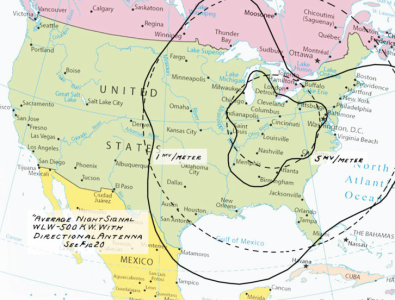
WLW 500 kW Directional vs. 50 kW Nondirectional 5 mV/m and 1 mV/m 50% Skywave Map

I have never seen this map before. WLW 500 kW Directional Skywave vs. 50 kW Nondirectional Skywave. For the first time, I can see why the experiment didn't catch on. The best skywave with the DA missed much of the most populated areas in the country, due to protection of the then CFRB 690 Toronto, due to complaints from Canada when using 500 kW Nondirectional.

1613189539732.png
 
Last edited:
Thank you for sharing! I am somewhat surprised the nighttime signal is not stronger in the areas where the signal was not attenuated. My late broadcast engineer father grew up on a farm near Carthage, IL, He remembered listening to WLW during the day there when they were at 500 kW. His first broadcast engineering gig was in Carthage with WCAZ in 1938 before he took a position with WTAD in Quincy in 1940.
 
Looks like the maximum signal direction ends up serving the fish in the Gulf of Mexico and the Yucatan Peninsula better. No doubt there were a few high end vacationers who spoke English that listened at Night in that region and thought it was great.
 
The dotted contour might be the 500 kW Nondirectional contour, not the 50 kW, though that is not clear from the labelling on the map. I'll have to figure it out using the old skywave curves. I would assume that the old 50 kW license with the Blaw Knox diamond shaped tower is the same as today.
 
The dotted contour might be the 500 kW Nondirectional contour, not the 50 kW, though that is not clear from the labelling on the map. I'll have to figure it out using the old skywave curves. I would assume that the old 50 kW license with the Blaw Knox diamond shaped tower is the same as today.
I believe you are correct on this. In all the years I lived in southern Wisconsin, I never recall daytime reception of WLW, except during rare daytime skywave and during critical hours, of course. During the years I grew up in Peoria, you could just barely receive WLW during the day, especially in winter. When I went to college in Macomb, IL., WLW could only be received at night.

Bob
 
When you look at this map, it's obvious why the FCC quickly (within 6 months) withdrew this experiment. Obviously the Canadians objected. But imagine David Sarnoff's reaction. I can imagine ten companies in 1934 that would demand the same type of license, including WSM and WSB. This is the day of bigger is better.
 
When you look at this map, it's obvious why the FCC quickly (within 6 months) withdrew this experiment. Obviously the Canadians objected. But imagine David Sarnoff's reaction. I can imagine ten companies in 1934 that would demand the same type of license, including WSM and WSB. This is the day of bigger is better.
WLW ran from May to December of 1934 with 500 kw non-directional, and was then ordered to remedy the situation. They directionalized and came back with 500 kw protecting Toronto's 690 station in early 1935. They were still under an "experimental" permit, though. They ran 500 kw until 1939, when the FCC, following the Wheeler Resolution, decided to limit power to 50 kw.

So they ran for a little over 4 years as a 500 kw directional station.

On March 1, 1939 WLW resumed 50 kw broadcasting but until 1942 retained the night experimental license as W8XO "in case" the high power was needed during what became WW II.

The Wiki article, although superficial, it reasonably accurate:


There is a lot more that can be read searching for "WLW" in Broadcasting Magazine selecting "30's" as the date range:

 
I've seen several attempts over the years to plug the WLW 500 kW signal into modern coverage prediction software, and the results looked similar to this map.

My biggest takeaway from this is that it demonstrates graphically the logarithmic nature of coverage increase vs. power increase. In the direction opposite the null, where the full 500 kW output was being concentrated, it does exactly what you'd expect to get from 500 kW vs. 50 kW: the 5 mV contour expands to take in Memphis, Birmingham and Atlanta, which mattered a lot considering how sparse the local dials were down that way at night before the war. But even 500 kW could only do so much; if it were 500 kW non-DA it still wouldn't have given 5 mV over New York or Philadelphia (where WOR's sidebands would have wreaked havoc on listenability anyway), or KC or Minneapolis.

(But then, with a much quieter dial and more sensitive receivers back then, I'm sure plenty of listeners enjoyed perfectly usable WLW reception down to 1 mV or 0.5 mV; that would never happen today!)

With better refinement of DA techniques, I'm sure WLW could ultimately have come up with a better DA that would have provided the required null to Canada while filling in some of those unneeded nulls to the southeast and to the west. In a hypothetical world where the war didn't end the 500 kW experiment for good, perhaps such a thing might have become politically feasible later on. It still wouldn't have mattered in the long run, as the business model moved away from huge regional coverage to sales focused within a local market.
 
I just happened to run into this video about WLW being at 500k watts on You Tube last night:

I wasn't specifically looking for this but it just happened to come up on other searches.
 
Last edited:
If you look in the 1960 NAB Engineering Handbook, on David's site, you'll find the old Skywave prediction graphs. The first has no correction for midpoint Latitude, the second uses a path midpoint Latitude. The present day Skywave prediction method uses a Geomagnetic midpoint latitude that uses the Magnetic North Pole, not the Geographic North Pole Latitude, applied to each path. That Skywave prediction method is used on fccdata.org, and compares very closely to physical maps of Class A 50% Skywaves, and AM applications available on the FCC website. The Treaties generally use the old Skywave prediction methods, and are probably in the Treaty text.

The big assumption that goes right out the window is the assumption that Class A nondirectional Skywave have a 0.5 mV/m 50% Skywave that goes out "750 miles", and even less true, reaches "38 States". If you look at the WSB 750 vs. WCCO 830 Skywave Maps, you'll see a dramatic difference. The further South the Skywave signal path midpoint Latitude is, the more closely it matches the old prediction graphs and methods. The WCCO 50% Skywave and other Class As go out substantially shorter distances than the WSB 50% Skywave does, and also goes out lesser distances to the North (higher Geomagnetic Midpoint Latitudes) than to the South.

Maybe David could post images of the old Skywave Prediction Graphs and Curves, from one source or another. It might still be on the present FCC website, perhaps easily printable, or another older copy of CFR 47, Section 73. The newfangled lawyer versions of CFR 47 online often omit the graphs, as their Processors are more like a 486SX. :)
 
Last edited:
The big assumption that goes right out the window is the assumption that Class A nondirectional Skywave have a 0.5 mV/m 50% Skywave that goes out "750 miles", and even less true, reaches "38 States". If you look at the WSB 750 vs. WCCO 830 Skywave Maps, you'll see a dramatic difference. The further South the Skywave signal path midpoint Latitude is, the more closely it matches the old prediction graphs and methods.
And this explains, to some extent, how Colombia can assign two non-directional 50 kw stations on the same channel in different parts of the country... and Colombia is only about 80% larger than Texas.
 
David, I'm not sure whether there is presently a prediction method which uses the South Magnetic Pole, or both Magnetic Poles, which conceivably could come into play over great, generally intercontinental, distances. I've seen some graphs that go out great distances, but they are very old.
 
I have looked at some of the 50 KW clears with software (on my own weekend time). I noticed effect of latitude on skywave patterns. Also noticed that quite a bit of ERP is necessary to get 2 mV or nearly 5 mV skywave in places a few hundred miles away.

My conclusion is from some transmitter locations, a DA with a well chosen pattern can make a memorable signal. For example WBZ, WBT, KCBS, KGO, and WWL. Also power is not a significant as non-radio civilians may think. As you all know, 500 KW is about 3.16 times the field strength at a given location, compared to 50 KW. Nice, but I don't think it was setting barns on fire five miles away. However, the interfering contour for co-channel stations could expand to continental proportions. And that is the problem since the understanding and expectation was/is that clear channel stations have wide area coverage at night.

You've all heard what happens when a day time station stays on. A few years back I heard WABC wiped out several nights in a row by a station somewhere down south. All it took was 1 KW.

A station on west coast has to keep eastward night ERP to just a few hundred watts to protect clear channel station on east coast.
A clear channel is like drinking water, doesn't take much to ruin it.

The times I've re-allocated the AM band for fun, could not come up with a clear channel plan I liked, with requirement that there must be at least two clear channel stations in markets that have them (for competitive reasons).
 
Last edited:
Turned it off, closed the front door on my way out, and heard WLS blaring from my car (since I had the volume up)
For some reason that reminds me of Clint Eastwood's "Play Misty for Me" except that the scenery in Carmel was nicer than in Oklahoma City.
 
David, I'm not sure whether there is presently a prediction method which uses the South Magnetic Pole, or both Magnetic Poles, which conceivably could come into play over great, generally intercontinental, distances. I've seen some graphs that go out great distances, but they are very old.
 
One thing I didn't understand is why Clint Eastwood left the door to his house open, knowing that the psycho fan girl could walk right in. Second, in general, I didn't understand why, for security reasons, they ever left the door open. And third, aren't there mosquitoes and flies in that canyon?
 
the 5 mV contour expands to take in Memphis, Birmingham and Atlanta, which mattered a lot considering how sparse the local dials were down that way at night before the war.

It also takes in Washington DC to the east. We've often discuss how there are very few radio stations in our nation's capitol with a signal strong enough to cover the market. That's because at the time when the frequencies were being assigned, they were given to certain stations that were meant to cover all of those areas.
 
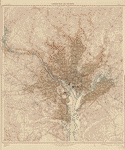
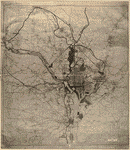
Most of 1940s Washington may have been contained within the boundary of the present day Beltway.


Here's one from 1917, just before radio. One thing is for sure, real estate would have been a great investment LOL

 
It also takes in Washington DC to the east. We've often discuss how there are very few radio stations in our nation's capitol with a signal strong enough to cover the market. That's because at the time when the frequencies were being assigned, they were given to certain stations that were meant to cover all of those areas.
Frequencies were not assigned as they do today with FM. It was pretty much a "first come" basis. That is why the major cities of the early 30's got the 1-A and 1-B clear channels.

Today, we might consider that Rochester, Buffalo, Schenectedy, Wheeling, Ft Wayne and the like did not deserve a clear as much as Phoenix, San Diego, Miami, Orlando, Tampa did. But at the time, those markets were very small and the surrounding areas not heavily populated (if at all) so nobody tried to build a big station there.

By the mid-30's, the prime real estate was pretty much taken... even on the regional channels. Much of what was licensed after WW II can be seen to have had to try very hard and very directionally to wedge the facility in while protecting the earlier protected licenses.

The FCC did not assign facilities to markets or frequencies, so what you have is most of the good facilities in those established markets and a lot of terrible ones in markets which grew in later decades.

As Greg points out, the DC market was adequately covered by 1500, 630, 980 and 570... and those later applications are notable for their deficiencies.

 
Status
This thread has been closed due to inactivity. You can create a new thread to discuss this topic.


Back
Top Bottom