• Get involved.
    We want your input!
    Apply for Membership and join the conversations about everything related to broadcasting.

    After we receive your registration, a moderator will review it. After your registration is approved, you will be permitted to post.
    If you use a disposable or false email address, your registration will be rejected.

    After your membership is approved, please take a minute to tell us a little bit about yourself.
    https://www.radiodiscussions.com/forums/introduce-yourself.1088/

    Thanks in advance and have fun!
    RadioDiscussions Administrators

WLW 500 kW Directional vs. 50 kW Nondirectional 5 mV/m and 1 mV/m 50% Skywave Map

Here’s a good one, I’ve mentioned this on another topic in the past, but there’s a station in Budapest, Hungry on AM 540 with 2 million watts. I wonder what the coverage area daytime and nighttime would be for a 2 million watt signal on the low end of the AM band especially on 540.
 
According to Wikipedia, Senator Burton Wheeler had an important influence on fate of superpower AM stations.

There was great fear that radio would become a regional or national force, so Wheeler wanted ownership and power limited. He was afraid that, unlike newspapers which were fairly local or, in limited ways, regional, radio could cover whole states and even the whole nation and become very influential.

Limitation on power was one way to prevent wide influence. Prohibiting national (domestic) shortwave was another. Ownership caps also prevented too much consolidation.

There are a lot of parallels between Wheeler's group and those who today want to find a way to limit or control social media, search engines and other Internet supposed "monopolies".
 
And this explains, to some extent, how Colombia can assign two non-directional 50 kw stations on the same channel in different parts of the country... and Colombia is only about 80% larger than Texas.
I've sometimes wondered if there are any CITIES where, due to a combination of factors like a very geographically large city and very poor ground conductivity, it would be possible to have TWO co-channel non-directional daytime 50kW signals in the SAME city, with both their protected-from-interference contours (0.5 mV/m since I'm thinking Class D; I know no place where two co-channel 50kW class As would fit in the same city even at the upper end of the AM BCB) would be contained entirely within city limits?

The times I've re-allocated the AM band for fun, could not come up with a clear channel plan I liked, with requirement that there must be at least two clear channel stations in markets that have them (for competitive reasons).
I've tried a little "back of the brain" AM band reallocation too. :) One of my ideas would have done clear channels differently, I think.
Basically instead of having individual big stations in certain cities like it is today, the "clear channels" would be for nationally-syndicated programming. Basically each network / whatever would get its own dedicated nationwide frequency, and build synchronized co-channel stations across the country. These would primarily be at the lower part of the AM BCB (and one idea I thought of also involved expanding down to longwave, and maybe using 20 kHz spacing above 540 and 18 kHz below 540).

(Also my idea would involve moving TV stations off channels 5 and 6, expanding the FM band there, and moving a lot of smaller stations there. Then....) For the upper part of the AM BCB (like above about 1200 or 1400 or so), that would be for smaller low power / local stations for which, due to simpler / less expensive equipment / etc (correct me where I'm wrong? I think FM can use less transmitter power so lower power bill there), small operations that would find it financially hard to set up on FM could still set up on AM with a small transmitter (like 10-250 watts or so) and short antenna (like 50-200 feet).


However ... with a lot of radio listening being done online these days ... I'm starting to think maybe that idea isn't all that feasible anymore. I wonder if there could be some other (even if non-broadcast) use of the AM BCB and other SW/MW/LW/etc frequencies, that would take advantage of their strengths (like longer distance propagation)?

I do still have a bit of a gripe with moving radio content entirely online, though....
With radio, the end user / listener can listen fairly cheaply - just buy a $5-10 radio, some batteries (rechargeable strongly recommended - I have some of the same Eneloop AAs that I've been using for 10-15 years, possibly more, and they're still working well enough), and you can listen.
But, with internet, you need a computing device (yeah you can get something for $50-100 but generally >$300-400 is much better), internet service (can be as cheap as $10-20/month but >$40-50/month is better), and even then you can have sudden dropouts, network hiccups, etc.
Internet radio does give you a lot more choice for programming content, true. :) But then, analog AM radio, at least in my experience (especially listening in rural areas as I'm traveling away from a station) is more graceful as the signal degrades. (I even prefer AM over FM for weak signals.) Sure there's a lot of noise as the station gets weak, but most of the time for me (as long as you're not in a thunderstorm or near man-made noise generators) it's like white / pink noise (like a steady version of ocean waves)... and you can still hear the content, whereas with digital / internet, it's either perfect or it's gone, and it can be quite jarring.

Going back to the beginning of this discussion, A Class 1-A station was protected to its 0.1mv/m contour and because of a lack of man-made interference, you didn't need much signal to hear it.
I wasn't around back in the early days of radio - only born in 1981, and my first DXing memory was on a cheap-quality freebie radio that came with a bike I got for my 10th birthday, listening one night ... and sandwiched under (not between - selectivity was very poor on that radio) a Mexican music station on 860 (XEMO) and a religious station on 910 (KECR), was a very faint talk / news station that was right at the noise floor. I talked to my dad (a radio engineer, but not primarily broadcast) about it and he explained skip and other things to me, and that started a long hobby / fascination with radio. :) (BTW that station was confirmed, with the aid of a much better quality car radio, to be 890 KDXU from St. George, Utah.)
Also I remember when I first had a slightly better quality radio (about when I was like 11 or 12 or 13 I don't remember now) ... hearing 600 (I think it was KOGO then) announcing on the air that they were the "brand new Hot Talk 600 KOGO" or something like that, I remember when Family Radio was still on 93.3 KECR (although I don't personally remember pre-FR 910 KMJC), I remember hearing the Padres on 760 KFMB, oldies on 1170 KCBQ, news/talk on 1130 KSDO, nostalgia on 1360 KPOP (now KLSD), oldies/nostalgia on 570 KLAC (as a kid I used to think it was a station located in some rural mountain / forest area for some reason), sports on 690 XETRA (now XEWW), I remember a couple news stations (one being 940 KFRE from Fresno, CA and really liking the music beds on the AP network news broadcasts), the KNX Drama Hour that we often listened to, Unshackled (when it was on Family Radio), and if i thought about it more I could probably come up with others. :)

I heard nothing, though, compared to many of you who could at least be my father (mother if there's any women here too?) or even possibly grandfather (although you'd likely have to be younger than him - my dad was born in 1946 and his dad was born in 1915. Dad's still living, grandpa passed away in 2002.) I feel like I *just* missed out on some fairly exciting radio listening, cause I heard of things (DX, etc) even as late as the 1980s that I wish I could have heard.

I was thinking/wondering, about that "lack of man-made interference" ... I think I've heard David Eduardo say recently (or at least several years ago, I wonder if the level is even higher now) that to get non-DXers to listen in a large metro area (like L.A. or NYC) you needed at least 10-15 mV/m of signal. I wonder what the equivalent would have been in the early days of radio? Would, for example, an 0.5 or even 0.1 mV/m signal (or even less) been totally adequate? Or were people more tolerant of fuzzy signals / interference because they had no other option, or some combination?


Also I think I may have heard WLW once near San Diego, CA, but I'm not 100% sure. I don't think I heard any ID, but I did pull up their stream on my phone and I think some of the voices may have sounded similar.
I kind-of think (based on the signal strength reading on the radio and the general sound) at that time that KALL (North Salt Lake, UT) may have had their transmitter on, but with an unmodulated carrier. (Normally they'd be MUCH louder than that here.)

I think gar got a better signal in HI than me in CA, though.
I've heard WLW here in Hawaii.

The ID comes near the end of the video.

 
(forum software made me split it into 2 messages cause when I clicked preview it complained, something about "10000 characters".)

That's correct - both WLW and WSM were reduced in height after they learned more about groundwave-skywave cancellation.

WLW's original design put a cancellation ring over Indianapolis, Columbus and Louisville, while WSM's cancellation ring landed on Knoxville and Birmingham, or so the story goes.
I've sometimes wondered if there's an antenna design that would effectively eliminate the cancellation ring? (For example, I've heard that sometimes there's a zone close in where the skywave angle is too high and just goes right through the ionosphere ... could it be pushed back with the right antenna design so where the groundwave signal is fading out (and probably beyond where most non-DXers would listen anyway) the skywave starts coming in? (Or some way to mitigate the sky/ground cancellation .... around here I often hear it on KFI and KNX.)

What was fascinating to observe was the changes in the KFI signal while they negotiated the rebuild of the tower that fell in an aviation accident. When they used one of the old KRKD towers, I can remember that the night signal became compromised going East on the 10 Freeway from around Redlands all the way to Banning. After Banning, the signal was clean again, but that zone was really a rugged reception area.

With the new tower, the cancellation occurs somewhere east of Desert Crossing and is gone by the time one reaches Blythe, also along the 10.
I heard KFI and KNX several years ago near Quartzsite, AZ, midday.
KFI's around 1:25, KNX around 6:35.

Also I had KFI near Gila Bend, AZ (on a PR-D15, which I ended up not keeping), at 8:00 in this video.


I also remember reading some posts / articles years ago from Bruce Carter (is he still around here?) where he had several 50kW class A stations at distances near 1000 miles in Lubbock, TX (like a couple from Chicago, for example). I wonder if WLW was one of his long-distance daytime catches? (I don't remember for sure and I'm not sure where his posts are on that is right now, I've lost track of it.)

Anyway I haven't been around here much myself recently, being currently involved with other things, with radio / DXing taking a back seat for the most part.
 
Well, even with seawater conductivity, you still have the Inverse Square Law/Inverse Field Law in place. So if you're way out at the end of Cape Cod, you're much farther than from Hull. I don't know what kind of antenna they planned, but there really isn't much advantage to being nondirectional and sending your signal into the Atlantic Ocean.
Indeed. According to the history card you cited (in a subsequent post), WBZ's application specified a directional antenna. I can only imagine what an immense signal that would have yielded.
 
What was fascinating to observe was the changes in the KFI signal while they negotiated the rebuild of the tower that fell in an aviation accident.
How does the present signal compare to the one before the aviation accident?
 
How does the present signal compare to the one before the aviation accident?
Scott might know if they did any measurements... but much would depend on how accurate the pre-accident data was. However, and as a person who drove from LA to either the Palm Springs area or AZ about 48 times a year when I was actively involved with talk radio, I can say that the post-rebuild signal seems to be very comparable with the "old" signal.

However, the biggest issue over recent years has been the increase in man made noise... from other vehicles, from electronic monitoring gear on freeways, from power lines, from gadgets in homes along the way... so comparing reception in 2021 with reception in the years around 2000-2005 is not going to be objective without actual test data.

In the last 20 years, the ITU has gone from considering even less than 5 mV/m to be "useful" in urban areas to where they now think 15 mV/m is needed. I know of many places on the freeways in Pasadena, Glendale, Burbank and that area where KFI can be noisily interfered with at certain locations.
 
From a theoretical standpoint, it should be possible to design sectionalized antenna which could fill in the vertical radiation characteristic nulls. You could also add a short directional antenna tower to do this, with a low field ratio. WWJ 950 with 5000 watts Night had a similar situation from the 8 Mile Rd. site, with a 186 degree and a 139.1 degree tower 31 degrees away. At the place where the vertical radiation characteristic of the 186 degree tower was near zero, the radiation from the 139.1 degree tower was essentially nondirectional. It performed that way when there was almost no cochannel interference, before WNTD and others went full-time, and others had PSSAs which interfered, for a couple hundred miles around. People listened in Indiana at Night, for instance.

 
The way the broadcast and advertising industry evolved, what would the purpose of powers like that be now, had they been approved.
 
Others were operated under contract to VOA (Westinghouse's WBOS, for instance), and I think some of the equipment was moved to the Greenville NC sites after WBOS closed.

Transmitters from WBOS to Greenville? I don't think any of the 22 transmitters at Greenville were removed from other older VOA locations.

It was that several of the Continental 420A transmitters at Greenville were procured for the early 1950s Baker East site near East Arcadia, NC, but they were never installed there. The site was never completed and the Continentals were put in storage for about 10 years.
 
From a theoretical standpoint, it should be possible to design sectionalized antenna which could fill in the vertical radiation characteristic nulls. You could also add a short directional antenna tower to do this, with a low field ratio. WWJ 950 with 5000 watts Night had a similar situation from the 8 Mile Rd. site, with a 186 degree and a 139.1 degree tower 31 degrees away. At the place where the vertical radiation characteristic of the 186 degree tower was near zero, the radiation from the 139.1 degree tower was essentially nondirectional. It performed that way when there was almost no cochannel interference, before WNTD and others went full-time, and others had PSSAs which interfered, for a couple hundred miles around. People listened in Indiana at Night, for instance.

In my neck of the woods in Macomb County WWJ’s signal is terrible from their current site. When they were on 8 Mile they had an excellent signal, both day and night through out the entire Detroit area. In my opinion WWJ should’ve keep the old site. I understand that the building on 8 Mile is gone or is about to be taken down.
 
The way the broadcast and advertising industry evolved, what would the purpose of powers like that be now, had they been approved.
If single huge stations delivered large audiences in entire regions, the advertising industry would buy that coverage.

But that only worked when radio's prime time was after sunset. Today, the night audience belongs to TV, and no radio station can cover really extensive areas in the daytime.
 
According to Wikipedia, Senator Burton Wheeler had an important influence on fate of superpower AM stations.

There was great fear that radio would become a regional or national force, so Wheeler wanted ownership and power limited. He was afraid that, unlike newspapers which were fairly local or, in limited ways, regional, radio could cover whole states and even the whole nation and become very influential.

Limitation on power was one way to prevent wide influence. Prohibiting national (domestic) shortwave was another. Ownership caps also prevented too much consolidation.

There are a lot of parallels between Wheeler's group and those who today want to find a way to limit or control social media, search engines and other Internet supposed "monopolies".
 
Yes, radioman 148 key phrase is "during the days of clear channels". Now there is a 10 KW non-d unlimited 690 in Honolulu, and a 10 KW non-d unlimited co-channel in Alaska. Depending on their night ERP to Hawaii some of the other western US co-channel stations might impair WLW in Hawaii.
No WLW, but early this morning on the Kaneohe, Hawaii receiver between 12:50-1:00AM CST WGN was heard and in the clear for at least 10 minutes.
 
Among the applications from the 1930s to the 1960s:
WBZ 400 kW
WSB 500 kW
WSM 500 kW (1930s), 750 kW (1962)
WHO 500 kW (1930s), 750 kW (1962)
WHAS 500 kW
KSL 500 kW (1930s, 1963)
WLW 650 kW (1930s), 750 kw (1962)
WOAI 750 kW
WJR 750 kW (1962)
WGN 750 kW (1962)
WCCO 750 kW (1963)

What's with all the applications in the 60s? I wasn't aware that there were any further attempts for superpower stations after they were shut down in 1939.
 
Well, even with seawater conductivity, you still have the Inverse Square Law/Inverse Field Law in place. ...

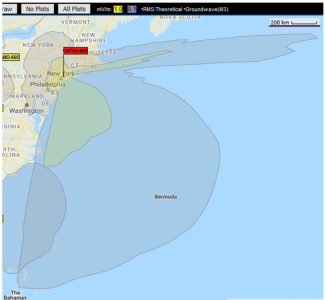
Below for perspective is a daytime contour map for 50 kW. non-D WFAN, using a frequency toward the low end of the AM broadcast band and a transmit site on a small island in Long Island Sound.

In some compass directions looking down the length of the Sound they have groundwave propagation paths that are entirely across sea water.

WFAN Daytime Cvg Contours.png
 
Last edited:
Status
This thread has been closed due to inactivity. You can create a new thread to discuss this topic.


Back
Top Bottom