You're ignoring the original premise that Audacy is losing valuable sales talent and not replacing it.
Why does this matter to me?

You're ignoring the original premise that Audacy is losing valuable sales talent and not replacing it.

The environment changes.You're ignoring the original premise that Audacy is losing valuable sales talent and not replacing it.
All that I have seen is the exact opposite. The larger groups tended to have the full complement of 5 FMs, and most markets have two or three larger groups and a few smaller clusters.When the big groups came in and were allowed to buy multiple stations they said oh we can combine staffs and reduce overhead. Then they started protecting their flank allowing one of their stations to flounder so the other could flourish. Fewer choices for the listener.
Lack of good sales people means a decline in revenue. A decline in revenue means a decline in the station value. A decline in station value means a decline in stock value. A decline in stock value means a decline in stock price, and eventually bankruptcy. Unless you think that driving a company into bankruptcy is good for anybody except a few fat cats at the top who have platinum parachutes it SHOULD matter to you.Why does this matter to me?
That model certainly won't work in a market the size of Buffalo or Rochester. Markets this size can't live on national business alone. Somewhere around 75% of the revenue comes from local direct. National, digital, and non-traditional revenue can't replace that.The environment changes.
At one point, some years ago, I was in charge of sales at a market-leading FM operation. We had raised rates from around $12 to over $200 in about 3 years, and found that either no local direct account could afford us or they wanted so much service that there was no profit. So I closed the local sales department entirely.
We had fewer sellers, but considerably better average spot rates and higher billing. This, today, is not a one-size-fits-all business.
Lack of good sales people means a decline in revenue.
A decline in revenue means a decline in the station value.
Unless you think that driving a company into bankruptcy is good for anybody except a few fat cats at the top who have platinum parachutes it SHOULD matter to you.
Radio does face a problem with spot loads. It's going to be necessary to push rates up on the OTA signal to reduce clutter.
When the big groups came in and were allowed to buy multiple stations they said oh we can combine staffs and reduce overhead.
Here is an idea for Audacy. turn KB into a broadcasting school and charge the kids to be on it and learn how to do radio.
The "big groups" came into Buffalo before you were born. The Buffalo Evening News played games with ownership rules to own two AMs at a time when they could only own one. Reducing overhead is the goal of any business, regardless of what it is. At one time, radio stations hired live musicians to play music. It was cheaper to play records. So they fired the musicians. Radio stations once did original live drama and comedy on the radio. It was cheaper to play records. So they fired all the actors. The pattern of cost cutting in radio goes back to the 1930s. Listening to the radio is based on cutting costs. People would rather listen to free music on the radio than pay for it. Everyone is trying to save money. Radio is not a government make-work program. It's private enterprise.
Yes the Buffalo Evening News owned WBEN and WEBR. The BBC owned WGR & WKBW but they were forced to divest.
I'm not the problem anyway since I'm out of market and I believe you are too. Evidently the people in Buffalo don't like the solution. The 0.1 shows it!Audacy has already solved the KB problem. You don't happen to like their solution. But it's the solution they've chosen.
Evidently the people in Buffalo don't like the solution. The 0.1 shows it!
They replaced the person in my seat, but they did not replace my clients. To this day, I have those clients, and now control the advertising they buy on Audacy, and every other radio and tv station.Do you think that they replaced Buddy when he left? Of course they did. At some point, everyone leaves a job. Either voluntarily, by firing, or by death. It happens to everyone.
Have you ever held a stock all the way to zero?
I said "agency business" and not "national business".That model certainly won't work in a market the size of Buffalo or Rochester. Markets this size can't live on national business alone. Somewhere around 75% of the revenue comes from local direct. National, digital, and non-traditional revenue can't replace that.
This will only work if groups of stations all combine... generally large owners or groups of smaller ones... to sell packages of many stations, probably by format and demos, nationally and regionally. No national or regional advertiser is going to buy, in this case, a single Buffalo station for its out of market listening. But if you combine 200 AC station, for example, you can create a package.Radio does face a problem with spot loads. It's going to be necessary to push rates up on the OTA signal to reduce clutter. As online listening grows radio will need to get innovative with localizing advertising using geofencing and other techniques to improve revenue from streaming. Right now, most stations either simply stream the main signal and replace some national spots with PSAs and "add-on" giveaways. If they have the technical wherewithal to follow the cable TV model they can present different commercials to different geographical locations making avails affordable for smaller buyers. Five zones, each sold at 25% of the cost of an all-market commercial, can increase revenue while allowing smaller advertisers to buy into their portion of the market. As online listening grows so does that opportunity.
Prior to the changes made in the early 40's, owners could have 2 AMs in a market. Today's KABC and KFI were owned by Earle C. Anthony. Arno Bulova had two AMs in New York City. Like those two, there were a number of two-station owners across the country. The FCC changed things as part of the break-up of NBC Red and Blue (not that kind of "red" and "blue") into NBC and ABC.The "big groups" came into Buffalo before you were born. The Buffalo Evening News played games with ownership rules to own two AMs at a time when they could only own one.
Not really. Until the autocratic head of the musician's union (AFM) lost power in the later 40's, most stations in markets even as small as Chatanooga had to have a percentage of live studio musicians.Reducing overhead is the goal of any business, regardless of what it is. At one time, radio stations hired live musicians to play music. It was cheaper to play records. So they fired the musicians.
That only happened when, after the TV freeze was lifted in the early 50's, almost all evening audiences (and the artists who had done radio) listeners became viewers and network radio crashed... although they all kept trying for more than a decade to keep the idea alive in different ways.Radio stations once did original live drama and comedy on the radio. It was cheaper to play records. So they fired all the actors.
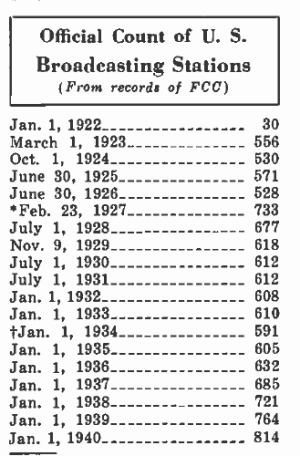
Remember, right before WW II, there were just 800 US radio stations. Most medium to large markets like Kalamazoo or Phoenix or Salt Lake City or Wichita had just a couple of radio stations, affiliated with the networks. Even a top 10 market like Cleveland just had four: a Red, a Blue, a CBS and a Mutual network station.The pattern of cost cutting in radio goes back to the 1930s. Listening to the radio is based on cutting costs. People would rather listen to free music on the radio than pay for it. Everyone is trying to save money. Radio is not a government make-work program. It's private enterprise.
People made nasty jokes about Emmis' all-sports station in NYC when it went on. Lots of "a bar without the beer" comments. Smulyen was called a crazy person. Today, all sports is one of radio's most profitable formats. Sports betting is an annex to the main building, but should be very profitable.Audacy has already solved the KB problem. You don't happen to like their solution. But it's the solution they've chosen.
Not really. Until the autocratic head of the musician's union (AFM) lost power in the later 40's, most stations in markets even as small as Chatanooga had to have a percentage of live studio musicians.

 library.williams.edu
But live drama on radio was a network thing, and TV killed the radio start... and the radio networks.
And that, in part, was why BMI was organized. https://worldradiohistory.com/Archive-All-Music/BMI-Magazine/BMI-20-Years-1940-1960.pdfThat was part of it, but artists and record labels also sued radio stations to prevent them from playing recorded music. Major labels specified on the records "Not For Broadcast" in order to dissuade airplay. They felt airplay hurt record sales. The most famous case was brought by band leader Paul Whiteman & RCA against radio station WNEW:
And, in that era, stations that wanted to fill in between network and local talk shows with music could buy "music libraries" on disk to play. Those were unknown songs by unknown artists that could be played rights-free.The inside story was that Whiteman was doing a live radio show for NBC Saturday nights. WNEW counter-programmed by playing Whiteman's records at the same time. The court ruled in favor of WNEW. That led to the very popular "Make Believe Ballroom" that ran on WNEW for many years.
But Mutual was almost a cooperative, controlled by the organizing stations. But Red, Blue and CBS originated shows in NY, Chicago, Detroit, San Francisco and LA, in a number of cases to have access to talent in each location.Remember that Mutual had four producing stations, and those stations each had theaters where they originated their drama. So yes the programming was fed on a network, but originated from specific stations. That was different from NBC and CBS, which originated its programming from its own studios. (except for outside productions, such as the Opry).
But the commercial networks, meaning ABC, NBC, CBS and Mutual were pretty much dead for scripted drama by the mid to late 50's, with some news and talk shows enduring well into the 60's. Some sports and things like The Breakfast Club ran through 1968, to the disgust of most stations that had to carry it.Also, radio drama continued on network radio until the mid-80s. NPR originated a very popular radio version of Star Wars, produced by KUSC.
And that, in part, was why BMI was organized.
But the commercial networks, meaning ABC, NBC, CBS and Mutual were pretty much dead for scripted drama by the mid to late 50's, with some news and talk shows enduring well into the 60's
But the commercial networks, meaning ABC, NBC, CBS and Mutual were pretty much dead for scripted drama by the mid to late 50's, with some news and talk shows enduring well into the 60's. Some sports and things like The Breakfast Club ran through 1968, to the disgust of most stations that had to carry it.
Didn't CBS Radio have a late-night mystery/suspense drama series at least into the '70s?
But BMI, where the "B" stands for "Broadcast" came out of the high fees and the restrictions that ASCAP was imposing. While both groups were representing the composers and authors, the much more radio-focused BMI made folks in all aspects of the industry aware that radio would fight back.BMI was organized because ASCAP was using its monopoly to screw radio for publishing royalties. Sort of a different issue.
There was an intermediary step there. After WW II, hundreds of new stations were authorized, doubling the AM count by 1950 and stretching it to 3,500 by 1960. By 1960, there were still 750 FMs still on the air, too. All of those 3,400 stations that did not exist in 1940 had to have programming and music formats, a creation of the early 50's, was the answer.Part of the reason was the scripted drama shows were owned by the advertisers. They owned the content and took it to TV. That left a huge financial hole for radio...a hole that was ultimately filled by local DJs playing recorded music.
