• Get involved.
    We want your input!
    Apply for Membership and join the conversations about everything related to broadcasting.

    After we receive your registration, a moderator will review it. After your registration is approved, you will be permitted to post.
    If you use a disposable or false email address, your registration will be rejected.

    After your membership is approved, please take a minute to tell us a little bit about yourself.
    https://www.radiodiscussions.com/forums/introduce-yourself.1088/

    Thanks in advance and have fun!
    RadioDiscussions Administrators

New York Metro Radio Ratings: June 2023

You're looking at "this week," and we're only three days into this week. Last week was 670 titles.

Nope, I did 7-day rolling. 579 gold titles on WXBK with at least one spin.

The far more successful HOT 96.9 in Boston played 284 titles over the same span. Seven of those are currents/recurrents.
 
Not going to happen, for the demographic reasons stated by David previously, and for the dismal state of rock in general, a genre that seems to have run out of ideas -- not surprising after a run of more than 60 years!
I definitely wouldn’t say that after Audacy just brought live 105 from the dead. Rock works in nyc, as seen by 104.3‘s ratings. It would be smart if Audacy launched a station to steal shares from them.
 
Rock works in nyc, as seen by 104.3‘s ratings. It would be smart if Audacy launched a station to steal shares from them.
I have mentioned that a Jack type format may be a good choice. It could mix classic rock and maybe some pop rock. Since Jack is not a rigid format, the music can be tweaked, based on current listener tastes.
This could serve as the classic rock station for listeners that don’t want lots of dj talk.
 
I definitely wouldn’t say that after Audacy just brought live 105 from the dead. Rock works in nyc, as seen by 104.3‘s ratings. It would be smart if Audacy launched a station to steal shares from them.
Live 105 was revived from the dead because there was some legacy in that market for the brand/format, and they more or less had nothing better to do with the signal. There's no such station in NYC as previous attempts at alternative or contemporary rock have been complete failures in just about every respect. Launching a station that's aimed at Q104.3 runs the risk of diluting CBS-FM's share.
 
Not going to happen, for the demographic reasons stated by David previously, and for the dismal state of rock in general, a genre that seems to have run out of ideas -- not surprising after a run of more than 60 years!

David doesn't like modern rock as he has stated many times here before. He presents opinions full of statistics but if you follow his posts you can see a consistent pattern of unwavering support for ethnic, Latin-American and Urban formats and constant negativity toward rock and other "white" formats.

He is also a champion for corporate radio consolidation which has not been helpful to current alternative/rock formats. So it becomes a chicken-or-egg question of where to lay the blame.

Keep in mind, rock music was always a form of defiance against the establishment and "Alternative" music was meant to be an alternative to the mainstream. Meanwhile, corporations are the very definition of the mainstream establishment. So the incompatibility between rock/alternative formats and corporate radio shouldn't really come as a surprise when you look at it that way.
 
He is also a champion for corporate radio consolidation which has not been helpful to current alternative/rock formats.

I disagree with that view. I doubt very much that you'd see as many alternative stations today if companies still operated on the two-per-market system. You'd instead have more stations in the more profitable formats. The only way fringe formats work is if you combine them with more profitable formats.

Keep in mind, rock music was always a form of defiance against the establishment and "Alternative" music was meant to be an alternative to the mainstream.

I agree with that, which is why alternative is better suited to non-commercial radio, such as WFUV.
 
David doesn't like modern rock as he has stated many times here before.
It's not a choice of mine for personal listening pleasure, although there are a few songs in my own library that belong in that (or "those") categories.
He presents opinions full of statistics but if you follow his posts you can see a consistent pattern of unwavering support for ethnic, Latin-American and Urban formats and constant negativity toward rock and other "white" formats.
That is so untrue that I will tell you directly it is an absolute lie.

Perhaps my most successful station was "Mega 98.3" owned by Emmis in Buenos Aires, Argentina. It is and was a rock station, playing Argentine rock from as far back as the late 60's to the present day. At one point, it had the highest cume and AQH listening of any single station in the all the Americas... including the USA.

Many years before, I did one of the very first "rock 40" FM CHRs in Birmingham, and folks kidded that we had "direct line with Macon".

Before that, I had South America's first rock FM, back in the late 60's: HCTT1 on 95.9 in Quito. All the music was in English and, despite being the owner of it an a dozen other stations, I did the early evening shift regularly..

My career in the US has mostly involved Hispanic formats, but outside I have done everything from all-classical to indigenous music of the Ecuadorian Andes... including rock, CHR, Disco, salsa, merengue, cumbia, AC, hot AC, all-news, news-talk, country, all sports, Catholic religious, beautiful music, and some you likely never even heard of.

Please note that "ethnic" does not apply to my 60 year involvement with radio in Latin America, as that's an American construct that does not apply elsewhere in the Western Hemisphere.

As to the racial statement about "white" formats, I can only say that I've lived all my adult life, both internationally and in the US, among family, friends and co-workers who did not look at color or race. This whole "hypenated" world is really a US construct that I have not been part of.
He is also a champion for corporate radio consolidation which has not been helpful to current alternative/rock formats. So it becomes a chicken-or-egg question of where to lay the blame.
Actually, consolidation has helped marginal formats because... when you own 5 FM and a translator or two in a market... you have to look at formats that can't stand on their own with a sole owner but can work when sold in conjunction with other stations in the market
Keep in mind, rock music was always a form of defiance against the establishment and "Alternative" music was meant to be an alternative to the mainstream. Meanwhile, corporations are the very definition of the mainstream establishment. So the incompatibility between rock/alternative formats and corporate radio shouldn't really come as a surprise when you look at it that way.
I never, ever looked at rock that way. Every major genre or type of music has followers. Some of those groups of partisans are larger than others.

At the present moment, alternative has the problem that the fan base has splintered and so there are multiple subsets, none of which is big enough to sustain a station. That is why the alt stations that are doing best, in their vast majority, are focused on mostly gold based formats... back when everyone liked the same songs.

Your allegations are horribly offensive to me. I think an apology is due.

 
Last edited:
I disagree with that view. I doubt very much that you'd see as many alternative stations today if companies still operated on the two-per-market system. You'd instead have more stations in the more profitable formats. The only way fringe formats work is if you combine them with more profitable formats.

The proliferation of the Alternative format began in the years prior to the Telecommunications Act of 1996, and the avalanche of consolidation in the years that followed, which ultimately coincided with the decline of rock and alternative formats.

Under the two-per-market system there were plenty of radio stations willing to be more adventurous than anything we hear under the current system. I don't know why you think things would be any different today. I disagree with your assessment -- I think radio would sound very different today if it hadn't been to the conglomerates cutting the talent and strangling the medium's creativity.

Competition fosters more exciting, innovative products. Allowing two or three companies with top-down executive structures to control everything in town allows them to play things exceedingly safe.

I agree with that, which is why alternative is better suited to non-commercial radio, such as WFUV.

Donors to public radio stations like WFUV are older, with plenty 65+. That means those stations have to cater to that demo. WFUV has an *Adult* Alternative format, emphasis on the 'Adult' -- very adult, as in seniors. They're not corporate, but also not appealing to younger music fans.
 
I disagree with that view. I doubt very much that you'd see as many alternative stations today if companies still operated on the two-per-market system. You'd instead have more stations in the more profitable formats. The only way fringe formats work is if you combine them with more profitable formats.
There are more different and distinctive formats post-consolidation than there were prior to it. Consolidation has benefited the listener through a broader variety of formats.
I agree with that, which is why alternative is better suited to non-commercial radio, such as WFUV.
I never think of formats on commercial radio based on social movements or avenues of thought. Analysis when picking a format is based on "which one will get the most salable listeners"; it is a business.
 
Last edited:
The proliferation of the Alternative format began in the years prior to the Telecommunications Act of 1996,

The proliferation of the format had NOTHING to do with radio laws. It had to do with the big money in rock music and the reaction by younger musicians to the hypocrisy of establishment rock. The music touched a chord and became popular, and that popularity led to more stations, including pop stations, playing it. But within the staffs at establishment rock stations, such as WNEW, there was concern and aversion to playing some alternative music. Some view that as partly the reason why the station became dated and less popular in the 90s.
Under the two-per-market system there were plenty of radio stations willing to be more adventurous than anything we hear under the current system. I don't know why you think things would be any different today.

They're more adventurous in formats where the quality of the music and the strength of the fan base justifies it. Rock is not one of those formats, and the lack of investment on the part of the music business is the best indication. This is NOT a radio problem. It's a music problem.

Competition fosters more exciting, innovative products. Allowing two or three companies with top-down executive structures to control everything in town allows them to play things exceedingly safe.
They can never control everything in town because there still are limits. This is why EMF and other religious broadcasters have been able to buy so many stations in NY. I'm sure iHeart would have loved to buy 95.5, but they were prohibited by law.

Donors to public radio stations like WFUV are older, with plenty 65+. That means those stations have to cater to that demo.
If younger demos were willing to be supportive of their music, it would get more attention and coverage. The NY area has more than its share of college owned and run stations, including WSOU that is staffed by students playing their music, and not that of elder people. So the music is available. If you want non-corporate radio, the money has to come from somewhere. There are no laws preventing the fans from owning radio stations. The people need to take the initiative. You complain about corporations, but then demand they lose money on your favorite music.
 
I have mentioned that a Jack type format may be a good choice. It could mix classic rock and maybe some pop rock. Since Jack is not a rigid format, the music can be tweaked, based on current listener tastes.
This could serve as the classic rock station for listeners that don’t want lots of dj talk.
The strength of Q104.3 lies strongly in the music (as said many times, it's as much about what they don't play vs. what they do), but also quite strongly about the personalities. Jim Kerr is an institution, so is Carol Miller, and Maria Milito and Ken Dashow are vets in their own rights. Ken's afternoon show is always a great listen, frankly their strongest daypart. The personalities + the music is a strong reason I suspect Q does so well.
 
The proliferation of the Alternative format began in the years prior to the Telecommunications Act of 1996, and the avalanche of consolidation in the years that followed, which ultimately coincided with the decline of rock and alternative formats.
Because the appeal of the music was lessening and the remaining partisans were dividing into subsets that did not "like each other's music". In fact, this is the same sort of thing that happened to Smooth Jazz, which died due to audience aging and a decrease in new product.

Formats die either becuase of ageing out (MOR, Beautiful Music, etc.), fragmentation of the core (Alternative Rock) or a combination of those factors. In one case, at least, the core fragmented and all survived: Top 40in the late 60's into the 70's where first we got "progressive rock" and then pop-based AC (CHR without the hard stuff, much of the Urban stuff and a different jock style). And progressive rock fragmented, with "Superstars" and hit-based AOR dividing and often killing progressive stations
Under the two-per-market system there were plenty of radio stations willing to be more adventurous than anything we hear under the current system. I don't know why you think things would be any different today. I disagree with your assessment -- I think radio would sound very different today if it hadn't been to the conglomerates cutting the talent and strangling the medium's creativity.
That is just not true. Single FMs with smaller partisan group appeal could not survive, so we had 3 and 4 AC stations in a market, two or three CHRs, maybe two Urbans. We now have derivatives like Churban, Hot AC, Urban AC.

Do you think that Alt would have survived in Philadelphia if the station were not sustained by iHeart? The station is around 14th in both AQH audience and revenue.
Competition fosters more exciting, innovative products. Allowing two or three companies with top-down executive structures to control everything in town allows them to play things exceedingly safe.
Competition does not foster that if the smaller appeal stations can't get agency sales. And when every other station was your competitor, you did not take risks as your single-station's survival was in play. Remember, prior to consolidation, over 50% of all US radio stations were not profitable. How many risks do you take if you are losing money every day?
Donors to public radio stations like WFUV are older, with plenty 65+. That means those stations have to cater to that demo. WFUV has an *Adult* Alternative format, emphasis on the 'Adult' -- very adult, as in seniors. They're not corporate, but also not appealing to younger music fans.
And that is because there is no way to finance a station, profit-seeking or not, if there is no income and not enough people to support it.
 
Last edited:
That is so untrue that I will tell you directly it is an absolute lie.
...

Your allegations are horribly offensive to me. I think an apology is due.

Here is an example, you wrote this to me earlier in this thread:

The market is only 41% non-Hispanic white. It is close to two-thirds ethnic, and that is not counting the significant percentage of immigrants from Russia, Persia, Eastern Europe and the Middle East who are also rather non-conforming in their tastes in entertainment.

There are members of ethnic groups and immigrants all over the market, so saying that this station should serve "white people" because of the signal ignores the fact that much of the population served well by it is ethnic or immigrant.

First of all, I said nothing at all about "white" formats, you're the one who decided to go there. And until now I let it go without a response. But I don't know why you have to distort statistics all the time.

So, I was talking about WXBK's signal that is strongest in the NJ suburbs and you came back suggesting this area is demographically equivalent to The Bronx and Brooklyn, which it is not.

And then you rattle off a bunch of numbers making it seem like "white" is not the largest segment of the population in the NYC metro, which it actually is. For the record, Nielsen shows the market's population Black: 2,682,700 (17%) and Hispanic 4,092,600 (25%). White is more than 30%.

Finally, you accused me of saying that 'this station should serve "white people"' which I did not say at all, those are words you put in my mouth. This is characteristic of so many of the things you write on this site.

So while I am sorry you took offense to what I said, I can't apologize for what I consistently see in your writing. People can go through your posts and decide for themselves if they agree.

If you would like some praise from me, sure. I admire your knowledge of the radio business even if I don't support all of your beliefs. I admire your website and the amount of work you put into it. I think you contribute greatly to the radio community through your work on this site. I don't dislike you, I just don't agree with some of your opinions, and I do see your personal opinion influence the statistics you choose to present. So I state mine, and I don't generally want to see them turn into arguments so I allow them to be discussions.
 
The elephant in the room has everything to do with race, though. That's the drift of white, suburban 18-34s (men, that is; women are drifting to country) to hip-hop/rap as their main music of choice rather that whatever is being put out there as rock. It has the hipness, anger and rebelliousness that alternative rock has ever had, just with beat replacing melody and samples replacing instruments. Times change.
 
Here is an example, you wrote this to me earlier in this thread:
And I was pointing out the simple fact that stations that are neither mass appeal nor cross color lines have an incredibly hard time in that kind of market.

An Alt format is predominantly and overwhelmingly white. So doing a non-Hispanic white format in an area that is predominantly everything else is not logical
First of all, I said nothing at all about "white" formats, you're the one who decided to go there. And until now I let it go without a response. But I don't know why you have to distort statistics all the time.
There is no distortion of statistics. However, Nielsen divided audiences into three groups... non-Hispanic white, Black and Hispanic. Because each is measured proportionally on all the stratification variables, we have to take those "statistics" into account.
So, I was talking about WXBK's signal that is strongest in the NJ suburbs and you came back suggesting this area is demographically equivalent to The Bronx and Brooklyn, which it is not.
Obviously you have not spent a lot of time in Newark or most of the "inner ring" Jersey suburbs. In particularly, it is highly Hispanic and the target of WXBK,, based on the music, is predominantly Hispanic in those areas.
And then you rattle off a bunch of numbers making it seem like "white" is not the largest segment of the population in the NYC metro, which it actually is. For the record, Nielsen shows the market's population Black: 2,682,700 (17%) and Hispanic 4,092,600 (25%). White is more than 30%.
The Metro Survey Area is now 18% Black, 26% Hispanic and 14% Asian. It also has, using somewhat date (and thus "less) proprietary research just over 10% first generation immigrants that are not Asian, Black or Hispanic... meaning Russian, Eastern European, Lebanese, Iranian and other groups. That leaves 30% non-Hispanic whites who are not first generation immigrants.
Finally, you accused me of saying that 'this station should serve "white people"' which I did not say at all, those are words you put in my mouth. This is characteristic of so many of the things you write on this site.
Tell me, then, the percentage of alternative rock listeners across the US that are not non-Hispanic white. I'll wait for your response.
So while I am sorry you took offense to what I said, I can't apologize for what I consistently see in your writing. People can go through your posts and decide for themselves if they agree.
Saying I am against rock is a total lie. Just admit it. I programmed the most successful rock station in the Hemisphere, as well as 5 or 6 others.
If you would like some praise from me, sure. I admire your knowledge of the radio business even if I don't support all of your beliefs. I admire your website and the amount of work you put into it. I think you contribute greatly to the radio community through your work on this site. I don't dislike you, I just don't agree with some of your opinions, and I do see your personal opinion influence the statistics you choose to present. So I state mine, and I don't generally want to see them turn into arguments so I allow them to be discussions.
But saying, in paraphrase, that I dislike rock and only "like" Latin and Urban formats is just totally, absolutely untrue. I don't program for my own tastes, or I'd be doing another salsa station or a vallenato station. I identify groups of potential listeners and try to super-serve them by research and involvement.

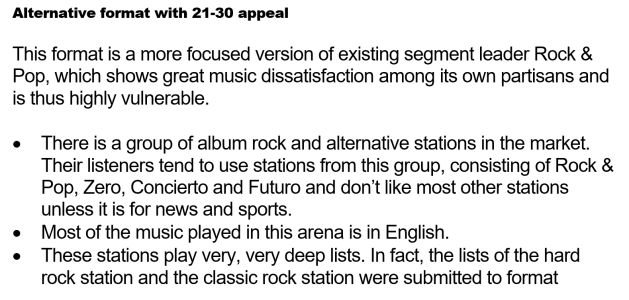
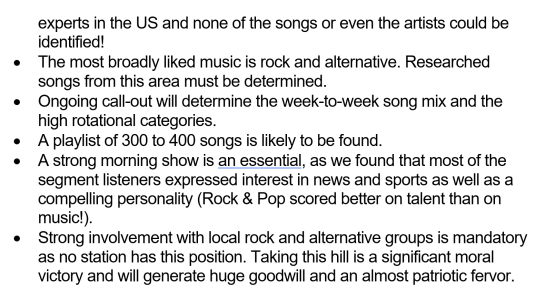
Here is an extract from a market analysis for Metromedia done in 1998, and it seems that I was recommending alternative for one of the stations they almost bought:

1689727895412.png
1689727923497.png
 
Last edited:
Live 105 was revived from the dead because there was some legacy in that market for the brand/format, and they more or less had nothing better to do with the signal. There's no such station in NYC as previous attempts at alternative or contemporary rock have been complete failures in just about every respect. Launching a station that's aimed at Q104.3 runs the risk of diluting CBS-FM's share.
Not so sure. Howard made wxrk as legendary as it gets. Audacy made a mistake trying to do “alt” in nyc instead of “rock”. And according to everyone here, they have a station they don’t know what to do with (94.7).
 
Not so sure. Howard made wxrk as legendary as it gets.
Howard made Howard legendary. That is the extent of it. Look at the LA "Howard Station" that had all talk after Howard, and did moderately well. When Howard left radio, the station could not sustain its audience.

Here is a bit about KLSX:

The station moved to a talk format as "Real Radio 97.1" on July 31, 1995. It featured Susan Olsen from the Brady Bunch and Kato Kaelin, who gain notoriety from the O.J. Simpson murder trial. The slogan switched to "The FM Talk Station" in 1996. Greater Media made a deal with CBS Radioto swap the station in 1997. From 1995 to 1997 KLSX played alternative music on weekends, but once it became KROQ's sister station, the weekend programming switched to adult alternative musicuntil 1999. By that time the only show still playing music on the talk outlet was Breakfast With The Beatles.

After Howard Stern announced his departure from CBS Radio to Sirius, Adam Carolla was named his successor to begin in January 2006. When the announcement was originally made on October 25, 2005, the station began calling itself "97.1 Free FM" as a jab at satellite radio, which required a subscription. Danny Bonaduce was added to the morning show in 2007. KLSX dropped its talk formaton February 17, 2009 to become top 40 station 9701 AMP Radio the next day.


Status
This thread has been closed due to inactivity. You can create a new thread to discuss this topic.


Back
Top Bottom