• Get involved.
    We want your input!
    Apply for Membership and join the conversations about everything related to broadcasting.

    After we receive your registration, a moderator will review it. After your registration is approved, you will be permitted to post.
    If you use a disposable or false email address, your registration will be rejected.

    After your membership is approved, please take a minute to tell us a little bit about yourself.
    https://www.radiodiscussions.com/forums/introduce-yourself.1088/

    Thanks in advance and have fun!
    RadioDiscussions Administrators

Post your latest DX

KMXA is definitely 50KW day power and is very strong again tonight. Blowing away XEPRS.

XEPRS has had issues with their signal ever since they lost a tower.. unfair comparison.

They went form local like every night here 3000 miles away to mixing with KFNQ Seattle, equally.
 
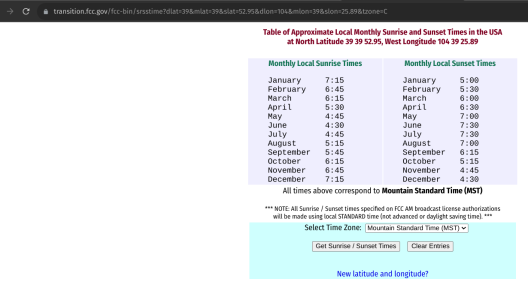
Local average sunset here in December is 4:30 pm so I can see if there's any kind of pattern switch or signal drop at that time. Critical hours not a factor for KMXA.

The 11 pm time, rather than midnight, for the start of the tone is interesting - timing it against KAAY?

The daytime pattern has a lobe to the ENE - any SDRs in Nebraska that could be checked?
 
Local average sunset here in December is 4:30 pm so I can see if there's any kind of pattern switch or signal drop at that time. Critical hours not a factor for KMXA.

The 11 pm time, rather than midnight, for the start of the tone is interesting - timing it against KAAY?

The daytime pattern has a lobe to the ENE - any SDRs in Nebraska that could be checked?

FCC calculated sunset time for KMXA is 445.
 
So that's why XEPRS is a little weaker at night, and KBOZ is more common. Even if KMXA wasn't on day power at night...interesting!
KAAY AR or KTGO in ND would be nice. But with KAAY planning to go 80 watts at night, my chances are slim even now.
 
So that's why XEPRS is a little weaker at night, and KBOZ is more common. Even if KMXA wasn't on day power at night...interesting!
KAAY AR or KTGO in ND would be nice. But with KAAY planning to go 80 watts at night, my chances are slim even now.

XEPRS lost that tower like a year, year and a half ago.. and im not sure ive heard that it was replaced yet.
 
Its not december yet.... sunset time in december is 430... sunset time in november is 445
Good point. I've also kept thinking that November 30 is on Monday and it's not. There are a lot of distractions in my personal life right now.

My other excuse: we had snow overnight.
 
So I sat through an extensive discussion of the hosts' Thanksgiving dinners between 4:30 and 5 pm on 1090 KMXA and heard no sign of any pattern switch or power drop during that time. This may not indicate anything since I'm so close but I would have expected at least a fluctuation in signal strength and saw nothing of the sort.
 
So I sat through an extensive discussion of the hosts' Thanksgiving dinners between 4:30 and 5 pm on 1090 KMXA and heard no sign of any pattern switch or power drop during that time. This may not indicate anything since I'm so close but I would have expected at least a fluctuation in signal strength and saw nothing of the sort.

it would take 2-3 seconds to do a pattern change and in that moment, the station does drop off.
 
it would take 2-3 seconds to do a pattern change and in that moment, the station does drop off.
KCBS San Francisco is able to do it in about a second. On the other hand, when KMBZ Kansas City was on its original site, it would take 5 seconds or more to go from its nighttime DA (which wasn't all that directional to start with) to nondirectional daytime operation.

As for KMXA, there was no variation whatsoever. Thus it might be worthwhile for someone in Kansas or Nebraska to try for it since the nighttime pattern definitely nulls out those states.
 
KCBS San Francisco is able to do it in about a second. On the other hand, when KMBZ Kansas City was on its original site, it would take 5 seconds or more to go from its nighttime DA (which wasn't all that directional to start with) to nondirectional daytime operation.

As for KMXA, there was no variation whatsoever. Thus it might be worthwhile for someone in Kansas or Nebraska to try for it since the nighttime pattern definitely nulls out those states.

It takes KRVN about 3 seconds and one day when n laramie, right at prime skywave zone.... i got the 880 in OR ID'ing at exactly the time KRVN switched from night to day pattern
 
it would take 2-3 seconds to do a pattern change and in that moment, the station does drop off.
I've been with stations that have everything synchronized with the antenna switch, so when the switch gets the command to change, the carrier is momentarily cut and brought back as soon as the relay closes. That is as little as about a third of a second.

The on-air sound is sort of like a tiny whishing sound. It is often not even "hearable".

If a station has the same pattern or just one tower, most transmitters in use today will do a power change with no noticeable on-air artifact at all.
 
Last night, 1370 KSOP Salt Lake City with Gene Autry Xmas music...500 watts. Also 1390 KRRZ Minot ND // stream. 550 had a Coast to Coast station under KOAC, likely KFYR Bismarck (pointing east). Two country stations on 600 probably CJWW and KSJB. 620 CKRM easy over KPOJ.
 
Back to 1090 KMXA - another night, more tone, starting promptly at 11 pm Mountain. It's as if it's on a timer.
 
50KW day power, Michael! This should be heard way further than Chicago. Maybe in Indiana, Ohio, or Kentucky!
 
Is WHB the usual regular down there on 810? I would assume so. Or KXOI Crane TX, on 500 watts.


Back
Top Bottom