• Get involved.
    We want your input!
    Apply for Membership and join the conversations about everything related to broadcasting.

    After we receive your registration, a moderator will review it. After your registration is approved, you will be permitted to post.
    If you use a disposable or false email address, your registration will be rejected.

    After your membership is approved, please take a minute to tell us a little bit about yourself.
    https://www.radiodiscussions.com/forums/introduce-yourself.1088/

    Thanks in advance and have fun!
    RadioDiscussions Administrators

Is there any chance that Alpha Media updates its signals to HD Radio?

I've worked for Alpha. In my experience, and the Alpha markets I worked in, they rarely even made sure their analog transmitters were kept updated. Updating studio equipment was not much better with Alpha. Night and day difference between working for them (when it came to engineering) and Saga. I really do think some stations (and station groups) are barely getting by these days. Alpha also really missed the boat on scoring some translator frequencies in the markets I worked, which were quickly scooped up by other local radio stations.
In quite a few markets I have been in I have been able to use progressive and advanced engineering as one more arrow in the quiver to beat competitors.

So many broadcast executives don't understand engineering at all, and many hide their ignorance by pretending that tech does not matter.

Back when stations spent on promotions and ad campaigns, it amazed me that a station with outdated gear, the FM antenna on the wrong side of the tower, antiquated processing and the like would spend tens of thousands on a promotion but not have a UPS at the transmitter site!
 
So many broadcast executives don't understand engineering at all, and many hide their ignorance by pretending that tech does not matter.

The executive doesn't have to understand tech. The tech people have to demonstrate the connection between what they do and making money. The executives understand money. I've worked with tech people who may not know how to do basic engineering. But they know how to make an effective presentation, get a budget for their department, and then justify that budget by delivering results. That's how to move tech higher on the priority list.
 
The executive doesn't have to understand tech.
Of course they don't. But they should. Radio and its newer related on-line services is based on technology. It is not like selling produce, where you don't have to be a farmer to "get" good corn or avocados.
 
Of course they don't. But they should. Radio and its newer related on-line services is based on technology. It is not like selling produce, where you don't have to be a farmer to "get" good corn or avocados.

The tech people have to speak their language. Bob Pittman isn't a tech guy. He's a research guy. But he has tech people around him who speak his language, and tech is a driving force at iHeart. Consider how many tech-based companies they run, such as Triton, Mediabase, and Selector. Not to mention their streaming site. The entire radio industry depends on iHeart tech companies.
 
The tech people have to speak their language. Bob Pittman isn't a tech guy. He's a research guy.
Not really. He is fundamentally a programmer whose first "big gig" was an FM CHR in Pittsburgh where he lost to a highly directional AM! He moved on to programming based jobs like MTV and now a content based position at iHeart. He tends to fall upwards, which is an interesting skill.

In fact, I would not call him a researcher at all. iHeart had two of the radio industry's best research companies and he destroyed both of them (Critical Mass and Broadcast Architecture).
But he has tech people around him who speak his language, and tech is a driving force at iHeart.
He is smart enough to have tech people who know what they are doing, but he did not create nor were the tech products created, under his stewardship. They were all purchases or part of larger purchases.
Consider how many tech-based companies they run, such as Triton, Mediabase, and Selector.
(Selector is one of RCS's products, not a separate company. Their major product is Zetta, the scheduling product.)
Not to mention their streaming site. The entire radio industry depends on iHeart tech companies.
Not really. Where iHeart put a stranglehold on broadcasters was through buying all the independent rep firms and having computerized buying introduced. Both were highly destructive to the industry.
 
Current active Alpha HD stations as of 12/2023:
Amarillo, TX - 102.9 KVWE
Columbia, SC - 93.5 WARQ
Fredericksburg, VA - 93.3 WFLS
Palm Springs, CA - 92.7 KKUU
Portland, OR - 101.9 KINK
San Antonio, TX - 94.1 KTFM
Wenatchee, WA - 104.7 KKRV

WARQ, WFLS, KINK and KKRV feed translators (sometimes multiple); WARQ-HD3 is leased to another broadcaster.

KKRV, KKNU and KTFM also feed translators.
 
Current active Alpha HD stations as of 12/2023:
Amarillo, TX - 102.9 KVWE
Columbia, SC - 93.5 WARQ
Fredericksburg, VA - 93.3 WFLS
Palm Springs, CA - 92.7 KKUU
Portland, OR - 101.9 KINK
San Antonio, TX - 94.1 KTFM
Wenatchee, WA - 104.7 KKRV

A lot of those stations added HD prior to their sale to Alpha. I know the first three on the list for a fact.
 
KKRV, KKNU and KTFM also feed translators.
I already mentioned KKRV. KTFM and KKUU are supposed to feed translators but their HD subchannels are off as of the last update.
A lot of those stations added HD prior to their sale to Alpha. I know the first three on the list for a fact.
Good point. It looks like all of them except for KINK had HD prior to Alpha's acquisition. It solidifies what I said above about Alpha not being big on HD, so what I'm thinking is with the exception of KINK, they maintain the status quo on stations they acquire. If it already has HD, they keep it going; if not, it probably won't as long as Alpha owns it.
 
I've worked for Alpha. In my experience, and the Alpha markets I worked in, they rarely even made sure their analog transmitters were kept updated. Updating studio equipment was not much better with Alpha. Night and day difference between working for them (when it came to engineering) and Saga. I really do think some stations (and station groups) are barely getting by these days. Alpha also really missed the boat on scoring some translator frequencies in the markets I worked, which were quickly scooped up by other local radio stations.
What a shame; they really do have a good radio product too. Just clear how terrible their equipment is. 106.5 shouldn’t be struggling 20 miles out from the broadcast site with such a flamethrower of a signal. I have had family complain about the signal quality while driving them to the airport just a few days ago, haha. They said to put on a local station!
 
What a shame; they really do have a good radio product too. Just clear how terrible their equipment is. 106.5 shouldn’t be struggling 20 miles out from the broadcast site with such a flamethrower of a signal. I have had family complain about the signal quality while driving them to the airport just a few days ago, haha. They said to put on a local station!
Were you in San Jose?
 
Were you in San Jose?

No, but the signal struggles in cities adjacent to it which is extremely odd when other signals with less power and less height do not. The only difference on paper is it is not HD.

Have had it struggle hard inside SJ, though.
 
No, but the signal struggles in cities adjacent to it which is extremely odd when other signals with less power and less height do not. The only difference on paper is it is not HD.
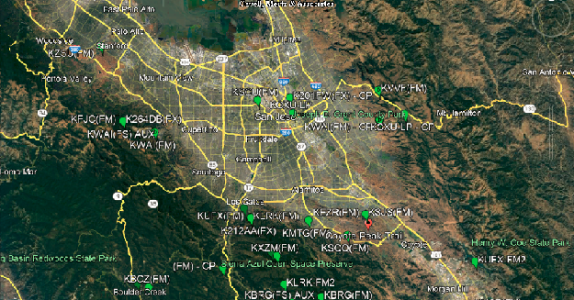
That's the key - "on paper". The terrain of the Bay Area can provide vastly different coverage than what the FCC predicts. Longley-Rice predictions come much closer to accuracy. Here's a quick screenshot of South Bay radio stations, courtesy of the Google Earth plugin from Cavell Mertz:

1703701301790.png
Not sure how well it shows up, but you get the idea. Some of those lower power or lower elevation stations you speak of have transmitters in areas that aren't shadowed to specific communities. The hills above East San Jose (104.9, 105.7) provide a killer signal to East San Jose & Downtown, and hit the peninsula well, with a penalty in the East Bay (Fremont, Hayward), where the signal is blocked by Monument Peak. There's a hill above Los Gatos, home to 98.5 and 95.3, that also covers San Jose nicely and gets into the East Bay way better than Coyote Peak or East San Jose. But those signals are absent in Morgan Hill & Gilroy. Further to the West, 97.7 and 89.7 cover Cupertino nicely, where the Coyote Peak signals have real issues. They also boom into Hayward & Castro Valley, where the higher-powered signals to the East have trouble. Speaking of Coyote Peak, that's where KSJO started out, 94.5 moved there from Loma Prieta many years ago to get some building penetration in San Jose, and Alpha moved 106.5 from the hills above East San Jose to Coyote, presumably to get better coverage in Fremont & the rest of the East Bay. But it still doesn't cover that area as well as the signals farther west. Even KBRG - with grandfathered power at 100.3 on Loma Prieta - has trouble in Los Gatos & Cupertino, where it's shadowed.

I see EMF has a CP to move 97.7 from the West side of the Santa Clara Valley to the East side. They certainly know what they're doing, and obviously want some coverage of East San Jose & the Coyote Valley.

While the presence of HD can help with multipath-ridden signals, I'm not sure it's completely the reason for what you're observing.

Dave B.
 
That's the key - "on paper". The terrain of the Bay Area can provide vastly different coverage than what the FCC predicts. Longley-Rice predictions come much closer to accuracy. Here's a quick screenshot of South Bay radio stations, courtesy of the Google Earth plugin from Cavell Mertz:

View attachment 6317
Not sure how well it shows up, but you get the idea. Some of those lower power or lower elevation stations you speak of have transmitters in areas that aren't shadowed to specific communities. The hills above East San Jose (104.9, 105.7) provide a killer signal to East San Jose & Downtown, and hit the peninsula well, with a penalty in the East Bay (Fremont, Hayward), where the signal is blocked by Monument Peak. There's a hill above Los Gatos, home to 98.5 and 95.3, that also covers San Jose nicely and gets into the East Bay way better than Coyote Peak or East San Jose. But those signals are absent in Morgan Hill & Gilroy. Further to the West, 97.7 and 89.7 cover Cupertino nicely, where the Coyote Peak signals have real issues. They also boom into Hayward & Castro Valley, where the higher-powered signals to the East have trouble. Speaking of Coyote Peak, that's where KSJO started out, 94.5 moved there from Loma Prieta many years ago to get some building penetration in San Jose, and Alpha moved 106.5 from the hills above East San Jose to Coyote, presumably to get better coverage in Fremont & the rest of the East Bay. But it still doesn't cover that area as well as the signals farther west. Even KBRG - with grandfathered power at 100.3 on Loma Prieta - has trouble in Los Gatos & Cupertino, where it's shadowed.

I see EMF has a CP to move 97.7 from the West side of the Santa Clara Valley to the East side. They certainly know what they're doing, and obviously want some coverage of East San Jose & the Coyote Valley.

While the presence of HD can help with multipath-ridden signals, I'm not sure it's completely the reason for what you're observing.

Dave B.

Ah okay! A lot of good information here. I appreciate the time and effort you took here for this post. Our terrain makes for an interesting situation with radio, certainly. What is the situation with 92.3? I was listening the other day all the way up in San Bruno with HD4 coming in with no issue. I rarely make it out to the east bay, sometimes I do go out to Union City but rarely. Most of my experience is from San Francisco down to San Jose.

Additionally, I was wondering if we have any knowledge of the processing 106.5 is using, both 106.5 and 94.5 seem to sound horrible and others have mentioned Alpha is very cheap, and may still have lingering financial issues
 
A station in Reno NV has really bad audio - KUEZ 104.1. I listen on a DaySequerra HD tuner and it can tell the quality of station's audio quality compared to other stations.
 
\What is the situation with 92.3? I was listening the other day all the way up in San Bruno with HD4 coming in with no issue.
If you were on the Bayshore Freeway, it's mostly a clean shot across the Bay and/or the flatlands on the peninsula to Coyote Peak. No terrain issues. If you were going up 280 to San Bruno, I'm surprised.
Additionally, I was wondering if we have any knowledge of the processing 106.5 is using, both 106.5 and 94.5 seem to sound horrible and others have mentioned Alpha is very cheap, and may still have lingering financial issues
We're just a bunch of radio nerds. I suspect that knowledge is known only to Alpha's engineer, and/or the contract engineer who takes care of those facilities. But I've been around long enough to know that processing is like religion, and everyone has their reasons for doing what they do. One man's trash is another man's treasure, so to speak. It could be economics, the desire for a particular sound, or maybe research that says most of their listening is on cheap table radios in warehouses & boom boxes at jobsites, and we just want it loud and compressed. Don't care what the audio quality is. Whatever it is, we're likely to never know on this message board.

Dave B.
 
Why does the OP wants HD for?

Just wondering
The obvious, HD radio (NRSC-5-D) significantly increases audio quality, as outlined by the FCC and Consumer Reports.

The stations with HD do better on lower heights and with less power, and as others have mentioned it helps with multipath.

Most importantly, the average listener cares about no static and if a signal sounds better they’ll flip to it more. They’re not actively seeking out the best audio quality but the night and day difference matters. If KMVQ dropped HD, I bet they’d start slipping in market share to KYLD.
 
The obvious, HD radio (NRSC-5-D) significantly increases audio quality, as outlined by the FCC and Consumer Reports.

The stations with HD do better on lower heights and with less power, and as others have mentioned it helps with multipath.

Most importantly, the average listener cares about no static and if a signal sounds better they’ll flip to it more. They’re not actively seeking out the best audio quality but the night and day difference matters. If KMVQ dropped HD, I bet they’d start slipping in market share to KYLD.
With current smartphone ownership being at 97%, it seems like HD Radio is like chasing a rainbow to get a seat! :unsure:
 
The obvious, HD radio (NRSC-5-D) significantly increases audio quality, as outlined by the FCC and Consumer Reports.

The stations with HD do better on lower heights and with less power, and as others have mentioned it helps with multipath.

Most importantly, the average listener cares about no static and if a signal sounds better they’ll flip to it more. They’re not actively seeking out the best audio quality but the night and day difference matters. If KMVQ dropped HD, I bet they’d start slipping in market share to KYLD.
With current smartphone ownership being at 97%, it seems like HD Radio is like chasing a rainbow to get a seat! :unsure:
 
Status
This thread has been closed due to inactivity. You can create a new thread to discuss this topic.


Back
Top Bottom