
-
Get involved.
We want your input!
Apply for Membership and join the conversations about everything related to broadcasting.
After we receive your registration, a moderator will review it. After your registration is approved, you will be permitted to post.
If you use a disposable or false email address, your registration will be rejected.
After your membership is approved, please take a minute to tell us a little bit about yourself.
https://www.radiodiscussions.com/forums/introduce-yourself.1088/
Thanks in advance and have fun!
RadioDiscussions Administrators
You are using an out of date browser. It may not display this or other websites correctly.
You should upgrade or use an alternative browser.
You should upgrade or use an alternative browser.
TV Guide editions and online resources
- Thread starter IM42A
- Start date

Thanks, will do.I'm fine with posting the article here if you scan it!
My memory may not be correct but I the residents of Amboy were invited to board a bus to LA to watch the Tonight Show in person.That city was Amboy, CA. It was in the May 28, 1977 edition under the title "Will 50 Bedsprings Finally Bring TV to Amboy, Cal.? I used to occasionally save articles from TV Guide when I was I was a young nerdling and actually have that one.

In the early days of the New Mexico edition, which included El Paso, listings for the two TV stations in Juárez were included and were in Spanish. I have issues from 1960 and 1961 with those listings. By 1964, the Juárez stations were no longer included in that edition.Bottom line, it was kind of bizarre to see program descriptions in French, in a US TV Guide.
I didn't know that. I looked at Matt Sittel's page and the Juárez stations were removed sometime between May 1961 and September 1962. It's also worth noting that both stations were at the same address, and they misspelled "Apartado".In the early days of the New Mexico edition, which included El Paso, listings for the two TV stations in Juárez were included and were in Spanish. I have issues from 1960 and 1961 with those listings. By 1964, the Juárez stations were no longer included in that edition.
The New Mexico TVG was interesting. From at least 1975, they carried the four VHF independents from Los Angeles, first with split bullets, then with partial (or in the case of KHJ, full) call letters. By the end, everything except KTLA had been removed (saw them on cable in Flagstaff AZ in 2002).
I think KTLA was carried on cable in El Paso, TX all the way until 2006 (it may have been dropped for a while when KJLF/KKWB had WB then brought back after said station became KTFN and affiliated with TeleFutura)
The Los Angeles independents had wide cable coverage throughout the southwest US, first via dedicated microwave, then most likely on satellite. New Mexico is interesting in that all four VHF independents were carried.

The Los Angeles independents had wide cable coverage throughout the southwest US, first via dedicated microwave, then most likely on satellite. New Mexico is interesting in that all four VHF independents were carried.
How did that work our rights-wise in the microwave era? Did the L.A. independents have to pay more for syndicated programming because of their distribution outside the L.A. market? Or was some of the programming blacked out? I know syndicated exclusivity became quite an issue with the advent of satellite-delivered superstations.
Just got the South Texas TVG today. I stand humbly corrected. I know I read something about Essex as well, but it was obviously another article, might have been the NYT article I cited.That city was Amboy, CA. It was in the May 28, 1977 edition under the title "Will 50 Bedsprings Finally Bring TV to Amboy, Cal.? I used to occasionally save articles from TV Guide when I was I was a young nerdling and actually have that one.
Here are the JPG images (may have to split it up into more than one post)
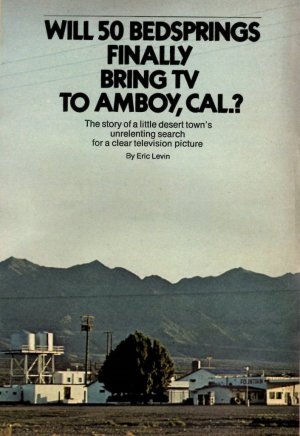
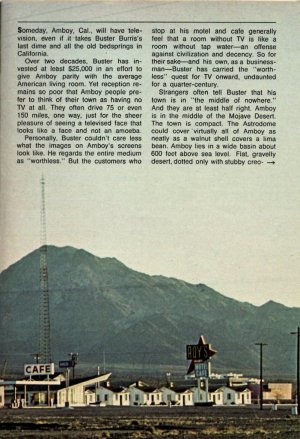
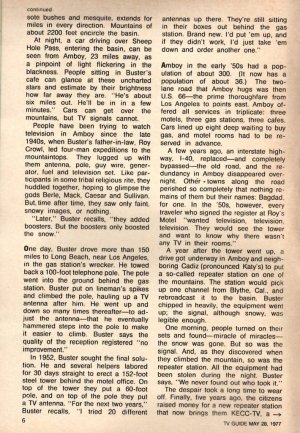
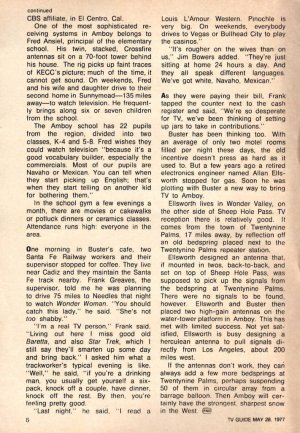
Got to wonder whatever happened to all those antennas Buster bought. Hope they found a good home. If I had been in California, I could have rented a U-Haul and helped him out with that. My patio is bristling with antennas, kept as far out of view of the HOA as possible behind a wooden fence or hidden by trees (suboptimal placement) --- OTARD protects me with at least one visible antenna at each of my two homes (mounted as high as I can manage), but an antenna farm, while a thing of beauty to hobbyists, could disturb neighbors who don't share the passion for the DX hobby.
Last edited:
And the South Texas TVG is, in fact, a very interesting edition after all:
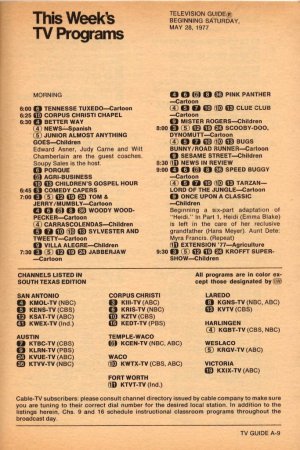
Black bullets, white bullets, split bullets, the whole nine yards (even though there was no need for split bullets, they could have used white ones for 6/10/11). Guess they wanted to underscore that these stations were outside of their circulation area.
Interestingly, KLRN is listed as an Austin station, because at the time, it was. KLRN's transmitter was moved near San Antonio in 1984, this after KLRN satellite KLRU was set up in Austin in 1979. Prior to this, the two cities shared KLRN.
Black bullets, white bullets, split bullets, the whole nine yards (even though there was no need for split bullets, they could have used white ones for 6/10/11). Guess they wanted to underscore that these stations were outside of their circulation area.
Interestingly, KLRN is listed as an Austin station, because at the time, it was. KLRN's transmitter was moved near San Antonio in 1984, this after KLRN satellite KLRU was set up in Austin in 1979. Prior to this, the two cities shared KLRN.
I had to be careful with this one since the center staples are failing, so I did a quick cellphone camera shot rather than run it through the flatbed scanner, and cut the color saturation way back so the paper doesn't look quite so yellowed.I didn't know that. I looked at Matt Sittel's page and the Juárez stations were removed sometime between May 1961 and September 1962. It's also worth noting that both stations were at the same address, and they misspelled "Apartado".
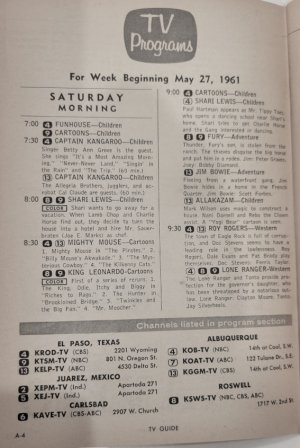
Yes, "Apartoda". It appeared that XEPM was on during the day and XEJ on at night, with a couple of hours of overlap between them.
Other things to note:
KAVE-TV was not interconnected then. Everything from CBS came in on film. So it could run the shows in pretty much any kind of pattern it wanted. It did not run any daytime CBS shows.
Videotape was still new. So delayed color network shows would revert to black-and-white. Daytime schedules tended to follow an Eastern minus 2-hour pattern.
KSWS apparently didn't have videotape at all: it ran the Tonight Show at 9:30 pm.
Albuquerque's educational KNME (channel 5) was absent. It was definitely on the air at that time. KNME was listed in the 1960 edition that I have, then disappeared for most of the rest of the 1960s, and then resurfaced, probably when - or just before - PBS was established.
It looks like KOB and KGGM had the same address, but they didn't. The two stations had cooperated in building "Broadcast Plaza" at 14th Street and Coal Avenue SW, a short distance from downtown Albuquerque. KOB was on one side of 14th Street SW, KGGM on the other side. KOB and KRQE, the successor to KGGM, are still there.
How did that work our rights-wise in the microwave era? Did the L.A. independents have to pay more for syndicated programming because of their distribution outside the L.A. market? Or was some of the programming blacked out? I know syndicated exclusivity became quite an issue with the advent of satellite-delivered superstations.
There were no independents in New Mexico at the time and most of the communities served (Roswell, Farmington, Alamogordo, Hobbs, Carlsbad, etc.) are/were drops in the bucket compared to the Los Angeles metro area's population, so I would almost imagine the New Mexico communities got the exact same programming that L.A. area viewers got on KTLA, KHJ, KTTV, and KCOP.
My apologies - it was KECC-9, not KBLU-13, that they tried to pull in for Amboy viewers.
I notice that they only got one station from Blythe when they put the repeater on the mountain. That's surprising. Couldn't even get a clear picture of anything on a 3000-ft. peak. But sporadic-E skip must have been plentiful and a summertime treat for these people, even if a station like KMID Midland or KWGN Denver only came in for an hour or two. Mt. Wilson was 134 miles away (for Los Angeles TV). Too far for daily conditions.
Had TV Guide returned about 7-8 years later they would probably find a 10-ft. C-Band dish on the motel property.
I notice that they only got one station from Blythe when they put the repeater on the mountain. That's surprising. Couldn't even get a clear picture of anything on a 3000-ft. peak. But sporadic-E skip must have been plentiful and a summertime treat for these people, even if a station like KMID Midland or KWGN Denver only came in for an hour or two. Mt. Wilson was 134 miles away (for Los Angeles TV). Too far for daily conditions.
Had TV Guide returned about 7-8 years later they would probably find a 10-ft. C-Band dish on the motel property.
Just out of curiosity, before satellite made it feasible to have a separate Mountain Time Zone feed for the networks, how much consistency was there from market to market in network offerings? Stations in larger markets, with the resources to do so, could either run the East Coast feed two hours behind, or tape the evening's schedule and run it either an hour (to be in sync with Central Time Zone patterns) or two hours ahead, to emulate the East Coast schedule. Were smaller markets, that might not have had the budget or personnel to do that, pretty much "on their own"? Prime time from 5 to 9 pm would be kind of awkward, but I suppose if that's all local viewers knew, they'd get used to it.I had to be careful with this one since the center staples are failing, so I did a quick cellphone camera shot rather than run it through the flatbed scanner, and cut the color saturation way back so the paper doesn't look quite so yellowed.
View attachment 7067
Yes, "Apartoda". It appeared that XEPM was on during the day and XEJ on at night, with a couple of hours of overlap between them.
Other things to note:
KAVE-TV was not interconnected then. Everything from CBS came in on film. So it could run the shows in pretty much any kind of pattern it wanted. It did not run any daytime CBS shows.
Videotape was still new. So delayed color network shows would revert to black-and-white. Daytime schedules tended to follow an Eastern minus 2-hour pattern.
KSWS apparently didn't have videotape at all: it ran the Tonight Show at 9:30 pm.
Albuquerque's educational KNME (channel 5) was absent. It was definitely on the air at that time. KNME was listed in the 1960 edition that I have, then disappeared for most of the rest of the 1960s, and then resurfaced, probably when - or just before - PBS was established.
It looks like KOB and KGGM had the same address, but they didn't. The two stations had cooperated in building "Broadcast Plaza" at 14th Street and Coal Avenue SW, a short distance from downtown Albuquerque. KOB was on one side of 14th Street SW, KGGM on the other side. KOB and KRQE, the successor to KGGM, are still there.
My apologies - it was KECC-9, not KBLU-13, that they tried to pull in for Amboy viewers.
I notice that they only got one station from Blythe when they put the repeater on the mountain. That's surprising. Couldn't even get a clear picture of anything on a 3000-ft. peak. But sporadic-E skip must have been plentiful and a summertime treat for these people, even if a station like KMID Midland or KWGN Denver only came in for an hour or two. Mt. Wilson was 134 miles away (for Los Angeles TV). Too far for daily conditions.
Had TV Guide returned about 7-8 years later they would probably find a 10-ft. C-Band dish on the motel property.
I suspect that the station from Blythe was a translator of a Phoenix or Las Vegas station. I can't imagine that the picture would have been all that good on the Blythe translator. By the time that you repeat a translator that already has a suboptimal signal, it would have been pretty snowy by the time Amboy saw it.
I have found VHS LP translator recordings that may have had a 'strong' signal but the picture from the full-power station was terrible. I have a tape in one of my tubs that has a 1988 KOMO Seattle recording of Town Meeting, which was Ken Schram's Sunday discussion show. It was found in Cle Elum and obviously taped from a VHF translator that the TV Improvement District maintained. The homeowners lived in that house since the '60s. The video signal is distorted and unwatchable while the audio seems to be OK. Needless to say, most Cle Elum residents relied on cable. Seattle FMs are very weak there as well, but just west of town towards Safeway, I get decent signals from KXXO-96.1 and the Spanish stations near Olympia on 99.3/102.9 (KDDS, KZTM).
I have another recording of a movie taped from KSL Salt Lake City, but it was actually taped from a translator 170 miles away in Ely NV. It came from an eBay lot some years ago out of nearby McGill. The picture and audio were lousy. I suspect the translator signal didn't relay ch 5 directly, but another translator down the line (maybe in Baker NV?)
I have another recording of a movie taped from KSL Salt Lake City, but it was actually taped from a translator 170 miles away in Ely NV. It came from an eBay lot some years ago out of nearby McGill. The picture and audio were lousy. I suspect the translator signal didn't relay ch 5 directly, but another translator down the line (maybe in Baker NV?)
The SLC stations were rebroadcast throughout all of Utah using a complicated "daisy chain" system of translators (as well as microwave links IIRC), and it was an example of a chain only being as strong as its weakest link. I was in Green River in 1985 and the SLC stations had a decidedly suboptimal signal by the time they got relayed to the Green River translators. (I'm assuming that the cable system there got its signals from those translators.)I have found VHS LP translator recordings that may have had a 'strong' signal but the picture from the full-power station was terrible. I have a tape in one of my tubs that has a 1988 KOMO Seattle recording of Town Meeting, which was Ken Schram's Sunday discussion show. It was found in Cle Elum and obviously taped from a VHF translator that the TV Improvement District maintained. The homeowners lived in that house since the '60s. The video signal is distorted and unwatchable while the audio seems to be OK. Needless to say, most Cle Elum residents relied on cable. Seattle FMs are very weak there as well, but just west of town towards Safeway, I get decent signals from KXXO-96.1 and the Spanish stations near Olympia on 99.3/102.9 (KDDS, KZTM).
I have another recording of a movie taped from KSL Salt Lake City, but it was actually taped from a translator 170 miles away in Ely NV. It came from an eBay lot some years ago out of nearby McGill. The picture and audio were lousy. I suspect the translator signal didn't relay ch 5 directly, but another translator down the line (maybe in Baker NV?)
Unless they already do it that way, I have to think that it would be more practical just to get the SLC stations via satellite links at each translator site, and rebroadcast a pristine signal.
That's what happened with Denver's stations, and I'm surprised Salt Lake TV wasn't on C-Band either for that purpose. Very rural cable systems around the west started carrying at least KRMA, and at times, other Denver stations, from 1987 onward.
Salt Lake City stations were microwaved all over SW Montana in the '70s and '80s.
Last year I was in Trout Creek MT at an estate sale that occurred during the Sanders County Yard Sale event. I picked up a bunch of VHS tapes and asked "how did they watch TV way out here" to the proprietor (a family member). She said before the satellite dish came in, all they had was "2, 4, and 6" (Spokane, which were on VHF translators based at Noxon MT). She also mentioned that "channel 6 hardly came in, you couldn't see the picture at all". My guess is the channel 12 translator that relayed KHQ also took the signal from a daisy chain as KHQ had a UHF translator in nearby Sandpoint ID.
Salt Lake City stations were microwaved all over SW Montana in the '70s and '80s.
Last year I was in Trout Creek MT at an estate sale that occurred during the Sanders County Yard Sale event. I picked up a bunch of VHS tapes and asked "how did they watch TV way out here" to the proprietor (a family member). She said before the satellite dish came in, all they had was "2, 4, and 6" (Spokane, which were on VHF translators based at Noxon MT). She also mentioned that "channel 6 hardly came in, you couldn't see the picture at all". My guess is the channel 12 translator that relayed KHQ also took the signal from a daisy chain as KHQ had a UHF translator in nearby Sandpoint ID.