• Get involved.
    We want your input!
    Apply for Membership and join the conversations about everything related to broadcasting.

    After we receive your registration, a moderator will review it. After your registration is approved, you will be permitted to post.
    If you use a disposable or false email address, your registration will be rejected.

    After your membership is approved, please take a minute to tell us a little bit about yourself.
    https://www.radiodiscussions.com/forums/introduce-yourself.1088/

    Thanks in advance and have fun!
    RadioDiscussions Administrators

Thoughts on proposed upgrade for Class A FMs

Many 3000 watt Class As are basically stuck. If to go 6 kW they have to be directional, they're often better off with 3000 watts nondirectional with favorable tower mounting.

If you look at many FM DAs, the real measured patterns on license applications are much less than the FCC Pattern Envelope (with all the 1.000 ratios where the measured pattern is much less, even in the major lobe). Many also have unneccessarily deep measured nulls. Don't get me started on the short spaced Class Bs which have had to relocate their tower under newer 73.213 rules.

Keep in mind that short spacing is usually caused by new FCC rues. The original pre 1964 FM station rules, which are available in the 1960 NAB Engineering Handbook, available on worldradiohistory.com, explain how this began. There were just two classes. Class A was 1 kW/250 feet/76 meters HAAT, and Class B was 20 kW/500 feet/152 meters HAAT. There were exceptions in the original Zone II, which resulted in all the grandfathered Class B superpower stations. All stations were protected to the 1 mV/m (60 dBu F(50,50) contour. Interference was protected contour and interference ratio based. NCE-FM station protection rules continue, using interference ratios. That would be a good start for new rules for the non reserved 92-108 MHz band, along with revised second and third adjacent interference ratios. Cochannel and first adjacent interference ratios should stay the same.

Some of those "agreements" to upgrade a Class As short spaced as a 6 kW nondirectional to a Class B are like de facto bribes to the big group owners of the Class Bs. Some of these were "suburban" stations allowed under the old rules, and those are the most problematic to move or upgrade under present rules.
 
Last edited:
They should allow translators for AM stations to become a new Class of licensed STATIONS, and to upgrade if possible under new rules, and turn in their AM license after a period of simulcast, like with the AM Expanded Band. Many translators already had to go through competitive hearings.

I also squeezed in several drop ins to the Table of Allotments, and upgrades many said were impossible. Some leading engineering consultants and owners were surprised when they discovered I was right, and the petitions and applications were approved.
 
They should allow translators for AM stations to become a new Class of licensed STATIONS, and to upgrade if possible under new rules, and turn in their AM license after a period of simulcast,

The FCC is not interested in shutting down AM. The translator idea was a way to keep these boat anchor AM stations afloat. Not to give owners an excuse to shut them down. What do you give the owners of existing FM stations to compensate them for all these new stations? That's what this opens up.
 
The FCC won't allow one to convert a secondary service into a primary service license without opening the channel for competing applications for CP's.. I understand those who would like to see the AM's translators given Class A-1 status. However, you would find lawyers and consultants drumming up clients to file competing applications and many of the small owners would be outbidden for their frequency and off FM.
 
Last edited:
It's also very sad to see some of the 50000 watt and other excellent lower power Class B AM, and even Class A AM facilities going silent, or going to Class D status with powers less or much less than 100 watts, while Class Cs and <=~1 kW Class Bs, and Class Ds with good PSSAs, continue to operate. This is partly due to interference to Class Bs from stations who fail to go to night or PSSA facilities, and partly due to the lower power and class stations having near center of city transmitter locations.
 
Last edited:
I think the best hope for the FM translators for AM's is to have the rules changed so that they can stay on FM as long as they hold a valid AM license. That would give them a year to fix the silent AM.

Creating Class 1-A would open a can of worms for them. Competing applications and heart break.
 
I'm in favor of it. I think it would provide an option for those properties that would otherwise struggle to cover a certain area quite adequate enough but can't upgrade to C3.
 
I'm in favor of it. I think it would provide an option for those properties that would otherwise struggle to cover a certain area but cant upgrade to C3.
Remember, we're just talking a 2.2 dB stronger signal under this Petition. And C3s and proposed C4s are only allowed in Zone II. A more general and applicable revision to rules in order to upgrade or relocate is in order. The NAB and Big Group Owners will hold this up anyway, so there should be something more than this which would allow more general changes.

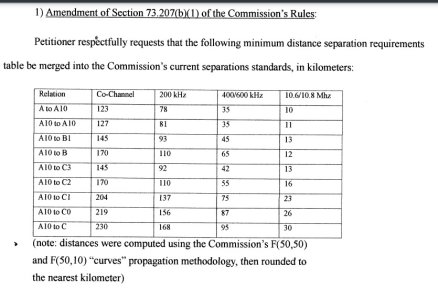
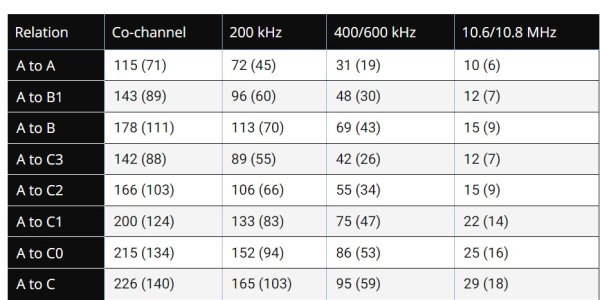
A complete analysis of the proposed Class A10 needs to be done to see if the separations are acceptable under current interference rules.

Again, some changes may be good, but this needs to apply more generally. The NAB and Big Group Owners will squawk anyway. "Let's give them something to squawk about" that's more general. Big stations and large group owners eventually see benefits themselves, like they did with Part 73.215, now one of the most popular rules for stations big and small.
 
Last edited:
Going from 6 KW to 10 KW won't increase your distance all that much. On FM you need to multiply your power by 10 to 20 times to go twice as far. A station with higher power in some areas just gets you more cornfields. And that's the kind of place where this new proposed Class A-0 fits best.
 
The 2 dB per 10 degree rule for FM station DAs should be revised or eliminated so that nulls in the measured licensed patterns are not unnecessarily deep and wide, and result in phantom shallow nulls in the major lobe. Also, where necessary (though admittedly not usually desirable for the above reasons), the permissible maximum to minimum field ratio should be raised from 15 dB to 20 dB. duTriel, Lundin, and Rackley proposed these in comments in the proceedings for Section 73.215 back in the 1980s, citing international agreements that permit it.
 
Yes, I realize the C3 reference is Zone II.

It could help provide a better signal in some cases though and honestly the public doesn't care about the radio industry enough anyway to really notice. Nor does radio have enough of a long term future at least as we know it where this stuff should really cause that much of a disruption.

There are still spacing requirements and technical rules to follow so if it can't be done then it can't be done. But if it complies and works for some outfits, then let it happen.

The reason for the fear of this I think is because of the unknown based on what we don't know. Problem is that radio's future is already limited and it likely doesn't really matter anyway. I believe this just manages the decline better.

At 43 years old I feel like I am on the younger end of the demographic here. We are part of a bygone era in what we love (radio). A new license category isn't going to upend the industry. If anything this is the compromise in response to the C4 issue.
 
Read the last paragraph. Where they say ''Implementing these proposals will enable stations to better serve the public with more reliable signal for news and emergency weather notifications.'' Absolute hooey. More stations won't result in more news or emergency notifications. It'll lead to more stations running Balance of Nature spots. It'll simply further dilute the funding base for radio. More does not equal better. We learned that from Docket 80-90. If the intent was to have more news, they could do that with the existing stations. As it is now, stations can't afford to provide news or emergency weather outside of EAS.
Preach it, brother!
 
I'm in favor of it. I think it would provide an option for those properties that would otherwise struggle to cover a certain area quite adequate enough but can't upgrade to C3.
So, you're okay with adding more overall band congestion with programming that was relegated to AM?
 
Yes, I am.
And other than some AM broadcasters who shunned FM for decades being given a new place to be, that helps radios future how?

Put it another way: If you spent millions of dollars owning and operating a group of FM stations for years, would you still feel the same about AM broadcasters shoehorning in next to your stations?
 
You might be happy with the upgrade if you owned a fully spaced Class A.. On the other hand, you might be quite displeased if you owned a Class B and a Class A increased power and moved 8 kilometers closer to you on your frequency.
 
Much to the delight of the NAB and Big Broadcasters, many of the Docket 80-90 allotments ended up in the middle of nowhere, and with the First Local Service preference to nearly nonexistent Communities of License. They often couldn't be moved to more populated areas without Petitions to Deny that prevented a lot of potentially useful moves, to areas that could have supported more stations, and not to Communities that already had 10 or more 70 dBu signals covering them, and didn't need more. They got them anyway, because they fit the distance separation requirements. The tiny COLs and Rural Radio Initiative could have had stations of a Class with no more than 1 kW/100 meter facilities, while larger community allotments were not affected nearly as much. Maybe those areas with relatively few allotments could have had full power stations with decent population counts.

But believe me, some of the Communities of License I proposed in studies, fell into that First Local Service nearly nonexistent community category. It amounts to treating the process like a legal "game", following the path of least resistance, rather than just a technical or logical one.
 
Last edited:
Many of the 80-90 allotments were tickets to bankruptcy. However, I found much more valuable channels and got to own some FM's.
 
Last edited:
Status
This thread has been closed due to inactivity. You can create a new thread to discuss this topic.


Back
Top Bottom