• Get involved.
    We want your input!
    Apply for Membership and join the conversations about everything related to broadcasting.

    After we receive your registration, a moderator will review it. After your registration is approved, you will be permitted to post.
    If you use a disposable or false email address, your registration will be rejected.

    After your membership is approved, please take a minute to tell us a little bit about yourself.
    https://www.radiodiscussions.com/forums/introduce-yourself.1088/

    Thanks in advance and have fun!
    RadioDiscussions Administrators

Alpha Media purge reaches Sherman/Denison/far north Dallas suburbs

All this talk about the Sherman/Denison area radio stations, but it should be noted that market was hurting a long time ago.

If you go back in time to the mid-eighties, they had a small number of stations -- on the AM band their was 910 KIKM (live/local top 40), 950 KDSX (Middle of the road music?), and 1500 KTXO (country). On the FM side was 96.7 KZXL/KIKM-FM (country), 101.7 KDSQ (automated top 40 via the TM Stereo Rock format), and 104.9 KLAK (adult contemporary via the Satellite Music Network "Star Station" format; yes, they originally started out on a different frequency).

But the 80-90 drop-ins hit the market hard. The first addition under Docket 80-90 was actually a rimshot of sorts -- 97.7 in Durant, OK moved to 97.5 and upgraded to a 50 kw C2. The owner of KLAK bought it and moved KLAK to that new frequency. 104.9 was sold and became KMKT (originally, this was "Katy Classics", an oldies format). 104.1 came on the air as KWSM (per the M Street Directory, with a "soft AC" format). As I recall, both 104.1 and 104.9 promptly got into financial trouble and ended up as distress sales.

KWSM was indeed initially soft AC “Smooth 104.1,” which is what those original calls derived from. It flipped to classic rock in 1990 and then to SMN’s Kool Gold oldies in ‘92, before going silent in the mid-1990s. It returned after it moved from 104.1A Sherman to 104.1C3 Sanger as standards KXIL. That was short lived (it seemed like it only existed until it could be sold...I don't even remember hearing ads on it). In 1998, Cumulus got it to turn it into a relay of 93.3 (AAA “Zone” relay KXZN, then “Merge” relay KMRR). It then moved to being one of KTCK’s repeaters in May 2001 as KTDK.
All this talk about the Sherman/Denison area radio stations, but it should be noted that market was hurting a long time ago.

If you go back in time to the mid-eighties, they had a small number of stations -- on the AM band their was 910 KIKM (live/local top 40), 950 KDSX (Middle of the road music?), and 1500 KTXO (country). On the FM side was 96.7 KZXL/KIKM-FM (country), 101.7 KDSQ (automated top 40 via the TM Stereo Rock format), and 104.9 KLAK (adult contemporary via the Satellite Music Network "Star Station" format; yes, they originally started out on a different frequency).

But the 80-90 drop-ins hit the market hard. The first addition under Docket 80-90 was actually a rimshot of sorts -- 97.7 in Durant, OK moved to 97.5 and upgraded to a 50 kw C2. The owner of KLAK bought it and moved KLAK to that new frequency. 104.9 was sold and became KMKT (originally, this was "Katy Classics", an oldies format). 104.1 came on the air as KWSM (per the M Street Directory, with a "soft AC" format). As I recall, both 104.1 and 104.9 promptly got into financial trouble and ended up as distress sales. At least one (maybe both) were sold in bankruptcy. AM 910 was turned into a DFW rimshot, while 101.7 struggled after dropping the automated Top 40 format in favor of a really dreadful Top 40 format from Satellite Music Network called "The Heat".

So by the early nineties, the area had too many radio stations and they all seemed to be struggling pretty badly with the exception of 96.7 KIKM(FM) and 97.5 KLAK -- those stations were stable through much of this era. It didn't help that several of the other stations (950, 101.7, 104.1, and 104.9) all ended up in the hands of a thoroughly incompetent operator (ownership on paper was under the Davis Family Trust and Octavian Communications Corp) that ran those stations even further into the ground.

So by the time the upgrades started happening to turn Sherman/Denison area stations into rimshots, the market had really turned into a radio slum of failing and/or badly run stations. The first to get upgraded out of the market were the Davis/Octavian stations, starting with 104.9 and 104.1, with 101.7 eventually following after another ownership change or two. Eventually, 96.7 followed.

It was probably necessary to have at least a couple of those stations move into the DFW market since Sherman/Denison just couldn't support them. That said, that left almost nothing on the FM band serving the Sherman/Denison area -- essentially, the only station that didn't get moved out was 97.5 KLAK. The market did subsequently gain some new service from additional drop-ins (93.1 in Bells, TX, 107.3 in Savoy, TX), plus a couple of move-ins in the form of KMAD-FM in Madill, OK being moved to Whitesboro, TX and KLBC in Durant, OK getting a power upgrade. I'm familiar with some of this because I was involved in one of the second batch of drop-ins, since I was the one who filed the rulemaking petition for the Bells stations, albeit originally on 92.9 -- but I wasn't the one who built it.

But from the discussion in this thread, it doesn't appear that the new set of stations in the Sherman/Denison area is doing all that much better than the batch that were there 35 years ago.
 
I do understand that changes need to be made from time-to-time, but I also see stations being creative and thinking out of the box to keep and even grow their audiences. You seem to fail to recognize that there is still any creativity and innovation at all in this industry.

Understand that most radio owners want what the rest of us want. Maybe that has changed a little since private equity has taken over so many of the large broadcasters, but even Cumulus returned more programming control to local markets after the Dickeys left. Alpha also had live and local talent at all of its clusters, though not necessarily all of its stations, until about three months ago. These decisions weren't made lightly. You may or may not like or agree with The Big A (I disagree with him from time-to-time myself), but his job is to figure out how to make money off of the stations he runs and/or consults. We suit up with the team we have, not necessarily our dream team, and he wears the same colors we wear, even if it doesn't always seem like it. I don't envy his job. He has to figure out how to profit off of a shrinking advertiser base while other mediums, including TV, have become more competitive from a price perspective. He also can't make his stations profitable without listeners. He has to figure all of that out on a smaller budget, and it might well be smaller next year. If he can't figure it out and the industry ends up in a death spiral before he can retire, he swings.

When it comes to creative and innovative thinking in the industry, what's nice about that is that you can access that anytime you want. Most radio stations are streaming, and you have access to them whenever you want. If those stations take off and start making money hand over fist, you can rest assured others will copy them.

All this talk about the Sherman/Denison area radio stations, but it should be noted that market was hurting a long time ago.

This is very true. Few stations ever made money there, and even the ones that did concluded they'd make more as also-rans in DFW. They probably weren't wrong either!

If you go back in time to the mid-eighties, they had a small number of stations -- on the AM band their was 910 KIKM (live/local top 40), 950 KDSX (Middle of the road music?), and 1500 KTXO (country). On the FM side was 96.7 KZXL/KIKM-FM (country), 101.7 KDSQ (automated top 40 via the TM Stereo Rock format), and 104.9 KLAK (adult contemporary via the Satellite Music Network "Star Station" format; yes, they originally started out on a different frequency).

I always remember KDSX as being country (I think it was SMN Real Country, but don't hold me to that), but my memory of that market and its radio stations starts around 1989. By that time, 910 had already become a DFW rimshot as KBLN and became KXEB a year or two later. KLAK was already on 97.5 and was still mostly running satellite programming. KDSQ had picked up The Heat, as you mention later, too.

104.9 was sold and became KMKT (originally, this was "Katy Classics", an oldies format).

I believe it was also Katy Country, like the current KMKT, before throwing in the towel.

104.1 came on the air as KWSM (per the M Street Directory, with a "soft AC" format). As I recall, both 104.1 and 104.9 promptly got into financial trouble and ended up as distress sales. At least one (maybe both) were sold in bankruptcy.

I always remember 104.1 as an SMN classic rock station that later switched to oldies, but, if Chip and the M Street Directory say it ran soft AC before that, I believe it. I believe both ended up silent for quite some time, and at least 104.9 would've lost its license if it had gone silent after 1996.

So by the early nineties, the area had too many radio stations and they all seemed to be struggling pretty badly with the exception of 96.7 KIKM(FM) and 97.5 KLAK -- those stations were stable through much of this era. It didn't help that several of the other stations (950, 101.7, 104.1, and 104.9) all ended up in the hands of a thoroughly incompetent operator (ownership on paper was under the Davis Family Trust and Octavian Communications Corp) that ran those stations even further into the ground.

After The Heat became Hot AC, KDSQ ran a local AC format. I never heard any jocks on it, but I believe it was the first station where I heard Amy Grant's version of Joni Mitchell's "Big Yellow Taxi" in the Summer of '94. "The Music Leader, KDSQ Denison/Sherman!" Can't remember if it was the next year or early in '96 when 101.7 became KDVE "The Dove."

It was probably necessary to have at least a couple of those stations move into the DFW market since Sherman/Denison just couldn't support them.

I'm not entirely sure why the lack of support for the stations in Sherman/Denison. San Angelo is roughly the same size and has always seemed to have done a lot better. It probably goes back to most listening being to DFW stations, but Sherman/Denison and Bryan County in Oklahoma still have businesses that have traditionally used radio. None of them are likely to be able to afford to buy DFW radio. I know it's a small market, but have they just always been able to afford KTEN and KXII?
I'm familiar with some of this because I was involved in one of the second batch of drop-ins, since I was the one who filed the rulemaking petition for the Bells stations, albeit originally on 92.9 -- but I wasn't the one who built it.

You and I talked about that roughly 25 years ago. I seem to remember you were going to run a Hot AC or CHR on the station if you had gotten it. You would've had to automate the bulk of the programming, but you could've afforded a morning personality and done afternoons yourself or something like that.

But from the discussion in this thread, it doesn't appear that the new set of stations in the Sherman/Denison area is doing all that much better than the batch that were there 35 years ago.

You can probably count yourself lucky having dodged that bullet.
 
Cumulus returned more programming control to local markets after the Dickeys left.

Correct, and also cut back on the national programming. But it was based on the idea that improving the ratings would improve revenues. The stations improved the ratings in most markets, but the revenue didn't follow. Shortly after that they went bankrupt. But the Cumulus Dallas cluster is very strong.
You may or may not like or agree with The Big A (I disagree with him from time-to-time myself),

My take here is that Alpha appears to be looking at its stations on a market by market basis. Some are worth spending money, others are not. The decision is based on the revenue potential. The Alpha stations in Missouri have replaced local programming with a syndicated podcast network. At least here, they're sticking with music.

 
Not really, but whatever. You just accept everything that happens and don’t ask any questions why. If Audacy decided to expand KRLD to every single primary and HD subchannel they have in DFW, you’d be the first to make an excuse for that.
Thinking the DOA HD system is a viable defense against an overall 70% decrease in radio TSL is just wishful thinking. Deck chairs...
I do understand that changes need to be made from time-to-time, but I also see stations being creative and thinking out of the box to keep and even grow their audiences. You seem to fail to recognize that there is still any creativity and innovation at all in this industry.
With nearly three quarters of radio listening time lost in the last two decades, where is the money and ROI for such enterprises?
 
I will say there has been substantial growth in the Sherman/Denison area and it's not just Dallas/Fort Worth heading north. Texas Instruments is opening a giant plant. A developer is opening up a substantial development (something like 2,000 housing units) among other things. 30,000 showed up to watch a free concert put on by the city featuring the Beach Boys. The little cities are growing substantially. That may not say too much for radio listening but there is a string sense of identity. The local paper is considered a joke and few read it (sort of like our Gainesville paper being surpassed in subscribers by a town 1/10th of Gainesville's population.

It appears they're looking at lowering operational expenses but listeners won't care and advertisers will continue to advertise. This area seems to be populated by businesses that spend on traditional media (the local paper excluded).
 
By that time, 910 had already become a DFW rimshot as KBLN and became KXEB a year or two later.
Fun fact: KRRV/910 was the ORIGINAL Sherman/Denison move-in. Kind of.
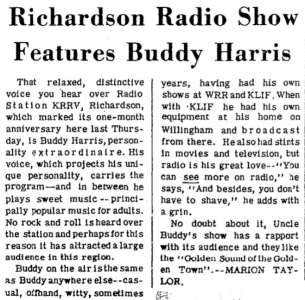
In Dec. 1964, they constructed a secondary studio in Richardson, from which midday host Buddy Harris originated his show. (Remember, at the time Richardson was just another small town on 75 between Dallas and Oklahoma.) The arrangement only last a few years.
In the 70s, as KIKM, 910 served as a training ground for several future DFW personalities, including Terry King, Ken Barnett and Steve Eberhart, who now owns KGAF/Gainesville.
1722137524353.png1722137575975.png
 
Where is the money and ROI for such enterprises?
In the pockets of high level executives and investors. Smaller companies don’t have those and seem to be able to manage the resources they do have more efficiently. In addition, with some companies, there’s quite a bit of wasteful spending. One of the companies I worked tor in the past pretty much let the PD and APD use the company credit card until their hearts were content. This included a $400 mural for one of the walls in one studio and another $50 to $100 for a new trash can for the studio, because the they didn’t like the color of the one they had.

On the other hand, a friends’ stations operate with zero debt, they’re careful with their money and have money left over at the end of the year to invest back into their stations, community and even things such as hosting parties for their loyal advertisers.

The current path most companies seem to be utilizing seems to be leading to a downward spiral, and even with the new forms of digital media that have emerged in the past couple of decades, it doesn’t have to be that way.
 
Fun fact: KRRV/910 was the ORIGINAL Sherman/Denison move-in. Kind of.
In Dec. 1964, they constructed a secondary studio in Richardson, from which midday host Buddy Harris originated his show. (Remember, at the time Richardson was just another small town on 75 between Dallas and Oklahoma.) The arrangement only last a few years.
In the 70s, as KIKM, 910 served as a training ground for several future DFW personalities, including Terry King, Ken Barnett and Steve Eberhart, who now owns KGAF/Gainesville.
View attachment 7395View attachment 7396
"...the 'Golden Sound of the Golden Town." I worked for years in Richardson never knowing it was "the Golden Town!"
 
Fun fact: KRRV/910 was the ORIGINAL Sherman/Denison move-in. Kind of.
In Dec. 1964, they constructed a secondary studio in Richardson, from which midday host Buddy Harris originated his show. (Remember, at the time Richardson was just another small town on 75 between Dallas and Oklahoma.) The arrangement only last a few years.
In the 70s, as KIKM, 910 served as a training ground for several future DFW personalities, including Terry King, Ken Barnett and Steve Eberhart, who now owns KGAF/Gainesville.
KIKM 910 became a preset on many DFW car radios in the mid-1970s when other Top 40/Contemporary AM stations such as KXOL 1360 and WFAA 570 changed formats, and while KFJZ 1270 was losing its way. The 910 signal was actually quite decent into the Metroplex at a time when most cars lacked FM.

My wife grew up in Richardson in the 1960s and well remembers its small town incarnation. Very different place today.
 
In the mid-1970s, I'm not sure how many DFW radios were headed to 910. You had KNUS, Z-97, WFAA, KIKM, KVIL, KLIF, KFJZ, KXOL and KDNT for your Top 40 desires. Do you recall with Z-97 went Top 40 commercial-free? KFJZ had Markie Baby or Mark Stevens. I listened to KIKM quite frequently but I'm in radio and was visiting stations back then looking for a way in. I even listened to Top 40/AC KKAJ with the 'new music mix' in Ardmore and top 40 KMMK FM in McKinney. My favorite format execution was KSEO (Radio 75 and FM 107) in Durant in the mid-1970s.
 
KIKM 910 became a preset on many DFW car radios in the mid-1970s when other Top 40/Contemporary AM stations such as KXOL 1360 and WFAA 570 changed formats, and while KFJZ 1270 was losing its way. The 910 signal was actually quite decent into the Metroplex at a time when most cars lacked FM.
KIKM only showed up once in the DFW ratings: Winter 1982 with a 0.3 share, though I'm sure if you were able to go back and break out just Collin County numbers from the 1970s, it probably pulled some respectable numbers there, just not enough to show up when the entire market was calculated.
 
In the pockets of high level executives and investors. Smaller companies don’t have those and seem to be able to manage the resources they do have more efficiently.

ROI= Return on investment. So yes, by definition, the money goes to investors. Until the company goes bankrupt, at which time the assets go to lenders. Keep in mind that Alpha is a smaller company. It was founded by Larry Wilson. When it went bankrupt, Larry lost everything, and he sued the company.

I think you're talking about single station owners. They're more like a mom & pop. I've worked for both big companies and single station owners. If you work for a mom & pop, it helps to be a member of the owner's family. If not, you're just hired help. Even if you are in the family, as in the case of KKGO's Michael Levine, you're at the whim of the owner. So there can be advantages and disadvantages of large & small owners.
 
Was KFYZ never a player in Sherman/Denison? I almost never see it mentioned and nearly never run into anyone outside of Fannin that remembers anything of it. All I do know, is it billed well and was local in the 80s and 90s right up until it moved outta town in 2006.
 
KFYZ was the local Bonham and Fannin County station. I doubt they tried for areas beyond with listeners and likely advertisers. As I recall, they were full service country in the late 1970s. I don't know what happened to them but they seem to have gone from a cash cow to nothing in a very short period of time.
 
KFYZ was the local Bonham and Fannin County station. I doubt they tried for areas beyond with listeners and likely advertisers. As I recall, they were full service country in the late 1970s. I don't know what happened to them but they seem to have gone from a cash cow to nothing in a very short period of time.
In order for KBOC 98.3 Bridgeport to upgrade to a full C to target D/FW, KFYZ's 98.3 Bonham allocation was moved to 96.1 Bennington OK and is now KZRC "Mix 96.1" and based out of Durant.

With the calls changed to KZRC and the KFYZ calls no longer being used, the KFYZ calls got picked up and used by a couple of stations in Santa Barbara CA for a while and are again no longer in use.
 
I always remember KDSX as being country (I think it was SMN Real Country, but don't hold me to that), but my memory of that market and its radio stations starts around 1989. By that time, 910 had already become a DFW rimshot as KBLN and became KXEB a year or two later. KLAK was already on 97.5 and was still mostly running satellite programming. KDSQ had picked up The Heat, as you mention later, too.

I believe it was also Katy Country, like the current KMKT, before throwing in the towel.
[...]
After The Heat became Hot AC, KDSQ ran a local AC format. I never heard any jocks on it, but I believe it was the first station where I heard Amy Grant's version of Joni Mitchell's "Big Yellow Taxi" in the Summer of '94. "The Music Leader, KDSQ Denison/Sherman!" Can't remember if it was the next year or early in '96 when 101.7 became KDVE "The Dove."
[...]
You and I talked about that roughly 25 years ago. I seem to remember you were going to run a Hot AC or CHR on the station if you had gotten it. You would've had to automate the bulk of the programming, but you could've afforded a morning personality and done afternoons yourself or something like that.

You can probably count yourself lucky having dodged that bullet.
Yeah, I do count myself lucky having dodged that bullet -- I was probably better off with the settlement agreement when all is said and done. Although I'd say that Lake Broadcasting (then owners of KLAK and the folks I settled with on that CP application) ended up fine in the end -- they sold KLAK, KMKT, and KMAD pretty much at the peak of radio station valuations in the late nineties. So I think that they got out when the getting was good.

And although I never have lived in the Sherman/Denison area or anywhere north of Allen, I actually did listen to a couple of these stations. When I first moved to Dallas in 1984, I came down here in a car that only had an AM radio, and 910 KIKM was the only Top 40 station that I could get on that AM radio, so I listened to them quite a bit until they flipped to country in late 1986 (going by memory, so may be off by a couple months). When I moved up to Allen, I was also able to pull in enough of a signal from 101.7 KDSQ to be able to listen to at home -- they carried the TM Stereo Rock automated Top 40 format (although by then I think it had already been sold and merged with Drake-Chenault's XT-40 format) that I had listened to in high school (KNWR Bellingham) and college (KHQ-FM Spokane), so it was kind of like finding an old friend on the radio dial. When they ditched that format in favor of SMN's The Heat, I was disappointed and quit listening -- and apparently I wasn't alone, because it didn't do well.

After they dumped The Heat, I continued listening for a different reason, which is that KDSQ turned into a real train wreck of a station. It wasn't always good, but it was interesting -- this was in the Davis Family Trust/Octavian era, and those folks truly did not know what they were doing. At one point (late 1993 into some portion of 1994, I think) they did an automated format that was sort of a classic hits/Top 40 hybrid, where you could hear anything from "In-A-Gadda-Da-Vida" by Iron Butterfly (the 15+ minute album cut, not the single edit) to "River of Dreams" by Billy Joel. If it were around today, it might be classified as an adult hits "we play what we want" format like Jack or Bob FM, but back then no one knew what the heck it was supposed to be. For radio nerds, it was fascinating, but probably not for anyone else. It ran essentially ad-free for a while before it disappeared in favor of an automated Top 40 format ("Hit music for young adults" is how they actually described it on air). That actually did well enough to get some advertisers back on the station until it got tanked by a combination of transmitter problems forcing operation at drastically reduced power and a tendency to run the two channels out of phase. That combination meant that when car radios mixed the station down to mono because of the weak signal, listeners would lose anything in the center of the stereo image and made it once again unlistenable.

I believe at some point the station briefly went dark before being sold to someone who knew what they were doing. After that, it went to some more normal programming before getting moved out and becoming a Dallas rimshot.

Oh, how I wish I had thought to record some of that and save the airchecks, though.

Anyway...back to the present day now.
 
KDSX AM in the 1974-78 era was News, I think 5:45 to 9, 11:30 to 1 (11:30 includes Paul Harvey in the half hour) and 4 to 6:30. Otherwise it was full service with 5 minutes of news on the hour and half hour with weather at :15 and :45. The AM format was Top 40 with oldies on Sunday afternoon at least (as they played the 15 minute Iron Butterfly "In-A-Gadda-Da-Vida" one Sunday afternoon). KDSX AM was the adult station in Sherman and Denison. I could imagine selling would not be much of an issue back then.

KDSX FM was automated beautiful music simulcasting the news blocks and then 5 minutes of news on the hour and half hour. It too was 24/7 like KDSX AM. I only listened twice and I really doubt the station broke even.

Standard Rates and Data in late 1974 noted decent rates for the AM. If you bought the AM in morning drive, the lunch run or afternoon drive, you could buy an FM spot for 50 cents. From 9 to 11;30am, 1-4pm and after 7pm, for every AM spot you bought, you could add a spot on FM for 25 cents. Otherwise the FM rate was a flat $1.25.

KIKM was top 40 and considered somewhat of a farm team station for Dallas/Fort Worth since so many jumped from KIKM to a Dallas station. If I recall correctly, KIKM's FM was automated country. Per a guy that worked at KIKM, working the AM kept you so busy, changing the reels at the FM and updating weather and such was sometimes missed. From around 1975 forward for several years, maybe close to a decade, KIKM was quite a powerhouse in the area. KIKM had a decent spot load and a guy that worked there said J.C. Penny ran a spot an hour 6am to 7pm.

I don't recall the format of 1500 then but it may have been country. I want to say it was KTXO then.

You could actually hear 750 KSEO clearly in the market. They were a full service Adult Contemporary centered on current hits. I was on the air there one hour in 1978. There was 5 minutes of UPI network news on the hour, 5 minutes of Oklahoma News Network on the half hour, In drive times and weekends, 90 seconds of UPI Sports at :15 and :45. Weather and Lake Texoma Fishing Report at :20 and :40. And I think a PSA or Community Calendar at :50.
 
From around 1975 forward for several years, maybe close to a decade, KIKM was quite a powerhouse in the area. KIKM had a decent spot load and a guy that worked there said J.C. Penny ran a spot an hour 6am to 7pm.
KIKM(AM) was clearly still a powerhouse when I moved to North Texas in 1984, judging by the spot load. But that was near the end of the era for them, and a couple years later the commercial load had dropped dramatically and longer music sweeps were a frequent occurrence. Around the end of 1986, they abandoned the Top 40 format, but it didn't help.
 
I recall being a fan of KFJZ back in the mid-70s. Very well programmed, good talent and a very ample commercial load.

I got my first fulltime on air job in 1978 on the border. By the time I returned to the metro in 1980, KFJZ was still top 40 but the talent sounded more small market and the commercial load barely half what it had been maybe 4 years prior when I was listening to the likes of Mark Stevens (later Stevens & Pruett of KLOL fame in Houston). The former dominant AMs fell and fell quickly to the FM dial. It likely didn't help that KFJZ FM, Z-97, had been top 40 for a few years, launching commercial free for, I think 3 months or so before airing commercials. The first letter to arrive when the first commercial aired with the time and business name won, I think, $10,000 (maybe $25,000...memory if fuzzy). Z-97 made such an impact their competitors even addressed it. I recall the evening jock on KLIF fielding a call from a listener who asked about it. The jock said 'they will have commercials soon enough'.

Radio in general is going the way many AM stations went once FM listening took over.

I'm lucky. The North Texas station I work is insanely popular given there are 50 signals you can get on your radio. We rely on local businesses and they feel they must include us as part of their marketing because the station has just over 1 in 4 in the county listening. I've worked stations where I had to explain the station I worked for when cold calling. I say who I work for or they see my shirt and there's instant respect. Here I walk in a business with my shirt with station logo and about 1/3rd of the time a customer of that business says hello and says they listen. Those shirts are a hell of a sales tool. I am not saying what we are doing here will change radio. The truth is, we are not a normal station. There are not a whole bunch of stations like us.
 
I recall being a fan of KFJZ back in the mid-70s. Very well programmed, good talent and a very ample commercial load.

I got my first fulltime on air job in 1978 on the border. By the time I returned to the metro in 1980, KFJZ was still top 40 but the talent sounded more small market and the commercial load barely half what it had been maybe 4 years prior when I was listening to the likes of Mark Stevens (later Stevens & Pruett of KLOL fame in Houston). The former dominant AMs fell and fell quickly to the FM dial. It likely didn't help that KFJZ FM, Z-97, had been top 40 for a few years, launching commercial free for, I think 3 months or so before airing commercials. The first letter to arrive when the first commercial aired with the time and business name won, I think, $10,000 (maybe $25,000...memory if fuzzy). Z-97 made such an impact their competitors even addressed it. I recall the evening jock on KLIF fielding a call from a listener who asked about it. The jock said 'they will have commercials soon enough'.

Keep in mind that, after 1975, you could not get separate measurements for Dallas and Ft. Worth. AM stations were designed to cover one or the other but not both. Even 50 years ago, only three or four AM's covered both Dallas and Ft. Worth 24 hours-a-day. AM died more quickly in DFW than in most areas for that reason.
 
Status
This thread has been closed due to inactivity. You can create a new thread to discuss this topic.


Back
Top Bottom