• Get involved.
    We want your input!
    Apply for Membership and join the conversations about everything related to broadcasting.

    After we receive your registration, a moderator will review it. After your registration is approved, you will be permitted to post.
    If you use a disposable or false email address, your registration will be rejected.

    After your membership is approved, please take a minute to tell us a little bit about yourself.
    https://www.radiodiscussions.com/forums/introduce-yourself.1088/

    Thanks in advance and have fun!
    RadioDiscussions Administrators

WMVP AM 1000 Transmitter

WCFL's night signal certainly hurt the White Sox between 1952 and 1966 and the Cubs became more popular downstate and in Iowa. Oddly, the White Sox became very popular in Buffalo, NY, 500 miles to the east.

When I was growing up in Boston, WCFL was by far the strongest signal from the Chicago area at night. 720 was overpowered by WOR from NYC and French CKAC Montreal. 670 was toast between WNBC and WNAC/WRKO Boston. 780 was between WABC NY and WEAN Providence and 890 just didn't do well in Boston.
During the 1952 thru 1966 time period the Chicago metro area was still rather sparsely populated in far west and southwest suburbs of Chicago. In that time frame these areas were probably considered as an Exurb. Were WCFL stated to have problems was during the 1968 thru 1993 era that experienced tremendous population growth in Will County (southwest) and Kane County and the western half of Dupage County (west).

In current times, WMVP (Disney) had rebuilt the Downers Grove transmitter site in 2006 with a dog leg array that help to improve coverage to the north/northeast suburban areas but as a result seemed to deepen the null towards the southwest that always existed to protect Oklahoma City and Mexico City at night. There is a WMVP HD2 carried on 100.3 FM which Good Karma leases from Hubbard but not sure how the many people in the Chicago area have access to HD radio. There is always the streaming App which can be accessed on a smart phone and used with Apple Car Play or Android Auto. Good Karma believes that streaming Apps are their future not over the air radio.

The WMVP relocation to the WCPT night site in Joliet appears at least on paper to solve some of the reception issues in southwest DuPage and northern Will counties that are highly populated that were experiencing the deep null with the previous night pattern from the old Downers Grove site. At issue now is what is probably a weaker day and night signal in the far North and Northwest suburbs now that the Joliet diplex site has been active for close to six months now. My guess is that WMVP is still listenable in the far north and northwest area but with increased background noise and probably some selective fading due to the shorter 298 FT towers at the WCPT/WMVP Joliet diplex site.
 
In current times, WMVP (Disney) had rebuilt the Downers Grove transmitter site in 2006 with a dog leg array that help to improve coverage to the north/northeast suburban areas but as a result seemed to deepen the null towards the southwest that always existed to protect Oklahoma City and Mexico City at night.
They were probably forced to do so, because of the FCC's "ratchet clause":

 
Glen Clark who engineered the WMVP 2006 tower rebuild requested a waiver of the ratchet clause as detailed below. It appears it was granted as WMVP was never required to drop their night time power to 40kW at that time.

5.0 Waiver of 47 C.F.R. 73.182(q) Is In The Public Interest

Part 73.182(q), Footnote 1, of FCC Rules requires that AM stations proposing nighttime facility changes must reduce their contribution to the night RSS of selected stations by 10%. This requirement is known informally within the broadcast industry as “the ratchet clause”.

Application of the ratchet clause to the instant application will reduce the number of persons residing within WMVP’s 25 mV/m night contour by more than 220,000 persons. The instant proposal contains 5,914,050 persons within the 25 mV/m night contour. Use of the 25 mV/m contour as a test is valid due to the extremely dense construction in the Chicago area. Application of the ratchet clause would unavoidably
reduce WMVP’s night power to 40.0 kilowatts. The population within the 25 mV/m night contour would fall to 5,682,688 persons.

Further, application of the ratchet clause is in conflict with Part 73.189(b)(2)(iii) of the Rules, which requires that Class A stations erect antenna systems which are more efficient than the antenna required for any other class of AM station. It is contradictory to require the installation of a tall tower to provide high efficiency with one rule and to then limit the power which one can apply to that antenna with another rule.

6.0 Other Alternatives Are Not Available

As with many urban areas with high density development, there are few contiguous land parcels which have not already been converted to strip malls or residential developments. The present site exists as a contiguous parcel only because the radio station has owned the property for more than 60 years. The aerial photograph shows the concentration of development on all sides. An extensive search was made for other
land parcels which could be used for WMVP and which could comply with the ratchet clause. Sites as far away as Joliet were considered. No suitable sites were found which could comply with both FCC and FAA requirements.

7.0 Summary

WMVP believes that a waiver of the “ratchet clause” portion of Part 73.182(q), Footnote

1, is in the public interest and is justified for the following reasons:
1) the proposed tower change was initiated by a desire to increase safety
2) the safety enhancements mandate physical changes
3) WMVP’s Class A status makes shorter towers impossible due to Part 73.189(b)(2)(iii)
4) alternative sites which would comply with 73.182(q) are not available
5) the only alternative is to reduce power to 40 kW, which would reduce service
6) Part 73.182(q) is in conflict with Part 73.189(b)(2)(iii)
 
You must admire what engineers devised in 1937 for the Havana Treaty that was implemented in 1941. Chicago and New York were given adjacent clear channels

2 clear channels WWL New Orleans and WBZ Boston decided to go directional by choice, as to why throw 50KW into the Gulf and Atlantic. WBZ would appear in Chicago an hour before sunset and it was the strongest AM signal in the Loop.

WCFL got the same boost beaming to the east. RKO General owned a station in Windsor, Ontario (CKLW) that had a terrible nighttime signal in Canada but was a blowtorch in the Northeast.

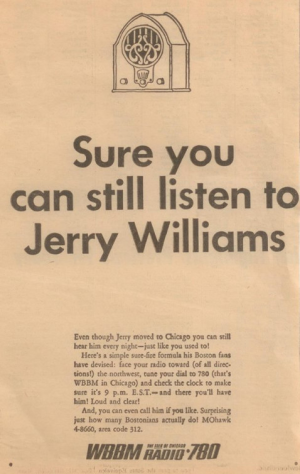
Nighttime AM were a big deal back then - Here is a WBBM-AM ad in the BOSTON GLOBE in 1965

1741862549547.png
 
You must admire what engineers devised in 1937 for the Havana Treaty that was implemented in 1941. Chicago and New York were given adjacent clear channels

2 clear channels WWL New Orleans and WBZ Boston decided to go directional by choice, as to why throw 50KW into the Gulf and Atlantic. WBZ would appear in Chicago an hour before sunset and it was the strongest AM signal in the Loop.

WCFL got the same boost beaming to the east. RKO General owned a station in Windsor, Ontario (CKLW) that had a terrible nighttime signal in Canada but was a blowtorch in the Northeast.

Nighttime AM were a big deal back then - Here is a WBBM-AM ad in the BOSTON GLOBE in 1965

View attachment 8764
Background noise an the AM band in the mid sixties was very low compared to today. All of the "clear channel" stations of that era were easy to pick-up with small transistor radios to listen to. If you happened to have a tube type radio, the noise floor was even lower.

At my location in Chicago today, a constant white noise covers the entire AM band at ground level. With a random length wire 20 to 30 FT up, the white noise is reduced. I'm assuming it has something to do with wireless high speed internet or even cell service in the area.

WBZ was an easy listen back then with Jerry Williams in the evening post 1968, and Larry Glick over nights. WBZ had a large influence on WIND back then with the common Group W ownership. Larry Glick in Boston on WBZ gave us Larry the Legand Johnson and later Chicago Eddie Schwartz on WIND. Jerry Williams in the evening on WBZ gave us Dave Baum and Contact on WIND. Larry Glick Lemonade promo on WBZ gave us the Benson and Russel Lemonade promo on WIND.

Jerry Williams was a true lefty of that era. In todays world, Audacy, iHeart and Cumulus would not have the intestinal fortitude to air a Jerry Williams type host. Of all the legacy radio ownerships of the 60s and 70s, Group W had the most integrity which is something that is severely lacking today.
 
WCFL's night signal certainly hurt the White Sox between 1952 and 1966 and the Cubs became more popular downstate and in Iowa. Oddly, the White Sox became very popular in Buffalo, NY, 500 miles to the east.
But... that was three generations ago. How long do you think the lasting effect of listening to distant AM stations endured among the people in those coverage... or non-coverage... areas?
 
But... that was three generations ago. How long do you think the lasting effect of listening to distant AM stations endured among the people in those coverage... or non-coverage... areas?
@DavidEduardo I think a lasting effect was passed on to the next generation.

The White Sox situation got worse when TV moved to WFLD Channel 32 in 1968, as the signal was compromised by the construction of the John Hancock tower that then caused problems on the SW side as the 32 signal from Marina City was almost unwatchable with ghosting issues.
 
WBZ was an easy listen back then with Jerry Williams in the evening post 1968, and Larry Glick over nights. WBZ had a large influence on WIND back then with the common Group W ownership. Larry Glick in Boston on WBZ gave us Larry the Legand Johnson and later Chicago Eddie Schwartz on WIND. Jerry Williams in the evening on WBZ gave us Dave Baum and Contact on WIND. Larry Glick Lemonade promo on WBZ gave us the Benson and Russel Lemonade promo on WIND.

Jerry Williams was a true lefty of that era. In todays world, Audacy, iHeart and Cumulus would not have the intestinal fortitude to air a Jerry Williams type host. Of all the legacy radio ownerships of the 60s and 70s, Group W had the most integrity which is something that is severely lacking today.

WBZ's signal was astonishing in those days. I remember distinctly that a pizza place on West Devon bought time on Glick because they served 'Boston Pizza'. Suddenly, they had lines out the door, and Glick wound up doing a remote from there.

For whatever reason, Glick became very popular in the Great Lakes region.


I visited WCFL at Marina City one night in May, 1971 as a college friend was doing overnight. I was used to union shops in Boston and New York, but WCFL had three techs working overnight in the studio.
 
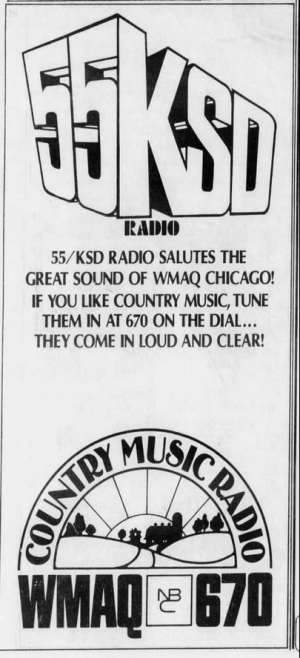
Here's something more nefarious: KSD, an MOR station in St. Louis, paid for newspaper ads promoting WMAQ in the 1970s. Apparently an attempt to cut into the audience of St. Louis country station WIL.

View attachment 8781

Truth in advertising. You can listen to 670 driving by the Gateway Arch. And right by the old KMOX / CBS studio on One Memorial Drive.
 
Here's something more nefarious: KSD, an MOR station in St. Louis, paid for newspaper ads promoting WMAQ in the 1970s. Apparently an attempt to cut into the audience of St. Louis country station WIL.

View attachment 8781
A week before switching to country music, WMAQ (Charlie Warner GM) was doing a salute to all of the major AM's in Chicago for all of their great programing with the message that "WMAQ will soon be one of them" So this was KSD's "back at you" so to speak.
 
A week before switching to country music, WMAQ (Charlie Warner GM) was doing a salute to all of the major AM's in Chicago for all of their great programing with the message that "WMAQ will soon be one of them" So this was KSD's "back at you" so to speak.
Charlie Warner's bio is here: About Me – Charles Warner

He came to Mizzou in 1988. I was in graduate school then, but had very little to do with the Journalism School until the following year and even then I was working mostly with news-editorial faculty. I had no interaction with Warner but knew that he was regarded as a big catch for the broadcast sequence.
 
Charlie Warner's bio is here: About Me – Charles Warner

He came to Mizzou in 1988. I was in graduate school then, but had very little to do with the Journalism School until the following year and even then I was working mostly with news-editorial faculty. I had no interaction with Warner but knew that he was regarded as a big catch for the broadcast sequence.
Charlie passed away a couple years ago. He had great stories to tell about working with Harry Carey, Bill Veeck, Bob Pittman and others in Chicago.
 
Charlie passed away a couple years ago. He had great stories to tell about working with Harry Carey, Bill Veeck, Bob Pittman and others in Chicago.
Thank you. Looking at the years on his CV, I was beginning to wonder if he was still around. Even accounting for a certain amount of self-promotion, he really did accomplish a lot.
 
This is slightly off topic but in the next few days those of us close to downtown Boston will no longer be able to hear WGN-AM at night as WJIB-AM is moving from 740 to 720. With the move WJIB can increase power to 5K non-directional day and 189 watts directional at night to the north and south, nulled west to protect WGN which is a major upgrade from their current 250 watts day. 5 watts at night on 740.
 
On a good night for skip, I'm thinking WGN will just come in and override the meager WJIB 189 watt figure eight pattern signal. In Chicago as an example, WCPT from it's east Joliet night site is directing a 1.5kW pattern towards Chicago. WBAP on many nights just overrides the WCPT night signal beating either head to head and sometimes even stronger than WCPT. The heavily direct 1.5 kW WCPT signal actually does not do to bad for itself on nights were WBAP does not compete with it. The WJIB 189 watt figure eight signal is almost a waste of effort. Do they even make a profit with the music format. Seems to be similar to METV FM.
 
Do they even make a profit with the music format. Seems to be similar to METV FM.
It's been listener sustained for many, many years. In fact, it brought in enough to add additional facilities extending up to Maine.
 
On a good night for skip, I'm thinking WGN will just come in and override the meager WJIB 189 watt figure eight pattern signal. In Chicago as an example, WCPT from it's east Joliet night site is directing a 1.5kW pattern towards Chicago. WBAP on many nights just overrides the WCPT night signal beating either head to head and sometimes even stronger than WCPT. The heavily direct 1.5 kW WCPT signal actually does not do to bad for itself on nights were WBAP does not compete with it. The WJIB 189 watt figure eight signal is almost a waste of effort. Do they even make a profit with the music format. Seems to be similar to METV FM.
WGN struggled at night in Boston with WOR New York 710 and CKAC Montreal 730 much stronger.

Today CKAC might be the biggest waste of a clear channel signal at night as they only air Montreal traffic reports in French 24 hours a day. I heard them in Ft Lauderdale a few weeks ago in my rental car.

WJIB is moving to the old WEEI site that was built by CBS ( now Salem-owned WEZE) in 1937.


Back
Top Bottom