• Get involved.
    We want your input!
    Apply for Membership and join the conversations about everything related to broadcasting.

    After we receive your registration, a moderator will review it. After your registration is approved, you will be permitted to post.
    If you use a disposable or false email address, your registration will be rejected.

    After your membership is approved, please take a minute to tell us a little bit about yourself.
    https://www.radiodiscussions.com/forums/introduce-yourself.1088/

    Thanks in advance and have fun!
    RadioDiscussions Administrators

TV Guide editions and online resources

That's a good question! In the conversion chart, the broadcast channels only go up to Channel 57 (WCFE). Channel 63 seems to just pop up from nowhere in the listings. I assume it's some kind of local cable-only operation. (It's not included among the cable networks either.)
Sounds kind of like what TVG did around 2004-2005, when they pulled the channels listed pages entirely from some editions, and you were "just supposed to know" what stations the channel numbers were. How they thought this made TVG easier to use, I've never figured out.

I posed this question in a letter I sent to TVG, and they never replied. A few months later, local editions were gone entirely.

 
The Northern Wisconsin edition was another strange one as it never added WMQF (which signed on in 2003) or WGKI/WFQX (which replaced WKBD on cable in the UP and Hurley, Wisconsin in 1995) to its listings. It also never had WWTV/WWUP despite that station having cable carriage as far west as Florence, Wisconsin (to the point of having a 25-49% NWC in Florence County, Wisconsin in 1993!)
I don't remember an Upper Peninsula edition, but Northern Wisconsin meant exactly that in the 1990s and earlier: The Green Bay and Wausau/Rhinelander markets plus Milwaukee, likely for cable viewers. They listed VHF stations only for Marquette, LaCrosse, Eau Claire, and Madison.
 
I don't remember an Upper Peninsula edition, but Northern Wisconsin meant exactly that in the 1990s and earlier: The Green Bay and Wausau/Rhinelander markets plus Milwaukee, likely for cable viewers. They listed VHF stations only for Marquette, LaCrosse, Eau Claire, and Madison.
There wasn't one. The UP was split between the Northern Wisconsin and Northern Michigan editions. All of the UP got the Northern Wisconsin edition except for Chippewa and Mackinac counties. The Northern Michigan edition's listings were Eastern Time, whereas the Northern Wisconsin edition's listings were Central Time. The Northern Wisconsin edition was circulated in some counties that were on Eastern Time, however, listings for Marquette and WKBD appeared in Central Time, with the ETZ resident having to make the mental note to add an hour to the time listed (a blurb appeared at the top of every other page explaining this).

1741746781669.png

This may seem bizarre, in that Marquette ran on ET, leading to the unusual situation of home edition stations within one time zone (Eastern) having their listings appear an hour earlier than they actually were in Marquette, but short of burdening the whole edition with both times, it was the only feasible way to list these stations. TVG regions often crossed time zones, and listings appeared with the time common to the bulk of the market.
 
I posed this question in a letter I sent to TVG, and they never replied. A few months later, local editions were gone entirely.
I don't recall what I expected to happen but I called and said I was considering cancelling. I was switched to a recording telling me how great TV Guide was now and when I tried to get a person back I was told they were too busy and call back. I sent a snail mail cancelling.

This was after local editions were taken away and even summaries of episodes weren't guaranteed. I saw just "Conclusion" for part 2 of an episode and that marked the conclusion of my subscribing.
 
I don't recall what I expected to happen but I called and said I was considering cancelling. I was switched to a recording telling me how great TV Guide was now and when I tried to get a person back I was told they were too busy and call back. I sent a snail mail cancelling.

This was after local editions were taken away and even summaries of episodes weren't guaranteed. I saw just "Conclusion" for part 2 of an episode and that marked the conclusion of my subscribing.
I have to wonder if, towards the end, they may have been trying to wean people away from the concept of local editions, and thus removed the channels listed page. Again, you were "just supposed to know".

Doesn't make much sense in an edition that has multiple stations on the same channel, using differently designed channel bullets for each.
 
"Join us tonight at 6:52 for the sports report, only on YOUR channel 10!"
Reminds me of generic promos I've heard, sometimes for stations with satellites, that say "on this station".

I just thought, "well, yes, I'd think so, it'd be pretty strange for you to be promoting a show on another station".

And, yes, I realize that nationally syndicated shows do that during breaks, I've heard Sean Hannity say it. It's probably another way of saying "don't touch that dial!".
 
And here's something I found, with an interesting twist:

https://archive.org/details/vintage-tv-guides

This is apparently a complete set of Northern California TVGs from 1965 through 1970. If you don't mind it being a single edition, this is an awesome slice of TVG history. TVG was a very high-quality magazine in those days, with extremely well-written, intelligent articles.

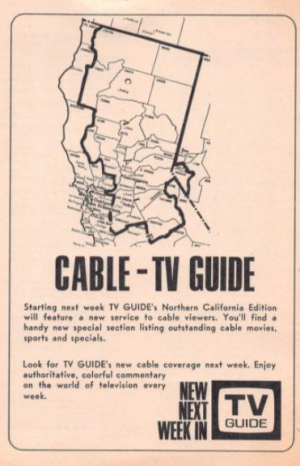
And I mentioned a twist. Beginning in January of 1970, this edition split the Bay Area stations out into a separate "Cable-TV Guide" at the end of the book, listing only "selected non-network" programs, with no "channels listed" section. (Shades of the 2005 TVGs in many areas!) These were not full listings, I don't know what criteria they used. The Bay Area stations were omitted from the main CL section.

1741841040950.png

And here's a copy of the first such "Cable-TV Guide":

https://archive.org/details/vintage-tv-guides/TV Guide 1970-01-17 Northern CA/page/n95/mode/2up

Note that local news was not listed.

Got to wonder how long this arrangement lasted.
 
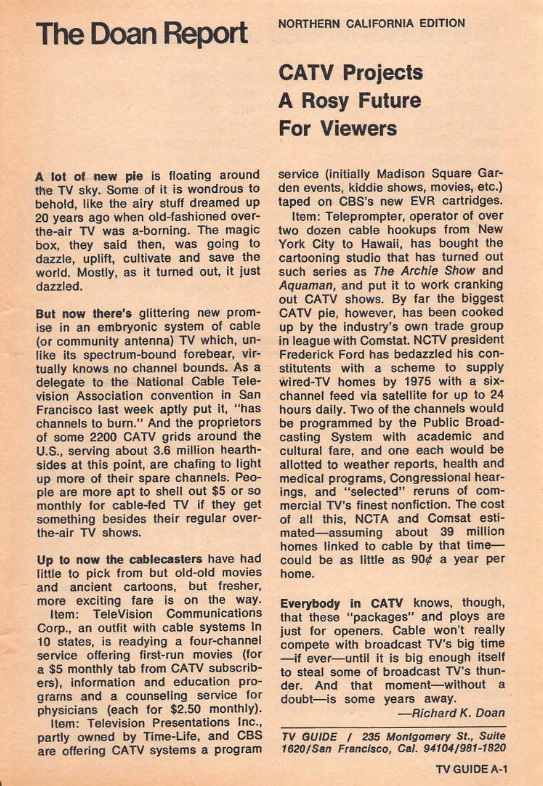
That's a great find! Here's a short but interesting preview of the cable industry from a 1969 TVG:


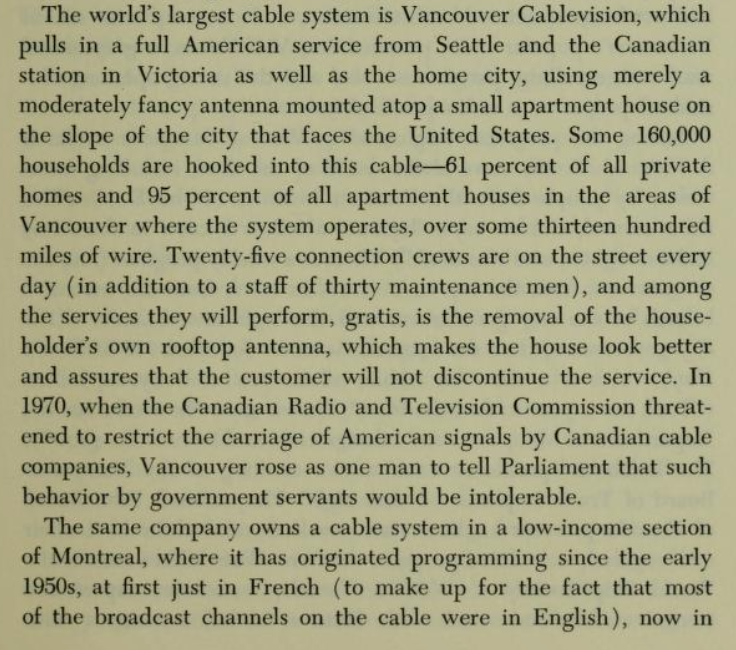
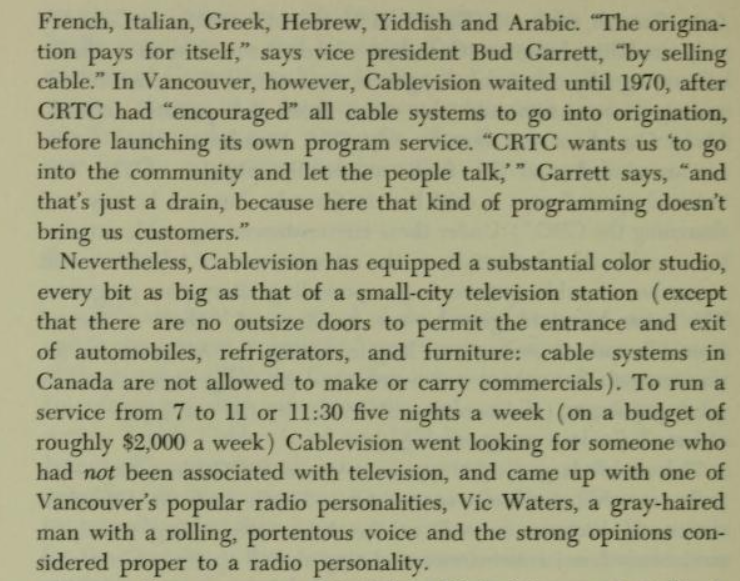
And speaking of the cable industry, here's an excerpt about cable in Canada from Martin Mayer's 1972 book:


Mr Doan doesn't seem to have anticipated satellite delivery of programming to cable systems, not sure if the concept even existed then. Back in the day, cable systems diversified their programming by bringing in distant stations (and especlially much-coveted independents) because that's all there was, and local stations often had widely divergent program lineups aside from network offerings (which were often pre-empted by other programming if the stations had the wherewithal). Things changed fairly quickly in the 1980s and beyond.
 
Mr Doan doesn't seem to have anticipated satellite delivery of programming to cable systems, not sure if the concept even existed then.

He does briefly mention a plan to deliver six channels via satellite, including a 24-hour satellite weather channel (13 years before the launch of the Weather Channel!)
 
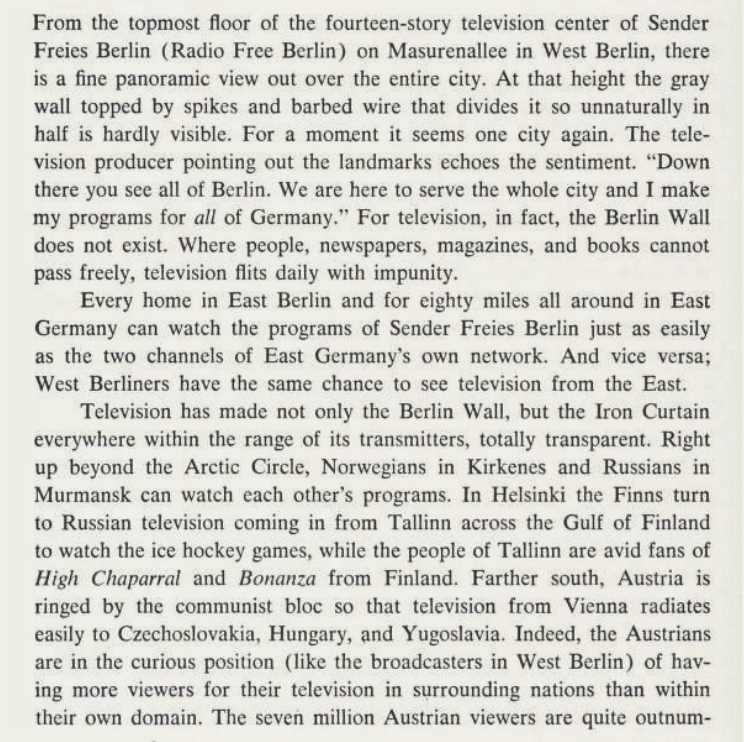
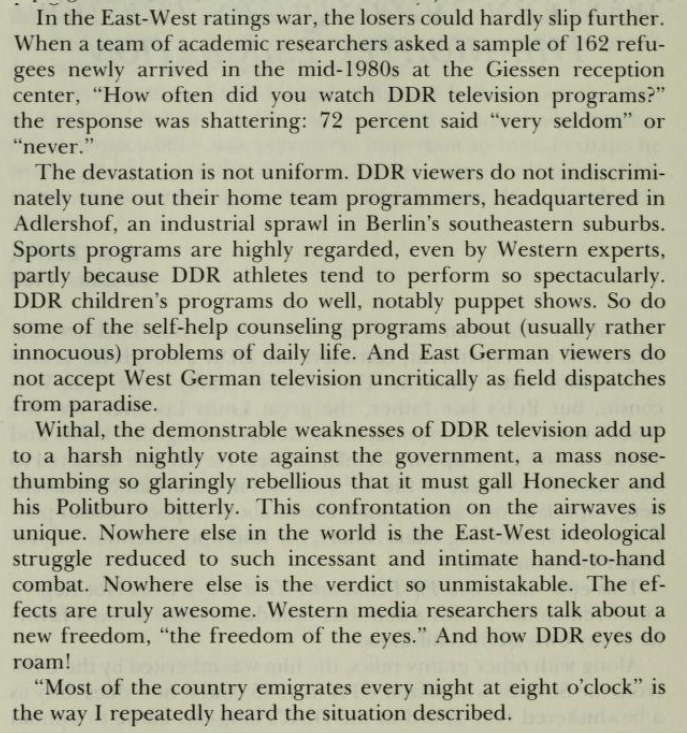
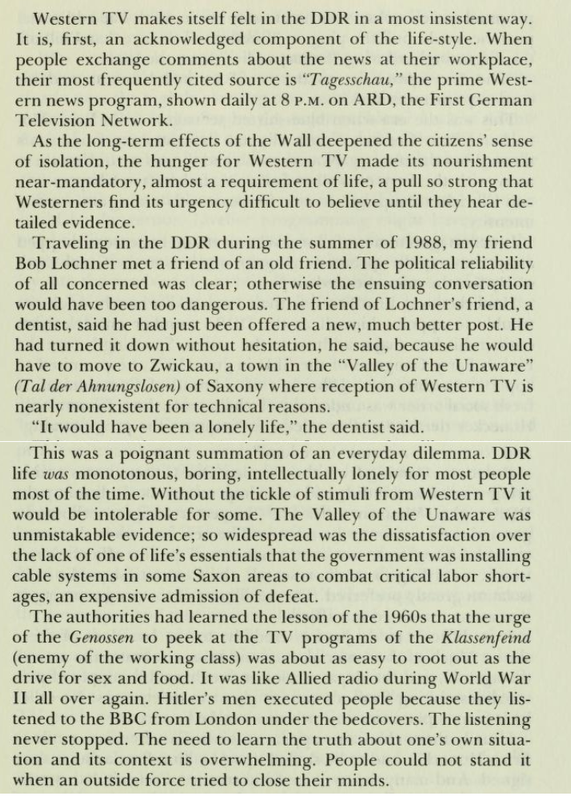
I tend to doubt it. As a rule, TV from the West (don't think there would have been any special provision for AFRTS) could be freely received in all of East Germany except for two parts parts in the far southeast and northeast. Here's more:

Tal der Ahnungslosen - Wikipedia

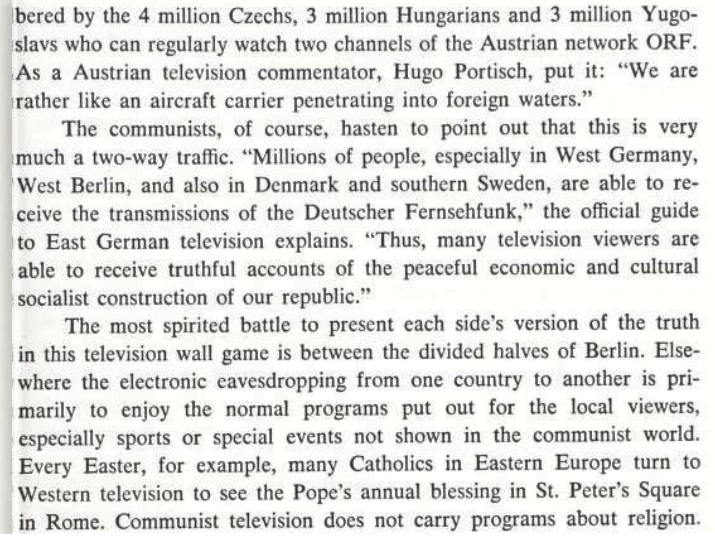
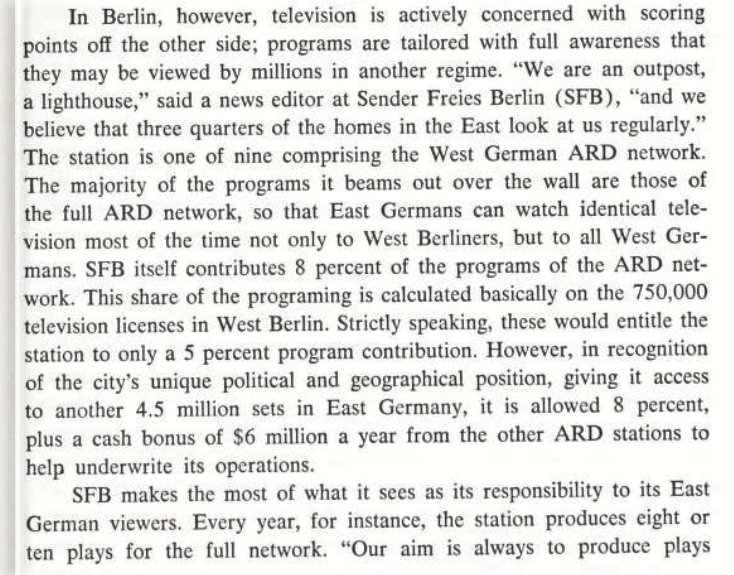
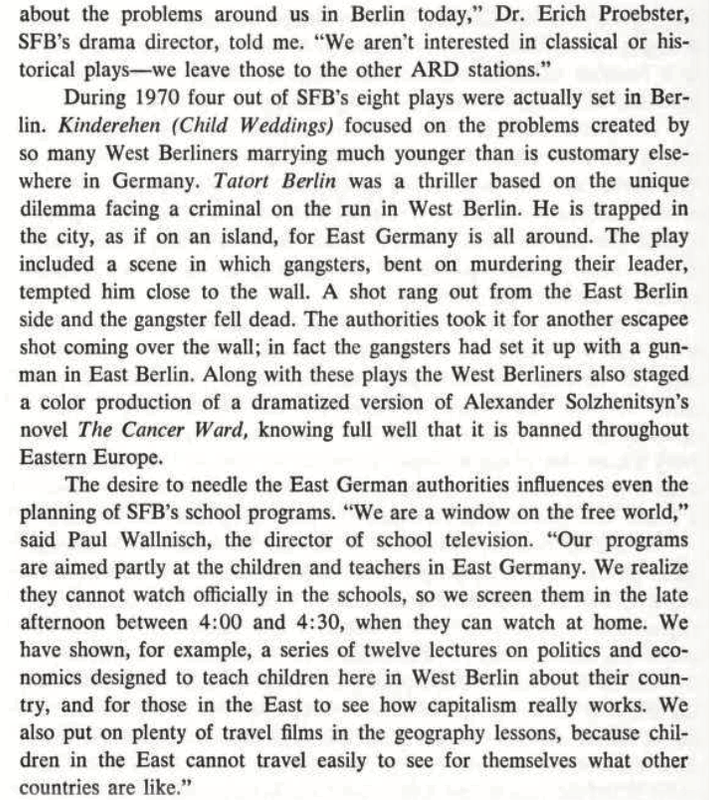
Here's an excerpt about television broadcasting across the Berlin Wall from The Universal Eye, Timothy Green's 1972 book about television around the world:


However, it was against the law for East Germans to watch those foreign broadcasts -- and anything from West Germany was considered "foreign". Decades ago, I read that the East German authorities would look for TV antennas pointed in the wrong direction. They'd also "test" grade school children by having the kids draw a clock face -- and if the kids drew the kind of clock face seen on West German broadcasts, the authorities knew that the parents were illegally watching the western broadcasts.

As a side note, if East Germans watched West German broadcasts (or vice versa) they would only get the broadcasts in B&W. East Germany and all the other Soviet block countries used the French-developed SECAM system for their color broadcasts, whereas West Germany used the West German-developed PAL system. The B&W portion of the broadcasts (along with the audio) were compatible between the two systems, but the color wasn't.

As far as I know, these prohibitions were lifted in the early 1970s. It was still illegal for members of the police and the army to watch Western television, but civilians faced no restrictions as long as they did not repeat "hostile propaganda." In fact, some East German CATV systems before the fall of the Berlin Wall included Western TV, including satellite channels, in their lineups. For anyone who understands German, here's an interesting 1987 report about that from the West German ARD network:


(At the end, the anchor mentions that their crew was prevented from doing any interviews for the report, so things were still far from free.)
 
Last edited:
He does briefly mention a plan to deliver six channels via satellite, including a 24-hour satellite weather channel (13 years before the launch of the Weather Channel!)
You're right, I didn't catch that part. Still, though, the proliferation of free-standing programming sources, such as WTCG/WTBS, USA, CBN, and the other early cable satellite channels, wasn't anticipated. Putting a floundering independent on satellite for nationwide distribution, as Ted Turner did, was a stroke of genius, add to this, that many markets lacked an independent station.
 
As far as I know, these prohibitions were lifted in the early 1970s. It was still illegal for members of the police and the army to watch Western television, but civilians faced no restrictions as long as they did not repeat "hostile propaganda." In fact, some East German CATV systems before the fall of the Berlin Wall included Western TV, including satellite channels, in their lineups. For anyone who understands German, here's an interesting 1987 report about that from the West German ARD network:


(At the end, the anchor mentions that their crew was prevented from doing any interviews for the report, so things were still far from free.)
I had to turn on subtitles even to understand the gist of what she was saying. My German is very basic. Add to that, I was already aware that there was a "dead zone" for West German reception in the south of the DDR around Dresden.
 
By the way, three complete issues of FF Dabei, East Germany's radio and TV guide, have been uploaded to Archive.com:

1970
1979
1989
I didn't know anything like this existed, thanks for passing it on. It is a far more attractive and less "socialist-feeling" (trying to find a word and can't quite reach it) than I expected, in fact, except for the lack of advertising, I'd be hard-pressed to distinguish it from a West German magazine. Obviously they didn't carry West German listings.

I have quite a few TV listings magazines from various countries. I used to get every one I could when I'd travel to Europe, and brought them back with me. They tend to be more similar than different, aside from the language and the programs listed, they're all in the columnar format with every network having its own separate listings.
 
Obviously they didn't carry West German listings.

They only added West German listings a few weeks before the fall of the Wall, after Honecker lost power.

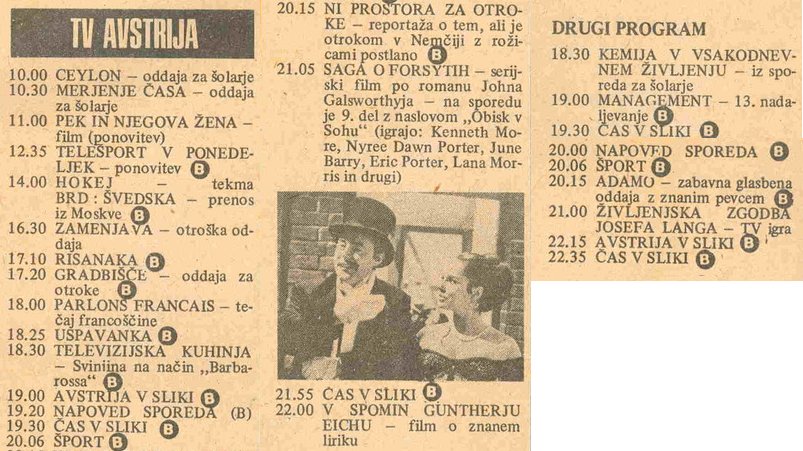
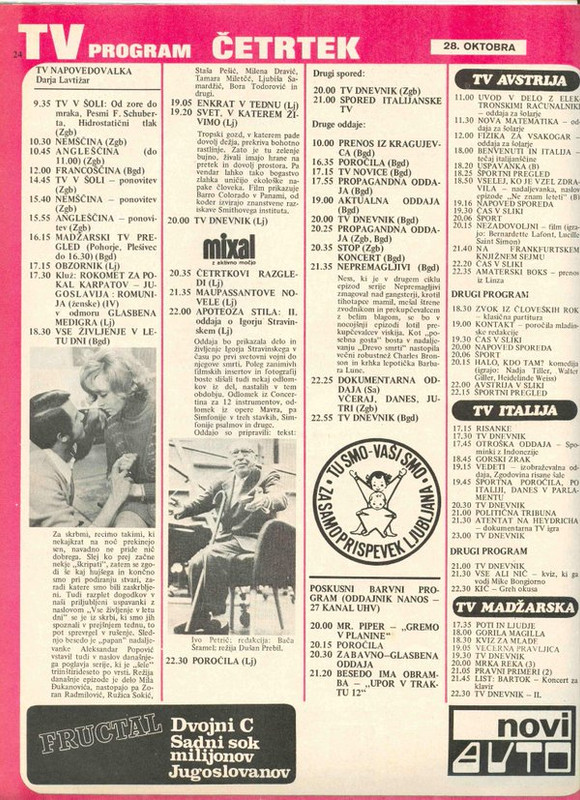
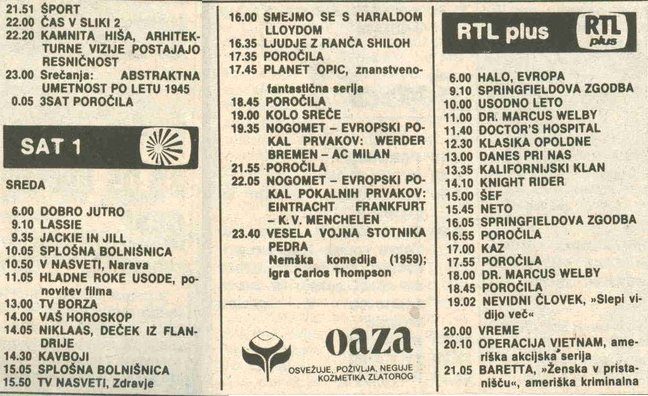
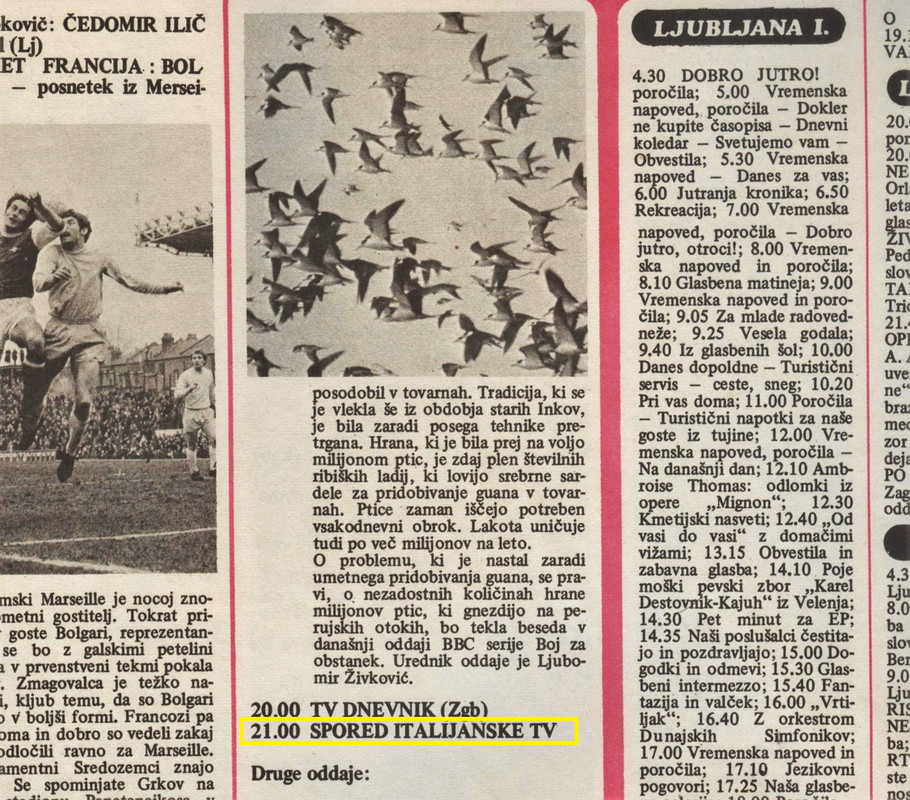
I believe the Hungarian guide did carry Austrian listings. Slovenian publications also carried Austrian and Italian listings, since the republic was Western-oriented and a part of Tito's relatively liberal Yugoslavia. Here are a few examples from the 1970s:


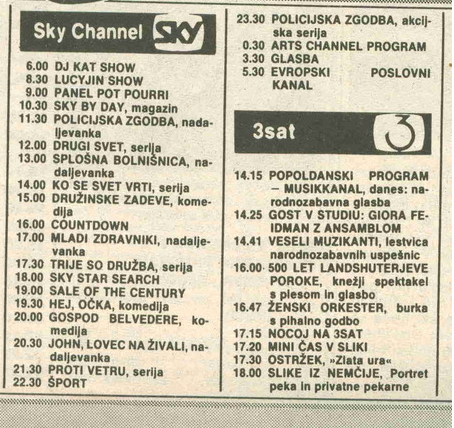
In the mid-to-late-1980s, Western European satellite channels were added to the lineup. Here's a sampler:


In fact, the local TV station in Ljubljana even relayed Italy's RAI on its second service for a few hours a day in the 1970s (after RAI's main evening news, but still!):


Back
Top Bottom