• Get involved.
    We want your input!
    Apply for Membership and join the conversations about everything related to broadcasting.

    After we receive your registration, a moderator will review it. After your registration is approved, you will be permitted to post.
    If you use a disposable or false email address, your registration will be rejected.

    After your membership is approved, please take a minute to tell us a little bit about yourself.
    https://www.radiodiscussions.com/forums/introduce-yourself.1088/

    Thanks in advance and have fun!
    RadioDiscussions Administrators

How was We Built This City considered "bad?"

Now, I’m curious….how did you get it to Quito? Drive to St. Louis and fly it out from there?
Had them shipped to my mother's home in Omena, MI. That avoided IL state sales tax. Then packed them and took them to a forwarder in Traverse City who shipped them by air to Ecuador.
 
The reference to KSD points to another instance of a radio-TV combo where the TV station was successful and the radio station….um, not so much. In KSD’s case, the TV station beat the freeze, enabling it to establish a dominant position for decades; there was no FM; the AM held its own for a couple of decades but ultimately had to contend with the mighty KMOX. in the 1970s, it was adult-contemporary but the desired audience never really materialized.

I just went to the ratings archive at WorldRadioHistory.com. The R&R Summary only goes back to the Spring of 1975 book, but KSD was a solid second until the Fall '76 book, when SLQ edged it out and KSD dropped to third.

Spring '75:
KMOX (Talk): 25.2
KSD (A/C): 11.5
KSLQ (Top 40): 6.1
WIL (Country): 5.8
KXOK (Top 40): 5.3

Fall '75:
KMOX (Talk): 24.5
KSD (A/C): 11.0
KSLQ (Top 40): 5.9
KSHE (AOR): 5.6
KADI (AOR) 5.3

(This----Fall '75---was the most recent book when KFMB hired Scott Burton to be PD)

Spring '76:
KMOX (Talk): 26.4
KSD (A/C): 8.3
KSLQ (Top 40): 8.1
KATZ (Beautiful): 6.1
WIL (Country) 5.9

(KSD didn't have a PD for the Spring '76 book---Tom Straw wasn't hired to replace Scott Burton until May)

Fall '76:
KMOX (Talk): 26.1
KSLQ (Top 40): 8.7
KSD (A/C): 7.7
WIL (Country): 7.0
KXOK (Top 40): 6.2


I mean, nobody was gonna get near KMOX, so I'm not sure how the desired audience never materialized. Second place with those shares was enviable.

Pulitzer didn’t seem too heartbroken when it dealt the station to Combined Communications, which in turn was sucked up by Gannett. It was unfortunate in a way since KSD was well programmed and had good people, but trends were just working against it.

Combined took over in April of 1979... the deal (swapping KTAR AM and KBBC-FM in Phoenix) was proposed in October of 1978.

The most recent book they'd have had at that point would have been Spring '78, and while there was further erosion, it wasn't bad:

Spring '78:
KMOX (Talk): 25.3
KSHE (AOR): 8.0
KSLQ (Top 40): 7.7
KEZK (Beautiful): 7.3
KSD (A/C): 6.7

That was a good book for a standalone AM A/C in 1978. And clearly, Combined saw an upside. They bought KCFM, which had a 1.9 as a Beautiful Music station) and created a solid combo.
 
I worked with plenty of Gates equipment the first 7 or 8 years of my career, which were also spent within a two hours drive from Quincy, Illinois. The first station I worked for full time bought one of the first MW-1A solid-state transmitters. When it was installed, replacing a Sparta tube transmitter, the station got much colder: the AC wasn’t working against the heat generated by the transmitter any more. (The transmitter was literally just steps from the newsroom.)

We also got a Gates slider-pot board in 1980, but, as I recall, it was made by someone else and just had the Gates branding. It wasn’t as durable as the older Gates boards; the interior construction was kind of cheesy, using the same kinds of pots one might have found in a transistor radio. The station had a “Yard” board but it was already out of service by the time I got there.
I have slept since my brief Hannibal/Quincy sojourn, but I remember the board still being rotary (I think Broadcast Electronics, which, like Gates, was in Quincy). I think the automation was Gates, and I don't remember the transmitter. The one advantage, if something broke and wasn't immediately fixable, the factory was across the river.
 
I wonder what meets the criteria for FCC fines? For example, I notice some stations air the line "d*** on you in a theatre" in You Oughta Know by Alanis which seems to be pushing it.
Alanis got mad when that was censored in her performance on an awards show or something on TV, if I', remembering correctly.
 
"Walk on the Wild Side"---generally the Top 40 stations played the 45, which didn't have the phrase. The 45 was 3:37, the album version 4:13, so Top 40 loved that. Most album stations I'm aware of played the album version because...

...again...

The phrase "giving head" does not include any of the words that would immediately get you into trouble and the typical album rock listener was unlikely to be offended and complain to the FCC. Many of those stations, at that time, were also playing Pink Floyd's "Money", which has "bulls**t" in the lyrics, and Steely Dan's "Showbiz Kids", which says "f**k".

A couple of the really gutsy ones played The Rolling Stones' "Starf***er" off the "Goats Head Soup" album, which says the title 64 times.

And if you think there are little old ladies listening to radio stations they don't like just so they can narc on them to the FCC for naughty lyrics, there aren't and weren't, even then.

As for "You Oughta Know", I recall "go down" being in the versions played on CHR. The edit for that song took out "do you think of me when you f**k her?"

And...minor point...it was 30 YEARS AGO, so who really cares?
Wasn't back then AM the main source of music and FM kind of some "hip" niche thing? Anyway, I've listened to the radio since 2004 and haven't heard any kind of F bombs or 7 dirty words...The Church of Lazlo on KRBZ used to tow the line than almost anyone in KC. I think there was some station down in Joplin when I was there a few years that occasionally used the F word, but it was some tiny hole in the wall station 103.5 the Underground (it changed formats but was owned by Mytownmedia), but stations like KSYN and KCAR (Zimmer stations and AMI) were edited like KC stations and almost every town I have visited.
 
Wasn't back then AM the main source of music and FM kind of some "hip" niche thing?

Depends on where you were. I grew up with Los Angeles radio, and by 1972, KLOS (an FM rock station) had beaten KHJ (the AM Top 40). The trend grew throughout the 70s, faster in some places, slower in others.

If you want a really good overview of FM rock radio, Radio & Records produced this special issue in 1978---it really illustrates the changes from the inception of what was then called "freeform" radio in 1967 over the following 11 years, a period in which some of the bigger FM rock stations were showing up as the #1 or #2 stations in the market, and drawing audience away from AM.


Anyway, I've listened to the radio since 2004 and haven't heard any kind of F bombs or 7 dirty words...The Church of Lazlo on KRBZ used to tow the line than almost anyone in KC. I think there was some station down in Joplin when I was there a few years that occasionally used the F word, but it was some tiny hole in the wall station 103.5 the Underground (it changed formats but was owned by Mytownmedia), but stations like KSYN and KCAR (Zimmer stations and AMI) were edited like KC stations and almost every town I have visited.

As I thought I said somewhere in here, there's little to be gained by being edgy anymore (unlike 30 years ago when it was worth paying a fine if Howard Stern got you in trouble because he could also take a station from worst to first), and profit margins are slim to non-existent, so risks aren't really taken.

A lot of stations that used to play the unedited versions play the edits now. Times and business change.
 
I don't know. I would assume so. Four yellow pots for the four cart decks...

What confuses me about that board, and always has, are the buttons and lights on the silver panel above the pots and program/audition switches. I've never seen an explanation as to what those are for and why there are so many.
My guess would be remote starts for equipment with status lights (maybe turntables, or reel to reel decks not in the photo?

A surprising number of stations back then had home-made boards, here's a photo of WBZ circa 1965. Notice anything missing? No VU meters. Apparently the union contracts stated that reading a meter was an engineer's job, so the jocks would just run the pots wide open.
WBZ-Bruce Bradley, mid 60s.jpg

I think the first board that allowed color coding was the Gates Yard that came out around 1960. There were a variety of colored circular aluminum inserts that fit into the indented top of each knob.

You could even buy an extra set of inserts. For some reason, the studio mike had the red insert and was always at the far left.
Most boards I've ever worked with had the control room mic pot at the far left. The one exception was the Gates board at the first station I worked at where the mic pot was in the middle.
As for "You Oughta Know", I recall "go down" being in the versions played on CHR. The edit for that song took out "do you think of me when you f**k her?"
Just barely edited. The edit serviced to radio was pretty much what you typed. Many stations (including the one where I worked back in '95) "refined" the edit somewhat. :ROFLMAO:
 
My guess would be remote starts for equipment with status lights (maybe turntables, or reel to reel decks not in the photo?

A surprising number of stations back then had home-made boards, here's a photo of WBZ circa 1965. Notice anything missing? No VU meters. Apparently the union contracts stated that reading a meter was an engineer's job, so the jocks would just run the pots wide open.
View attachment 9005


Interesting that the union allowed the WBZ jocks to run their own board, cart deck and turntables, but left levels to someone else.


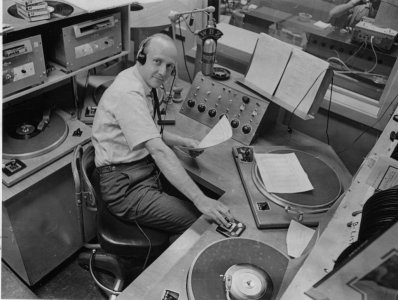
Although this angle doesn't show it, the KHJ air studio (until it was redone as a combo setup in 1977) was just a panel with a mic switch and volume control knobs for the headphones and air monitor:


0048229ARealDonSteeleKHJRadioStationJan261968_10_300dpi_4x6_300dpi_a_p.jpg.jpeg

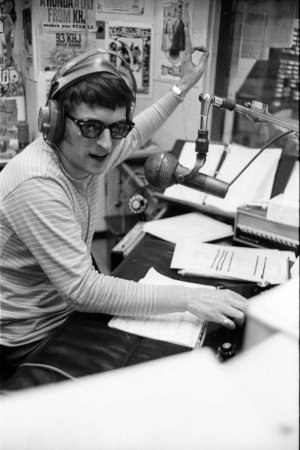
The view from the other side of the glass, where everything else happened:

6a010536b86d36970c0240a4a7f78c200d-600wi.jpeg

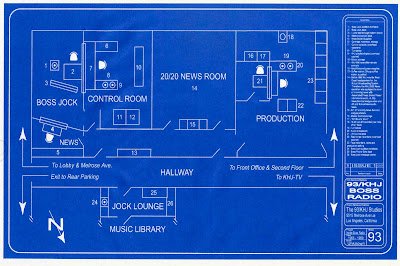
And here's the blueprint showing the layout:

PastedGraphic-2.jpg

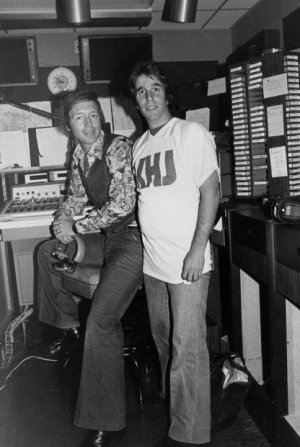
And, just because I mentioned it, the post-1977 studio setup with Henry Winkler visiting Charlie Tuna (the Happy Days soundstage on the Paramount set was a short walk through a gate behind KHJ:

479543454_1110866037746653_8600987141313964162_n.jpg

6a010536b86d36970c01bb082b38cd970d-580wi.jpg

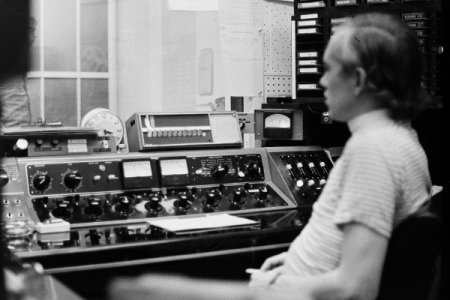
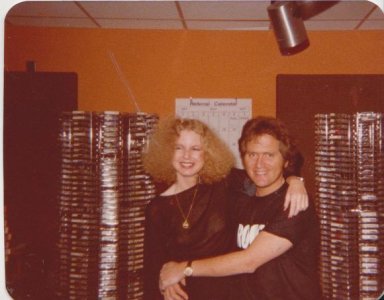
Finally, a shot looking the other way in the combo air studio (pictured are Bobby Ocean and Shaune McNamara, KHJ Music Director)
 
I just went to the ratings archive at WorldRadioHistory.com. The R&R Summary only goes back to the Spring of 1975 book, but KSD was a solid second until the Fall '76 book, when SLQ edged it out and KSD dropped to third.
I don’t have many memories of KSD for the first half of the 1970s…and I didn’t live in the St. Louis area until 1972, anyway. KSD wasn’t a station that was going to appeal to a 15-year-old. Neither was KMOX, but we all listened on snow days for school cancellations. KSD didn’t have that reputation, and the school districts all told people to listen to KMOX or KXOK for that information.

KRCH became KSLQ in the fall of 1972 and instantly began draining teen listeners from KXOK and, in my area, KIRL.
Spring '75:
KMOX (Talk): 25.2
KSD (A/C): 11.5
KSLQ (Top 40): 6.1
WIL (Country): 5.8
KXOK (Top 40): 5.3

Fall '75:
KMOX (Talk): 24.5
KSD (A/C): 11.0
KSLQ (Top 40): 5.9
KSHE (AOR): 5.6
KADI (AOR) 5.3

(This----Fall '75---was the most recent book when KFMB hired Scott Burton to be PD)
KSHE had been steadily growing, so had KADI though a fire crippled its coverage for a while. It was about 1974 when my listening moved, first from KXOK/KIRL to KADI, then to KSHE.

I could have been avant-garde, and had no older siblings from which to take cues, but I think it was around this time that listening really started to reshuffle.
Spring '76:
KMOX (Talk): 26.4
KSD (A/C): 8.3
KSLQ (Top 40): 8.1
KATZ (Beautiful): 6.1
WIL (Country) 5.9

KATZ was never a beautiful-music station…it was *the* black-oriented station in St. Louis until the turn of the decade when KMJM came along, and when the owner of KATZ bought the FM station in Alton, Illinois.
(KSD didn't have a PD for the Spring '76 book---Tom Straw wasn't hired to replace Scott Burton until May)

Fun fact: Tom Straw filled in occasionally on KSD-TV to do weather if Dianne White or one of the Weather Corporation meteorologists weren’t available for Channel 5.
Combined took over in April of 1979... the deal (swapping KTAR AM and KBBC-FM in Phoenix) was proposed in October of 1978.

The most recent book they'd have had at that point would have been Spring '78, and while there was further erosion, it wasn't bad:

Spring '78:
KMOX (Talk): 25.3
KSHE (AOR): 8.0
KSLQ (Top 40): 7.7
KEZK (Beautiful): 7.3
KSD (A/C): 6.7

That was a good book for a standalone AM A/C in 1978. And clearly, Combined saw an upside. They bought KCFM, which had a 1.9 as a Beautiful Music station) and created a solid combo.
Some context. It was later in 1978 when KSD began transitioning to a news/talk format, one day part at a time. The full-service AC format wasn’t bad, not bad at all, but do you think KSD would have started the shift to news/talk if it didn’t have to? Another complication was that Pulitzer was under pressure to exit its St. Louis broadcast operations. Yet another complication was that KMOX’s Bob Hyland had no hesitation to hire away talent from competing stations and then underutilize them, just so that talent wouldn’t be available for the other stations. Meantime, on the FM band, in November of that year, KCFM, which was losing the BM audience to KEZK (which was on the old KDNA frequency), moved to a kind of light-rock format that it called “The Natural Turn-On”. If KCFM had stuck with it, it could have been a precursor to AAA. It was like a progressive-rock approach without the harder rock of KSHE. Maybe it was intended for West County yuppies, but did yuppies exist then? Anyway, Harry Eidelman sold KCFM to Combined about a year later; I think Combined had gotten absorbed into Gannett by the time the sale had closed; KCFM went back to beautiful music; KSD was constantly shifting, news/talk, to all-news, to some news, and so on. Finally it found success as country KUSA. It took time for the combo to get traction, in other words.

And none of *that* chunky paragraph even gets into Doubleday’s entry into the market in 1978, first with the revived KWK and then adding WWWK(FM).

When I’m back home, I can look some things up and be more precise on dates. I also have a complete set of the St. Louis Journalism Review from its founding in 1973 up to about 2010 that I should refer to, since the SJR covered broadcasting in some depth.

 
KATZ was never a beautiful-music station…it was *the* black-oriented station in St. Louis until the turn of the decade when KMJM came along, and when the owner of KATZ bought the FM station in Alton, Illinois.

That was my error entirely---I misread R&R's (B)---which means "Black". My brain went to "Beautiful", which they used (BM) for.

Some context. It was later in 1978 when KSD began transitioning to a news/talk format, one day part at a time. The full-service AC format wasn’t bad, not bad at all, but do you think KSD would have started the shift to news/talk if it didn’t have to?

No, but that's '78, and a lot of AC stations were beginning the transition to more talk elements. Back to KFMB as an example---that's the year they stopped playing music in the evenings and brought in Bill Ballance for a six-hour talk show (6 pm-12midnight). By '79, Mark Larson was doing extended sports segments in afternoon drive---to the point that KFMB-TV sports anchor Ted Leitner got billing---the show was "Larson With Leitner".

From this R&R article, it looks like KSD did the same thing---replacing music with talk at night (October '78), and flipped to News/Talk in October of 1979:


But remember, a few things are at work there---Combined now owns it, and Combined had experience in the format---they had just traded KTAR to get KSD. And they now had an FM they could serve a music audience with.

Also, the numbers had dropped precipitously. That 5th place with a 6.7 in the Spring '78 book was 11th place with a 3.6 in the Spring '79 book.

Utlimately, my point stands---Pulitzer had enviable numbers with KSD as an AC when they owned it. They may have seen the writing on the wall in terms of mid-and-long-range trends for standalone AM music stations, but they weren't alone in that by any means.
 
That was my error entirely---I misread R&R's (B)---which means "Black". My brain went to "Beautiful", which they used (BM) for.


No, but that's '78, and a lot of AC stations were beginning the transition to more talk elements. Back to KFMB as an example---that's the year they stopped playing music in the evenings and brought in Bill Ballance for a six-hour talk show (6 pm-12midnight).

From this R&R article, it looks like KSD did the same thing---replacing music with talk at night (October '78), and flipped to News/Talk in October of 1979:


But remember, a few things are at work there---Combined now owns it, and Combined had experience in the format---they had just traded KTAR to get KSD. And they now had an FM they could serve a music audience with.
The KCFM sale had just closed around that time in 1979. The BM format didn’t last all that long; again, I’ll have to look this up when I get home, but the “KS94” AC format started around 1981, if I’m remembering it correctly.

Also, the numbers had dropped precipitously. That 5th place with a 6.7 in the Spring '78 book was 11th place with a 3.6 in the Spring '79 book.

Utlimately, my point stands---Pulitzer had enviable numbers with KSD as an AC when they owned it. They may have seen the writing on the wall in terms of mid-and-long-range trends for standalone AM music stations, but they weren't alone in that by any means.
I still think there has to be more to the story, since KSD decided to transition format right at the time when they knew that there would be a new owner in some form or another, due to the need to divest the broadcast operations. That’s not normally when a station would be making big changes, I should think.

There was a lot of turmoil at KSD in that period, well documented in contemporary media accounts, even (and especially) in the Post-Dispatch.
 
The KCFM sale had just closed around that time in 1979. The BM format didn’t last all that long; again, I’ll have to look this up when I get home, but the “KS94” AC format started around 1981, if I’m remembering it correctly.


I still think there has to be more to the story, since KSD decided to transition format right at the time when they knew that there would be a new owner in some form or another, due to the need to divest the broadcast operations. That’s not normally when a station would be making big changes, I should think.

There was a lot of turmoil at KSD in that period, well documented in contemporary media accounts, even (and especially) in the Post-Dispatch.

The sale was announced the same month the talk replacing the music at night started. They’d likely been talking with Combined for some time to put together the station swap.

In that scenario, it wouldn’t be unusual for Pulitzer to say “Nighttime music audience numbers are evaporating. We see other stations are trying talk at night. Do you have any objections if we were to go ahead while the FCC approves the sale?”

I can see Combined, which, again, owned KTAR in Phoenix and KSDO in San Diego, as saying “No. We’d be doing that anyway.”
 
Those who saw the show on Hulu have known this for a while, but I am watching "Paradise" on ABC. A teenage boy says his father makes him listen to old 80s and 90s rock and the boy tells his father it is lame. A girl sees him listening to music and wants to know what he is listening to. It is "We Built This City". They both hate it.
 
There is irony in this somewhere.... and this is not a parody video... or is it?

 
Six. One of the 7 hasn't been treated as a dirty word in years.
By whom? The FCC never declared the individual words as prohibited; they just found the broadcast of the Carlin comedy routine to be so.
 
Depends on where you were. I grew up with Los Angeles radio, and by 1972, KLOS (an FM rock station) had beaten KHJ (the AM Top 40). The trend grew throughout the 70s, faster in some places, slower in others.
Another good example was Miami, where Bartell's WMYQ beat both WFUN and WQAM almost instantly in 1972. And then Buzz Bennett came in with Y-100 (and was soon replaced by Bill Tanner) and the market went predominantly FM for music for anyone under about 45.


Back
Top Bottom