• Get involved.
    We want your input!
    Apply for Membership and join the conversations about everything related to broadcasting.

    After we receive your registration, a moderator will review it. After your registration is approved, you will be permitted to post.
    If you use a disposable or false email address, your registration will be rejected.

    After your membership is approved, please take a minute to tell us a little bit about yourself.
    https://www.radiodiscussions.com/forums/introduce-yourself.1088/

    Thanks in advance and have fun!
    RadioDiscussions Administrators

AM time-brokered stations powering down

There has been a continuing reduction in time brokered activity.

I have noticed in recent weeks that local Chicago-area station WKTA-1330 has been operating mostly during the day only, going off in the early evening. Previously, they had been on the air (and are licensed for) 24 hours, with a nighttime signal was was too strong for their 110 watts.

Also, WEEF-1430, which shares the same transmitter site as WKTA at Interstate 294 and Dundee Road in Northbrook, has been heard with a much weaker signal both night and day here in NW Chicago, about 10 miles south of the transmitter. Like WKTA, they are licensed for unlimited operation. Their previous power was 1600 watts day and 750 watts night. They sound much weaker both day and night.

Both stations are brokered, with WKTA mostly Russian during the day and WEEF mostly Spanish-language.

It's been a year and a half since WRDZ-1300 in suburban La Grange lost their transmitter site and has been silent.

At about the same time, WSBC-1240 started relaying WCPT-820 programming in unsold time segments, especially in the evening and overnight. WSBC is the survivor of the longtime three-station share arrangement on 1240 with WEDC and WCRW.

As I've observed in the past, I think some brokered broadcast programming is being used to drive traffic to an online stream of ethnic output.
 
Sounds like candidates for permanent silence and license surrender.
 
Broker stations can make money if they keep expenses under control and their customers keep on sending money. It's simple if enough paid programers want on the air after 6PM you stay on. Keeping a station on air 24 hours a day without a paying program to cover costs at night is questionable. Then another factor is the extra expense of an AM direction station.

It is all about how much money you have after expenses.
 
You're right, brokered time stations can make money if there are the people to pay. Typically the programmer wants a certain audience that might be concentrated in a certain area of the metro, so hitting enough geography with your signal just improves the ability to make money. Keeping costs real low is the key. We didn't do this but an engineer at another brokered station was telling me all of that station's programmers operated from their own studio. They had to prepay their show to get a 'key' to unlock the station's on air computer to get the program on the air. This engineer could override the computer in case of a glitch but pretty much the station operated without the need of a human on site, just a contract engineer.

Another station in a major metro a couple of notches below Chicago was a Spanish Language brokered station. The owner had a deal with a ministry to buy sunset to 6am for $15 an hour if he's keep a warm body in the studio. At $15 an hour he could break even at night.

By the way, brokered stations are generally a certain rate per hour. The more hours you buy the less the rate per hour. On a lease one station might say cover all expenses of the operation plus a few thousand a month for the time. Another station takes care of all the costs and charges a lump sum monthly to the client. Both ways are essentially the same

The bad part is you run through clients rather quickly because they don't understand you need more clients than just what it takes to buy the time. I stress to them some clients always cancel so you want more clients than you need so you're not in a panic when a couple of clients cancel. You will always have some hours unsold because of this. I set my rates where we broke even at 50% sell-out.

And if I had an AM with 249 or less watts a night, I'd likely try to sell every hour from the latest monthly sunrise and earliest monthly sunset of the year. Stations can opt to use night power for 249 watts or less. AMs are only required to operate 2/3rds of the time 6am to 6pm Monday through Saturday.
 
Back in 1977 + 1978 when I was working PT @WPTN we had a preacher who bought an hour Sunday afternoons. I had to collect $55 cash and write him a receipt. He was a really nice guy. It started out just him, then a 4 piece band started showing up, couple of weeks later he had a couple singing. Then they had someone to answer the phone taking hymn and prayer requests. The band ( traditional Blue Grass) was actually quite good. He wanted me to let one of his crew run the board. I said you had to have FCC license to control the station. He preached a couple of times about serpents but I saw no snakes in the studio. I never checked the rest of the building.

It was kinda nice to have someone in building. The back half building had poor lighting and could have been a Steven King set. The secretary would not go back there alone. She always got someone to "help" her find stuff.
 
He wanted me to let one of his crew run the board. I said you had to have FCC license to control the station.

Quick thinking on your part. Technically, a board op didn't need an operator license, but whoever was signing the transmitter log had to.

I kinda wonder why the preacher wanted that. It sounds from your description that you didn't have any issues with the program content, so I imagine you were professional in your "producing" the show.
 
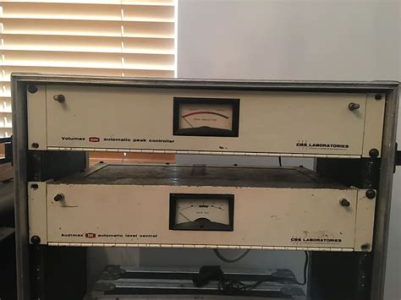
One quirk of the station: they were using a modified Audiomac and Volumemax. The set up worked good but there was a "gate" on the agc where if you did pop a "p or b" in a mic there would be about 2 seconds of 50% volume reduction then it took 3 or 4 seconds to get back up to normal. You could hear it on the air monitor speakers or headphones. One really good thing, if a song went down to around 25% board level the agc would pick up quiet parts of songs and bring them up to almost full volume. Phill Specter would have been proud.
 
One quirk of the station: they were using a modified Audiomac and Volumemax. The set up worked good but there was a "gate" on the agc where if you did pop a "p or b" in a mic there would be about 2 seconds of 50% volume reduction then it took 3 or 4 seconds to get back up to normal. You could hear it on the air monitor speakers or headphones.
Was that why he wanted one of his crew to run the board, did he think it was you doing that?
 
One quirk of the station: they were using a modified Audiomac and Volumemax.
Nitpicking. It's "Audimax" and "Volumax".
The set up worked good but there was a "gate" on the agc where if you did pop a "p or b" in a mic there would be about 2 seconds of 50% volume reduction then it took 3 or 4 seconds to get back up to normal.
This is the famous "zero ohm resistor" where some stations modified the timing by just putting a wire where the standard resistor was. The best results for Top 40 wa by reducing the value by 50% to 75%. I think the resistor was a 10 k, and I used a 2.2 k in mine.
You could hear it on the air monitor speakers or headphones. One really good thing, if a song went down to around 25% board level the agc would pick up quiet parts of songs and bring them up to almost full volume. Phill Specter would have been proud.
That was the effect of the zero ohm resistor syndrome. It essentially removed the gate from the circuit.
 
I imagine this is what you both are remembering:

1746252705072.png
 
Yep. Except for stations with the transmitter and studio at the same location, you'd never see both of them mounted together.

Agreed. The only times I saw this combination in use, the Volumax was at the studio and the Audimax was at the transmitter.
 
I imagine this is what you both are remembering:

View attachment 9118
I imagine this is what you both are remembering:

View attachment 9118
The AM had only the AGC at the studio. Very similar to the above (it's been almost 50 years, wish I took pictures)
They had 94.3 FM then which is now 94.7. The FM had a unit looked a lot like 4440


Both AM and FM used the old "balanced" phone lines to the transmitter.
 
The AM had only the AGC at the studio. Very similar to the above (it's been almost 50 years, wish I took pictures)
They had 94.3 FM then which is now 94.7. The FM had a unit looked a lot like 4440


Both AM and FM used the old "balanced" phone lines to the transmitter.

Yes, that is a later version of the Audimax. But as I said, I remember it the other way around.

Maybe David can remind me of what I am trying to remember.
 
Yes, that is a later version of the Audimax. But as I said, I remember it the other way around.
Audimax was an AGC. It was not a limiter, but it did prevent overloading the STL, whether that was a landline or microwave.
Maybe David can remind me of what I am trying to remember.
Volumax was a limiter and peak limiter. It squashed and also prevented excursions (peaks) that would cause overmodulation. When created, AM was king and the system was designed for monaural AM audio without the 10 kHz limit. So it worked well with monaural FM in the early 60's, too.
 
I kinda wonder why the preacher wanted that. It sounds from your description that you didn't have any issues with the program content, so I imagine you were professional in your "producing" the show.
When I worked Sunday mornings we had several preachers who paid no attention to the clock and I had to literally cut them off almost every week. I shudder to think how long they could have gone if they had controlled the board.
 
Volumax was a limiter and peak limiter. It squashed and also prevented excursions (peaks) that would cause overmodulation. When created, AM was king and the system was designed for monaural AM audio without the 10 kHz limit. So it worked well with monaural FM in the early 60's, too.
Unfortunately, no. Even mono FM uses 75us pre-emphasis, which an AM Volumax had no “awareness” of. It would make a terrible peak limiter for any FM. It was the pre-emphasis control section they added that made the FM Volumax what it was, and it was pretty OK right up until the Optimod 8000 seriously kicked its butt.
 
Broker stations can make money if they keep expenses under control and their customers keep on sending money. It's simple if enough paid programers want on the air after 6PM you stay on. Keeping a station on air 24 hours a day without a paying program to cover costs at night is questionable. Then another factor is the extra expense of an AM direction station.

It is all about how much money you have after expenses.
That last statement tends to hold true for all stations, regardless of class or format.
 
Status
This thread has been closed due to inactivity. You can create a new thread to discuss this topic.


Back
Top Bottom