• Get involved.
    We want your input!
    Apply for Membership and join the conversations about everything related to broadcasting.

    After we receive your registration, a moderator will review it. After your registration is approved, you will be permitted to post.
    If you use a disposable or false email address, your registration will be rejected.

    After your membership is approved, please take a minute to tell us a little bit about yourself.
    https://www.radiodiscussions.com/forums/introduce-yourself.1088/

    Thanks in advance and have fun!
    RadioDiscussions Administrators

TV Guide editions and online resources

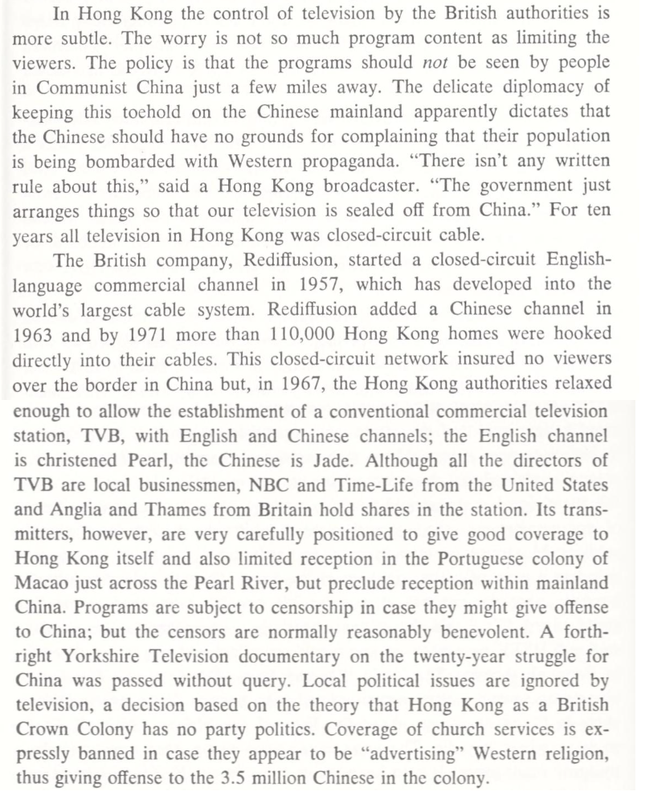
With Iran in the news, here's a look at English-language Iranian TV listings from 1969, a decade before the Islamic Revolution:


Source: John Preddle, Kayhan International, broadwcast.org

NITV refers to National Iranian Television (soon to be replaced by NIRT, National Iranian Radio and Television), while AFTV refers to American Forces Television.

Here are some TV commercials from before the Islamic Revolution, including many very Western-looking ones:


And here's a fragment from an English-language NIRT Channel 5 newscast from before the Islamic Revolution:


The English-language newscasts included reports from American networks:


And here's American radio personality Wolfman Jack greeting his listeners on NIRT's English-language radio service (go to the 8:45 mark if not taken there automatically):
 
With Iran in the news, here's a look at English-language Iranian TV listings from 1969, a decade before the Islamic Revolution:


Source: John Preddle, Kayhan International, broadwcast.org

NITV refers to National Iranian Television (soon to be replaced by NIRT, National Iranian Radio and Television), while AFTV refers to American Forces Television.

Here are some TV commercials from before the Islamic Revolution, including many very Western-looking ones:


And here's a fragment from an English-language NIRT Channel 5 newscast from before the Islamic Revolution:


The English-language newscasts included reports from American networks:


And here's American radio personality Wolfman Jack greeting his listeners on NIRT's English-language radio service (go to the 8:45 mark if not taken there automatically):

I notice here, and on Press TV, that English-speaking reporters and commentators tend to speak American-accented English (or near enough to it). I'm wondering if that is the default accent taught in schools there. That would be kind of strange, you'd think they'd want some distance between themselves and the US.
 
I notice here, and on Press TV, that English-speaking reporters and commentators tend to speak American-accented English (or near enough to it). I'm wondering if that is the default accent taught in schools there. That would be kind of strange, you'd think they'd want some distance between themselves and the US.

Before the Islamic Revolution (1979), Iran was a close American ally. Perhaps that legacy lives on in the variety of English that is taught in schools.
 
Before the Islamic Revolution (1979), Iran was a close American ally. Perhaps that legacy lives on in the variety of English that is taught in schools.
That's what I was thinking.

I also have to wonder if Press TV sees American-accented reporters as more relatable to whatever US viewers they might be able to reach via streaming media.
 
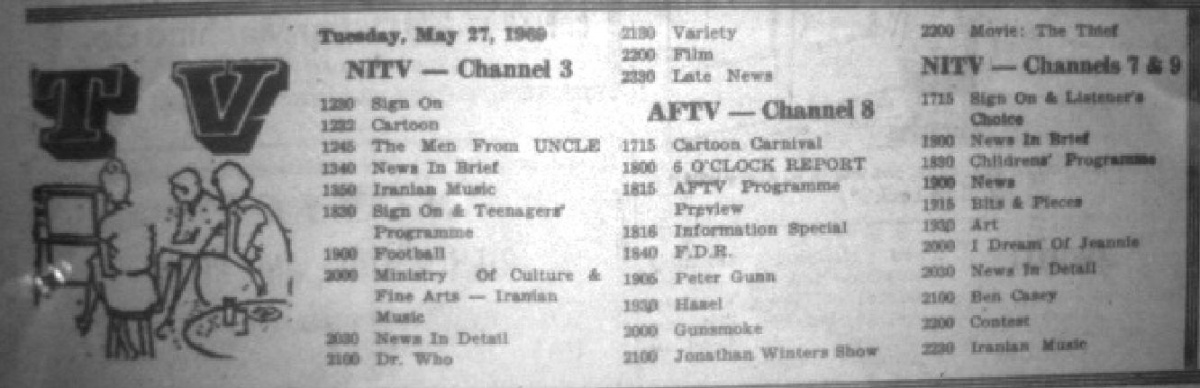
From 1995, the launch day and the day after listings for Slovenia's POP TV, created with the merger of three four local stations and an American-owned company:


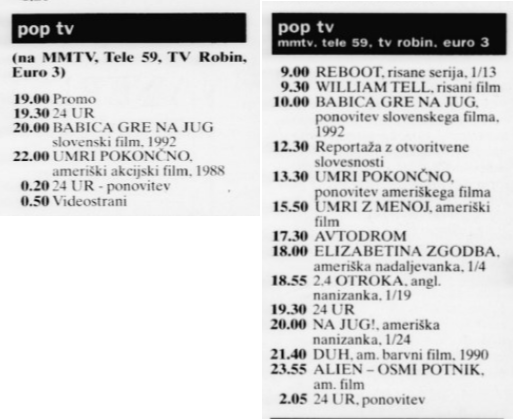
A newspaper ad for the station's 7:30pm news:


And the launch day edition of that newscast (in its entirety):


It would later be expanded to 45 minutes and then an hour.
 
Wish we had English subtitles for those listings, although I got a chuckle of that one movie being titled "Duh".
 
Duh is roughly spirit or ghost in Serbo-Croat, and it is said like the word "do" but add an "h" on the end. Yeah I know Slovenian is different from Serbo-Croat but it be similar

Then that was probably the movie "Ghost" with Patrick Swayze, Demi Moore, Whoopi Goldberg. The year matches.
 
"Osmi" means "eighth" something.

"Ghost" or "spirit' would be duch in Polish, pronounced roughly the same way (the "ch" being kind of aspirated with the "c" almost silent).

The Slavic languages have so many similarities, that if you know one, you can pretty much suss out something in another one. You likely won't get every word right, but you can often figure out the rest from context.
 
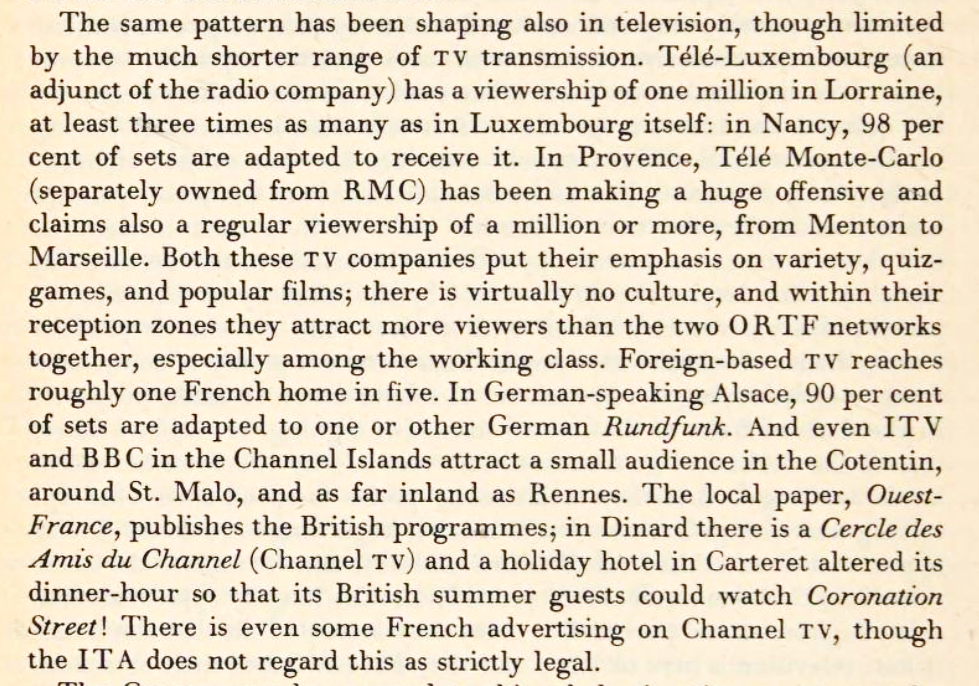
An interesting excerpt about cross-border TV viewing in 1960s France, where ORTF enjoyed a monopoly on broadcasting, from John Ardagh's The New French Revolution: A Social and Economic Survey of France 1945-1967 (1967):


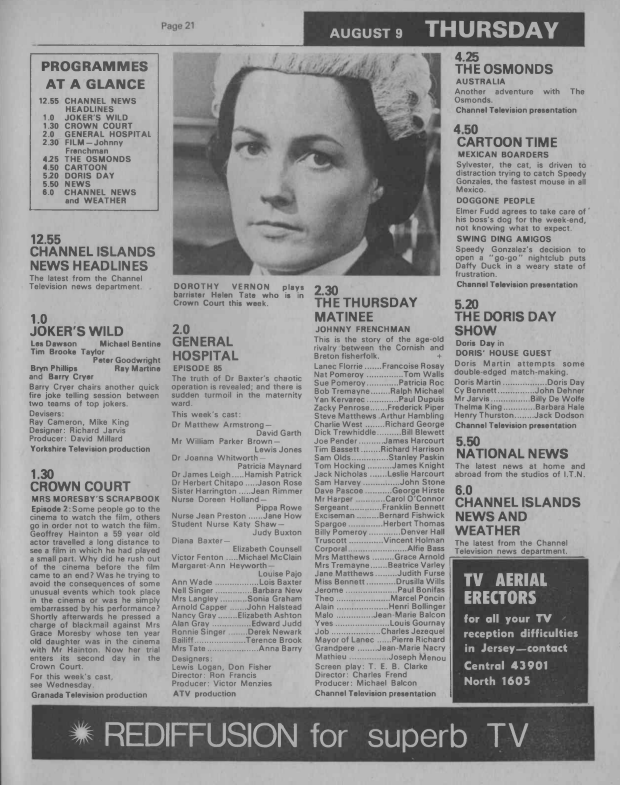
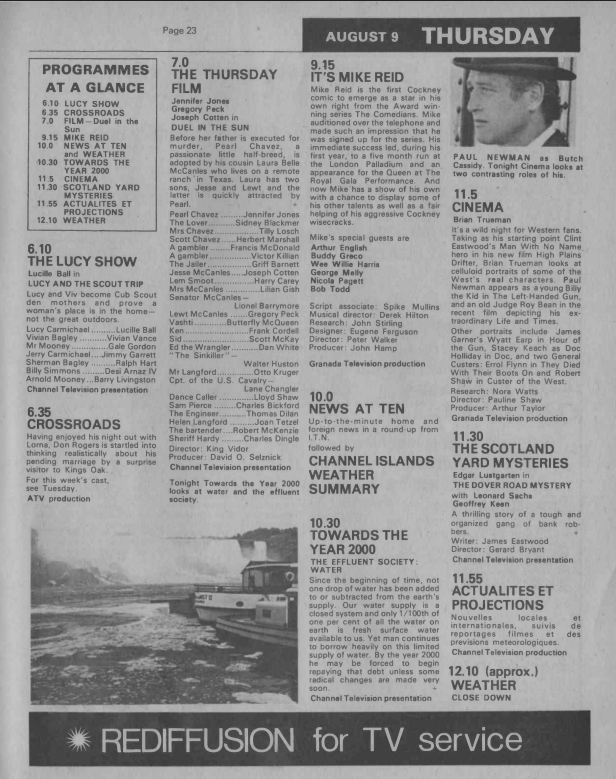
In the excerpt above, the author mentions Channel TV in the Channel Islands, the UK territory just off the coast of Normandy. Here are listings for a typical day in 1973 as printed in Channel TV Times:


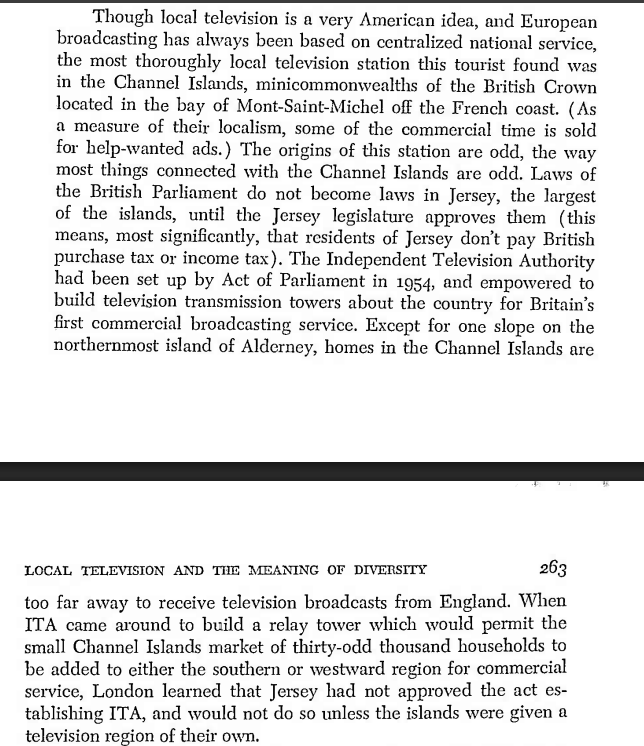
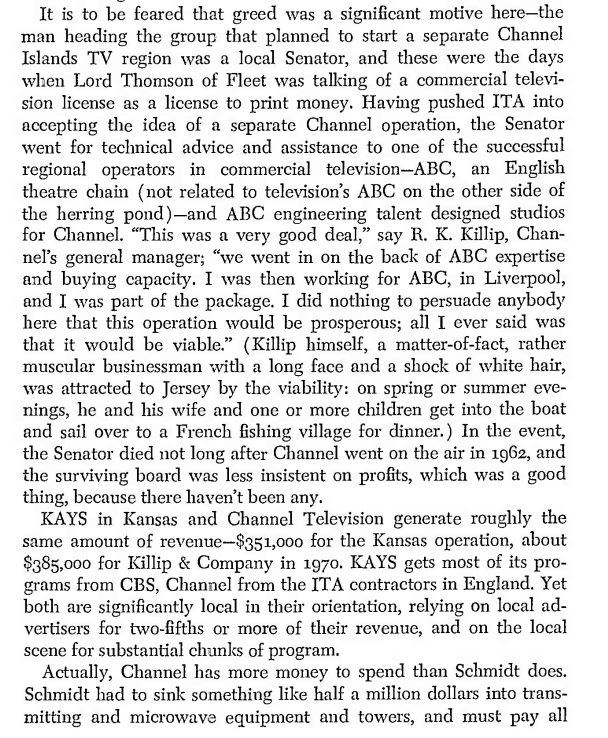
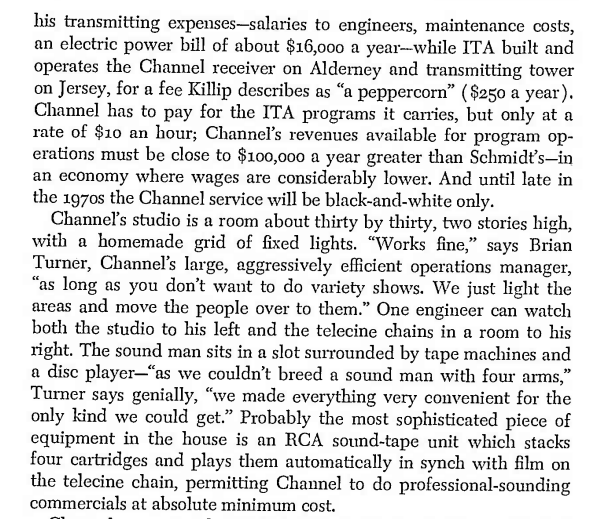
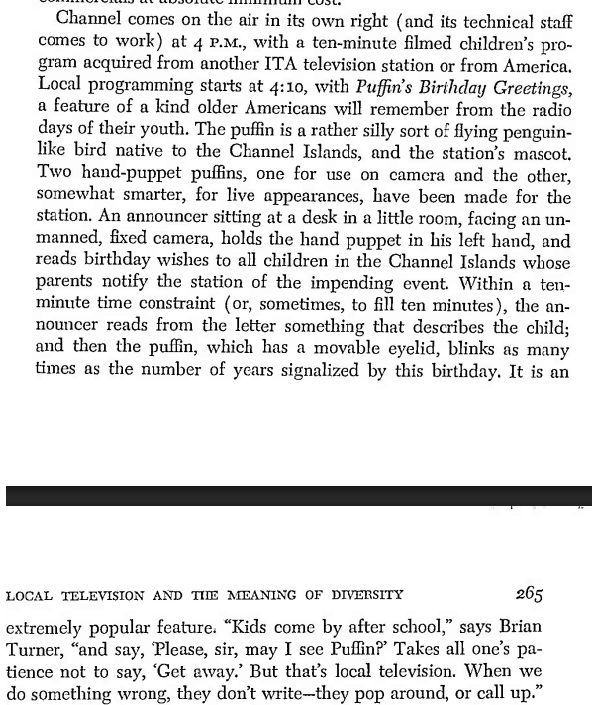
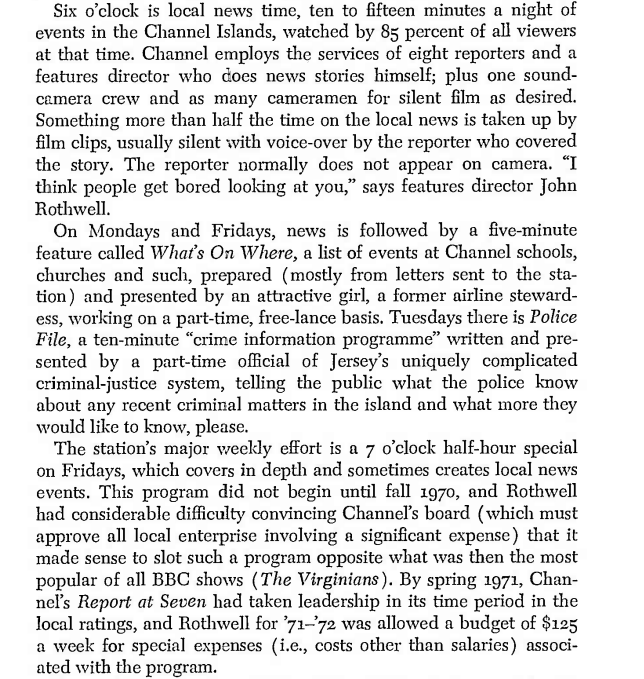
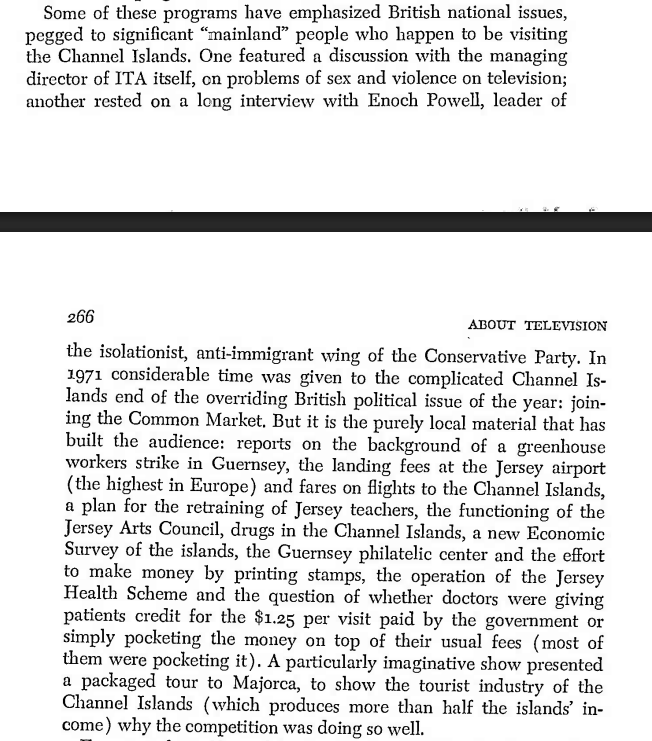
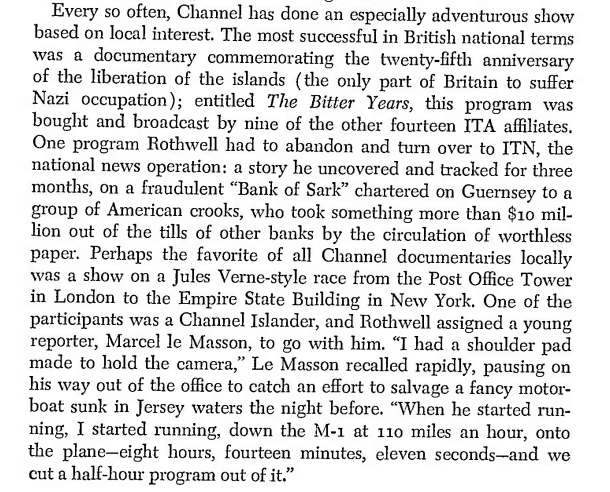
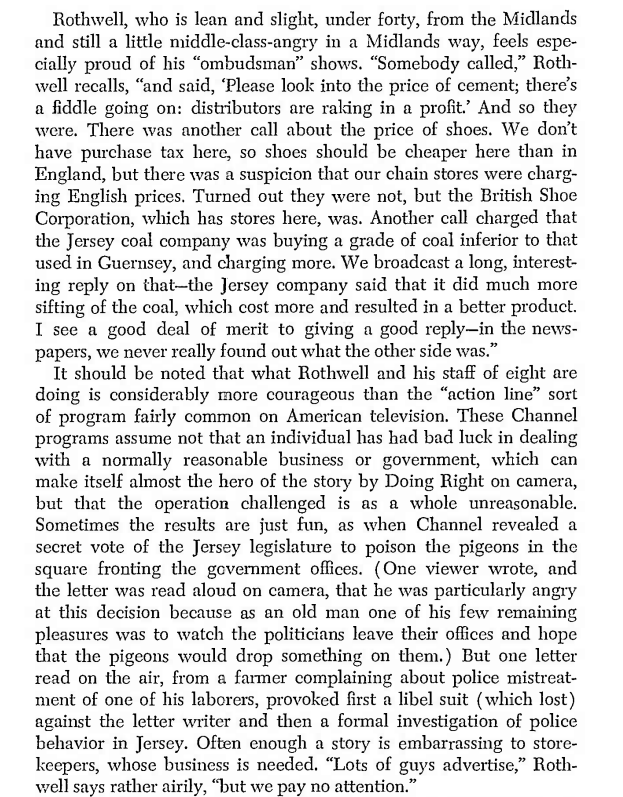
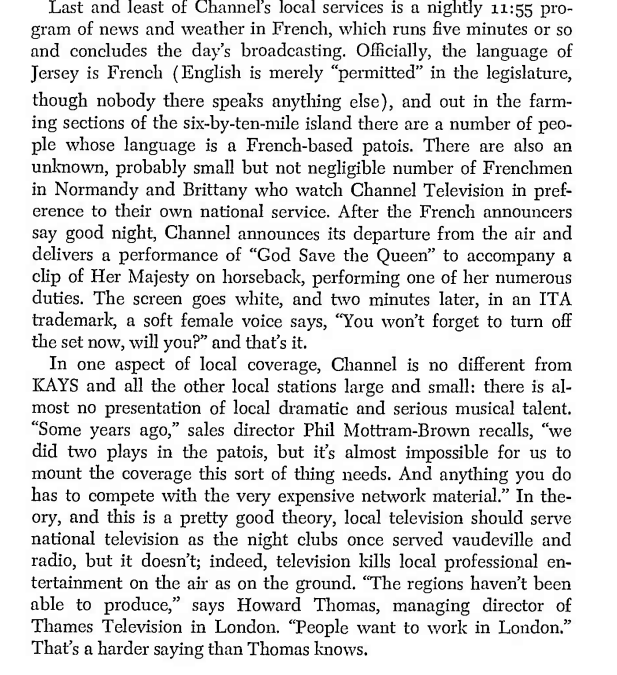
Martin Mayer, whose profile of KAYS in Hays, Kansas, we read upthread, also wrote about Channel TV in his 1972 book About Television:


(cont'd)
 
The Channel TV Times vaguely reminds me of The Newfoundland Herald, though with listings for just one channel instead of the TV Guide-style listings in the Herald.

You could kind of say that the Channel Islands are to France what St-Pierre et Miquelon are to Canada.
 
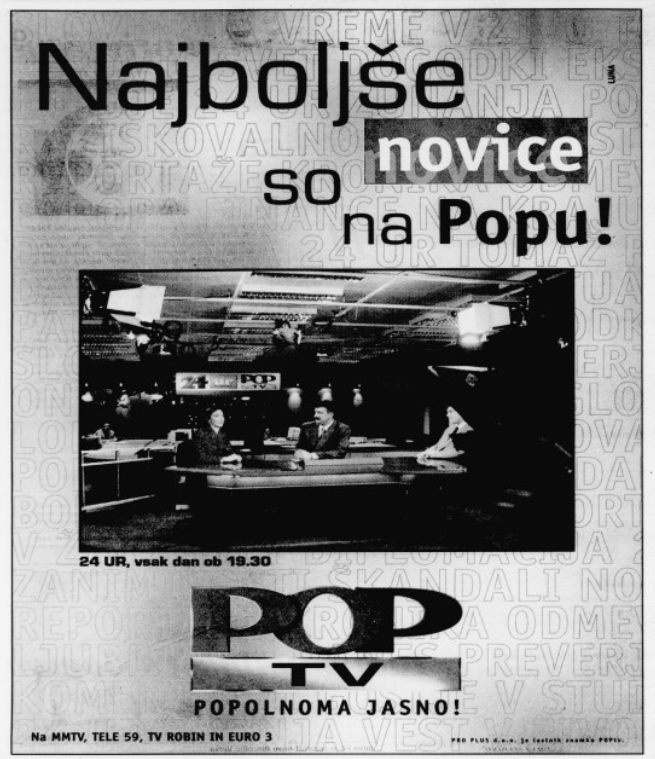
Here's a look at television in a very different British territory, Hong Kong, from Timothy Green's 1972 book The Universal Eye:


And here are some bits and pieces of Hong Kong's English-language television from 1981--you can see a news update at the 5:50 mark:

 
Here's a look at television in a very different British territory, Hong Kong, from Timothy Green's 1972 book The Universal Eye:


And here are some bits and pieces of Hong Kong's English-language television from 1981--you can see a news update at the 5:50 mark:


I wasn't expecting to see the Winston cigarette commercial at 4:04. I'd be interested to know how long cigarette ads continued to air on TV outside the United States, I do know that in 1991 there was a commercial for either Winston or Marlboro on the in-flight entertainment either to or from (don't remember which) Sint Maarten (Dutch West Indies), but of course that is not "television" per se. I didn't see local TV while I was there so I don't know if broadcasters followed suit.
 
The Channel TV Times vaguely reminds me of The Newfoundland Herald, though with listings for just one channel instead of the TV Guide-style listings in the Herald.

You could kind of say that the Channel Islands are to France what St-Pierre et Miquelon are to Canada.

What you're seeing here is one of the localized editions of TV Times, which was the program magazine of all the ITV franchisees.

You had to buy both TV Times from ITV and Radio Times from the BBC to get listings for both commercial and BBC TV. It wasn't until 1991 (!) that listings magazines came out in the UK showing all channels.

Each ITV region had its own edition of TV Times, since programming was so varied among the regional operators.


Back
Top Bottom