With all the doom and gloom being posted about linear TV watching, which OTA network if any, goes away first? ABC, CBS, Fox and NBC use to "dominate" TV viewing. The future is hard to predict

-
Get involved.
We want your input!
Apply for Membership and join the conversations about everything related to broadcasting.
After we receive your registration, a moderator will review it. After your registration is approved, you will be permitted to post.
If you use a disposable or false email address, your registration will be rejected.
After your membership is approved, please take a minute to tell us a little bit about yourself.
https://www.radiodiscussions.com/forums/introduce-yourself.1088/
Thanks in advance and have fun!
RadioDiscussions Administrators
You are using an out of date browser. It may not display this or other websites correctly.
You should upgrade or use an alternative browser.
You should upgrade or use an alternative browser.
Which of the big 4 OTA network goes away fist?
- Thread starter secondchoice
- Start date

With all the doom and gloom being posted about linear TV watching, which OTA network if any, goes away first? ABC, CBS, Fox and NBC use to "dominate" TV viewing. The future is hard to predict
I don't think you can predict that until the first of those four sells their owned stations. Then my money would be on that one.
With all the doom and gloom being posted about linear TV watching, which OTA network if any, goes away first? ABC, CBS, Fox and NBC use to "dominate" TV viewing. The future is hard to predict
I agree with the previous comment. As long as they own stations, they need to program them.
What we're seeing is all four companies are sharing network content with streaming platforms. Network still attracts a big mass audience. Streaming is more convenient. They're just looking to make the finances work.

K.M. Richards
Program Director, The Eighties Channel™
I don't think you can predict that until the first of those four sells their owned stations. Then my money would be on that one.
I agree with the previous comment. As long as they own stations, they need to program them.
What we're seeing is all four companies are sharing network content with streaming platforms. Network still attracts a big mass audience. Streaming is more convenient. They're just looking to make the finances work.
Combing both of your excellent answers, here's my take:
We already have seen the changes over the decades in what products are advertised on broadcast television. If you were to tell someone with no knowledge of the history of the medium that the original big sponsors of early network shows were companies like Texaco, Carnation condensed milk, and Colgate toothpaste, they'd look at you as if you were from another planet.
I just watched the live feed of ABC World News Tonight. Here were the advertisers ...
First break: Attruby, Empower, Opdivo
Second break: HPV vaccination (Merck), J.P. Morgan, Ultomiris, The Farmer's Dog, GoodRX, AFib testing advocacy (Bristol Myers Squibb/Pfizer)
Third break: Vraylar, Lifelock, Biofreeze, Jardiance
Eight out of those 13 are either for name-brand prescription drugs, a pharmacy discount service, or drug manufacturers' urging people to test for conditions which they, naturally, will have the treatment for. A ninth was for an OTC pain reliever. Two more are for investment firms. The remaining two are a home delivery gourmet dog food company and a identity protection service.
It looks to me like the pharmaceutical industry is propping up network television. That's good, of course, as the viewing audience greys out. I see lots of spots during the local ABC7 Eyewitness News for automobiles (mostly SUVs, with some luxury or sportscars) and several local furniture stores, but much of the rest of the breaks are filled with promos for ... Eyewitness News!
Setting aside that it shouldn't be necessary for ABC7 to promote the news during a newscast, where are the mainstream advertisers?
And, more importantly, is there any new category of advertisers which might fill the void as all of the above reduce their buys?
I think that once we see fewer than six pharmaceutical ads per hour on the networks, at least one of them will consider fading to black.

The recent talks of WPLG and WANF removing their affiliations in August made the discussions about which OTA Networks is going away due to their parent companies protecting their streaming apps accelerate the speculation we are in today.
K.M. Richards
Program Director, The Eighties Channel™
Oh, I almost forgot. ABC7 runs lots of spots for several local personal injury law firms.
...much of the rest of the breaks are filled with promos for ... Eyewitness News!
Setting aside that it shouldn't be necessary for ABC7 to promote the news during a newscast,...
That's been going on for decades. I think we were among the first at KTVK in Phoenix, when we went indie and had so many newscasts to promote. Same basic idea as recycling dayparts on radio.
KCRA here in Sacramento does it. Watch the 5 and you'll get (separate) promos for the 6, the 11, the next morning (before the Today show) the next midday and of course, the KCRA mobile app.

Yes I was thinking something like that since Disney owns KABC-TV there would be more promos for movies and shows streaming on Hulu and Disney+ in the same way I see them during NBA season on ABC when the Lakers have a game on ABC.It looks to me like the pharmaceutical industry is propping up network television. That's good, of course, as the viewing audience greys out. I see lots of spots during the local ABC7 Eyewitness News for automobiles (mostly SUVs, with some luxury or sportscars) and several local furniture stores, but much of the rest of the breaks are filled with promos for ... Eyewitness News!
Setting aside that it shouldn't be necessary for ABC7 to promote the news during a newscast, where are the mainstream advertisers?
And, more importantly, is there any new category of advertisers which might fill the void as all of the above reduce their buys?
I don't think any of these networks will go away anytime soon. I don't know anyone who uses those streaming services.
You really should get out more:
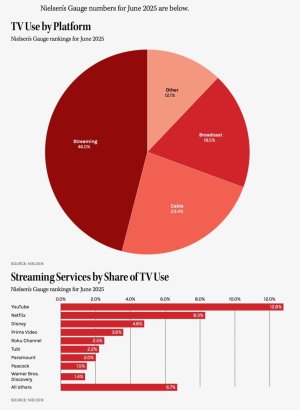

It's important today to look at the source of the content people view, not the medium used to view it.
Start with broadcast and cable, which represent over 40% of "TV" usage. Then take streaming, which is represented significantly by either current network and cable channel or reruns, and you are left with a much smaller percentage of video that is not or never was part of "broadcast TV" or the core companies behind it.
And when you analyze YouTube, for example, how much of the usage of that source entertainment / news / sports and how much is video on how to make wine at home or how to fix Windows after a BSOD?
My point is that the distribution and timeliness have changed, but if you track the content a lot comes back to what used to just be OTA TV and Cable TV.
It's important today to look at the source of the content people view, not the medium used to view it.
Start with broadcast and cable, which represent over 40% of "TV" usage. Then take streaming, which is represented significantly by either current network and cable channel or reruns, and you are left with a much smaller percentage of video that is not or never was part of "broadcast TV" or the core companies behind it.
And when you analyze YouTube, for example, how much of the usage of that source entertainment / news / sports and how much is video on how to make wine at home or how to fix Windows after a BSOD?
Okay, but let's go back to the streaming breakout:
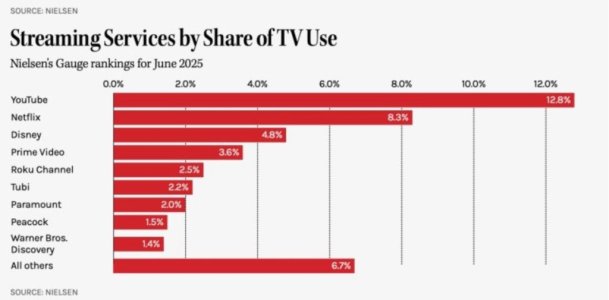
The only streamer where you're going to get the tutorials is YouTube---and yes, you can watch entertainment content there, too. They're 12.8% of the streaming pie. That leaves 81.2% of streaming.
My point is that the distribution and timeliness have changed, but if you track the content a lot comes back to what used to just be OTA TV and Cable TV.
Netflix used to be overwhelmingly TV rerun-driven, when it had Friends and The Office.
Today, its number one show and number seven show (different seasons) in the U.S. is an OTA re-run---the industry term is now "acquired show" (the CW's Sullivan's Crossing), but apart from that, a couple of sports things and a re-purposed pre-school YouTuber (Ms. Rachel), it's all Netflix originals (Squid Game, The Waterfront, The Sandman, Quarterback and a Nate Jackson standup comedy special).
Disney+ doesn't break out a "most popular" list, but it generated a lot of buzz with original series The Mandalorian.
All of the shows labelled "Top 10" on Amazon Prime are originals:
Prime Video: Browse
 www.primevideo.com
The Roku Channel is largely an aggregator, and can be used to access OTA content:
Roku
The Roku Channel is your home for free TV, Roku Originals and premium entertainment. Watch an ever-changing selection of original series, hit movies, TV shows, 24/7 live news (in U.S. and Canada only) and popular kids’ entertainment — all totally free. Choose from thousands of entertainment...
channelstore.roku.com
Tubi is bargain-basement OTA retread-heavy:

Most Popular TV Shows
Watch free most popular tv shows movies and TV shows online in HD on any device. Tubi offers streaming most popular tv shows movies and tv you will love.
While Paramount+ streams a lot of CBS and Paramount linear content, it's also done well with the new entries in the Star Trek franchise and the whole Yellowstone universe. Peacock does the same for NBCUniversal linear content, and has yet to have a Yellowstone-level breakout original.
And then there's WBD/HBO Max. They don't do a Netflix-style Top 10, but they've built the brand (apart from the Discovery channel re-treads, which, as we learned in a recent thread, don't drive eyeballs, and which is why it's "HBO Max" again. It and Apple+ (buried in the "all others") are the ones with the buzz:

Emmy Nominations 2025: ‘Severance’ Leads All Shows With 27 Nods, ‘The Penguin,’ ‘The Studio’ and ‘White Lotus’ Close Behind
See the 2025 Emmy nominations full list. Severance leads the way, followed by The Penguin, The Studio and White Lotus.
 variety.com
The world is changing, both in terms of delivery and content:

Streaming Ratings: ‘The Pitt’ Hits High Mark With Season Finale
‘The White Lotus’ stays at No. 1 the week after its season ends, and ‘Black Mirror’ and ’The Handmaid’s Tale’ make solid returns.
 www.hollywoodreporter.com
The big, hot shows for the season have come and gone (needing to finish their runs for an Emmy deadline) but even in this slow period, if you look at original shows and acquired shows, there are a lot of eyeballs on original streaming entertainment content:

Streaming Ratings: ‘Love Island USA’ Hits High for Second Straight Week
Former NBC series ‘Blindspot’ takes to top overall spot a week after being added to Netflix.
www.hollywoodreporter.com
Last edited:
Sullivan’s Crossing is a CTV show that airs on The CW in the U.S.Today, its number one show and number seven show (different seasons) in the U.S. is an OTA re-run---the industry term is now "acquired show" (the WB's Sullivan's Crossing)
Michael, all good points.
But many of those original content shows are subscription magnets. Subscribers then spend lots of additional time with other content.
The originals, being "first run" rack up high aggregated subscriber numbers. Sort of like bestsellers at the public library, where you may have to wait weeks or months to read a new "bestseller" but can get any Dickens or Longfellow or Kipling title you want instantly.
How many of use "subscribed" to watch The Sopranos but spent most of the time watching other stuff. The new exclusive content will get the highest ratings, but the huge libraries of reruns will never compete as there are so many choices. Similarly, I got Paramount+ for the Taylor Sheridan content, but ended up filling many hours with shows that I had missed, not seen all episodes of or whatever.
But many of those original content shows are subscription magnets. Subscribers then spend lots of additional time with other content.
The originals, being "first run" rack up high aggregated subscriber numbers. Sort of like bestsellers at the public library, where you may have to wait weeks or months to read a new "bestseller" but can get any Dickens or Longfellow or Kipling title you want instantly.
How many of use "subscribed" to watch The Sopranos but spent most of the time watching other stuff. The new exclusive content will get the highest ratings, but the huge libraries of reruns will never compete as there are so many choices. Similarly, I got Paramount+ for the Taylor Sheridan content, but ended up filling many hours with shows that I had missed, not seen all episodes of or whatever.
Sorry---meant the CW (I'm old enough to remember when that was the WB). Fixing.Sullivan’s Crossing is a CTV show that airs on The CW in the U.S.
Michael, all good points.
But many of those original content shows are subscription magnets. Subscribers then spend lots of additional time with other content.
The originals, being "first run" rack up high aggregated subscriber numbers. Sort of like bestsellers at the public library, where you may have to wait weeks or months to read a new "bestseller" but can get any Dickens or Longfellow or Kipling title you want instantly.
How many of use "subscribed" to watch The Sopranos but spent most of the time watching other stuff. The new exclusive content will get the highest ratings, but the huge libraries of reruns will never compete as there are so many choices. Similarly, I got Paramount+ for the Taylor Sheridan content, but ended up filling many hours with shows that I had missed, not seen all episodes of or whatever.
Same at our house. But broadcast TV in 2025 doesn't benefit from my watching L.A. Law reruns on Hulu. And every hour I spend watching streaming content, old or new, is an hour that I don't spend watching broadcast TV.
But my point is that the network that originated most of those shows gets revenue either from subscriptions, ad sales or resale to other aggregators.Same at our house. But broadcast TV in 2025 doesn't benefit from my watching L.A. Law reruns on Hulu. And every hour I spend watching streaming content, old or new, is an hour that I don't spend watching broadcast TV.
K.M. Richards
Program Director, The Eighties Channel™
The people I know use YouTube, but not the others.
Anecdotal evidence is the worst kind to rely on to make a conclusion. It is akin to trying to get a conviction in court based entirely on circumstantial evidence.
Every time I see a phrase that starts with "the people I know" or similar verbiage, I know that I don't just need to take what follows with the proverbial grain of salt, I will likely need the whole damned salt shaker.
Same for "nobody I know" as in the previous post.