• Get involved.
    We want your input!
    Apply for Membership and join the conversations about everything related to broadcasting.

    After we receive your registration, a moderator will review it. After your registration is approved, you will be permitted to post.
    If you use a disposable or false email address, your registration will be rejected.

    After your membership is approved, please take a minute to tell us a little bit about yourself.
    https://www.radiodiscussions.com/forums/introduce-yourself.1088/

    Thanks in advance and have fun!
    RadioDiscussions Administrators

Song you wondered how they they ever got played on Top 40 radio

What is really interesting about "Angie Baby," is that it was written by Alan O'Day before he hit it big himself with "Undercover Angel." According to an interview I heard with Mr. O'Day back in the 1970s, "Angie Baby," was originally titled "Angie's Baby," and was supposed to have been about a girl who became a teenage mother after her boyfriend snuck into her room one night and had sex with her. According to Alan, Helen read the lyrics and told him that she couldn't sing a song like that and demanded that he changed the lyrics to have a different ending. Which he did and the song went to #1 in the U.S.

That's not the story Alan was telling in 2006:

 
It peaked at #23 in its first release (end of 1971 into early 1972) and at #53 in 1974, so how much radio play did this ever actually get? I'm guessing it got at least a little the first time around, but maybe not the second time since there are plenty of songs in the bottom half of the Hot 100 that were pretty much ignored by radio.

Since I'd never heard of it, let alone heard it, I got curious enough to look up the lyrics and to skim through the song on You Tube. Based on that, while I know they were trying to get what they considered an important message across, the way they did it just seems like it was cause listeners to change stations with all those voice overs and the sobbing at the end.

On the other hand...the first half of the seventies was a time when a lot of songs about death made it onto the radio. A couple have been mentioned here, but adding to the list would be Terry Jacks with "Seasons in the Sun" (a huge hit at the time), Austin Roberts with "Rocky", Hot Chocolate with "Emma" (so different from their subsequent hits), and David Geddes with "Run Joey Run" and "The Last Game of the Season". So in that sense, "Once You Understand" wasn't completely out of place for its era.

(As an aside, the last time I heard "Seasons in the Sun" on a commercial radio station was probably in late 1986, when 94.9 had recently flipped to rhythmic-leaning CHR/Top 40 as KHYI, Y-95. They were running jockless and commercial free for their first several months, with aggressive ("Get out of the way, wimp!") and sexually suggestive ("Lock in and jerk your knob off") station liners interspersed between the songs. And somehow amidst all that, on one occasion I heard "Seasons in the Sun", albeit from a single that had obviously seen better days as I could hear the scratches. I never heard it again, and I never have understood exactly what the point of playing it was...)

"Seasons in the Sun," is also an interesting song because of the change in the lyrics of the last verse. The Kingston Trio had released the song in late 1963 as a single (it didn't go anywhere for them) with the following last verse lyrics:

"Goodbye Francois, my trustful wife.
Wighout you I'd have had a lonely life.
You cheated lots of times but then
I forgave you in the end
Though your lover was my friend.

Goodby Francois it's hard to die
When all the birds are in the sky.
Now that spring is in the air
With your lovers everywhere--
Just be carefull I'll be there."

Terry Jacks made it a #1 U.S. record by changing that very bitter last verse to a more positive one.
 
What is really interesting about "Angie Baby," is that it was written by Alan O'Day before he hit it big himself with "Undercover Angel." According to an interview I heard with Mr. O'Day back in the 1970s, "Angie Baby," was originally titled "Angie's Baby," and was supposed to have been about a girl who became a teenage mother after her boyfriend snuck into her room one night and had sex with her. According to Alan, Helen read the lyrics and told him that she couldn't sing a song like that and demanded that he changed the lyrics to have a different ending. Which he did and the song went to #1 in the U.S.

I also thought Helen's career took a weird turn. Her four biggest hits were a feminist anthem about power ("I Am Woman") and three songs about psychologically damaged women "Delta Dawn", "Leave Me Alone (Ruby Red Dress)" and "Angie Baby".

1970s Top 40 was a weird place.
 
Oh Lord, "Once You Understand". Topped the list of worst songs ever in a book I read in the 1990s. I only remember it because my small town local station played. Outside a Casey Kasem rerun, the only other place I've heard it was a 1974 Y-100 Miami aircheck.

That one got a lot of airplay in Phoenix both in 1971 and in 1974. My mother hated it--she didn't like the kids or their parents "mouthing off" at each other, as she called it. With the exception, of the tail end, I thought it was kind of funny. (I was 8 years old when I first heard it and 11 years old the second time around.)
 
I don't think anyone has mentioned Jan Ian's controversial interracial dating tune from 1967, entitled "Society's Child."

Then there was Stories' "Brother Louie" which came out in 1973, and I don't remember there being any controversy by that time. Although the song it its original form (by Hot Chocolate) was a bit more controversial... it was a hit in the UK, but Stories had the US hit.

The reason that the Hot Chocolate version of "Brother Louie," never got played in the U.S. (apart from a station in Buffalo, NY) was that their version of the song (which was the original, by the way) included acted-out scenes of parents telling their kids to stay from people of the other race, and Hot Chocolate's record company didn't believe that would fly in the U.S., especially in the South.
 
Just L.A. or other parts of the country? Any midwest towns or anything you know of?

While I never heard ads for "Deep Throat," in Phoenix (where I was living in 1973) or Tucson (where I was going to school at the time), I certainly heard ads for X-rated theaters and movies in both cities. And there is an aircheck from WXLW in Indianapolis from February 1974 where, during the 90 minutes or so of the tape, you hear two or three X-rated theater and movie ads during the late afternoon. Comments around that aircheck (available at the old Reelradio site) indicate that many of the X-rated theater ads were "bartered", which (I think) means that the stations ran those ads for something in return other than, or in addition to, financial compensation.
 
Well, we've already mentioned "My Sharona". Rod Stewart uses the phrase "my virgin child" in "Tonight's the Night", and then there's "Hot Legs":

Imagine how my daddy felt
In your jet black suspender belt
Seventeen years old,
He's trudging sixty four
You got legs right up to your neck
You're makin' me a physical wreck
I'm talkin' to you
Hot legs in your satin shoes
Hot legs, are you still in school?
Hot legs, you're makin' me a fool
I love you, honey

And I can think of two more from the pre-Beatles' era though they weren't big hits. Andre Williams' "Jailbait," (1957), though it points out the legal hassles, describes the practice very well. And The Cookies' minor hit from January, 1964, "Girls Grow Up Faster Than Boys," is literally about a teenage girl trying to get an older man who once dated her older sister to date her.
 
Okay. I've gone (mostly) through this very long thread, responding to a few things. Now I'll list my few "How the hell did top 40 radio ever play these songs."

My first one is Barry White's "I'm Gonna Love You Just a Little More, Baby," from 1973. While it is true that Sylvia, Chachakas, and Jane Birkin had hit the top 40 (or the top 100 in the latter case) with orgasms from the female's perspective, this was the first time I ever heard the same from a male's perspective. I kept waiting for KRIZ, KRUX, and KUPD to stop playing the song but they never did. (In fact, nationally, the song would peak at #3 on Billboard's charts in late June of 1973.)

The next song I would have to pick would be Paul Anka's "(You're) Having My Baby," from 1974. There was no profanity or drug lyrics in the song and I suppose it was catchy (I could hear it on the radio roughly every 30 minutes at the time.) As an 11-year-old, I could never understand why radio would play a song like that. Especially a song that was being adopted by the anti-abortion movement...

Much later, I would hear an interview with Paul Anka (he also composed the song.) During that interview, he stated that he had written that song for his then-wife who was pregnant at the time. He never dreamed that it would become a rallying cry for anti-abortionists...

My next choice would have to be the Eagles' "Life in the Fast Lane," and its use of the word "goddam" in its lyrics. It was the first song I ever heard with that word in its lyrics (though it was followed on the charts almost immediately by Firefall's "Cinderella," which also uses the same word and which I thought (and still think) was a much better song.) What struck me was back in 1977 when I first heard the song, none of the Phoenix radio stations, top-40, album rock, or oldies (KOOL-FM briefly played that one as a current) tried to erase the word goddam from the song's lyrics. It was only during the 2000s and later that I heard an edited version of the song, mostly on IHeart stations online. I assume the growing prudishness announced by the arrival of Christian nationalism had a lot to do with that.

The final song I will list here is "Good Girls Don't", The Knack's follow-up to their 1979 monster, "My Sharona." Like the Charlie Daniels Band's song, "The Devil Went Down to Georgia," discussed earlier in this thread, there were some differences in the lyrics between the album and 45 versions. Playboy magazine (which I was receiving in braille at the time) noted them quite correctly. On the album version, part of the first verse reads:

"and she makes you want to scream
Wishing you could get inside her pants."

However, on the 45 version, those two lines read:

"And she makes you want to scream
Wishing she was giving you a chance."

The other edit in the song comes during the middle bridge which is repeated twice. On the album, part of that bridge's lyric reads:

"And in between each madness that you know it generates
Till she's sitting on your face."

But the same portion of the 45 bridge's lyric reads:

"And in between each madness that you know it generates
Till she puts you in your place."

That single version, with its changed lyrics, peaked at #11 on Billboard in November of 1979.
 
Okay. I've gone (mostly) through this very long thread, responding to a few things. Now I'll list my few "How the hell did top 40 radio ever play these songs."

My first one is Barry White's "I'm Gonna Love You Just a Little More, Baby," from 1973. While it is true that Sylvia, Chachakas, and Jane Birkin had hit the top 40 (or the top 100 in the latter case) with orgasms from the female's perspective, this was the first time I ever heard the same from a male's perspective. I kept waiting for KRIZ, KRUX, and KUPD to stop playing the song but they never did. (In fact, nationally, the song would peak at #3 on Billboard's charts in late June of 1973.)

It's time for America's favorite new game show, Spot the Orgasm.

I've been listening to this for 52 years and I never knew I heard Barry getting off.


I still don't know that.

The next song I would have to pick would be Paul Anka's "(You're) Having My Baby," from 1974. There was no profanity or drug lyrics in the song and I suppose it was catchy (I could hear it on the radio roughly every 30 minutes at the time.) As an 11-year-old, I could never understand why radio would play a song like that. Especially a song that was being adopted by the anti-abortion movement...

Much later, I would hear an interview with Paul Anka (he also composed the song.) During that interview, he stated that he had written that song for his then-wife who was pregnant at the time. He never dreamed that it would become a rallying cry for anti-abortionists...

Correct. And (as mentioned before) the audience for Top 40 radio by 1974 was mostly female aged 9 to 30, and probably not terribly politically plugged-in.
They just liked the record and focused on the melody and the chorus and not the verse.


My next choice would have to be the Eagles' "Life in the Fast Lane," and its use of the word "goddam" in its lyrics. It was the first song I ever heard with that word in its lyrics (though it was followed on the charts almost immediately by Firefall's "Cinderella," which also uses the same word and which I thought (and still think) was a much better song.) What struck me was back in 1977 when I first heard the song, none of the Phoenix radio stations, top-40, album rock, or oldies (KOOL-FM briefly played that one as a current) tried to erase the word goddam from the song's lyrics. It was only during the 2000s and later that I heard an edited version of the song, mostly on IHeart stations online. I assume the growing prudishness announced by the arrival of Christian nationalism had a lot to do with that.

KFRC in San Francisco created an edit. The only California Top 40 I ever heard play it uncut was KTNQ.

The final song I will list here is "Good Girls Don't", The Knack's follow-up to their 1979 monster, "My Sharona." Like the Charlie Daniels Band's song, "The Devil Went Down to Georgia," discussed earlier in this thread, there were some differences in the lyrics between the album and 45 versions. Playboy magazine (which I was receiving in braille at the time) noted them quite correctly. On the album version, part of the first verse reads:

"and she makes you want to scream
Wishing you could get inside her pants."

However, on the 45 version, those two lines read:

"And she makes you want to scream
Wishing she was giving you a chance."

The other edit in the song comes during the middle bridge which is repeated twice. On the album, part of that bridge's lyric reads:

"And in between each madness that you know it generates
Till she's sitting on your face."

But the same portion of the 45 bridge's lyric reads:

"And in between each madness that you know it generates
Till she puts you in your place."

That single version, with its changed lyrics, peaked at #11 on Billboard in November of 1979.

And the single version is what got on Top 40 radio.
 
Okay. I've gone (mostly) through this very long thread, responding to a few things. Now I'll list my few "How the hell did top 40 radio ever play these songs."

My first one is Barry White's "I'm Gonna Love You Just a Little More, Baby," from 1973. While it is true that Sylvia, Chachakas, and Jane Birkin had hit the top 40 (or the top 100 in the latter case) with orgasms from the female's perspective, this was the first time I ever heard the same from a male's perspective.

I still don't hear that in Barry.

Of course, the standard for such things is easily:


In all seriousness, that barrier was broken by Led Zeppelin's "Whole Lotta Love". Yeah, there was a radio edit, but it wasn't available commercially, so the 45 you bought in stores had what was euphemistically referred to as "ape calls" that begin around 2:10:


(Leslie Neilsen as Lt. Frank Drebin in "The Naked Gun 2 1/2: The Smell of Fear" (1991)

And (back to Led Zeppelin's "Whole Lotta Love"), seriously. The whole song. I'm pretty sure most barriers about sex songs on the radio fell the moment that got play (it peaked at #4).

I kept waiting for KRIZ, KRUX, and KUPD to stop...

As Robert W. Morgan used to say, I've got six lines and each of 'em would turn this place into a taco stand by noon.
 
Here's the thing:

Once a supposed taboo is broken in popular music, it doesn't re-generate itself as soon as the record that did the taboo-breaking leaves the charts. One orgasm begats another, ditto "bitch", ditto any of the things shocking and not-really-that-shocking (again, I had no idea we had so many Tibetan monks in our group).

It stops when it stops.

What you're seeing now is a generational change. Children of the 60s and 70s didn't freak out over the idea that someone was a little underage in a song. Maybe we should have, but Romeo and Juliet were 14, we'd read or seen Candy and/or Lolita and in our teens, most of us thought either Marcia or Greg Brady were unspeakably hot (your mileage may vary).

We understood fiction.

Again, when we found out it was autobiographical ("My Sharona", Woody Allen's Manhattan), yeah, there was absolutely an ick factor.

Beyond that, we don't comment on women's bodies anymore. "Bitch" is aggressive. There are new rules being made by the people who are the audience for today's popular music, and it'll happen every 25-30 years or so for as long as there is popular music.
 
Here's the thing:

Once a supposed taboo is broken in popular music, it doesn't re-generate itself as soon as the record that did the taboo-breaking leaves the charts. One orgasm begats another, ditto "bitch", ditto any of the things shocking and not-really-that-shocking (again, I had no idea we had so many Tibetan monks in our group).

It stops when it stops.

What you're seeing now is a generational change. Children of the 60s and 70s didn't freak out over the idea that someone was a little underage in a song. Maybe we should have, but Romeo and Juliet were 14, we'd read or seen Candy and/or Lolita and in our teens, most of us thought either Marcia or Greg Brady were unspeakably hot (your mileage may vary).

We understood fiction.

Again, when we found out it was autobiographical ("My Sharona", Woody Allen's Manhattan), yeah, there was absolutely an ick factor.

Beyond that, we don't comment on women's bodies anymore. "Bitch" is aggressive. There are new rules being made by the people who are the audience for today's popular music, and it'll happen every 25-30 years or so for as long as there is popular music.

I agree with everything you've written above except your last sentence. Many of the people making the rules today about what should and shouldn't be heard in song lyrics are not part of the generation that is actually listening to those songs. What you saw back in the late 1960s was a rebellion against the prevailing standards; what you're seeing now is a rebellion against that rebellion or, more appropriately, reactionism.
 
I agree with everything you've written above except your last sentence. Many of the people making the rules today about what should and shouldn't be heard in song lyrics are not part of the generation that is actually listening to those songs. What you saw back in the late 1960s was a rebellion against the prevailing standards; what you're seeing now is a rebellion against that rebellion or, more appropriately, reactionism.

I see your point. I think the reason they have influence on songs they're not listening to (example being further edits of songs for airplay today that weren't so thoroughly edited when new) is that the majority of the population is younger now (if you look at 55 as being the dividing line) and broadcasters have to consider that when determining "community standards".
 
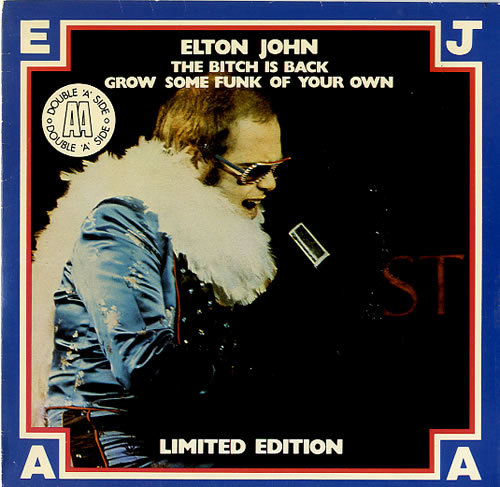
What's funny about "The Bitch Is Back," is that one of the lines in the song's second verse became even more controversial than the song's title; to wit:

"I get high in the evening sniffing pots of glue."

There were stories around that time (I remember my parents talking about them) about teenagers who started sniffing glue at parties as a means to get high because of that line.
Man, never even realized that's what that line said, Ted. It always sounded kinda jumbled to me and I never gave it too much thought. My goodness!
 
I always thought it was "dots of glue".

For the longest time, I heard that lyric as:

"I get high in the evening with the pop top blues."

In fact, reading the actual lyrics K.M. Richards kindly posted above, I missed most of what Elton John was singing in that second verse. That said, what comes off to me after looking at those lyrics is how really sarcastic that song is! Since Bernie Taupin wrote the song's lyrics at the time, I can only think that the inspiration for those lyrics was something that really made him angry.


Back
Top Bottom