• Get involved.
    We want your input!
    Apply for Membership and join the conversations about everything related to broadcasting.

    After we receive your registration, a moderator will review it. After your registration is approved, you will be permitted to post.
    If you use a disposable or false email address, your registration will be rejected.

    After your membership is approved, please take a minute to tell us a little bit about yourself.
    https://www.radiodiscussions.com/forums/introduce-yourself.1088/

    Thanks in advance and have fun!
    RadioDiscussions Administrators

Closely-Spaced AMs

Happy holidays everyone, been awhile since I've posted.

1520 KHz is a busy spot on the dial here in the midwest, however these three seem particularly close to one-another:

WPAY Rossford, Ohio (Class B)
WQCT Bryan, Ohio (Class D)
WRCI Three Rivers, MI (Class D)

Spacing:
WQCT - WRCI: 63 Miles
WQCT - WPAY: 53 Miles

Three co-channel signals within a 60-mile radius.

Does anyone know of any other examples?

Dan
 
No specific examples come to mind. Factors to consider are ground conductivity, and FCC rules for the pertinent stations.
For example FCC database says there are 127 licensed stations on 1450 in the area regulated by the FCC.
 
Last edited:
The Class "C" 1230 1240 1340 1400 1450 1490 stations are pretty well packed together especially in the east US.
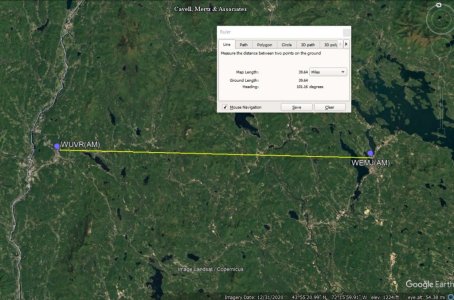
Like these two 40 miles. Poor ground conductivity between them.
WURV has a half-wave tower so they are 640 watts but equivalent to 1000 watts with a quarter wavelength tower.
WEMJ is 1000 watts with a slightly less that 1/4 wl tower.

chjmgchkjchk.JPG
 
Well, until 2010, you had WJMP at 1520kHz licensed to Kent, OH and, (this one's still on the air) WINW some 60 miles south in Canton, OH. If I remember correctly, both transmitter antennas were directional arrays with WJMP going into the lake and WINW going south.
 
The Class "C" 1230 1240 1340 1400 1450 1490 stations are pretty well packed together especially in the east US.
Like these two 40 miles. Poor ground conductivity between them.
WURV has a half-wave tower so they are 640 watts but equivalent to 1000 watts with a quarter wavelength tower.
WEMJ is 1000 watts with a slightly less that 1/4 wl tower.

View attachment 10989
Wow, under 40 miles. Seems exceedingly close, even considering poor ground conductivity.
 
On 1550, you have 4 stations within a 100 mile circle centered near Mt. Airy, NC:

WIGN/Bristol TN (35 kW)
WKBA/Vinton VA (10 kW)
WCLY/Raleigh NC (1 kW)
WBFJ/Winston-Salem NC (1 kW)

But at night, your car's tail lights have more power than the 4 transmitters combined.
 
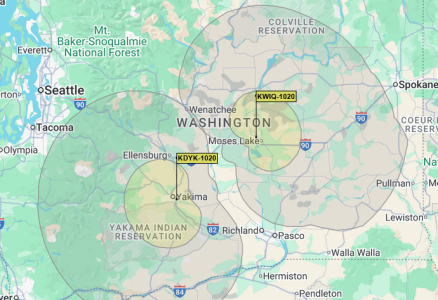
These two are 66 miles apart.
Decided to co-exist with directional antennas daytime.
KDYK with 4000 watts and KWIQ with 2000 watts.
At night both are non-directional with 400 watts each.

1765689379164.png
 
Well, until 2010, you had WJMP at 1520kHz licensed to Kent, OH and, (this one's still on the air) WINW some 60 miles south in Canton, OH. If I remember correctly, both transmitter antennas were directional arrays with WJMP going into the lake and WINW going south.
They were actually about 22 miles apart. Also close are the 1340 stations in Philadelphia and Reading, PA, as well as the 1450 stations in Chattanooga and Athens, TN.
 
London has something slightly different, two synced transmitters 9 kHz apart on 963 and 972 just a few miles from each other. I'm not sure why it was set up this way, but they tend to splatter each other in areas between the transmitters, which unfortunately is most of urban London. They have had various formats, these days a South Asian music station with a 0.4 share.
 
London has something slightly different, two synced transmitters 9 kHz apart on 963 and 972 just a few miles from each other. I'm not sure why it was set up this way, but they tend to splatter each other in areas between the transmitters, which unfortunately is most of urban London. They have had various formats, these days a South Asian music station with a 0.4 share.
Interesting. Not many of those on this side of the pond. I believe KKOB in Santa Fe, NM still operates an on-frequency synchronous transmitter on 770 KHz though.
 
Happy holidays everyone, been awhile since I've posted.

1520 KHz is a busy spot on the dial here in the midwest, however these three seem particularly close to one-another:

WPAY Rossford, Ohio (Class B)
WQCT Bryan, Ohio (Class D)
WRCI Three Rivers, MI (Class D)

Spacing:
WQCT - WRCI: 63 Miles
WQCT - WPAY: 53 Miles

Three co-channel signals within a 60-mile radius.

Does anyone know of any other examples?

Dan
At one time, WINW, Canton, OH and WKNT (I think), Kent, Ohio were 30 miles apart on 1520, but both highly directional.
 
That was the situation that came to mind for me. Could not remember the call letters.
I heard the short-spaced situation on 1010 in Texas, KBBW in Waco and KLAT in Houston, many times first-hand. KLAT has to tuck in its signal to the north and west big-time.
 
At one time, WINW, Canton, OH and WKNT (I think), Kent, Ohio were 30 miles apart on 1520, but both highly directional.
Has to be some kind of record! Begs the question: All things considered, this was the best possible choice of frequencies? No, I'm not aware of ground conductivity in northeast Ohio. Still though, someone at the FCC made this decision to license these stations 25-30 miles apart. I wonder how aggressively the other (Whoever was first on the frequency) station contested this assignment at the time.
 
All good questions I'd love to know the answers to as well. I live about two hours southwest in suburban Columbus but I do know we have northeast Ohio posters here.
Conductivity is decent. You have to get a county or two south of the Akron area before it starts to really fall off entering Appalachia.
 
That was the situation that came to mind for me. Could not remember the call letters.
I heard the short-spaced situation on 1010 in Texas, KBBW in Waco and KLAT in Houston, many times first-hand. KLAT has to tuck in its signal to the north and west big-time.
Boy howdy, was it ever a null. West on I-10 the Katy Freeway used to take you from a reasonably clear KLAT to a distant, but clearly audible KBBW just another mile west. When KLAT dropped off, it really dropped. That was before the reconfiguration of the day pattern, but iWaco was significantly nulled. Kind of like 610 used to be. I haven't heard it since the change from the longtime West Road site, but it used to just die completely at Spring-Steubner. One minute, KILT. The next, virtually no trace of it.
 
All good questions I'd love to know the answers to as well. I live about two hours southwest in suburban Columbus but I do know we have northeast Ohio posters here.
Conductivity is decent. You have to get a county or two south of the Akron area before it starts to really fall off entering Appalachia.
There was an engineering firm in the 60s that could figure out a way to cram almost anything anywhere. There were lots of crazy directionals in the midwest because of them (6 towers, 250 watts in Muncie IN on 990 as only one example).


Back
Top Bottom