I never could figure out why the Boston NBC station chose to identify themselves as "Channel 10" when WJAR-TV in nearby Providence established the "channel 10" ID decades ago. After all, they were actually on the real channel 10 in the analog days. What hit home is watching some of the coverage of the horrible shooting at Brown with a "Boston 10" mic right next to a "WJAR 10" mic. I understand why the NBC station wants to have a traditional number, but why not "Channel 3"? The closest is Hartford CT, way out of the region. Maybe there is some reason that you TV guys know about.

-
Get involved.
We want your input!
Apply for Membership and join the conversations about everything related to broadcasting.
After we receive your registration, a moderator will review it. After your registration is approved, you will be permitted to post.
If you use a disposable or false email address, your registration will be rejected.
After your membership is approved, please take a minute to tell us a little bit about yourself.
https://www.radiodiscussions.com/forums/introduce-yourself.1088/
Thanks in advance and have fun!
RadioDiscussions Administrators
You are using an out of date browser. It may not display this or other websites correctly.
You should upgrade or use an alternative browser.
You should upgrade or use an alternative browser.
Two Channel 10s?
- Thread starter radiofollower
- Start date
Maybe there is some reason that you TV guys know about.
My understanding is that relates to the cable channel it was able to get on most area systems.
NBC tried that in San Francisco when they bought KNTV/11 San Jose and started identifying it as "NBC3" based on their cable channel in the Bay Area, and dumped KRON/4. With Channel 3 (also an NBC affiliate) being relatively close, in Sacramento, confusion reigned.II understand why the NBC station wants to have a traditional number, but why not "Channel 3"? The closest is Hartford CT, way out of the region. Maybe there is some reason that you TV guys know about.
Hartford to Boston is only a bit further than San Francisco to Sacramento. The only difference is that Hartford's Channel 3 is CBS.
Evidently it doesn't cause any confusion in Boston or Providence. Referring to WBTS as "NBC 10 Boston" probably helps. WJAR viewers have been watching that station a long time, and know the difference.I never could figure out why the Boston NBC station chose to identify themselves as "Channel 10" when WJAR-TV in nearby Providence established the "channel 10" ID decades ago. After all, they were actually on the real channel 10 in the analog days. What hit home is watching some of the coverage of the horrible shooting at Brown with a "Boston 10" mic right next to a "WJAR 10" mic.

Well KNTV is currently known as NBC Bay Area. But at the time KNTV had the NBC3 name NBC was waiting for a permit approval to move their transmitter from Loma Prieta Peak to San Bruno Mountains in the South San Francisco area. At that time the rest of the Bay Area outside on San Jose had to watch NBC Bay Area via cable. Yes and also both Sacramento and San Francisco TV Markets have to share Solano County, California where Vallejo and Benicia is in the San Francisco TV Market likewise Vacaville, Dixon, Rio Vista is in the Sacramento TV Market.NBC tried that in San Francisco when they bought KNTV/11 San Jose and started identifying it as "NBC3" based on their cable channel in the Bay Area, and dumped KRON/4. With Channel 3 (also an NBC affiliate) being relatively close, in Sacramento, confusion reigned.
Hartford to Boston is only a bit further than San Francisco to Sacramento. The only difference is that Hartford's Channel 3 is CBS.
Back to this one NBC is more about paying attention to the Viewers on Peacock. Yes the NBC 10 Boston name is a cable branding given that WBTS-TV is on low power stations via OTA. I don’t know how this connects to Sinclair owned WJAR-TV except they have the OTA signal on 10.
It doesn't, aside from both stations being known as "10". Again, the addition of "Boston" to the WBTS branding should clarify it for any viewers, that along with being on PSIP channel 15.1. WJAR has been channel 10 for a long time and is well-known to Providence-area viewers. WJAR probably has minimal viewership in the Boston market, despite being readily available OTA. If anything, it would serve as a fallback for shows not available on WBTS, though I doubt that an NBC O&O would pre-empt NBC programming except once in a blue moon.Back to this one NBC is more about paying attention to the Viewers on Peacock. Yes the NBC 10 Boston name is a cable branding given that WBTS-TV is on low power stations via OTA. I don’t know how this connects to Sinclair owned WJAR-TV except they have the OTA signal on 10.
Also San Diego has NBC 7 when it’s on Channel 39 due to cable providers placing KNSD-TV on Cable 7 in that TV Market. But then again where we are today is about NBC protecting Peacock TV app.
It's fairly common for TV stations to use lower channel numbers for marketing purposes, of which reflecting their most common cable channel is only one of those purposes. WCIV Charleston SC (ABC) continues to market itself as "ABC4" due to having been on OTA channel 4 for decades, which they lost when WGWG acquired the license (a saga too complicated to go into here). They are now on PSIP channel 36.2, and are likely on cable channel 4 on most (if not all) cable systems in their market.Also San Diego has NBC 7 when it’s on Channel 39 due to cable providers placing KNSD-TV on Cable 7 in that TV Market. But then again where we are today is about NBC protecting Peacock TV app.
A totally counter-intuitive scenario unfolded in the Beckley-Bluefield WV market when the digital transition took place and WOAY (channel 4) decided it would be a good idea to start using channel 50, their DTV channel, instead of channel 4. The only thing that even remotely makes sense, is that WVNS Lewisburg, in the same market, was channel 59, and they thought a higher channel number would actually be a plus. Or perhaps someone at WOAY mistakenly thought they had to use their new DTV channel. They've since reverted to channel 4 both on PSIP and in their marketing.
WJAR 10 is the primary NBC channel in Bristol County MA. Comcast there is considered part of the Providence DMA thus excluding NBC10 Boston from being carried. This is a problem since Bristol County is in MA and residents there including myself don't care about news from RI in most cases with the exception of the recent event that took place. I live in MA and pay taxes there. My primary TV cable coverage should be the Boston DMA. Our local Boston TV stations that we do receive on Comcast in Bristol County such as Channels 4, 5, & 7 had expanded coverage of the tragedy at Brown. Luckily Comcast has on its X1 platform a majority of out of area local NBC and Fox newscasts including NBC10 Boston.
Just guessing, I would say that WBZ/WCVB/WHDH are carried on cable in Bristol County due to grandfathering as well as possibly being on the FCC significantly viewed list. WBTS has no such history, nor is it on the SV list (which is ancient). Just out of curiosity, are the Boston stations blacked out (or overlaid by in-market stations) when they duplicate Providence-market programming (wouldn't be so much of an issue with independent WHDH)?WJAR 10 is the primary NBC channel in Bristol County MA. Comcast there is considered part of the Providence DMA thus excluding NBC10 Boston from being carried. This is a problem since Bristol County is in MA and residents there including myself don't care about news from RI in most cases with the exception of the recent event that took place. I live in MA and pay taxes there. My primary TV cable coverage should be the Boston DMA. Our local Boston TV stations that we do receive on Comcast in Bristol County such as Channels 4, 5, & 7 had expanded coverage of the tragedy at Brown. Luckily Comcast has on its X1 platform a majority of out of area local NBC and Fox newscasts including NBC10 Boston.
I'm sure the Providence DMA really, really wants to hang onto Bristol County. That would kick them down several notches on the DMA list.
IM42A you are correct, since WBTS came on a few years ago there is no history. CBS, ABC and CW have duplicate channels, NBC10 Boston is not carried at all. As fot CW, Boston's CW is carried in SD and not blacked out. As for Fox, Boston 25 is also carried in SD. It is blacked out only for Fox national programs allowing Fox Providence solo airing. The rest of Boston 25 including its newscasts are shown.

K.M. Richards
Program Director, The Eighties Channel™
IM42A you are correct, since WBTS came on a few years ago there is no history.
Which is a good time to remind everyone that the FCC has on occasion waived the "significantly viewed history" criteria for stations that have not been on the air long enough to build viewership, in matters where that would normally be a factor.
Which is a good time to remind everyone that the FCC has on occasion waived the "significantly viewed history" criteria for stations that have not been on the air long enough to build viewership, in matters where that would normally be a factor.
Would a Class A or LPTV station qualify either for must-carry, or to be included on the SV list? (WBTS is Class A, though they piggyback on WGBX's full-power signal.)
K.M. Richards
Program Director, The Eighties Channel™
Would a Class A or LPTV station qualify either for must-carry, or to be included on the SV list? (WBTS is Class A, though they piggyback on WGBX's full-power signal.)
LPTVs are not eligible as standalones, but can be bundled into negotiated carriage agreements with co-owned full power stations.
Channel sharing or simulcasting on full-power stations' subchannels does not change their status other than the aforementioned common ownerships.

This "two channel 10s" question surfaces every few months and the answer remains the same:
For the 85-90% of Boston DMA viewers who use cable, satellite or OTT streamers to get their TV, there is no confusion. They tune to "channel 10" (or just "NBC" on streamers) and they see NBC for Boston. The vast majority of them don't get WJAR at all, or if they do it's because it's significantly viewed in a few communities south of Boston and shows up somewhere in the high 90s.
"10" was chosen because it didn't conflict with anything else on the Comcast systems that dominate the DMA. There are other channels that already had use of 3 and 8 on many of the systems.
As for the 10-15 percent of Boston DMA viewers who use OTA reception, only a small minority of THOSE, mostly south and a little bit west of Boston, can get WJAR's 10.1 over the air. So we're down to maybe 3 percent of the entire DMA that actually faces real-world confusion between "NBC 10" from Providence on 10.1 and "NBC 10" from Boston on 15.1.
Then there's Bristol County and nearby areas that are in the Providence DMA. They don't get WBTS on cable - it's too new to get SV status and as a class A license it's not entitled to SV anyway - so the "NBC 10" they get on cable and satellite is WJAR that's home to their market, and only if they have OTA reception is there a possibility they might also discover the other "NBC 10" on 15.1.
And most viewers - nearly all of them - just don't think as deeply as we do about all of this. If they want to watch Fallon or Sunday night football or whatever, they turn on the "NBC" that exists for them on cable or satellite and probably don't think any further about the matter. Half of them probably don't realize NBC left channel 7, or even channel 4!
For the 85-90% of Boston DMA viewers who use cable, satellite or OTT streamers to get their TV, there is no confusion. They tune to "channel 10" (or just "NBC" on streamers) and they see NBC for Boston. The vast majority of them don't get WJAR at all, or if they do it's because it's significantly viewed in a few communities south of Boston and shows up somewhere in the high 90s.
"10" was chosen because it didn't conflict with anything else on the Comcast systems that dominate the DMA. There are other channels that already had use of 3 and 8 on many of the systems.
As for the 10-15 percent of Boston DMA viewers who use OTA reception, only a small minority of THOSE, mostly south and a little bit west of Boston, can get WJAR's 10.1 over the air. So we're down to maybe 3 percent of the entire DMA that actually faces real-world confusion between "NBC 10" from Providence on 10.1 and "NBC 10" from Boston on 15.1.
Then there's Bristol County and nearby areas that are in the Providence DMA. They don't get WBTS on cable - it's too new to get SV status and as a class A license it's not entitled to SV anyway - so the "NBC 10" they get on cable and satellite is WJAR that's home to their market, and only if they have OTA reception is there a possibility they might also discover the other "NBC 10" on 15.1.
And most viewers - nearly all of them - just don't think as deeply as we do about all of this. If they want to watch Fallon or Sunday night football or whatever, they turn on the "NBC" that exists for them on cable or satellite and probably don't think any further about the matter. Half of them probably don't realize NBC left channel 7, or even channel 4!
I agree with you, NBC Boston should have put themselves on cable channel 3 (or 8). It would have been easier to tune to, since you are only pressing one channel number button on a remote instead of two for channel number 10.I never could figure out why the Boston NBC station chose to identify themselves as "Channel 10" when WJAR-TV in nearby Providence established the "channel 10" ID decades ago. After all, they were actually on the real channel 10 in the analog days. What hit home is watching some of the coverage of the horrible shooting at Brown with a "Boston 10" mic right next to a "WJAR 10" mic. I understand why the NBC station wants to have a traditional number, but why not "Channel 3"? The closest is Hartford CT, way out of the region. Maybe there is some reason that you TV guys know about.
I'm guessing it had something to do with Philadelphia having NBC on 10, and that's where NBC's parent company is headquartered. Oddly, Boston and San Diego are the only NBC O&O's that use a "cable channel number" branding. But when the station first launched in 2017, it used a more simple "NBC Boston" branding with a logo similar to the one the NBC station in San Francisco uses today (NBC Bay Area).
And to add to the confusion, with many folks ditching cable, if they put up an antenna they'll "see" NBC on channel 10.1, but it'll be WJAR from Providence!
I'm guessing it had something to do with Philadelphia having NBC on 10, and that's where NBC's parent company is headquartered.
No. Read the other posts in this thread. Starting with the one immediately preceding yours.
Where are the counties that are split in half for either Boston or Providence tv markets? I don't see any confusion here and also there are no cities that happen to land on the border of two or more TV markets.This "two channel 10s" question surfaces every few months and the answer remains the same:
For the 85-90% of Boston DMA viewers who use cable, satellite or OTT streamers to get their TV, there is no confusion. They tune to "channel 10" (or just "NBC" on streamers) and they see NBC for Boston. The vast majority of them don't get WJAR at all, or if they do it's because it's significantly viewed in a few communities south of Boston and shows up somewhere in the high 90s.
"10" was chosen because it didn't conflict with anything else on the Comcast systems that dominate the DMA. There are other channels that already had use of 3 and 8 on many of the systems.
As for the 10-15 percent of Boston DMA viewers who use OTA reception, only a small minority of THOSE, mostly south and a little bit west of Boston, can get WJAR's 10.1 over the air. So we're down to maybe 3 percent of the entire DMA that actually faces real-world confusion between "NBC 10" from Providence on 10.1 and "NBC 10" from Boston on 15.1.
Then there's Bristol County and nearby areas that are in the Providence DMA. They don't get WBTS on cable - it's too new to get SV status and as a class A license it's not entitled to SV anyway - so the "NBC 10" they get on cable and satellite is WJAR that's home to their market, and only if they have OTA reception is there a possibility they might also discover the other "NBC 10" on 15.1.
And most viewers - nearly all of them - just don't think as deeply as we do about all of this. If they want to watch Fallon or Sunday night football or whatever, they turn on the "NBC" that exists for them on cable or satellite and probably don't think any further about the matter. Half of them probably don't realize NBC left channel 7, or even channel 4!
This isn't like the situation between San Francisco and Sacramento TV markets where they have to get half of Solano County, California plus Fairfield and Suisun City, California happen to be located within close proximity to the border where the DMA lines are drawn. Also when I look at Rhode Island its land area and population size is close to the Population and land area size of Sacramento County. Also we are in a different era now its about protecting TV apps in this case Peacock one would think Peacock would end the confusion between WBTS-TV and WJAR-TV.
Attachments
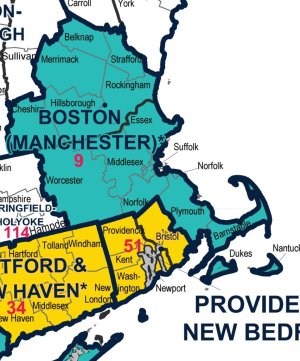
At least in southern New England, the population centers are so close together, that in several cases, stations from a neighboring DMA can easily be received OTA even in the core city of another DMA. Interest in actually watching those stations would vary. While many viewers in Providence no doubt like having Boston news at least as an add-on to watching their own local news, Boston viewers likely don't give two hoots about what is going on in Providence (or Manchester for that matter). Here in Columbia SC, I can get Augusta OTA, but I don't watch their news because I have no need, I have no ties to the place, and nothing goes on there that affects me. I watch WPDE from Myrtle Beach sometimes because I used to live there, and I can usually get them OTA at least for the 11 pm newscast. (And of course news from any market in the US is available streaming online if you're so motivated. OTA is just one less hoop through which to jump.)Where are the counties that are split in half for either Boston or Providence tv markets? I don't see any confusion here and also there are no cities that happen to land on the border of two or more TV markets.
This isn't like the situation between San Francisco and Sacramento TV markets where they have to get half of Solano County, California plus Fairfield and Suisun City, California happen to be located within close proximity to the border where the DMA lines are drawn. Also when I look at Rhode Island its land area and population size is close to the Population and land area size of Sacramento County. Also we are in a different era now its about protecting TV apps in this case Peacock one would think Peacock would end the confusion between WBTS-TV and WJAR-TV.
True to the point here its just I try to comprehend how it is specifically in that part of New England and the viewing habits there how it sparked the "confusion" of the Channel 10's WBTS and WJAR. I tried to look for places where some of the "borders of TV Markets" used to be sparsely populated at the time when the DMA maps were drawn but could not prove that here.At least in southern New England, the population centers are so close together, that in several cases, stations from a neighboring DMA can easily be received OTA even in the core city of another DMA. Interest in actually watching those stations would vary. While many viewers in Providence no doubt like having Boston news at least as an add-on to watching their own local news, Boston viewers likely don't give two hoots about what is going on in Providence (or Manchester for that matter). Here in Columbia SC, I can get Augusta OTA, but I don't watch their news because I have no need, I have no ties to the place, and nothing goes on there that affects me. I watch WPDE from Myrtle Beach sometimes because I used to live there, and I can usually get them OTA at least for the 11 pm newscast. (And of course news from any market in the US is available streaming online if you're so motivated. OTA is just one less hoop through which to jump.)