• Get involved.
    We want your input!
    Apply for Membership and join the conversations about everything related to broadcasting.

    After we receive your registration, a moderator will review it. After your registration is approved, you will be permitted to post.
    If you use a disposable or false email address, your registration will be rejected.

    After your membership is approved, please take a minute to tell us a little bit about yourself.
    https://www.radiodiscussions.com/forums/introduce-yourself.1088/

    Thanks in advance and have fun!
    RadioDiscussions Administrators

Reflections on Radio and Records... from half a century ago

davideduardo

Moderator/Administrator
Staff member
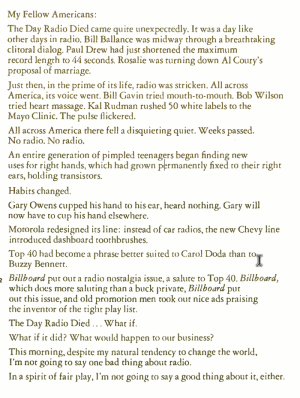
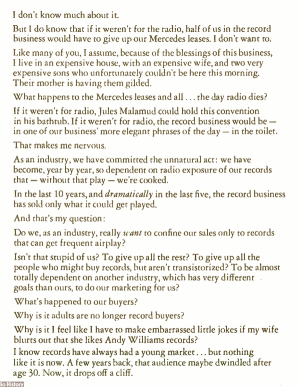
This is the first two pages of a speech by Stan Cornyn of RCA from the NARM convention in 1975.

You can see the full speech at MID CENTURY RADIO COLLECTION: Unique or short-run publications. It's worth reading both for the ideas and the marvelous use of our English language. And it comments on music's then dependency on radio, the record industry's focus only on young buyers and a lot more.

1776559456565.png
1776559493917.png

A select quote from Cornyn is "When it comes to racing into any new technology, the record business finishes just ahead of the Amish." Maybe that, today, can be applied to the radio business.
 
This is the first two pages of a speech by Stan Cornyn of RCA from the NARM convention in 1975.


I was at a music conference yesterday that was filled with a lot of wisdom just like that speech. Lots of great platitudes about both the record business and the media business. For the sake of discussion, radio, TV, and DSPs were viewed as the same thing. A label executive said she won't sign artists who don't have a social media presence. Artists need to have their music talked about either by DJs, critics, social media, or other forms of influencers. The music won't attract listeners on its own. People need to be pushed in that direction. I wonder what artists think about that view. A few people near me were pretty upset about that comment. They must live in the "build it and they will come" camp.

One statistic I heard was that 70% of the music being heard today is from catalog, as opposed to currents. I wonder how that fits with what Cornyn was saying. Is having immediate access to every recording ever made good for new music or classic music? It sounds like it's better for the old stuff.

Someone at this conference said that at one time, the recording industry depended on radio to sell their product. Exactly what Cornyn said 50 years ago. That situation has obviously changed. But the reality is that the recording business is smaller now than it was then. Is the record business better now that radio isn't the force it once was? Is the music better than it was then? Can it stand on its own without those of us in the media talking about it? I don't know. We may find out.
 
A key point Cornyn made was that the record industry failed to chase adult consumers. That point is critical today to both music and radio.

Your point about "is the music better" is worth a thread of its own. Of course, each generation tends to "own" its own music while thinking that everything else sucks. But I've been following Coachella both last weekend and this one on YouTube (or I can just stand in my backyard and hear it pretty clearly... I live that close to it) and there is some really good content being put out.

In fact, there is content that I like, my wife likes... yet stations targeting older adults just ignore.

We have another thread about music taste formation, and I believe that there is a significant group of adults who enjoy older stuff, but are not obsessed with it... and have moved on to more recent and even current music. Yet radio seems to be unable to find a music blend that incorporates much newer music yet is aimed at 35-54 or even 45-64. Cornyn gets it right that the music biz failed to appeal to mature adults: I think that radio has left behind a lot of adults that don't want to hear "classic hit" as they have outgrown them.
 
A key point Cornyn made was that the record industry failed to chase adult consumers. That point is critical today to both music and radio.

I just edited my post and added this paragraph that addressed that comment:

One statistic I heard was that 70% of the music being heard today is from catalog, as opposed to currents. I wonder how that fits with what Cornyn was saying. Is having immediate access to every recording ever made good for new music or classic music? It sounds like it's better for the old stuff.

Cornyn gets it right that the music biz failed to appeal to mature adults: I think that radio has left behind a lot of adults that don't want to hear "classic hit" as they have outgrown them.

The problem with what Cornyn was talking about is he was only looking at the popular part of music and radio. He wasn't looking at the big picture. In 1975 we still had beautiful music radio. We still had commercial classical and jazz radio. It was possible to hear opera on the radio every week. There were radio stations regularly playing music from the 30s, 40s, and 50s. Some of them were popular, but because they dealt in catalog, they weren't the focus of the recording industry. We still had brick & mortar record stores that stocked a lot of that older music. Some even had educated staff to guide customers to the best performances or the right recordings to own to have a balanced collection. Where is that today?
 
In fact, there is content that I like, my wife likes... yet stations targeting older adults just ignore.

We have another thread about music taste formation, and I believe that there is a significant group of adults who enjoy older stuff, but are not obsessed with it... and have moved on to more recent and even current music. Yet radio seems to be unable to find a music blend that incorporates much newer music yet is aimed at 35-54 or even 45-64. Cornyn gets it right that the music biz failed to appeal to mature adults: I think that radio has left behind a lot of adults that don't want to hear "classic hit" as they have outgrown them.
I’m one of those adults. I’m in my 40’s and I’ve always listened to current stuff, but when I want to hear music from either bands I know with either no gold or gold I haven’t heard before, or new national and local bands, the options locally are KU’s college station KJHK, and 90.9 The Bridge and sometimes 98.9 for rock, because the previously mentioned stations don’t really play rock. I never listen to 94.9, I already heard all those songs growing up or in the past. I liked listening to them then, I just would rather hear new music/new to me music. Also the mixshows on Saturday nights on 107.3 the Vibe with DJ Kirby are fun.

I’ll usually only listen to KMXV and KMJK when they run the top 40 shows for Rick Dees and Carson Daly, because there are some songs on those I’d never hear on those stations otherwise.

For international new music, I like the Indigenous countdown show and BBC Radio Scotland’s Introducing in Scotland. When SiriusXM would run the weekly BBC Radio 1 Chart Show, I liked listening to that, too. I’ve never been loyal to just one station, I’ve always jumped around.
 
This is the first two pages of a speech by Stan Cornyn of RCA from the NARM convention in 1975.

You can see the full speech at MID CENTURY RADIO COLLECTION: Unique or short-run publications. It's worth reading both for the ideas and the marvelous use of our English language. And it comments on music's then dependency on radio, the record industry's focus only on young buyers and a lot more.

View attachment 11835
View attachment 11836

A select quote from Cornyn is "When it comes to racing into any new technology, the record business finishes just ahead of the Amish." Maybe that, today, can be applied to the radio business.
Though I am sure we are meant to take these words rhetorically, I would point out that by the mid 1960s the so-called "adult" audience was sated. They had all the records they wanted, and really much more than they could have ever dreamed they might have. Though it might have been only 20, 40, or 60 LPs. They had grown up with network radio and kept listening long after the networks had ceased to entertain on radio. After say 1963 most of the record buying, including of MOR artists, was done by young people. Oh listeners in their 50s and 50s might occasionally add something they found striking or important to their collections, but surveys show that only half of all adults were still buying recordings in 1966 while 82 percent of teenagers were actively engaged in that pursuit.

Because of that fact MOR artists still active were mostly hustled by recording companies into making youth-oriented tunes hoping the young generation still buying would accept them and acquire them. Which they did not always feel comfortable with. And doubfful that youthful buyers were going for Andy Williams or Frankie Laine or Doris Day doing White Rabbit or Born To Be Wild.

Another factor was that a recording company had to lay out a lot of money for musicians and arrangers to make the kind of full orchestral sessions MOR artists were accustomed to. Much greater savings in going with a small guitar band or a few studio instrumentalists or by purchasing masters already produced and recorded by others.

George Melachrino died in 1965, Hugo Winterhalter in 1973. Mantovani and Hugo Montenegro retired from recording in 1975, Percy Faith died in early '76. Andy Williams was active to about 1980. Other artists still selling in the 70s such as Ferrante and Teicher, Paul Mauriat, Roger Williams sold as well to mostly younger buyers. The over 30s never embraced Mauriat at all or Montenegro's later style both of which which they considered "rock".

So I would say quite natural that the record companies had long since set down the older generation by 1975 since they had stopped buying. There was still product that older listeners might have been interested in being made in England and Europe to the mid 1980s which for the most part American buyers did not have access to. I can remember a number of good things available on Peters International by the later 70s and Bainbridge reissued some of Bob Shad's 1960 - 63 Time Records catalogue in the early 80s. They had few takers.

The generations which had grown up with radio in the 20s and 1930s stayed with it, gravitating to Beautiful Music stations on FM in the 1970s when MOR outlets became less and less music-oriented to the point that personality hosts no longer chose their own music, leaving that up to young aides who tended to program current Top 40 hits.

Then a funny thing happened. In the 1980s the younger agency time buyers less and less wanted the older audience. That same audience who had bought them all manner of records when they were growing up (and kids records were 10 percent of the market, sometimes more, in the 1950s and into the 60s) which went far to establishing them as regular record buyers in life!

How many Beautiful Music stations gave up the ghost in the 1980s and early 90s while they still had double digit rating shares? Granted that audience was already shrinking due to attrition and the lack of an active recording industry producing new product to support it. Which had ceased to exist because of lack of demand, as already mentioned, and because few younger music arrangers possessed the skills of the older writers most of whom had been trained in network radio. You may recall that from 1973 through the early 80s Beautiful Music syndicators such as Schulke and Bonneville commissioned their own music to obtain suitable new product or gathered together with notable stations, as you did with IBMA, for the same end. The more successful of this custom music was by arrangers who had been working before 1960, as younger men, with the exception of the brilliant Nick Ingman, had no or too little experience in setting pop music for orchestral forces.

The obvious point I am making is that the mature audience stopped buying in quantity by the mid 60s so the recording industry eventually set them aside. Without the backing of new commercial recorded product the MOR radio formats appealing to older people dried up and radio set the older audience aside as undesirable. After the death of the Beautiful Music radio in the early 1990s its audience learned to do without radio for the remaining 20, 30, 40 years of their lives. Yes after 2000 it had a revival on non-commercial internet outlets but most of its former adherents lacked the necessary technological skills to access them.

Including some of us who were still not yet 30 in 1975 when Mr. Cornyn's address was delivered. Many of us who grew up with terrestrial radio in the 1950s loving it and being excited by it have now lived half our lives without it. We have our CDs and vinyl records most or which we acquired many years ago. You may recall after the materials shortages brought about by the oil embargos of 1973 and after resulted in record companies withdrawing and deleting their catalogs how used record shops sprang up almost like magic for about 25 years. From which we were able to buy scores of 10 and 25 cent LPs of the 50s and 60s for a while. When what we cherished had not yet been isolated and marginalized as "beautiful music" or "easy listening' or "nostalgia" but was just popular or classical music.

Thank you.

 
I was at a music conference yesterday that was filled with a lot of wisdom just like that speech. Lots of great platitudes about both the record business and the media business. For the sake of discussion, radio, TV, and DSPs were viewed as the same thing. A label executive said she won't sign artists who don't have a social media presence. Artists need to have their music talked about either by DJs, critics, social media, or other forms of influencers. The music won't attract listeners on its own. People need to be pushed in that direction. I wonder what artists think about that view. A few people near me were pretty upset about that comment. They must live in the "build it and they will come" camp.

One statistic I heard was that 70% of the music being heard today is from catalog, as opposed to currents. I wonder how that fits with what Cornyn was saying. Is having immediate access to every recording ever made good for new music or classic music? It sounds like it's better for the old stuff.

Someone at this conference said that at one time, the recording industry depended on radio to sell their product. Exactly what Cornyn said 50 years ago. That situation has obviously changed. But the reality is that the recording business is smaller now than it was then. Is the record business better now that radio isn't the force it once was? Is the music better than it was then? Can it stand on its own without those of us in the media talking about it? I don't know. We may find out.
Well social buzz and media buzz have always sold records. I'm sure even David Rose's and Artie Shaw's marriages even somehow could be useful to record sales.

The larger ensembles such as the Beautiful Music and Classical Music that used to excite me - were available primarily on the old networks. As they were either studio ensembles or did limited and then only major city touring. Then as some of them became more popular you could hear them sometimes on juke boxes in the 1940s. Then as they sold more and more records you could get them more and more on the DJ programs for a while even after the demise of the old network good music shows in 1957 - 58.

The most recent recordings I have acquired I had to order from the orchestra itself - in that case the Minnesota Orchestra - as the record companies are not doing the Classical recording they once were. As most still existing Classical Music stations now are playing primarily catalog items which were made 40 - 50 years ago. Beautiful Music recording in the US mostly stopped around 1970 because it ceased earning the companies enough to keep it going and to encourage new artists.

Anything we build - well we cannot be guaranteed like magic that anyone will come and enjoy it and buy it. That is not the way it ever worked. You can only try it and see.
 
A key point Cornyn made was that the record industry failed to chase adult consumers. That point is critical today to both music and radio.

Your point about "is the music better" is worth a thread of its own. Of course, each generation tends to "own" its own music while thinking that everything else sucks. But I've been following Coachella both last weekend and this one on YouTube (or I can just stand in my backyard and hear it pretty clearly... I live that close to it) and there is some really good content being put out.

In fact, there is content that I like, my wife likes... yet stations targeting older adults just ignore.

We have another thread about music taste formation, and I believe that there is a significant group of adults who enjoy older stuff, but are not obsessed with it... and have moved on to more recent and even current music. Yet radio seems to be unable to find a music blend that incorporates much newer music yet is aimed at 35-54 or even 45-64. Cornyn gets it right that the music biz failed to appeal to mature adults: I think that radio has left behind a lot of adults that don't want to hear "classic hit" as they have outgrown them.
A classic hit is a classic hit and no question we can hear some which will please us. But - it we want to hear a greater percentage of what pleases us or will please us then we must turn off our radios. And for many of us that had been the case since the early 1990s when the Beautiful Music stations left us. Many of us former our tastes listening to radio including the closing years of network radio. And once we became used to Classical or Beautiful Music or Jazz outlets where we could hear what we enjoyed much more or all of the time then there was no going back to generalist radio where we could enjoy what was on only part of the time. So you might say we became spoiled. Then generalist tastes changed and what we enjoyed most was no longer broadcast. Which perhaps was inevitable.
 
I was at a music conference yesterday that was filled with a lot of wisdom just like that speech. Lots of great platitudes about both the record business and the media business. For the sake of discussion, radio, TV, and DSPs were viewed as the same thing. A label executive said she won't sign artists who don't have a social media presence. Artists need to have their music talked about either by DJs, critics, social media, or other forms of influencers. The music won't attract listeners on its own. People need to be pushed in that direction. I wonder what artists think about that view. A few people near me were pretty upset about that comment. They must live in the "build it and they will come" camp.

One statistic I heard was that 70% of the music being heard today is from catalog, as opposed to currents. I wonder how that fits with what Cornyn was saying. Is having immediate access to every recording ever made good for new music or classic music? It sounds like it's better for the old stuff.

Someone at this conference said that at one time, the recording industry depended on radio to sell their product. Exactly what Cornyn said 50 years ago. That situation has obviously changed. But the reality is that the recording business is smaller now than it was then. Is the record business better now that radio isn't the force it once was? Is the music better than it was then? Can it stand on its own without those of us in the media talking about it? I don't know. We may find out.

I'm reading your response and I'm reminded of something that a record company promoter told a then-NPR reporter. What he said (and I'm paraphraising here) was that the record companies could see when record sales were happening because radio was playing those records a lot; in other words, in the past, it was the repetitive playing of records that pushed people to go out and purchase them. With the rise of computers and the Internet, this appears to no longer be the case, at least in terms of physical product. And this is where the recording industry is currently stuck--they still want people to purchase the physical product. Why? Because the profit margins on the physical product was (and still is) greater than what the industry gets from selling that same music over the Internet, even if you add in the cost of creating and marketing that product.

I have privately discussed in the past the idea that Napster and its ilk were founded in the early 2000s *precisely because* the price of the physical product was too high; yet if your were to ask Don Henley or Cheryl Crow (the former of whom I've once heard in an interview on this topic), they would deny that the CDs were priced too high to begin with. In fact, their argument is that the price should match what they and their record labels feel it should be to cover both costs and profits, regardless of how many people actually purchased those CDs and albums at the higher prices. and that brings me to Economics 101 (I had to take *that* both in high school and college) where the teachers/professors emphasized that in a marketplace with many sellers and many buyers, covering costs is less important, at least in the short term, than what the market will actually bear.

Getting back to Cornin's point (at least what I could read of it outside of the graphic), another mistake that all involved made was assuming that older people would behave the same no matter which generation they born in. As poster Dick's History pointed out, the older adults in 1975 had not grown up on records and therefore weren't really willing to purchase what they didn't purchase as kids. By the 1980s and 1990s, however, newer generations raised on records had become older adults and many of those people continued to purchase their favorite artists, first on albums then on CDs. Of course (as I have noted above), with the radical reshaping of the ground by the availability of music on the Internet in the early 2000s, it is likely that folks in their 20s now will not be purchasing physical product when they become older as they will prefer to hear it over the Internet for either nothing (with commercials, such as on youtube.com) or for an annual fee.
 
This is the first two pages of a speech by Stan Cornyn of RCA from the NARM convention in 1975.

Once small detail: I was curious about who Stan Cornyn was, and sought some context about this speech. I found out Cornyn spent his entire career at Warner Brothers Records, not RCA. He started there in 1958. He was there when the label bought Reprise from Frank Sinatra. He wrote liner notes for several Sinatra albums, and actually won a Grammy for best album notes. He remained at Warners until 1990.

The 60s was a great decade for Sinatra. His music career experienced a huge revival. He had #1 songs, and other artists in his genre shared in that revival. Stan Getz had a hit with Girl From Ipanema. Al Hirt had instrumental hits. Dean Martin had hit songs on the radio, and a hit TV show. The Rat Pack was in full bloom in Las Vegas.

One side note about Sinatra: He complained loudly about radio. One of his first discoveries when he started Reprise Records was that radio didn't pay royalties to artists or record labels, only songwriters. He was furious about this, and testified before congress in the 1950s seeking a change in copyright rules to give artists and labels a royalty. It never happened. mainly because the music industry couldn't agree how to handle it. The thinking at the time was to have the established PROs (BMI and ASCAP) distribute the money they already collected to artists and labels. Radio didn't want to pay more, and the songwriters didn't want to share any of their money. Sinatra was angry and bitter, and sold his record label to Warner Brothers. Cornyn was there, and perhaps heard Sinatra's complaints about radio.

But the other observation I'll make is that the recording industry and the radio industries were changing after the 60s. The recording industry was definitely chasing the huge baby boomer generation with rock music. At the same time, radio was also reflecting this cultural shift in music. The broad range of music that could be heard on AM Top 40 in the 60s became narrower. No more instrumentals. No more jazz. The 70s saw the rise of format radio. While it was possible for artists such as Sinatra, Martin, Getz, or even Haggard, Cash, and Owens to have Top 40 hits in the 60s, all that ended in the 1970s. If you wanted to have a Top 40 hit. you had to fit a certain style and sound, and the format was aiming strictly at a younger demographic.

So by 1975, there was a bit of a schism in music radio. Rock radio was in full bloom, and record labels were signing acts to chase after that audience. Older music was still getting played, but not on the same stations as the pop music. It's very possible that reality was what led to this speech. Nothing annoys older people than being made to feel they were old. They wanted to be hip and cool, and have their music played on the same stations as the hip and cool people. That was no longer happening.

By 1975, Sinatra was no longer having pop hits. His music was classified as "Adult Contemporary," and he still had hits there. But it wasn't getting airplay on Top 40 stations. People know Sinatra today for his version of the Theme From New York, New York. That song was released in 1980. It barely made Top 40, peaking at #32. It did much better in the AC chart, peaking at #10. Ironically it won a Grammy for Best Pop Vocal Performance, but that said more about the Grammys than anything. It wasn't a pop hit.

So that's the context. My impression is that Cornyn was reflecting a lot of the frustrations of his generation, seeing the music splinter, and subsequently radio splinter into separate formats. No longer was music or radio unified, where you could hear the complete spectrum of current music on one station. Things got even worse as time moved on, and that brings us where we are today.
 
With the rise of computers and the Internet, this appears to no longer be the case, at least in terms of physical product. And this is where the recording industry is currently stuck--they still want people to purchase the physical product.

Based on what I heard at the music conference Friday, the recording industry is no longer pushing physical product. They still make it, but the entire focus is on digital service providers (DSPs). The profit is built around the digital royalty, which is why the industry is so focused on having broadcast radio pay labels and artists in unity with streaming. The profit margin is lower, but the usage is higher, so songs that stream the most make a lot of money. They don't see broadcast radio as different from satellite or streaming, and therefore should pay the same royalty. They don't understand that broadcasting is analog, and streaming is digital. They don't understand that broadcast radio pays the digital royalty when the signal is streamed. That infuriates them even more.

In fact, their argument is that the price should match what they and their record labels feel it should be to cover both costs and profits, regardless of how many people actually purchased those CDs and albums at the higher prices.

Henley was an early advocate for broadcast radio to pay the digital royalty. His manager is Irving Azoff, who started Global Music Rights, a PRO that promised writers higher royalties than BMI or ASCAP. So Henley isn't shy about demanding more money for his music. Anyone who has thought of seeing The Eagles on tour will pay very high ticket prices to see them. They know they have something people want to see, and aren't shy about charging top rates for it. BTW Azoff is also involved with Live Nation and Ticketmaster, which just lost a monopoly lawsuit last week.

On the other hand, music consumers have always looked for ways to get the music they want at the lowest price, and if possible for free. That's what led to Napster and file sharing in the early 2000s. It was a digital version of what people did in the 80s and 90s: Recording music from friends rather than buying it themselves. Now with DSPs, anytime someone listens to music, someone pays. Maybe not the person listening, but someone is paying. It may be Google, Apple, or Amazon, but they get paid per play. That's what the music industry wants from broadcast radio.
 
There were radio stations regularly playing music from the 30s, 40s, and 50s.
I don't recall this being true in the 70s. I remember a writer for The Charlotte Observer speculating about the next big thing and wondered how big band would do.

Shortly after my high school's band played big band music and the students liked it, the station in my town switched to big band, and in the 80s a Charlotte station played a mix of big band and soft AC similar to what adult standards stations would do a few years later. Other NC stations started playing big band, including one that had been Top 40 immediately before the change.
 
By 1975, Sinatra was no longer having pop hits. His music was classified as "Adult Contemporary," and he still had hits there.
It was? I can't say I ever heard him on adult contemporary radio.

I don't think he was on the MOR station either. And that station was playing what might have been called soft AC.
 
A select quote from Cornyn is "When it comes to racing into any new technology, the record business finishes just ahead of the Amish." Maybe that, today, can be applied to the radio business.

The irony to me was that Cornyn was complaining about the way the music industry was adapting to the baby boom. All of a sudden, he felt old. That's what happens anytime a new technology comes along. The record labels objected to radio airplay of their music in the 1930s. The reason there is no label royalty today is because the record labels didn't want to legalize airplay of recorded music. They felt it would put them out of business. Instead, airplay led to a huge growth of the music industry, and by the 60s, they viewed radio as their partners. In a way, Cornyn objected to that view. It sounds like he felt the labels were too comfortable in their relationship with radio. A lot of that is what led to the formation of Radio & Records as a publication, as differentiated from Billboard and other trades at that time.

The record business was looking for an alternative to radio, and it found a willing partner in TV. Ultimately that led to the formation of MTV, which was actually created as a partnership between Warner Brothers and American Express. It was launched by playing "Video Killed The Radio Stars." It was wishful thinking on the part of the record labels.

As for radio adapting to new technology, you're seeing the result of that right now. The staffing and budgets that were possible during the heyday of radio are unsustainable and unnecessary in the digital age. DSPs such as Spotify can operate more efficiently than iHeart or Audacy. That means those companies have to downsize to fit the new economy. The record labels went through the same thing as they switched from physical product to digital. The reason things move slowly is because of the human element. Otherwise things would happen a lot quicker.
 
I don't recall this being true in the 70s.

That's why the internet is your friend. You can search for radio playlists from the 70s and see that WNEW-AM radio in NYC was playing everything from Count Basie and Paul Whiteman in the 30s to Rosemary Clooney and Patty Page. At the time WNEW was a popular commercial radio station in NYC. However, the audience was all over 50.

It was? I can't say I ever heard him on adult contemporary radio.

Once again, your memory is faulty. I got my information from the Billboard charts. If you search Sinatra's discography, you'll see that he got played on AC radio. Maybe not the ones you listened to, but he received enough airplay to register in the national charts. There's a big world beyond Charlotte NC.
 
Cornyn was a brilliant writer. A sampling of his album liner notes is here:


And anyone who wants to hear the real stories from Warners in the 1960s and 1970s should read his book:

 
I don't recall this being true in the 70s. I remember a writer for The Charlotte Observer speculating about the next big thing and wondered how big band would do.

Shortly after my high school's band played big band music and the students liked it, the station in my town switched to big band, and in the 80s a Charlotte station played a mix of big band and soft AC similar to what adult standards stations would do a few years later. Other NC stations started playing big band, including one that had been Top 40 immediately before the change.

Keep in mind that during the 1970s, radio markets were a lot less cookie-cutter. For example, KXIV (now KSUN) in Phoenix was playing MOR and pre-rock material at least since I moved there in 1972. And, in 1975, KWAO licensed in Sun City, joined them on the FM band and KPHX (on 1480 kHz) also played pre-rock music, including big bands, for a brief while. It seemed to make sense there as the audience was generally older and whiter. In Los Angeles, on the other hand, KFI, which did play some pre-rock music during that timeframe, didn't play anything from the 1930s and 1940s and KMPC (which was transitioning to an AC) wasn't playing big band music during that period, either.


Back
Top Bottom