• Get involved.
    We want your input!
    Apply for Membership and join the conversations about everything related to broadcasting.

    After we receive your registration, a moderator will review it. After your registration is approved, you will be permitted to post.
    If you use a disposable or false email address, your registration will be rejected.

    After your membership is approved, please take a minute to tell us a little bit about yourself.
    https://www.radiodiscussions.com/forums/introduce-yourself.1088/

    Thanks in advance and have fun!
    RadioDiscussions Administrators

KZDC downgrading day signal

KZDC 1250 has applied to move its daytime transmit site to the current night diplex with KTSA. Day power will be 290 watts from the same directional array used at night. Night power remains at 920 watts.

This obviously marks the end of the current separate day site, which ran 25kw.

There had been speculation that the KZDC license would be turned in, but it would appear the station will be kept going a while longer.

Check the attachments to the application:

 
KZDC 1250 has applied to move its daytime transmit site to the current night diplex with KTSA. Day power will be 290 watts from the same directional array used at night. Night power remains at 920 watts.

This obviously marks the end of the current separate day site, which ran 25kw.

There had been speculation that the KZDC license would be turned in, but it would appear the station will be kept going a while longer.

Check the attachments to the application:


While I can understand the advantage of dropping your daytime tower location so you are using the same location for both day and nighttime transmissions, why drop the power during daylight hours to less than half of the allowed nighttime power. It seems to me that you would lose some of your current and potential San Antonio market audience with such a drastic reduction.
 
While I can understand the advantage of dropping your daytime tower location so you are using the same location for both day and nighttime transmissions, why drop the power during daylight hours to less than half of the allowed nighttime power. It seems to me that you would lose some of your current and potential San Antonio market audience with such a drastic reduction.
The 1250 programming is also on 94.5. That's where the audience is listening... I too was told over a year ago the plan was to surrender the KZDC license when the daytime tower lease is up. They've instead for whatever reason decided to diplex it full time on the night site and that's the best they can do with the one tower non-directionally.
 
While I can understand the advantage of dropping your daytime tower location so you are using the same location for both day and nighttime transmissions, why drop the power during daylight hours to less than half of the allowed nighttime power. It seems to me that you would lose some of your current and potential San Antonio market audience with such a drastic reduction.
Probably because that's all the power they can get as a non-directional daytime operation from the KTSA site. I haven't looked to see what exactly 1250 has to protect, but if it's a choice between turning the AM off completely and leaving it on at minimal expense to support the translator, you do what you have to do these days.
 
Probably because that's all the power they can get as a non-directional daytime operation from the KTSA site. I haven't looked to see what exactly 1250 has to protect, but if it's a choice between turning the AM off completely and leaving it on at minimal expense to support the translator, you do what you have to do these days.

And I didn't realize (gulp) that only one tower was used for the nighttime arrangement. Given that information:

1) There are no same frequency stations KZDC has to protect until you get to Seminole (going north/northwest); Paris (going northeast); or Port Arthur (going southeast), and all of those are pretty far away.
2) On the other hand, when one looks at adjacent frequencies, one finds stations at 1260 kHz licensed to Falfurrias, San Angelo, and Taylor (an Austin suburb). The Taylor station especially would really limit how much power one could legally use with a non-directional antenna on 1250 kHz.

Thanks for the heads up.
 
Probably because that's all the power they can get as a non-directional daytime operation from the KTSA site. I haven't looked to see what exactly 1250 has to protect, but if it's a choice between turning the AM off completely and leaving it on at minimal expense to support the translator, you do what you have to do these days.

From what I can tell looking at the application, it would seem to be using the same 4 towers in the daytime that it uses at night. You can probably figure out the FCC filings better than I can since you make those filings regularly, though. I also was under the impression that an AM had to cover the entire city of license during the daytime. That daytime signal doesn't do that, though the nighttime signal does, albeit barely.

1) There are no same frequency stations KZDC has to protect until you get to Seminole (going north/northwest); Paris (going northeast); or Port Arthur (going southeast), and all of those are pretty far away.

Unless there's some kind of issue with interference to KTSA, I can't figure this one out either. San Antonio's 1250 was, for decades, a 1,000 non-directional signal in the daytime. I suppose some station(s) could've upgraded around the changes to 1250's new daytime pattern, thus making the old non-directional signal no longer workable. I'm not sure who that would've been, but it doesn't look like it was KTAE, which has had the same daytime power and transmitter site for at least the last 30 years.
 
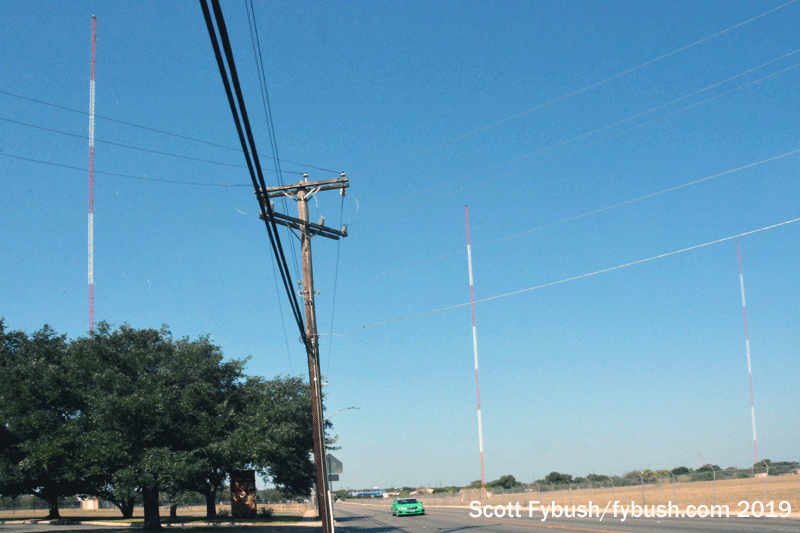
KZDC's nighttime site has five towers: three on one side of a road that cuts it in half, and two on the other side.

Is the fifth tower unused, or is it used by another co-located station?

Also, if you click of "view towers" on FCCData, it shows four towers all on the North side of the road, which doesn't match Google's latest Street View images from November 2025.
 
KZDC's nighttime site has five towers: three on one side of a road that cuts it in half, and two on the other side.

Is the fifth tower unused, or is it used by another co-located station?

Also, if you click of "view towers" on FCCData, it shows four towers all on the North side of the road, which doesn't match Google's latest Street View images from November 2025.
See from @fybush directly...

 
KZDC's nighttime site has five towers: three on one side of a road that cuts it in half, and two on the other side.

Is the fifth tower unused, or is it used by another co-located station?

Also, if you click of "view towers" on FCCData, it shows four towers all on the North side of the road, which doesn't match Google's latest Street View images from November 2025.
According to the tower maps on fccdata.org, co-located KTSA uses a separate single tower during the day for non-directional use, while employing four different towers for the night directional pattern. So five towers total at the site.
 
Do they have to protect XESC which is around 195 miles away?

It looks like XESC is no longer on the air. Certainly, https://fccdata.org doesn't show the station, and that probably makes sense as the country is now in the middle of moving most of its AM outlets to FM frequencies (and replacing the E in the callsign with an H when the FM move takes place). That said, I wouldn't be surprised if KZDC did have to protect a frequency where another station no longer exists due to the 1940 NARBA treaty.
 
It looks like XESC is no longer on the air. Certainly, https://fccdata.org doesn't show the station, and that probably makes sense as the country is now in the middle of moving most of its AM outlets to FM frequencies (and replacing the E in the callsign with an H when the FM move takes place). That said, I wouldn't be surprised if KZDC did have to protect a frequency where another station no longer exists due to the 1940 NARBA treaty.
IIRC The Canadians have a station on paper on 1510 that would make it hard for WLAC to drop their northeast null. Of course now WFIF is trying to move to 1510 from 1500, WLAC's chance to have a two tower footprint aren't going to happen. They could end up at 1300's site which is kinda weird because the old WMAK and WLAC were direct competitors in the mid to late 1970's.
 
My text above got interrupted. What I meant to say nations are protective of their bandwidth whether they use it or not. Mexico seems a little more cooperative. Apparently they did let some US station's on their channels have class B nighttime service last century like 900 in Calhoun GA non directional 266 watts. That's definitely more than flea power.
 
IIRC The Canadians have a station on paper on 1510 that would make it hard for WLAC to drop their northeast null. Of course now WFIF is trying to move to 1510 from 1500, WLAC's chance to have a two tower footprint aren't going to happen. They could end up at 1300's site which is kinda weird because the old WMAK and WLAC were direct competitors in the mid to late 1970's.
The little WFIF application isn't going to have any effect on what WLAC can or can't do.

As you correctly noted, there's the former CJRS Sherbrooke that's still protected, among other things.

It's more likely at this point that WLAC becomes the next WBT than that iHeart invests anything into keeping it operating at any significant power once the site is gone.
 
I also was under the impression that an AM had to cover the entire city of license during the daytime. That daytime signal doesn't do that, though the nighttime signal does, albeit barely.
The coverage requirement for AM broadcast is 50% of the area or 50% of the population of the CoL must receive a 5 mv/m signal, and this application meets both criteria.

And I didn't realize (gulp) that only one tower was used for the nighttime arrangement. Given that information:

1) There are no same frequency stations KZDC has to protect until you get to Seminole (going north/northwest); Paris (going northeast); or Port Arthur (going southeast), and all of those are pretty far away.
It appears KDEI/Port Arthur TX and KTAE/Elgin TX are the limits on daytime power. At night, KDEI sends the bulk of its signal into the Gulf of America with a directional antenna, and KTAE drops to 0.14 kW, which allows KZDC to raise its power with its directional antenna.


Back
Top Bottom