
I do love a classic 911. I have a neighbor about three doors down who has one in Guards Red.This reminds me of the time I spent waiting for some things to be added to my lowly Macan which I spent looking at the ones in the $150 g's and up prices. I know that the largest expense on one of them would involve traffic court and insurance premiums.
And my favorite is:
View attachment 4540

-
Get involved.
We want your input!
Apply for Membership and join the conversations about everything related to broadcasting.
After we receive your registration, a moderator will review it. After your registration is approved, you will be permitted to post.
If you use a disposable or false email address, your registration will be rejected.
After your membership is approved, please take a minute to tell us a little bit about yourself.
https://www.radiodiscussions.com/forums/introduce-yourself.1088/
Thanks in advance and have fun!
RadioDiscussions Administrators
You are using an out of date browser. It may not display this or other websites correctly.
You should upgrade or use an alternative browser.
You should upgrade or use an alternative browser.
2024 Ford Mustang Drops AM Radio From Infotainment
- Thread starter davideduardo
- Start date
- Status
- Not open for further replies.

Oh, Yeah!!!I do love a classic 911. I have a neighbor about three doors down who has one in Guards Red.
Years ago, when I was managing stations, my FCC counsel in DC had one of those. He had a farm in rural Garrett County, MD, and we'd drive up there for a weekend whenever I was in town and I just loved accelerating up a rolling hill and literally flying off the crest.

You still own that 911?
As I told her, statistics mean nothing, as compared with the sound and ground-pounding fury of raw, computer controlled forced induction internal combustion.I don't know what your tolerance for sleeping on the couch is, Kelly, but your wife is mistaken.

Not to mention maintenance costs. Hint: your landscaper would make more than you do just working on your car alone!I know that the largest expense on one of them would involve traffic court and insurance premiums.

Have you watched your neighbor drive it in the rain? Loop de loop de loop...etc.I do love a classic 911. I have a neighbor about three doors down who has one in Guards Red.
Oh, no—-neither of the 911s ever gets driven in the rain. He has four other cars for that.Have you watched your neighbor drive it in the rain? Loop de loop de loop...etc.
It was, alas, never mine. It's on display at our local Porsche dealer (one of the biggest selling ones in the US) and if you are in good graces with them, they let you ride it around the neighborhood.You still own that 911?
I know that! I should've made it clear that I was in a sarcastic and facetious mood and all that was meant as a sort of satirical rant about the increasing sameness of modern pop culture. Sorry....Okay. That makes absolutely no sense whatsoever. The entire object is to make money. They do that by offering competing products that one-up the other guys and appealing to the vanity of the buyer.
c
Sure it will happen. Just as the wired house will happen. Give it enough time. 5G is projected by many to have faster speeds than cable. Cable will become the equivalent of the modern day wireline telephone. I give cable maybe 20 more years, if that. Right now many cell systems provide 'cellular home internet' -- cell system based internet service that is equivalent to DSL. I have DSL, and I can stream video OK. And that's with the present day technology, and DSL tech is at least a couple decades old, if not older than that.You're telling me (without saying those words) that you don't know what current devices do. A modern TV accesses the internet. It does not need a go-between device. Even if 5G cellular becomes a universal and reliable way to access data, its maximum download speed is still slower than currently-available good home internet service.
IF they got around that, the TVs would include 5G, just as they include Bluetooth and Wi-Fi now.
You're imagining the digital version of set top converter boxes by routing content through a phone. Not gonna happen.
5G promises to improve cellular home internet's performance. I suppose we will have to wait until it is widely adopted to see exactly how well it does. Maybe it will bomb. I guess we shall see.
For any device to access the internet, it needs a "go-between device". Every device uses another device for internet access. What I was talking about was the increasing tendency for people to rely on the device they use the most -- their phone. Phones will increase in capability, and the cell systems will also increase in internet delivery capability. I can see the day when a phone will be the portal for all things internet. And that includes the equivalent of modern day cable TV, which, as we know, it's aging out.
The fact is, we don't know the limits of what 5G will do because it's not ubiquitous yet, and its infrastructure is still in the process of development. But I think 5G will be a game changer.
Just look at how far the tech has increased since 1998 or 2000, when most phones still didn't have internet access, and whatever internet access some phones had was limited. That led many to think that cell phones would just be convenient for when you're out and about, for calling home, calling your boss, and/or texting and taking grainy pictures. But look at how much that has changed. The change is not going to stop.
Cell phones have become a necessity, and that tendency is only going to move forward, not stay static. They will be used for nearly everything one does that involves communication or dealing with the greater internet infrastructure. it's only a matter of time. As for businesses adopting any new phone-based technology, they already have in most other respects.
Even banking. I remember when ATMs were called "cash machines" because they actually were used to get cash. Now they are used to replace bank tellers, and in my region the ATMs are slowly disappearing in numbers. In fact, there are articles that ATMs themselves are declining nationwide, and even in other places like the UK and Oz. So are actual bank branches. They are disappearing too. Because people are banking online, using the internet -- and much of that is on their cell phone.
It looks like we both agree that the cell phone is taking over. Our difference of opinion seems to be how quickly, and just how extensive that takeover will be. I myself am a bit disturbed by the phone replacing everything else, but the world is what it is. I mean, I still listen to a device called a "radio".
Sure it will happen. Just as the wired house will happen. Give it enough time. 5G is projected by many to have faster speeds than cable.
Than bad or mediocre cable of the present, yes. 5G download speed maxes out at 1,000 Mbps. More typical performance is in the 300-500 Mbps range. My Comcast/Xfinity home service maxes out at 1,200.
For any device to access the internet, it needs a "go-between device". Every device uses another device for internet access. What I was talking about was the increasing tendency for people to rely on the device they use the most -- their phone. Phones will increase in capability, and the cell systems will also increase in internet delivery capability. I can see the day when a phone will be the portal for all things internet. And that includes the equivalent of modern day cable TV, which, as we know, it's aging out.
So you're picturing the phone, in essence, replacing the modem/wi-fi router. That's a lot riding on one device that can be dropped in a toilet, left in an Uber, stolen, broken or just run out of battery. Especially when, if 5G becomes the default for home service, the simplest, most elegant solution is to have the TV connect to the 5G signal instead of to a phone that's connected to the signal.
Sure it will happen. Just as the wired house will happen. Give it enough time. 5G is projected by many to have faster speeds than cable. Cable will become the equivalent of the modern day wireline telephone. I give cable maybe 20 more years, if that. Right now many cell systems provide 'cellular home internet' -- cell system based internet service that is equivalent to DSL. I have DSL, and I can stream video OK. And that's with the present day technology, and DSL tech is at least a couple decades old, if not older than that.
5G promises to improve cellular home internet's performance. I suppose we will have to wait until it is widely adopted to see exactly how well it does. Maybe it will bomb. I guess we shall see.
For any device to access the internet, it needs a "go-between device". Every device uses another device for internet access. What I was talking about was the increasing tendency for people to rely on the device they use the most -- their phone. Phones will increase in capability, and the cell systems will also increase in internet delivery capability. I can see the day when a phone will be the portal for all things internet. And that includes the equivalent of modern day cable TV, which, as we know, it's aging out.
The fact is, we don't know the limits of what 5G will do because it's not ubiquitous yet, and its infrastructure is still in the process of development. But I think 5G will be a game changer.
Just look at how far the tech has increased since 1998 or 2000, when most phones still didn't have internet access, and whatever internet access some phones had was limited. That led many to think that cell phones would just be convenient for when you're out and about, for calling home, calling your boss, and/or texting and taking grainy pictures. But look at how much that has changed. The change is not going to stop.
Cell phones have become a necessity, and that tendency is only going to move forward, not stay static. They will be used for nearly everything one does that involves communication or dealing with the greater internet infrastructure. it's only a matter of time. As for businesses adopting any new phone-based technology, they already have in most other respects.
Even banking. I remember when ATMs were called "cash machines" because they actually were used to get cash. Now they are used to replace bank tellers, and in my region the ATMs are slowly disappearing in numbers. In fact, there are articles that ATMs themselves are declining nationwide, and even in other places like the UK and Oz. So are actual bank branches. They are disappearing too. Because people are banking online, using the internet -- and much of that is on their cell phone.
It looks like we both agree that the cell phone is taking over. Our difference of opinion seems to be how quickly, and just how extensive that takeover will be. I myself am a bit disturbed by the phone replacing everything else, but the world is what it is. I mean, I still listen to a device called a "radio".
In reading some of the back and forth posts both yesterday and today, @boombox4, I think what @michael hagerty and others are explaining is that much of the tech that you say is coming or will one day happen, is already here. Perhaps it's in a slightly different form than you envision it, but the fundamental capabilities are there and in some cases, have been for a while.Than bad or mediocre cable of the present, yes. 5G download speed maxes out at 1,000 Mbps. More typical performance is in the 300-500 Mbps range. My Comcast/Xfinity home service maxes out at 1,200.
So you're picturing the phone, in essence, replacing the modem/wi-fi router. That's a lot riding on one device that can be dropped in a toilet, left in an Uber, stolen, broken or just run out of battery. Especially when, if 5G becomes the default for home service, the simplest, most elegant solution is to have the TV connect to the 5G signal instead of to a phone that's connected to the signal.
Smartphones are already capable of doing much of what you've predicted - and much more. Regarding TV watching at home, I have Comcast as my provider and I have no cable box. My TV is connected directly to WiFi and my TV is the control device, in does everything a more traditional "cable box" once did, so no need for a phone to act a as a go-between device for me to view something on my TV or act as a 5G "hot spot". If I want to watch video files from my laptop or phone, my TV connects to my computer or iPhone via Bluetooth. If it would become a situation where 5G would become the future for things like connecting TVs to receive and watch content, why not simply have the TV connect up directly to 5G as Michael implies, vs. having your phone act as a "middle man"? That said, I can alreadhy use my iPhone as a wireless remote to operate my SmartTV. "There's an app for that". All that tech exists. You say the "Wired House" will happen. I'm unsure exactly what you're getting at when you refer to a wired house, but the term "Wired House" was being used by Radio Shack more than 30 years ago when they already had modules and systems that would allow you to turn things on and off and control them from a push of a button next to your easy chair. The "internet of things" has existed en masse for consumers for a decade where one can set their thermostat, turn on their oven or stove, control their refrigerator, switch on or dim lights and view content from camera systems in their home, from anywhere in the world, so long as they can get an internet or cell data connection. The question. of course, is what level of comfort some people have with all that tech and how invasive do some feel it is.
Even with all that, cell phones are no more or less valuable to steal for thieves than they once were, and even if someone does take your phone (which you can track using various methods so you can try and find it quickly if stolen) that doesn't mean they can have access to the content on it, and in many cases such as banking and finance, just having your stolen phone in hand doesn't give thieves any level of access to pump gas and buy things with your $$, for instance.
5G has been aggressively rolled out since the TV repack a few years ago. My work phone, an iPhone 13, mostly gets a 5G signal around work and major populated areas, but not near my home as I live out in the boonies. Sometimes I'll run Speedtest.net just to see what kind of connectivity I'm getting. Typical download speed runs between 40-150Mbps, which is pretty good to a mobile device.5G promises to improve cellular home internet's performance. I suppose we will have to wait until it is widely adopted to see exactly how well it does. Maybe it will bomb. I guess we shall see.
One thing we need to remember, is the public Internet is built on what was the original phone system. Except that now, all what was considered 'voice grade' traffic, has moved to Internet/graphic/VoIP traffic.For any device to access the internet, it needs a "go-between device". Every device uses another device for internet access. What I was talking about was the increasing tendency for people to rely on the device they use the most -- their phone. Phones will increase in capability, and the cell systems will also increase in internet delivery capability. I can see the day when a phone will be the portal for all things internet. And that includes the equivalent of modern day cable TV, which, as we know, it's aging out.
I don't know about it being a game changer. Practically speaking, you don't need a 'gig' connection to play video games, or watch a movie. Most of that is marketing hype. Generally anything above 12-20Mbps is fine.The fact is, we don't know the limits of what 5G will do because it's not ubiquitous yet, and its infrastructure is still in the process of development. But I think 5G will be a game changer.
Certainly anecdotal, but my wife and kids would rather lose a limb than lose use of their phone. Wife was having a meltdown the other day because her phone wasn't behaving as expected. I asked the age old technical question which received an annoyed look: "When was the last time you restarted it?"Cell phones have become a necessity, and that tendency is only going to move forward, not stay static. They will be used for nearly everything one does that involves communication or dealing with the greater internet infrastructure. it's only a matter of time. As for businesses adopting any new phone-based technology, they already have in most other respects.
That's what happened recently with Silicone Valley and Signature Bank(s). Some concerning posts were made on social media, and bank customers with phones started withdrawing deposits at a rapid rate. In other terms; a bank run.Even banking. I remember when ATMs were called "cash machines" because they actually were used to get cash. Now they are used to replace bank tellers, and in my region the ATMs are slowly disappearing in numbers. In fact, there are articles that ATMs themselves are declining nationwide, and even in other places like the UK and Oz. So are actual bank branches. They are disappearing too. Because people are banking online, using the internet -- and much of that is on their cell phone.
That's because chances are good you're white, male, and over 50.It looks like we both agree that the cell phone is taking over. Our difference of opinion seems to be how quickly, and just how extensive that takeover will be. I myself am a bit disturbed by the phone replacing everything else, but the world is what it is. I mean, I still listen to a device called a "radio".
People on TV get their phones destroyed all the time. That doesn't sound good.Point taken, but the phone isn't just used to watch on a small screen, the phone / cell connection is also used to access the programming over the internet and cell system, and it's piped to a larger screen using bluetooth or similar technology. I.e., good bye cable box, good bye OTA TV (eventually). Good bye cinema is already probably happening.
Once keeping all of your personal info and financial info and financial access becomes commonplace on phones (I've seen suggestions online for people to photograph key documents on their phones, and who knows just how far phone tech will expand in just 20 more years?), the info inside the phones will become even more important than it is now. I can see the day where there will be no debit or credit cards. It will be an app on your phone, and nothing else. Same with your passport, drivers license, and other important ID. That's the direction it's all heading.
Camaro and Mustang should be cop cars. In fact, I've seen these online.No car at all. After several years coming in third to Challenger and Mustang, Chevy is discontinuing the Camaro.
Never! And we can only hope great looking cars from the 50s and 60s will still be around. In Cuba they had to be.Sometimes I feel like we'll encounter a time where all car models will be discontinued, and we'll be reduced to having only one model of each type of car (compact and standard sedans will be called "Car", crossovers, SUVs and minivans will be called "SUV", delivery trucks and full size vans will be called "Van" and pickup trucks will be called "Truck"), and every vehicle of each type will be identical, so nobody will have to compete, and nobody will have to worry about what options to get because there won't be any options; every car will have the same set of standard features.
Some jurisdictions use them for pursuit vehicles. The drawback is size---it's cramped up front---no real room for the shotgun and it's worse in the back---if there's an arrest, the officer has to wait for someone in a traditional cruiser to transport the suspect.Camaro and Mustang should be cop cars. In fact, I've seen these online.
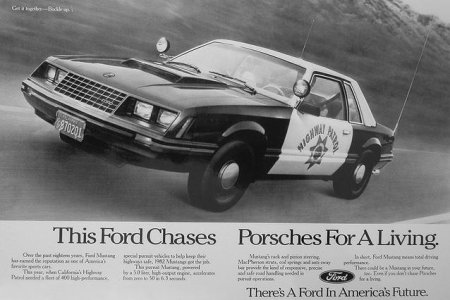
The idea goes back 40 years to when early 80s patrol sedans had no chance of catching high-powered sports cars, so the CHP put a few hundred V8 Mustangs and Camaros into the fleet strictly for pursuit.
Cop cars are supposed to be four-door.
So why did you say Camaro and Mustang---which have always been two-door cars---should be cop cars?Cop cars are supposed to be four-door.
I was certain that the ones made for police use would be made differently.So why did you say Camaro and Mustang---which have always been two-door cars---should be cop cars?
- Status
- Not open for further replies.