I think that WDBN left the format, and the call letters were changed in the early or mid 1980s. I always had a sense that they were one of the last standard-bearers for the format.

-
Get involved.
We want your input!
Apply for Membership and join the conversations about everything related to broadcasting.
After we receive your registration, a moderator will review it. After your registration is approved, you will be permitted to post.
If you use a disposable or false email address, your registration will be rejected.
After your membership is approved, please take a minute to tell us a little bit about yourself.
https://www.radiodiscussions.com/forums/introduce-yourself.1088/
Thanks in advance and have fun!
RadioDiscussions Administrators
You are using an out of date browser. It may not display this or other websites correctly.
You should upgrade or use an alternative browser.
You should upgrade or use an alternative browser.
58 years of Beautiful Music comes to an end
- Thread starter KilowattKat
- Start date

Most likely to: 'the great beyond'There's no hidden boogeyman, no massive underserved audience clamoring for beautiful music. The audience moved on.

Yet, isn't that part of the issue?
There's folks that would like to see these relics of formats on commercial radio. Industry pro's like yourself and others have explained the very viable rationale on why this is no longer commercially viable on OTA radio.
Now, as a person that might be interested in listening to these format relics of the past, one needs to have a bit of technical knowledge in order to partake of this...whether it's buying a SXM subscription, figuring out how to listen to on-line versions of these stations, et. al.
In short, for those that may not be technologically-savvy, or care to invest $$ in listening on-line, options are small - and none.
Okay, so what do---what can---we do for those people?

While I have not listened lately, KIXI AM In the Seattle market still is listed as “Adult Standards”.
I mean, yeah.Most likely to: 'the great beyond'
Although, and this was a bit of a surprise to me---there are 2.7 million people aged 90 and older in the USA right now---50 years ago, that was about 450,000. So that's people born before 1933.
Narrow the scope just ten years to people 100 and older and it's 97,000.
I just went to their website---the "Now Playing" shows:While I have not listened lately, KIXI AM In the Seattle market still is listed as Big Band/Nostalgia.
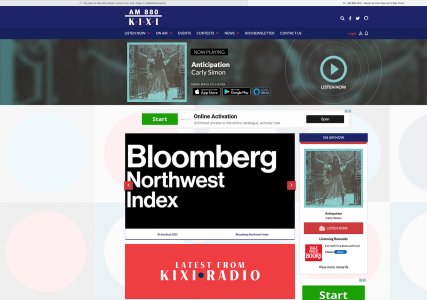
And let's not start an "Is Carly Simon Big Band/Nostalgia?" thread like the Classic Rock one, okay?
What they're doing here is pretty much all they can do. If you were 25 when "Anticipation" came out, you're turning 77 this year.
And here's just how goofy the mix gets when you're trying to do this format today:
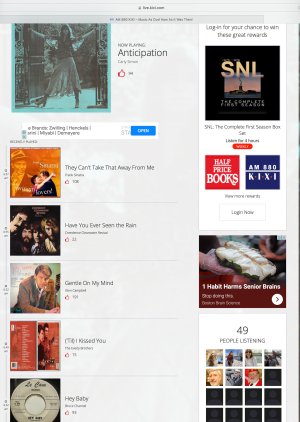
Looking at the timeline, they went straight from Creedence to Sinatra. Maybe a sweeper, but no time for a palate-cleansing spot break.
In the 6:00 a.m. hour, they also played Eric Burdon & War's "Spill the Wine".
Looking at the timeline, they went straight from Creedence to Sinatra. Maybe a sweeper, but no time for a palate-cleansing spot break.
In the 6:00 a.m. hour, they also played Eric Burdon & War's "Spill the Wine".
I edited this post from big band to adult standards.I just went to their website---the "Now Playing" shows:
View attachment 4313
And let's not start an "Is Carly Simon Big Band/Nostalgia?" thread like the Classic Rock one, okay?
What they're doing here is pretty much all they can do. If you were 25 when "Anticipation" came out, you're turning 77 this year.
Looking at KIXI's schedule, it appears music has become a small part of their programming. They play music from 9:00 p.m. to 7:00 a.m., then do an hour of Bloomberg Radio, followed by a two-hour financial advice program. From 10:00 to 3:00 p.m., it's John Tesh, which I'm guessing is still an insert-your-own-music thing for stations. There's a business show from 3:00-4:00, a healthcare show from 4:00-5:00, another hour of Bloomberg from 5:00-6:00, two hours of music from 6:00-8:00 and "When Radio Was" from 8:00-9:00.
And looking at that list, I'd question that. Scrolling back through their "recently played" page, it's really more of a traditional 1956-72 oldies station with two standards (Sinatra, Dean Martin, Tony Bennett) thrown in an hour.I edited this post from big band to adult standards.
That mixed music/talk format is a bit quirky and odd, but if it works for them, more power to them!
It's a 0.1 the last three books, and they're being beaten by two HD-2s and one stream.That is a bit quirky and odd, but if it works fir them, more power to them!
I've told this story before, but it's been a few years.
In 1977, KOLO-AM in Reno hired me because they wanted to keep their personality but modernize their music, which was largely MOR.
What they wanted me to do was to take them to the late 70s AM version of AC, which essentially was whatever the Top 40 in the market was playing, minus the five or six hardest records, and with a gold library that went back a bit further than the Top 40, which was all post-Beatles. I went with 1964 forward until an all-oldies station came on, at which point, I broadened the library back to 1956.
The target was the center of the 25-49 demographic---37-year-olds. And I got them with music that had zero standards content whatsoever.
Those 37-year-olds are 83 today. And I was playing them The Bee Gees, Chicago, Linda Ronstadt, Steely Dan, Fleetwood Mac, Jimmy Buffett and Stevie Wonder.
Standards is a whole lot older than we realize sometimes.
In 1977, KOLO-AM in Reno hired me because they wanted to keep their personality but modernize their music, which was largely MOR.
What they wanted me to do was to take them to the late 70s AM version of AC, which essentially was whatever the Top 40 in the market was playing, minus the five or six hardest records, and with a gold library that went back a bit further than the Top 40, which was all post-Beatles. I went with 1964 forward until an all-oldies station came on, at which point, I broadened the library back to 1956.
The target was the center of the 25-49 demographic---37-year-olds. And I got them with music that had zero standards content whatsoever.
Those 37-year-olds are 83 today. And I was playing them The Bee Gees, Chicago, Linda Ronstadt, Steely Dan, Fleetwood Mac, Jimmy Buffett and Stevie Wonder.
Standards is a whole lot older than we realize sometimes.
Sure, but other than incontinence supplies, (mostly TV) canes and mobility devices, (also mostly TV) what advertisers want to reach that audience?I mean, yeah.
Although, and this was a bit of a surprise to me---there are 2.7 million people aged 90 and older in the USA right now---50 years ago, that was about 450,000. So that's people born before 1933.
I wasn't suggesting that there was a salable audience there---I was just surprised that the number of people over 90 had increased by that much.Sure, but other than incontinence supplies, (mostly TV) canes and mobility devices, (also mostly TV) what advertisers want to reach that audience?
Given that the average life expectancy at birth was 61.7 years for a man born in 1933 and 65.1 for a woman, these are remarkable rates, largely attributable to 90 years worth of advancement in nutrition, lifestyles, workplace safety and medicine.

It isn’t the responsibility of any business to cater to that narrow an audience. Moreover, there have always been people who might be interested in something not on “terrestrial” radio. Now there are options for many such tastes; decades back, not so much.Yet, isn't that part of the issue?
There's folks that would like to see these relics of formats on commercial radio. Industry pro's like yourself and others have explained the very viable rationale on why this is no longer commercially viable on OTA radio.
Now, as a person that might be interested in listening to these format relics of the past, one needs to have a bit of technical knowledge in order to partake of this...whether it's buying a SXM subscription, figuring out how to listen to on-line versions of these stations, et. al.
In short, for those that may not be technologically-savvy, or care to invest $$ in listening on-line, options are small - and none.
Yes, it costs money. Maybe a modicum of technological ability. Ok, and oh well. Sorry, but it’s generally a business for the masses (in general terms).
Edit: It was WDPN, so never mind.Wasn't WDBN in Medina, Ohio one of the first, if not the first, Beautiful Music formatted radio station? I remember glancing at a book about Beautiful Music and seeing the call letters of WDBN in it.
But it was beautiful music, not that many years ago. I heard it at night.
Last edited:
Although she has done that kind of music.I just went to their website---the "Now Playing" shows:
View attachment 4313
And let's not start an "Is Carly Simon Big Band/Nostalgia?" thread like the Classic Rock one, okay?
What they're doing here is pretty much all they can do. If you were 25 when "Anticipation" came out, you're turning 77 this year.
Songs like "Anticipation" have been part of "adult standards" for many years.
Funeral homes, nursing homes, financial planners, insurance, anything related to Medicare or Social Security.Sure, but other than incontinence supplies, (mostly TV) canes and mobility devices, (also mostly TV) what advertisers want to reach that audience?
Heard on the radio an interesting related discussion on the predicted viability-of, and why the future of Social Security is always a topic of political conversation. What isn't commonly said in the discussion; is the typical lifespan of working American's went from 70-something when Social Security was invented, to 80-something today. That means your average Radio Discussions member will start collecting Social Security when they hit 65, and SSI will continue paying out now until they're 90. That's why all the political theater about how 'SSI will be going bankrupt', mainly because people live so much longer.I wasn't suggesting that there was a salable audience there---I was just surprised that the number of people over 90 had increased by that much.
- Status
- This thread has been closed due to inactivity. You can create a new thread to discuss this topic.