But the radio horizon you mentioned isn't very relevant to extended coverage via "skip" conditions, is it?We were ONLY discussing EXTENDED propagation, NOT normal coverage.

-
Get involved.
We want your input!
Apply for Membership and join the conversations about everything related to broadcasting.
After we receive your registration, a moderator will review it. After your registration is approved, you will be permitted to post.
If you use a disposable or false email address, your registration will be rejected.
After your membership is approved, please take a minute to tell us a little bit about yourself.
https://www.radiodiscussions.com/forums/introduce-yourself.1088/
Thanks in advance and have fun!
RadioDiscussions Administrators
You are using an out of date browser. It may not display this or other websites correctly.
You should upgrade or use an alternative browser.
You should upgrade or use an alternative browser.
Affect of TV Receive Antenna Height on Signal Strength it Receives
- Thread starter rfry
- Start date
Back in the old days when WJFM 93.7 was 500 kW, and there weren't many stations on 93.7, it would waft in and out for several hundred miles around under normal, or nearly normal conditions. It could have been reflected by airplanes, or rapidly changing weather fronts and conditions.
Sporadic E can be close to inverse field, so WJFM could theoretically peak at near 2.5 mV/m at 1000 miles, considering slant distance. It was fun to spot Sporadic E by the rapid bounce of the pin of a d'Arsonval signal stength meter on an old, slow AGC receiver.
Sporadic E can be close to inverse field, so WJFM could theoretically peak at near 2.5 mV/m at 1000 miles, considering slant distance. It was fun to spot Sporadic E by the rapid bounce of the pin of a d'Arsonval signal stength meter on an old, slow AGC receiver.

I referred to thermal extended propagation only.But the radio horizon you mentioned isn't very relevant to extended coverage via "skip" conditions, is it?
Much, much less significant for ionospheric bouncing around.
What is important to remember with skip though is that as one gets closer to a station, it will be strongest just slightly beyond its minimum skip distance.
This happens because as the angle gets higher, the apparent wavelength that the ionosphere "sees" is reaching the MUF.
One has to think of this as Einstein dreamed about the consequences of riding on a light beam.
Last edited:

Back in the old days when WJFM 93.7 was 500 kW, and there weren't many stations on 93.7, it would waft in and out for several hundred miles around under normal, or nearly normal conditions. It could have been reflected by airplanes, or rapidly changing weather fronts and conditions.
Sporadic E can be close to inverse field, so WJFM could theoretically peak at near 2.5 mV/m at 1000 miles, considering slant distance. It was fun to spot Sporadic E by the rapid bounce of the pin of a d'Arsonval signal strength meter on an old, slow AGC receiver.
When I lived in downtown Milwaukee for 16 years, I could regularly listen to them on most days.
Bob
For anyone who might be interested, below is a clip showing a section of a Longley-Rice coverage study for the non-D, ~4kW ERP FM stations on Willis/Sears Tower in Chicago. The study includes the effects of terrain elevations (300-ft resolution).
This study was made using parameters and techniques not present in the FCC F50,50 methods for determining FM signal coverage, so the two results are not directly comparable.
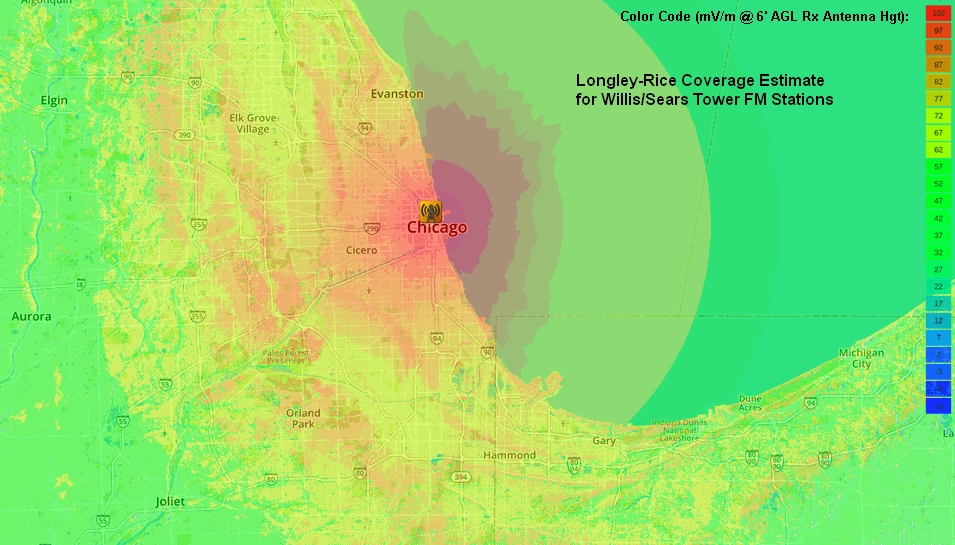
This study was made using parameters and techniques not present in the FCC F50,50 methods for determining FM signal coverage, so the two results are not directly comparable.
Last edited:
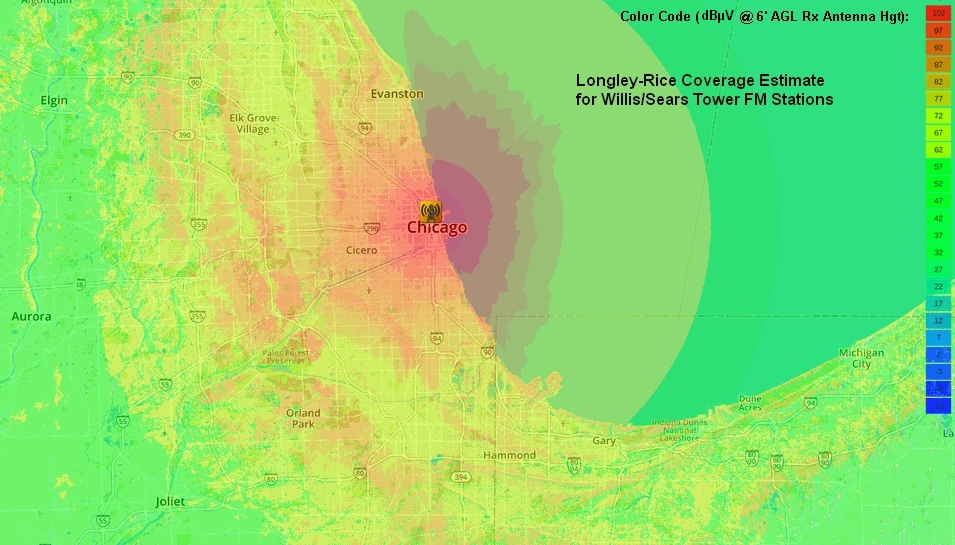
Very neat, rfry! Looks like the blue lake color is mixing with the dBu colors, which makes to kind of difficult to see the actual colors. Would like to see the East side of Lake Michigan. In Cass County, ALL Chicago analog TV stations, even UHF, could be seen on Rabbit Ears and 1 Bay Bowties. WFLD-TV 32 was perfectly clear on a small portable near Sawyer, with the telescoping whip, near Ground Level.
Back in the early 1980s, you could hear WJFM on a Panasonic Portable with the AFC off. Also WOOD-FM. This was in the NW Chicago Suburbs, near ORD.
Back in the early 1980s, you could hear WJFM on a Panasonic Portable with the AFC off. Also WOOD-FM. This was in the NW Chicago Suburbs, near ORD.
Last edited:
Very interesting rfry--Thanks for posting.
SC: I sent it to you as an e-mail attachment.... Would like to see the East side of Lake Michigan. ...
Thanks for the responses.
- Status
- This thread has been closed due to inactivity. You can create a new thread to discuss this topic.