
• Get involved.
    We want your input!
    Apply for Membership and join the conversations about everything related to broadcasting.

    After we receive your registration, a moderator will review it. After your registration is approved, you will be permitted to post.
    If you use a disposable or false email address, your registration will be rejected.

    After your membership is approved, please take a minute to tell us a little bit about yourself.
    https://www.radiodiscussions.com/forums/introduce-yourself.1088/

    Thanks in advance and have fun!
    RadioDiscussions Administrators

Affect of TV Receive Antenna Height on Signal Strength it Receives

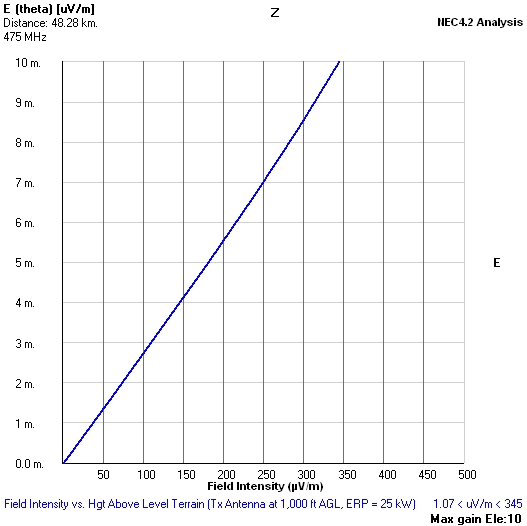
Below is a graphic showing that an approximately linear relationship applies. That is, doubling the receive antenna height above ground ~doubles the r-f voltage existing across the output terminals of the receive antenna (other things equal).

Elevating the receive antenna sufficiently may provide more improvement than that, if it reduces the propagation losses resulting from obstructed paths such as possible from nearby buildings, hills, etc.

UHF-TV-FI-vs-HAGL-30-mi.jpg
 
This is very true, particular with FM signals. There is a point of no return though. The further the signal must travel, the weaker it becomes. I've heard many times the limit for FM is "is about" 100 miles, but this is not necessarily true. I've picked up stations over 160 miles away. Those stations though, are very high above sea level, which helps them travel quite a distance. I'm going to say, 200-225 is the limit though ( unobstructed view from receiver to transmitter ) before the signal has gotten to weak for the radio to hear it. For local stuff on a average radio, and not trying to DX, yes, 75-100 miles is about right for FM. The same could have been applied to the old analog VHF/UHF TV signals. The high the transmitter, the further the signal would travel. Not trying to get technical, just keeping it elementary.
 
Before all the drop ins and squeeze ins and translators and IBOC, unduplicated and unpacked FM frequencies could be regularly heard over 200 miles away with a sensitive and selective tuner with a large FM Yagi-Log in Michigan. 50-100 kW ERP was heavily favored over skyscraper locations with lower ERP.
 
... 50-100 kW ERP was heavily favored over skyscraper locations with lower ERP.

Just an observation:

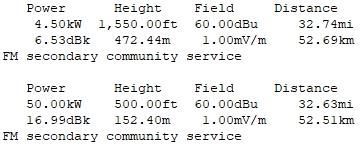
For an example, and based on the Class B equivalency required for FM stations on Willis (Sears) Tower in the Chicago Loop, their ERP must be limited to about 4 kW per polarization in order to provide the same distance to their 60 dBuV/m field contours as a reference Class B FM radiating 50 kW per polarization from 500 feet HAAT.

That reduced ERP reduces "building penetration" at relatively short distances from that transmit antenna site. However that is somewhat mitigated by the greater relative ERP they radiate from their 1-bay antennas toward elevation angles serving those buildings.

The fields received from a 50 KW ERP station and those 4 kW ERP stations if all are located at the same transmit site essentially are the same, at distances nearer to, and greater than the radio horizon (= 55.7 miles at -0.6° elevation, in the case of the Willis Tower antennas).
 
Before all the drop ins and squeeze ins and translators and IBOC, unduplicated and unpacked FM frequencies could be regularly heard over 200 miles away with a sensitive and selective tuner with a large FM Yagi-Log in Michigan. 50-100 kW ERP was heavily favored over skyscraper locations with lower ERP.

I had an FM yagi years ago. At my location in the near north Chicago suburbs I could regularly hear WIXX from Green Bay, Wi after WKQX signed off.
 
I could hear WIXX in Genesee County by nulling out WRIF 101.1, on a somewhat regular basis. I could hear WMBI-FM 90.1 on my Sony with a telescoping whip, fading in and out all the time. And WYCA 92.3, WYEN 106.7, WNUS-FM/WGCI 107.5, WFMR 96.5 and WLPX 97.3. WJML-FM 98.9 and WBRN-FM 100.9 would also come in when I had the Archer Antennacraft FM-10 antenna nulling out WRIF 101.1.
 
I could hear WIXX in Genesee County by nulling out WRIF 101.1, on a somewhat regular basis. I could hear WMBI-FM 90.1 on my Sony with a telescoping whip, fading in and out all the time. And WYCA 92.3, WYEN 106.7, WNUS-FM/WGCI 107.5, WFMR 96.5 and WLPX 97.3. WJML-FM 98.9 and WBRN-FM 100.9 would also come in when I had the Archer Antennacraft FM-10 antenna nulling out WRIF 101.1.

That's quite a haul to regularly hear those stations.
 
The major advantage of height over power is a reduction in multipath where the station being received is coming in at an angle well above the horizon.
Stations with greater height but reduced power have much less extended propagation including both tropospheric ducting and E-skip.
 
The major advantage of height over power is a reduction in multipath where the station being received is coming in at an angle well above the horizon.
Stations with greater height but reduced power have much less extended propagation including both tropospheric ducting and E-skip.

That would explain SC's reception of the Chicago stations which were running higher power and lower height than the Sears (Willis) tower.
 
This was in the early 1970s to mid 1980s, I should have added. It was before all the Docket 80-90 related stations signed on. One by one they stopped being receivable once the new stations signed on. I did hear WMBI-FM several years ago on the Delco in the Buick.
 
The horizon is a limiting factor too, since beyond that, reception will only happen it there is knife edge refraction bending the signal at some intermediate obstruction - or tropo /skip from weather effects. A signal from an antenna at 1000 ft will reach about 50 miles, without other assistance. If there are intermediate high ground areas it gets more complicated.

Here is a simple calculator on QSL.net of the line of sight distance between 2 antennas:

https://www.qsl.net/kd4sai/distance.html
 
... Stations with greater height but reduced power have much less extended propagation including both tropospheric ducting and E-skip.

Below is a comparison of the FCC F50,50 coverage radius to the 1 mV/m field intensity contours for an FM station on the Willis (Sears) Tower in Chicago and a 50 kW FM at 500 feet HAAT.

The reason for the parity of the two signals is the lower propagation loss resulting from better Fresnel zone clearance for the higher transmit antenna.

Class-B-FM-Comparison-overheight.jpg
 
Think of how bad a UHF TV antenna would have been for a hypothetical Channel 99.
And how high the transmission line losses would have been!
Only sixteen channels above the original channel eighty-three.
Many antennæ would have slightly more gain but the line loss would have been about one dB worse
 
If it was a CM-4251 Parabolic Reflector, it would be OK. Did you ever see the patterns and gain of some of the long Yagis and Log Periodics after you got much above Channel 50 though? RG-59 used to be typical in the ~1970s and the losses were pretty high up that far.
 
RG-59 used to be typical in the ~1970s and the losses were pretty high up that far.
300Ω twinlead had much less loss than typical coaxial cables of the day. Other maladies from which it suffered dropped it out of favor for practical reasons, like it's Z (impedence) went haywire when it got wet, near metal, or turned too sharply, plus the cheap stuff would be eaten up by solar UV radiation. In controlled environments, high-quality, twisted twinlead is unbeatable for long, straight runs.
 
The horizon is a limiting factor too, since beyond that, reception will only happen it there is knife edge refraction bending the signal at some intermediate obstruction - or tropo /skip from weather effects. A signal from an antenna at 1000 ft will reach about 50 miles, without other assistance. If there are intermediate high ground areas it gets more complicated.

Here is a simple calculator on QSL.net of the line of sight distance between 2 antennas:

https://www.qsl.net/kd4sai/distance.html

I'm far from a technical expert, but back in the day when the FM band was much less crowded I regularly received signals from 70-80 miles with a good yagi. As previously mentioned I often received WIXX from Green Bay, Wi about 175 miles from me. No tropo was involved.
 
This is very true, particular with FM signals. There is a point of no return though. The further the signal must travel, the weaker it becomes.

Not at all.

The only reason it becomes 'weak' is because of the curvature of the earth.

Just remember how FM signals can come in as strong as locals up to 1500 miles away during E skip.

Even more distant with a double hop.
 
Not at all.
Yes at all!
Free space path loss degrades all signals by 6dB each time the distance doubles.
This is why LEO (low earth orbit) sats are much stronger at ground level than HEO (high earth orbit) sats.
However without ground loss, a full power FM or TV station will still be full quieting at several thousand kilometers distant, like maybe several times around the world.
 
I thought VHF signals mainly depended on line of sight, not ground waves as is the case with Medium Wave signals where signal loss over distance is caused by absorption by the earth's surface.
 
Status
This thread has been closed due to inactivity. You can create a new thread to discuss this topic.


Back
Top Bottom