• Get involved.
    We want your input!
    Apply for Membership and join the conversations about everything related to broadcasting.

    After we receive your registration, a moderator will review it. After your registration is approved, you will be permitted to post.
    If you use a disposable or false email address, your registration will be rejected.

    After your membership is approved, please take a minute to tell us a little bit about yourself.
    https://www.radiodiscussions.com/forums/introduce-yourself.1088/

    Thanks in advance and have fun!
    RadioDiscussions Administrators

Affect of TV Receive Antenna Height on Signal Strength it Receives

I thought VHF signals mainly depended on line of sight.
They do, mostly, and so do flashlights, but flashlights get dimmer as you leave them, even in clear air.
As the signal goes in any direction, it spreads out, vertically and horizontally, so you lose half the energy in each plane. 3dB+3dB=6dB.
In the case of full power FM or TV stations, you could receive them above ground for many thousands of miles.
On the moon, you would receive a cacophony of stations along the outside of the earth's disc all beaming their signals along their horizons.
 
All stations would be nearly 60 6dB weaker than if you received them from a thousand miles away via E-skip. A loss that great would give you a lot to.make up for with large antennæ plus amplifiers.
 
I thought VHF signals mainly depended on line of sight, not ground waves as is the case with Medium Wave signals where signal loss over distance is caused by absorption by the earth's surface.
Surface wave signals are attenuated by travel along lossy surfaces such as Earth, but those losses are additional to the normal 1/r propagation loss of a free space path.
 
BTW...we do not use the moon as a passive reflected for two reasons:
1. It is very inefficient
(rough and absorbtive).
2. Parts of the moon are hundreds if not thousands of miles farther than the center so the reflected signal would be smeared.
"POPUD" would sound like "WWWOOOWWWUUULLL".
 
I really didn't expect to hear anything on the moon, but it would sure be interesting to hear what we could pick up in the upper layers of Earths atmosphere, AM & FM.
 
All stations would be nearly 60 6dB weaker than if you received them from a thousand miles away via E-skip. A loss that great would give you a lot to.make up for with large antennæ plus amplifiers.

So why could I hear stations from over 1,000 miles with only my portable receiver and built in antenna that came in so strong for brief times that they even activated the RDS station ID function?

https://www.youtube.com/watch?v=J4F_kVfXPtY
 
Without the earth in the way, one kilo-mile is not much for a full-power FM station.
As you quoted me, a quarter-million miles would be about 48dB weaker.
Stick one in orbit and it will cover a third of the earth.
 
So why could I hear stations from over 1,000 miles with only my portable receiver and built in antenna that came in so strong for brief times that they even activated the RDS station ID function?

https://www.youtube.com/watch?v=J4F_kVfXPtY

That was probably "E skip" which occurs due to a reflection layer very high in the atmosphere. Common on shortwave frequencies, it is rare on the FM band, and is usually erratic. It is also called "Sporadic E".
 
Oh, I was well aware that was E Skip.

But the claim was that I would need a much more powerful receiver and good antenna to hear an FM station at that distance.

Even low power FM stations can easily be heard that far during E Skip openings.
 
Even low power FM stations can easily be heard that far during E Skip openings.
Not easily! They tend to get obliterated by full-power stations.
The ionosphere would have to be favoring the LPFM location by more than 1000:1 over a class C station location.
 
The major advantage of height over power is a reduction in multipath where the station being received is coming in at an angle well above the horizon.
Stations with greater height but reduced power have much less extended propagation including both tropospheric ducting and E-skip.

Multipath is a phenomenon that occurs at the receive end, not transmission. Any receiver at whatever field strength can be affected by multipath. It's just physics. The difference is; a transmit antenna with less gain to the horizon have higher fields above and below the antenna. If a receiver is close enough to receive ground reflections plus direct, you can have severe effects of multipath close in. That was a big issue we dealt with consumers switching to receiving DTV in 1998-1999. Some viewers were using too high of gain receive antennas only blocks away from the transmission site.

Your second statement about reduced power and greater height having less chances of ducting is incorrect. It has everything to do with the frequency and corresponding atmospheric conditions related to the frequency. Sort of like the multipath situation; If one has reflective surfaces near the receiver that reflect well at the frequency(s) one is receiving, multipath occurs. If warm air currents are the correct density and traveling in the right direction, ducting will occur.

I was hired to solve a crazy-daily ducting/inversion situation with a 24Ghz microwave installation across a small body of water. You could literally stand on the roof of both building ends and see the other side, including the antenna. In an attempt to solve the problem, the contractor installed much higher gain antennas on both sides. Come to find out, between the ambient and air temperature rising off the water, I was able to receive the signal with a low gain antenna with a big hill in the way 27 miles from the transmit site. Really all I needed to do was switch polarity from Horizontal to Vertical. Even with the different polarity, one could watch the signal drop about 3dB at the same time, as the warm air rises off the water.
 
I will address your points when I get home in a few hours.
My phone is inconvenient for such a long reply.
 
In the old days, you had Class A Channels and Class B-C Channels. The Class A stations were more closely packed, but you didn't have Class B1 B C3 C2 C1 C0 and C overpowering Class As on cochannel frequencies.
 
Multipath is a phenomenon that occurs at the receive end, not transmission.
Multipath can occur anywhere along the path between points A and B although nearly all of the culprit obstructions are usually near the recipient.
A Miami TV station on channel two went circular polarity and a nearby tower began causing ghosting, a close cousin of multipath, in certain directions.
I was not referring to where the listener can tilt their head back and see the transmitting antenna.
I meant that a station thirty miles away and on the other side of obstructions that is 3Kw@600m will do much better than one that is 50Kw@150m, though both will have the same ultimate coverage area.
I lived and worked east of a downtown area with some stations on the west side that were too low to clear the buildings.
Had they been less powerful but higher up, I know that I would have heard them much better because when I traveled north to clear the obstructions, the stations all blasted in though I had gone farther from them.

Your second statement about reduced power and greater height having less chances of ducting is incorrect.
For any height, a station with higher ERP will always be extended more than one with lower ERP.
From five-hundred miles away, a 100Kw station at a height of one foot will nearly always be received with significantly more quieting than a 1Kw station on a two-thousand-foot hill or mountain,
though the later will do significantly much better within its area than the former; height is irrelevant for DXing.

I was hired to solve a crazy-daily ducting/inversion situation with a 24Ghz microwave installation across a small body of water..
I worked at a TV station with a long microwave path (WCIX/WTVJ) in Miami. We had two receive antennæ on our tower.
When the feed to our main one faded out, we would simply switch to the other; cheap, manual diversity reception. They should have used signal voting.
BTW...for tropo paths, linear polarity becomes randomized, but left hand and right hand circular should remain unaffected as long as there are no reflections.

 
... For any height, a station with higher ERP will always be extended more than one with lower ERP. From five-hundred miles away, a 100Kw station at a height of one foot will nearly always be received with significantly more quieting than a 1Kw station on a two-thousand-foot hill or mountain, ... height is irrelevant for DXing.

Not sure about that.

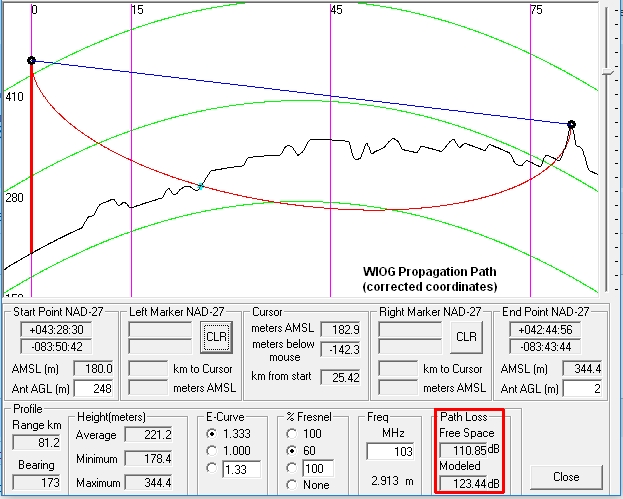
Below is a Longley-Rice analysis of a ~50-mile path over real Earth terrain. Even though a line-of-sight path exists between its two end points, this path has significant added loss from Fresnel zone obstruction.

For other things equal and the transmit antenna radiating from a much lower elevation above the earth like 100 feet, path loss would be far more than the ~123 dB shown, due to additional losses produced by diffraction of the direct wave along the terrain profile, as well as having zero clearance for the Fresnel zone.

WIOG-Path-correct-coordinates.jpg
 
I did specify a distance of five-hundred miles. not within the normal service area of any station.
Of course, within normal coverage areas, height is at least as important as the square of the ERP.
The only advantage that a high station would have at great distances is that in my example above,
its RF horizon would be a few dozen miles closer to the receiver.
 
.. The only advantage that a high station would have at great distances is that in my example above, its RF horizon would be a few dozen miles closer to the receiver.

However neither of the two stations in your example would produce a reliably useful signal over a 500-mile, great-circle path to a consumer-level FM receiver — even with its receive antenna elevated 100 feet (and more) above the surface of a perfectly smooth Earth.
 
We were ONLY discussing EXTENDED propagation, NOT normal coverage.
 
Status
This thread has been closed due to inactivity. You can create a new thread to discuss this topic.


Back
Top Bottom