KJR & KOMO Seattle Histories
Histories of radio stations KJR & KOMO Seattle
www.theradiohistorian.org
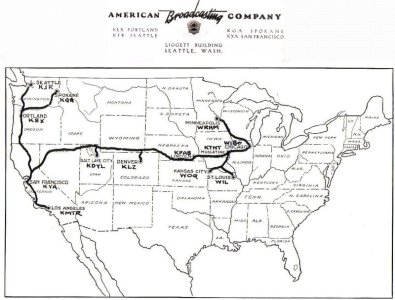
Yes prior to NBC's Blue Network getting the name American Broadcasting Company as a result of NBC being required to spin off Blue Network in the 1940's, there was a radio Network based in Seattle whose flagship station was KJR which held the name American Broadcasting Company and it had affiliates like KJR Seattle, KYA San Francisco, KMTR Los Angeles, KEX Portland and KGA Spokane as it's affiliates. The ABC whose flagship station KJR Seattle also had a deal to carry CBS programming to the west.
On November 11, 1928, KJR changed frequencies and raised its power again — this time to 970 kc with 5,000 Watts. The latest Western Electric studio equipment was installed, and equalized telephone lines were used to feed high quality audio to the transmitter.
Soon after taking over the stations, Linden signed an agreement with the Columbia Broadcasting System (later CBS) to distribute that network’s programs in the West. Columbia’s network at that time ended in Omaha, and it was anxious to extend its programs to cover the Western part of the country. The new network was called the American Broadcasting Company — the first of several radio networks to carry that name, and no relationship to the present ABC network. The agreement called for the ABC to pick up Columbia’s programs in Omaha and relay them to the West, mixed with its own programs. Most of the ABC network’s programs originated in Seattle, but KYA and the other stations also originated some shows. Also, on certain nights, Columbia would reverse the phone lines and relay the Seattle programs to the Eastern half of the U.S.7
ABC’s ambitious network program schedule debuted on December 22, 1928, with a three hour program sponsored by the Union Oil Company. On January 6, 1929, new telephone circuits were added to feed additional affiliated ABC stations in Omaha (KOIL), Denver (KLZ), Salt Lake City (KDYL) and Los Angeles (KMTR — later KLAC). The burgeoning network now had eight stations.
The payroll grew to nearly 300 people between the Westlake Square studios and Liggett Building offices. With the high expenses and modest income, some people questioned the source ofthe ABC Network's revenue. In 1928, it finally became apparent where the free-flowing money was coming from. It was discovered that Linden and Campbell had been regularly borrowing money from their own Puget Sound Savings and Loan to keep the station afloat, and to finance their lavish Camlin Hotel project. An agreement was secretly made for the payment of restitution to the Savings and Loan by the two partners in the amount of $1.5 million, and Linden resigned his position as president of the bank — but only to be replaced by Campbell.