• Get involved.
    We want your input!
    Apply for Membership and join the conversations about everything related to broadcasting.

    After we receive your registration, a moderator will review it. After your registration is approved, you will be permitted to post.
    If you use a disposable or false email address, your registration will be rejected.

    After your membership is approved, please take a minute to tell us a little bit about yourself.
    https://www.radiodiscussions.com/forums/introduce-yourself.1088/

    Thanks in advance and have fun!
    RadioDiscussions Administrators

Any currently-in-production part 15 stereo 75us FM transmitters worth owning?

I'm looking for options. What's out there these days that's 75us, stereo, reasonably clean (no audible distortion by average hearing standards), takes unbalanced headphone or stereo RCA inputs for connecting to common consumer analog sources, won't be receivable too many middle class suburban-sized houses away, and has no discernible delay (so it can be used as much for listening to music as for sending TV audio to a walkman)?

Is there anything with all this, and possibly also an input gain control (to compensate for line-level outputs lacking volume controls)?

Extra bonus points if it has even the most basic peak limiter so I can push the level a little for minimally FM hiss-free listening without inducing clipper crackles.

P.S. Apologies for asking on the engineering board, but I only trust this audience to be lead in the right direction. Nobody is going to know what 75us means in the normiesphere, and "reasonably clean" to many people outside the broadcast world actually means possibly still audibly distorted, deal-breaking EQ curves/roll-offs, etc.
 
I'm looking for options. What's out there these days that's 75us, stereo, reasonably clean (no audible distortion by average hearing standards), takes unbalanced headphone or stereo RCA inputs for connecting to common consumer analog sources, won't be receivable too many middle class suburban-sized houses away, and has no discernible delay (so it can be used as much for listening to music as for sending TV audio to a walkman)?
If you use the search function on this site, this has come up before and a few people have suggested options they've used in the past. There have also been discussions about the legality of it all, antenna type and height, etc.
 
I'm looking for options. What's out there these days that's 75us, stereo, reasonably clean (no audible distortion by average hearing standards), takes unbalanced headphone or stereo RCA inputs for connecting to common consumer analog sources, won't be receivable too many middle class suburban-sized houses away, and has no discernible delay (so it can be used as much for listening to music as for sending TV audio to a walkman)?
Are we going to play DJ?
"DJ Oldeschool spinning the hits to keep the request line lit!"
 
Mikey - I was just hoping there might some kind people who would post model numbers they knew off the tops of their heads to quicken my research along those lines, here and elsewhere. I'm a little overwhelmed with all kinds of other ongoing projects at the moment so simply hoped for a few shortcuts. :)

And Kelly, the amplifier for my "home entertainment" console has a spare analog output upon which appears the audio from the television, physical media decks, local HDD multimedia player STBs, and streaming multimedia player STBs, the latter of which can both run apps (Spotify) as well as slurp whatever raw LAN and internet endpoints I feed it -- so internet talk/music station shoutcast streams, direct podcast MP3 URLs, or live or replayable HLS/MPD URLs (e.g. video podcasts on Youtube). Pretty much everything fidelity-wise up to and including the CD player or FLACs streaming off a server on the LAN, so that's why I'm asking where I know there are good ears. I just wanna be able to walk around the property with a good portable FM headset or turn on the radios in various rooms around the house so I can listen to stuff without bugging everyone else.
 
I just wanna be able to walk around the property with a good portable FM headset or turn on the radios in various rooms around the house so I can listen to stuff without bugging everyone else.
Depending on the size of your property, that area of coverage may not comply with Part 15 rules:

§ 15.239 Operation in the band 88–108
MHz.
(a) Emissions from the intentional
radiator shall be confined within a
band 200 kHz wide centered on the op-
erating frequency. The 200 kHz band
shall lie wholly within the frequency
range of 88–108 MHz.
(b) The field strength of any emis-
sions within the permitted 200 kHz
band shall not exceed 250 microvolts/
meter at 3 meters. The emission limit
in this paragraph is based on measure-
ment instrumentation employing an
average detector. The provisions in
§ 15.35 for limiting peak emissions
apply.
(c) The field strength of any emis-
sions radiated on any frequency out-
side of the specified 200 kHz band shall
not exceed the general radiated emis-
sion limits in § 15.209.


Per the chart in 15.209 the distance for the FM Broadcast band would be no higher than 150 microvolts per meter at 3 meters (9 feet)
 
Last edited:
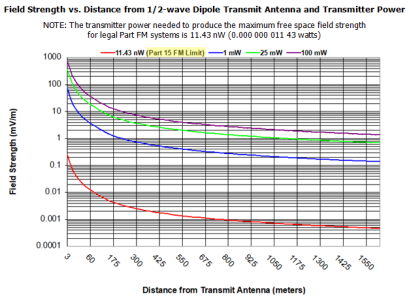
Below is a chart showing the field strengths for various transmitter powers, for the conditions shown there.

Part 15 FM Field vs Distance & Pwr.png
 
Just try to keep the signal within your block. Don’t interfere with anyone else. And hope there are no DXers in your neighborhood. Maybe use the free version of Stereo Tool for your audio processing and MPX generation.

In Las Vegas the city sets up a drive through Christmas light display synchronized to music that plays on a low power unlicensed FM transmitter. It’s on a racetrack which is several square miles. The transmitter covers the whole racetrack and a few miles along the adjacent highway. Here’s the kicker, iHeart’s on air personalities are on the station, and iHeart must have supplied the music too. I’m sure iHeart used a spare exciter running a few watts. I wouldnt be surprised if iHeart even installed a PPM encoder on the unlicensed station to boost the ratings of its AC station that goes all Christmas every year.

2 years ago I set up a transmitter for a church to cover the parking lot. They bought a 15 watt transmitter on eBay. I thought it was overkill. I put the transmitter in the middle of the church next to the PA system and hooked it up to a dipole. It was easier to keep the transmitter and antenna inside instead of running long audio and/or coaxial cables.

I needed to use the full 15 watts to have an acceptable signal in the parking lot! Inside the church the signal overloaded my SDR even with the gain all the way down and using my skin as an antenna. Outside the church the signal faded less than a block away on a car radio. This is an example of reverse building penetration. The signal was way above part 15 inside but below part 15 outside.

I may or may not have run that 15 watt transmitter outside and driven around town for an hour. Not a bad signal for a 5 foot HAAT.
 
Last edited:
15 watts right in the middle of a church almost certainly exceeds safe RF levels for the congregation, but you do you.
 
Just try to keep the signal within your block. Don’t interfere with anyone else. And hope there are no DXers in your neighborhood. Maybe use the free version of Stereo Tool for your audio processing and MPX generation

2 years ago I set up a transmitter for a church to cover the parking lot. They bought a 15 watt transmitter on eBay. I thought it was overkill. I put the transmitter in the middle of the church next to the PA system and hooked it up to a dipole. It was easier to keep the transmitter and antenna inside instead of running long audio and/or coaxial cables.

I needed to use the full 15 watts to have an acceptable signal in the parking lot! Inside the church the signal overloaded my SDR even with the gain all the way down and using my skin as an antenna. Outside the church the signal faded less than a block away on a car radio. This is an example of reverse building penetration. The signal was way above part 15 inside but below part 15 outside.
I'm guessing the church building is either steel-and-concrete or the siding is lath-and-stucco or other decorative siding. Either will reduce the signal between inside and outside by 30-40 dB, if not more. I would think that 15 watts would work just fine if the setup stays inside, and then some.

I run a 1 watt Amazon made-in-China transmitter inside my house to play my own music. With the antenna shortened to 18 inches, inside a stucco house and its associated attenuation, my signal drops fast in my van at a radius of about 200 feet, which at least in theory, keeps it legal within the spirit of the regulations (and OET 63) if not the exact wording. With all the houses built the same, no way can the signal be heard inside any other house in my neighborhood, other than maybe my next door neighbors on either side.
I may or may not have run that 15 watt transmitter outside and driven around town for an hour. Not a bad signal for a 5 foot HAAT.
"May or may not?" :ROFLMAO:

Running it outside is definitely a no-no. Making that legal (15 watts to 11 nanowatts) would require a 91 dB attenuator that could handle 15 watts (I'd go 25 watt resistors, for safety). Essentially, you'd need a dummy load with the 11 nW being stray radiation.
 
15 watts right in the middle of a church almost certainly exceeds safe RF levels for the congregation, but you do you.
As long as you don't stand within 2 feet or so of the antenna, you should be good at this power level on the FM band. I used to run 100 watts into indoor antennas and had no issues on any frequency (ham bands, of course) My WiFi and other devices, on the other hand... o_O

 
There's "should be good" and there's actually looking at what the FCC/OSHA/OET guidelines are. Running Nick's 15 watts through the FCC's Worksheet #1 shows that at 2 meters above ground, 15 watts into a vertical dipole violates FCC maximum permissible exposure levels. At 3 meters above ground, it's 50% of MPE levels, but that still exceeds the 20% limit for uncontrolled access.

Not a setup I'd use.
 
This was in 2020 when everything was shut down. Nobody was inside except the church staff. The attendees were outside sitting in their cars. I had to keep the antenna 20 feet away from the PA system to avoid RF ingress. I had the antenna sitting on one of the wooden benches and nobody would have been sitting near it.
The transmitter has not been used in over a year, ever since the services could be held indoors. I did think about using that transmitter when I was in a rush to get a silent station back on the air before it was off for a year. But I ended up obtaining a transmitter from another station and used that instead.
 
I didn't abandon this thread. Too many other things going on to look back here until now. Thanks for everyone's replies.

Again, there are a number of past discussions on this site with suggested models and information about the other stuff I mentioned above. Here's just 1:
Alright, I'll look around.

Depending on the size of your property, that area of coverage may not comply with Part 15 rules:
154 x 56 feet is the lot size. Transmitter would be in a [probably lathe and] stucco woodframe house. Typical southern California suburban construction (think Kevin Arnold's neighborhood in The Wonder Years). I would hope for full quieting to all the edges but a small white hiss at the edges length-wise would be tolerable. If I could stop the signal from going an inch beyond any of the lot's boundaries, I would. Some of the things I listen to are political podcasts (both wings) and while there are no four letter words, I don't want to get T-hunted by angry neighbors (red or blue), or bitched about to Riley Hollingsworth. I've always liked the idea of owning a great-sounding, long-range transmitter for a large rural property somewhere, but in this case, I'm hoping all I'll need is part 15 compliance. Or at least something that, once it penetrates a few walls, has fallen to part 15 compliance by the skin of the outer walls of the house.

Below is a chart showing the field strengths for various transmitter powers, for the conditions shown there.
That's a great chart, rfry. Saved. Thanks. Do you know about where, roughly, on the lefthand side stereo full quieting ends for the average FM tuner with a traditional boombox-style telescoping metal antenna or a walkman using its headphone cable as one?

I run a 1 watt Amazon made-in-China transmitter inside my house to play my own music. With the antenna shortened to 18 inches, inside a stucco house and its associated attenuation, my signal drops fast in my van at a radius of about 200 feet, which at least in theory, keeps it legal within the spirit of the regulations (and OET 63) if not the exact wording. With all the houses built the same, no way can the signal be heard inside any other house in my neighborhood, other than maybe my next door neighbors on either side.
That sounds about like what I'm looking for. Are you willing to share the make/model (if it is still being sold there)? I'd like to research it further.

Running it outside is definitely a no-no. Making that legal (15 watts to 11 nanowatts) would require a 91 dB attenuator that could handle 15 watts (I'd go 25 watt resistors, for safety). Essentially, you'd need a dummy load with the 11 nW being stray radiation.
I wonder if any of these amazon/ebay transmitter manufacturers have ever thought to sell ~15 watt units "for use with laboratory test equipment" (without specifying exactly which equipment would benefit from such a driver), and then in the package, include a short whip antenna with a standard PL-239 or BNC connector that consisted of a "leaky dummy load" at the base that allowed just the 11 nW you're referencing to radiate on into the antenna above it. "Lucky test unit conveniently doubles as legal part 15 transmitter for enjoying music around laboratory when not driving happy oscilloscope -- included free!" There are already several models with "press and hold buttons X and Y simultaneously for 5 seconds" backdoors to toggle >= 1 watt modes. Very reminiscent of all those Chinese DVD players with the "secret test menus" for disabling CSS, CGMS-A, Macrovision, and region restrictions back in the day. Remember how obvious some of them were? https://dvdmedia.ign.com/media/hardware/image/loopholesmenu.jpg

Maybe use the free version of Stereo Tool for your audio processing and MPX generation
I would be happy to as soon as someone finds a way to make a Raspberry Pi or similar run it. (With it chained to Octimax, whose preprocessing, set lightly on "Club", I find adds an old school pleasantness to StereoTool's work.) But I don't want to dedicate a 24/7 computer with two sound cards for something this minuscule. :) Great story about iHeart, by the way. If the biggest radio conglomerate on earth is doing literal institutional piracy... there may as well be no FCC at this point.

15 watts right in the middle of a church almost certainly exceeds safe RF levels for the congregation, but you do you.
I just had to include a reply to you to say: I adore your web site. Thanks for all the photos all these years, especially back in the '90s when there was nothing else like it!

 
That's a great chart, rfry. Saved. Thanks. Do you know about where, roughly, on the lefthand side stereo full quieting ends for the average FM tuner with a traditional boombox-style telescoping metal antenna or a walkman using its headphone cable as one?
Probably around 1 mV/m, which the FCC defines as about the minimum signal strength for good reception of analog FM stereo, in metro areas.
 
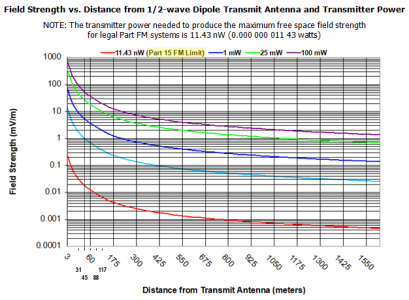
Then according to https://www.ahsystems.com/EMC-formulas-equations/field-intensity-calculation.php, for 47 meters I would want .000073 watts from a 0dBi radiator to get something that looks like the attachment. Unless there are any units with potentiometer controls, trying to find something that covers this property as ideally as possible will be impossible and the only realistic option will be going Faraday and putting something more powerful inside an old metal fishing tackle box with the lid cracked open. The degree of hinge tilt would be my potentiometer. :)
 

Attachments

  • field_strength_modified.png
    field_strength_modified.png
    76.3 KB · Views: 3
Status
This thread has been closed due to inactivity. You can create a new thread to discuss this topic.


Back
Top Bottom