In recent years, with cord-cutting rampant, I wondered if a local over-the-air only program magazine would be possible, including main and sub-channels, that would appeal to those with antennae. Here in Chicago, I counted up about 120 OTA outlets, not including subchannels.
One problem with doing that would be the extreme language fragmentation of broadcast television audiences today versus in decades past. At least here in Los Angeles, there are seemingly endless languages represented by all our stations, and I wonder how many of their viewers are fully non-English speaking. It would be difficult producing a "full service" publication like a new TV Guide, with listings augmented by articles and advertising, if everything in it but the grids was uninteresting or opaque to so many of its subscribers. During its prime, wasn't TV Guide available in an all-Spanish edition for markets with large Spanish-speaking populations? In any case, having editions for an ocean of languages would require tons of employees, and lots of ongoing market research to keep abreast of what to print, how much, where to distribute it, and so on.
I only wonder, if television is destined to be replaced with on demand video (regardless of origin), how long those listings services will last.
I think what the online listings sites need to start doing is add streaming to what they list. Picture them indexing the complete catalogs of all the VOD libraries like Netflix, plus offering traditional listings for the linear channels on all the OTT platforms like Pluto.
The real killer app feature would be if they allowed searching across all platforms simultaneously. And that means the ability to do simple searches plus power searching of any category imaginable for film and television buffs. For example, imagine that a power user wants to find every movie released in the USA between 01/01/1980 and 12/31/1989 that was done by Warner Brothers, is in English, has French subtitles available, is rated between PG and R, runs 100 or fewer minutes, is in color, is a comedy, has Danny Elfman as the music composer, and that co-stars Geena Davis. Or imagine a regular user looking for any French language film from the 1960s that's a romance with English subtitles. Or someone just searching for any and all films with Chevy Chase. Many of the linear OTT and VOD platforms don't offer this kind of searching power, and the linear television listings sites upgrading themselves to "all-platforms metadata clearinghouses" in order to give people that power would be a splendid way for them to remain relevant. They could even offer natural language AI searches of film and television series/episode descriptions, so users could find things they only remember vaguely. "Which movie was about the two high school students who rode in a phone booth to get people from antiquity for a book report in San Dimas?" Or, "which movies have scenes filmed at Raging Waters in California?"
In any case, the key thing would be that when your search results appeared, you'd see all possible sources combined -- roof antenna diginets, local broadcast stations, cable/satellite networks, and all known internet OTT platforms. From there, you could sort and drill down using the same search fields you populated when running your search. For example, if you ran the complex Geena Davis search above, you could choose to sort not just by title, but by year or length, since those two were non-exact (left blank or specified as ranges) in your search. Or you could add/remove operators (e.g. add a writer, remove the year range). The ability to sort by traditional attributes would also go without saying. E.g., by "air time" (for linear streams, cable/satellite networks, and OTA channels/diginets), by "available until" (for VOD platforms), and even by price (which would either show as "Free," "Free with Ads," give the per-view cost for PPV items on platforms like Youtube and Tubi, or show the per-month cost for whole-platform subscription services like Netflix). Searching by price would be a wonderful way, in particular, to bargain hunt.
TV and Satellite Week is still published weekly in the UK in print and digital editions.
That's different. K.M. was referring to Satellite TV Week, a now extinct U.S. publication similar to Satellite Orbit. It was also for U.S. C-band and ran during the 1980s and 1990s.
Remember TV-Cable Week, which Time Inc. launched to combat TV Guide in 1983? System-specific grid listings inside a national color section. Ran through $100 million in 20 weeks ($47 million in production costs plus a massive start-up cost) and Time folded it when only 19 cable systems, including those owned by Time Inc., picked it up. TV Guide had 17.1 million circulation at the time.
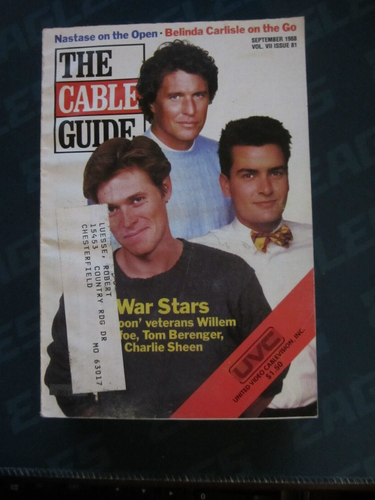
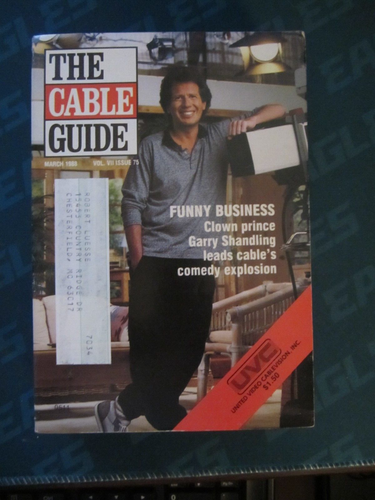
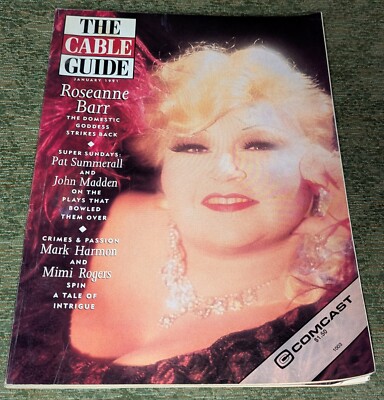
Ouch. I don't remember that publication, but I do remember one my grandmother paid for through her cable company called "The Cable Guide." It was very much like TV Guide but its contents were customized to her system's channel line-up. I found several editions for sale on eBay, including these:
Find many great new & used options and get the best deals for Cable Guide Magazine Regional TV Guide Sept 1988 Platoon Sheen Dafoe Berenger at the best online prices at eBay! Free shipping for many products!
www.ebay.com
Find many great new & used options and get the best deals for The Cable Guide Magazine Regional TV Guide March 1988 Gary Shandling at the best online prices at eBay! Free shipping for many products!
www.ebay.com
I try to do my best explaining products but make mistakes as we all do. See Photos, You will receive one of these in the photos.
www.ebay.com
Example of an inside page, customized for a specific system:
https://i.ebayimg.com/images/g/n2IAAOSwdlNnmCTs/s-l2000.jpg
While looking through those, I also noticed copies of another publication for sale called Cable Today, apparently for a cable system in the Bay Area: