• Get involved.
    We want your input!
    Apply for Membership and join the conversations about everything related to broadcasting.

    After we receive your registration, a moderator will review it. After your registration is approved, you will be permitted to post.
    If you use a disposable or false email address, your registration will be rejected.

    After your membership is approved, please take a minute to tell us a little bit about yourself.
    https://www.radiodiscussions.com/forums/introduce-yourself.1088/

    Thanks in advance and have fun!
    RadioDiscussions Administrators

Anyone listening to the yacht rock weekend on klos

Yet passionate fans take studio tours, visit the Grammy museum, and love the facts and details about the music they love. They do it every day in LA.
Yes, by the hundreds in a nation of 330 million. Most of those visitors are not locals, either.
I'm not saying they should do this all the time. Just do what Matt Pinfield did today, and connect the dots. It what DJs have done from the beginning. Otherwise, they can save a lot of money by not hiring any talent, and just play the music with no commentary. Like they do on several other LA stations. That's not what Pio is doing. He's built a station around heritage local talent who know the market, the music, and the culture.
But he is stepping out of the established bounds as he knows that LA is a market of migrants and immigrants with far less a sense of community than, let's say, in Cincinnati or Buffalo.
That's not who he's programming to at KLOS. He knows that. He's aiming at a very narrow target. Apparently he knows what he's doing.
Yet none of that has been done in the decades of decline of KLOS until Pio arrived and decided that a bit of the unusual and unexpected was needed.
 
But he is stepping out of the established bounds as he knows that LA is a market of migrants and immigrants with far less a sense of community than, let's say, in Cincinnati or Buffalo.

I sense he's delegating a lot to Keith Cunningham, who knows the format. And as the article points out, the station is now getting the best ratings in over 30 years. Likely by taking audience away from KROQ.

Yet none of that has been done in the decades of decline of KLOS until Pio arrived and decided that a bit of the unusual and unexpected was needed.

Radio used to be fun. That's what he's trying to bring back. It's working.
 
Shouldn't people be told the ingredients that go into a hot dog? I mean if people knew what they were eating when they ate a hot dog, they might not eat so many of them. (Oh yeah, the free market and all that!)
I know the ingredients. But when I am actually taking one off the barbeque, I really don't want to think about that. "Time and Place" and all that.
Bringing this back to radio, obviously not giving out factoids about the songs you're playing isn't going to kill you, making having those factoids less important than knowing what the ingredients in a hot dog are.
On a station that plays gold, the songs are generally several decades old... or more. Unless the artist or a band member just died or was inducted into a Hall of Fame today or the like, those factoids are stale and have been heard before many times by the core listener.
Maybe I'm old-fashioned and stupid but I *really* do believe that radio, because of its accessibility by the masses, has a duty, regardless of what the market thinks, to provide factoids, not about songs, but about things that could allow its listeners to make good and just decisions, especially in emergency situations.
Even if a station is live at the time of an emergency, the average DJ on the air is likely totally unqualified to do any useful action in an emergency. People know the "best sources" for emergency info, and they know that their all-music station is not one of them.

I learned this the hard way. With the #1 and #3 all music stations in Puerto Rico, in 1980 we went all-news when a major hurricane was coming our way. A ratings period was taking place, and we dropped by half or more on each station. Nobody wanted our information about the hurricane when there were renowned news stations that always did a fine job. We would have done better mentioning our all news competitors regularly, and continuing to play the hits.
With all due respect to you and many in the younger generations, radio's first goal, above being a profitable business, should be to inform the public about the world around them and what to do when emergencies arise.
But, to repeat, most stations do not have the staff or expertise to do that. And today, they don't have the money to have a back-up plan when most stations can't even be live most of the day.

One of the most noble goals of a radio station is to provide entertainment to listeners. That does not always mean covering news or community activities; it can just mean having great mixes, a fun morning show and the like. That is a service to many... as much as being a news provider.
 
I sense he's delegating a lot to Keith Cunningham, who knows the format. And as the article points out, the station is now getting the best ratings in over 30 years.
Yet all the ratings increases did not come until Ferro entered the building.
Likely by taking audience away from KROQ.
I don't see much overlap or sharing between the two stations. Alternative and classic rock generally are not the biggest sharing partners. And when they do a Yacht Rock weekend, that has to be anathema to KROQ listeners!
Radio used to be fun. That's what he's trying to bring back. It's working.
On that I agree. Fortunately, his stations are big enough to have live talent much of the time to make this work.
 
So all this fussin' and a'feudin' aside:

Who is going to post the numbers showing if KLOS' listening went up, or down, during its Yacht Rock weekend? And when will they post them?
 
Who is going to post the numbers showing if KLOS' listening went up, or down, during its Yacht Rock weekend? And when will they post them?

When the PPM numbers come out for this ratings period.

And it will have to be someone with access to the demo breakouts to be meaningful.

And weekends (especially holiday weekends) aren't that important to the overall ratings anymore.

And who knows how many regular KLOS listeners who are PPM panelists were out of town?

In other words, even when you get your answer, it may be meaningless.
 
One could say a similar thing about country music. It's artists primarily live in Nashville. The songs for the most part are written in Nashville. The music is mostly recorded in Nashville using Nashville musicians. The record labels have offices there. A lot of country music institutions are there. There is an entire media structure based in Nashville.
And the average country fan wants to know how many pounds Jelly Roll has lost this week, not what studio he laid down his latest tracks in or who has a new building on Music Row.
Lew Dickey even named a bunch of his radio stations "Nash."
And how did that go for him?
And yet amazingly, the music is played on radio stations around the world.
Mostly in just a few English speaking countries, mostly Canada, Australia, and a bit in England. In the rest of the world, country is either a niche genre or has spawned a local variety, such as in Germany... in German.

The idea that all things American are world famous is absurd. "The World Series" for decades only had American teams. Even now, baseball is of limited world interest, with just a few pockets of interest outside the United States.

My point is that the inner workings of entertainment sources, whether movies, radio, TV, music or the like, are generally not of mass, wide-spread interest.

In radio, it used to be "the thing" to talk about "Dallas" the morning after a new episode. That was because fifty or sixty million might have watched a key showing (90 million for "Who shot J.R?") with many more wanting to know even if they did not get to watch. Today, a TV show gets 8 to 10 million viewers at best... meaning that probably only about 1% to 2% of your listeners even watched it. Same for baseball, even most basketball games.

There is very little that radio can talk about in the fields of entertainment that listeners either don't already know or simply don't care about.
However, when Nashville radio stations play country music, they often make reference to some of the geographic facts I listed above. In my view, that was an opportunity missed by KLOS for its yacht rock special. But that's just me.
Until you started bringing it up, I never thought of yacht rock as being geographically identifiable with any city or area. It's not like country with Nashville or Motown with Soul or Blues with New Orleans.

The amusing thing about yacht rock is that every magazine or online article about the genre has a different perspective of what songs are and are not in the genre. Obviously, the answer to all this is to recruit a sample of people who like a montage of what everybody would call yacht rock and have them score hundreds and hundreds of other songs that might fit the broad category.

This is what would solve the question of whether "Go Your Own Way" without Lindsey's guitar solo is yacht rock or not. It's a listener decision, not one made by "experts" and "music critics".

 
So all this fussin' and a'feudin' aside:

Who is going to post the numbers showing if KLOS' listening went up, or down, during its Yacht Rock weekend? And when will they post them?
Anyone with access to the actual Nielsen report for this "month" can't and won't publish the data as it is in violation of their station or group's contract.
 
My point is that the inner workings of entertainment sources, whether movies, radio, TV, music or the like, are generally not of mass, wide-spread interest.

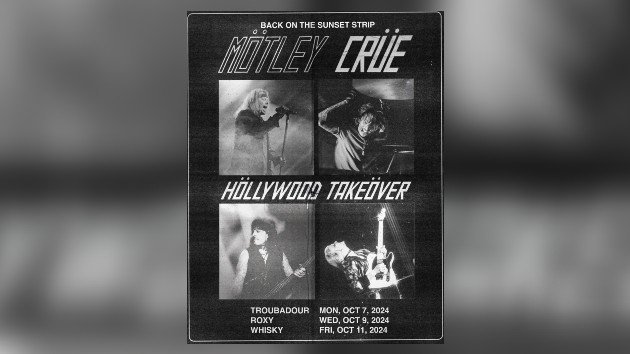
Meanwhile, this morning on KLOS, Motley Crue drummer Nikki Sixx called Heidi & Frank to talk about the band's Hollywood Takeover.


Exactly what I'm talking about. When hair bands ruled Sunset Strip.
 
Meanwhile, this morning on KLOS, Motley Crue drummer Nikki Sixx called Heidi & Frank to talk about the band's Hollywood Takeover.


Exactly what I'm talking about. When hair bands ruled Sunset Strip.
Yes, and that is of local interest in the LA market. Not so much in Shreveport.
 
Yet none of that has been done in the decades of decline of KLOS until Pio arrived and decided that a bit of the unusual and unexpected was needed.

KLOS has had plenty of quirky programming features in recent years. Pio actually eliminated a lot of the quirkiness from the day to day playlist.
 
Reminder: We're talking about KLOS, which is in LA, not Shreveport. Why bring it up?

Talking about Los Angeles is of local interest in LA. That's what I've been saying.
But in this case, it is a local event tied with a local venue with a well known rock band, Motley Crue. How many stations nationally can get a comparable event that is local, with big star names and tied with the station format?

In this case, it's a local event. The artist (Nikki) and the band will be appearing at three venues in upcoming days. This is not the same as the tired artist trivia about who played the drums or where the studio was or how the album was panned by critics but later became their biggest one ever. Old, stale.
 
KLOS has had plenty of quirky programming features in recent years. Pio actually eliminated a lot of the quirkiness from the day to day playlist.
And by doing that, he made the "big quirks" very special... rather than just another unexpected variation in what listeners came to the station for.
 
But in this case, it is a local event tied with a local venue with a well known rock band, Motley Crue. How many stations nationally can get a comparable event that is local, with big star names and tied with the station format.

Once again, I'm not talking about this from a national perspective. Go back to my first post on this subject. I'm talking about an LA radio station playing music with local connections. That's exactly what Heidi & Frank were doing this morning. They're talking about the 80s, when Nikki & the guys played Sunset Strip. It's all about the past. Listen to the interview.
 
Until you started bringing it up, I never thought of yacht rock as being geographically identifiable with any city or area. It's not like country with Nashville or Motown with Soul or Blues with New Orleans.

Exactly. It's a term that didn't even exist until 2005 for music that was 20-plus years old---and it was coined as part of a comedy video.

Some of (maybe most of) the music came from L.A., but Al Stewart, Ace and Alan Parsons were British, the Little River Band was Australian, the Atlanta Rhythm Section were from Doraville, Georgia. Boz Scaggs was from Texas via San Francisco and Bobby Caldwell, Daryl Hall, John Oates and the guys from Steely Dan were east coasters living in L.A.

All this is is a brief cycle in popular music, one that trended toward smoothness, sophistication and the re-introduction of session pros, that some guys decided to have a bit of fun with in 2005:

 
I miss jonseyes jukebox speaking of quirky

As I recall, Steve Jones had planned on going to a one-show per week schedule around 2019, but that was delayed because of his heart surgery. I'm pretty sure that the cancellation came not long after the sale of KLOS from Cumulus to Meruelo not long afterwards.

I thought he was still doing the podcast version at Jonesy's Jukebox but apparently that ended in 2022 as well.
 
Heck, if you go to Yacht Rock Radio's website there seems to be quite a few stations running it. And pretty sure a lot of those stations aren't in a warm tropical area with boating opportunities available 24/7. The majority of the stations seem to run it for a couple of hours, maybe any more than that and listeners might be throwing themselves overboard to escape it.


Back
Top Bottom