• Get involved.
    We want your input!
    Apply for Membership and join the conversations about everything related to broadcasting.

    After we receive your registration, a moderator will review it. After your registration is approved, you will be permitted to post.
    If you use a disposable or false email address, your registration will be rejected.

    After your membership is approved, please take a minute to tell us a little bit about yourself.
    https://www.radiodiscussions.com/forums/introduce-yourself.1088/

    Thanks in advance and have fun!
    RadioDiscussions Administrators

Christmas in July? Viable format switch? Will anyone tune in? Will advertisers buy?

I see. If that's the case, it seems to me that streaming is unfairly skewing things so when a big artist releases something, everyone else gets obliterated because any of their releases get crowded off the charts.

Or am I missing something? My musical interests primarily lie in charts of the past (50s, 60s, 70s, and 80s, with a bit of 90s), so I don't pay much attention to anything current other than what I read in places like this forum, and perhaps I'm misunderstanding how charts work nowadays.

c
 
If that's the case, it seems to me that streaming is unfairly skewing things so when a big artist releases something, everyone else gets obliterated because any of their releases get crowded off the charts.

Correct. That's why CHR radio doesn't follow the Hot 100, but rather its own airplay charts. The effect of streaming on the charts demonstrates the inherent difference between how people stream and how they listen to the radio. They are not the same, and one is not a replacement for the other. Streaming companies offer curated radio, but its usage is almost non-existent. People listen to Spotify or Apple Music to hear their own playlists, and that usually means a much narrower group of artists.
 
I see. If that's the case, it seems to me that streaming is unfairly skewing things so when a big artist releases something, everyone else gets obliterated because any of their releases get crowded off the charts.

Or am I missing something? My musical interests primarily lie in charts of the past (50s, 60s, 70s, and 80s, with a bit of 90s), so I don't pay much attention to anything current other than what I read in places like this forum, and perhaps I'm misunderstanding how charts work nowadays.

c
What Big A said.

Basically, everything's a single today, and at the same time nothing is a single.

Imagine if when The Beatles released the White Album in 1968, we counted how many plays each song on it got. You'd have an album from which no 45s were actually released at the time with probably 28 tracks that would chart all at once for a few weeks (I'm guessing "Wild Honey Pie" and "Revolution #9" would be a once-is-enough for most people).
 
Basically, everything's a single today, and at the same time nothing is a single.
Quite a paradox. It both is and isn't at the same time.

So, as a peculiarity of how charts work nowadays because of this paradox, when an album is released that has, say, 20 songs, it manifests on the chart as 20 singles, sequentially ordered into 20 slots that move up and down more or less as a unit depending on how many plays the album gets, and also the order of the songs on the chart can vary depending on which ones get more plays. Am I making sense?

c
 
Imagine if when The Beatles released the White Album in 1968, we counted how many plays each song on it got.

Some of this happened with their first album. At the time, radio wanted to play the most Beatles. The only way to do that was with album cuts. So you'd have several album cuts in the Top 10 at the same time.


when an album is released that has, say, 20 songs, it manifests on the chart as 20 singles,

Because people don't buy albums, they stream the songs online. So sales isn't as much of a factor as plays.
 
Some of this happened with their first few albums. At the time, radio wanted to play the most Beatles. The only way to do that was with album cuts. So you'd have several album cuts in the Top 10 at the same time.


Because people don't buy albums, they stream the songs online. So sales isn't as much of a factor as plays.
That's exactly how I consume new music. I hear that an album is coming out, I head for Spotify on the release date, listen to all the songs, bailing out one verse into the ones that don't appeal to me, then revisit my favorites for a few weeks until I've heard them enough. The ones I like most make their way onto my personal playlists. I also check out videos that my favorite artists put out on YouTube while between albums. I'm not purchasing anything, but my streaming is worth fractions of cents each time.
 
Some of this happened with their first album. At the time, radio wanted to play the most Beatles. The only way to do that was with album cuts. So you'd have several album cuts in the Top 10 at the same time.


Wanted to get this right:

Those weren't LP cuts. Billboard only charted singles on the Hot 100 (which is why, for example "Stairway to Heaven" never charted).

What made the five singles possible was the Beatles' label situation at the time. Material earlier than "Meet the Beatles" (the US album) was licensed out to small U.S. labels.

"Can't Buy Me Love" was the new single on Capitol, only two weeks old when it leapt from #27 to number one.

"Twist on Shout" was on Tollie Records and had been out for about four weeks.

"I Want To Hold Your Hand" was the old Capitol single---peaked and on its way down after 12 weeks on the chart.

"She Loves You" was on Swan and had been out for 11 weeks.

And "Please Please Me" was on Vee Jay and had been on the chart for 10 weeks.


Radio DID play Beatles' album cuts, and many charted them on their own surveys, but they did not chart on Billboard's Hot 100 until or unless they were released on a little record with a big hole.
 
Last edited:
That's exactly how I consume new music. I hear that an album is coming out, I head for Spotify on the release date, listen to all the songs, bailing out one verse into the ones that don't appeal to me, then revisit my favorites for a few weeks until I've heard them enough. The ones I like most make their way onto my personal playlists. I also check out videos that my favorite artists put out on YouTube while between albums. I'm not purchasing anything, but my streaming is worth fractions of cents each time.

I'm the opposite---I came up in the album era (post Sgt. Pepper), and I generally want to hear what the artist thinks is worthy of putting together as a package. Occasionally, there'll be a track or two that I really don't like that I'll have Apple Music ditch. More than that and the album isn't really something I want to have.
 
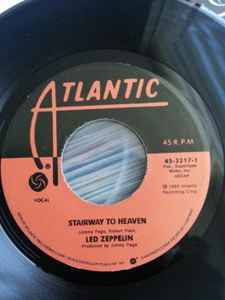
That's a UK/Europe release, BigA.

The only 45s of "Stairway" for the U.S. were promotional copies not for sale, and thus not eligible for the Hot 100.
The copyright date on that 45 is fuzzy, but it looks like 1988, which means it was some sort of re-release, regardless of which market it was pressed for.
 
The copyright date on that 45 is fuzzy, but it looks like 1988, which means it was some sort of re-release, regardless of which market it was pressed for.
I think that's right. I found the original photo online and can blow it up a bit bigger. Still not really in focus. 1988 works, though, as it has the Warner Communications logo, which was used from 1972 (the year after Led Zeppelin IV was released) until 1990.
 
That's a UK/Europe release, BigA.
The only 45s of "Stairway" for the U.S. were promotional copies not for sale, and thus not eligible for the Hot 100.

If there were promo copies then the song received airplay, and likely was tracked on some chart other than the Hot 100. The problem we have today is that most artist pages primarily use Billboard. This particular song was before R&R.
 
If there were promo copies then the song received airplay, and likely was tracked on some chart other than the Hot 100. The problem we have today is that most artist pages primarily use Billboard. This particular song was before R&R.
It was an 8 minute song & “Rock and Roll” and “Black Dog” were the album singles, those were probably more likely to be played.
 
If there were promo copies then the song received airplay, and likely was tracked on some chart other than the Hot 100. The problem we have today is that most artist pages primarily use Billboard. This particular song was before R&R.
Gonna make me work for this, huh?

LED ZEPPELIN IV was released in mid-November of 1971. It debuted at #36 on Billboard's LP chart the week of November 27.

The first single from the album was "Black Dog", which debuted at #67 the week of December 25. The follow-up was "Rock and Roll".

Billboard did not have an airplay chart at that time. I just looked.

But none of that matters, because---

A) We weren't talking about airplay charts, we were discussing the Hot 100 and the Beatles holding the top five positions with singles, not LP cuts (I parenthetically gave "Stairway to Heaven" as the example of how a hugely popular LP cut doesn't make the Hot 100 because that was a singles chart).

B) The first time Atlantic pressed "Stairway to Heaven" in the United States as a promo-only 45---was 1976. And the story behind that:

By '76, "Stairway" had become a hot item in most Top 40 stations' Gold libraries. The original copies of LED ZEPPELIN IV were five years old and had seen better days. Atlantic was getting a large number of requests from Top 40 stations to re-service the album. The promo copies were gone, and they would have had to take them from stock---and the album was still selling well. So Atlantic had a limited run of 45s made--and labelled them "Atlantic Promotional EP"---with "Stairway" on both sides.


It was library service, not an official single release, and so, "Stairway to Heaven" was not considered a single in the US, but an album cut, and as such, did not chart on its own in the US until Billboard's downloads chart---in 2007.

 
Status
This thread has been closed due to inactivity. You can create a new thread to discuss this topic.


Back
Top Bottom