• Get involved.
    We want your input!
    Apply for Membership and join the conversations about everything related to broadcasting.

    After we receive your registration, a moderator will review it. After your registration is approved, you will be permitted to post.
    If you use a disposable or false email address, your registration will be rejected.

    After your membership is approved, please take a minute to tell us a little bit about yourself.
    https://www.radiodiscussions.com/forums/introduce-yourself.1088/

    Thanks in advance and have fun!
    RadioDiscussions Administrators

Cox and the whole method used to make WSB a leader as AM is dying

R

Rick Rose 2.0

Guest
I saw some recent reports that compared the ratings for stations in 2000 to 2020 and notice that WSB actually improved its ratings while many other top 50 markets heritage 50kW news talk stations lost ratings. Those that choose to not make a serious move to FM are feeling the loss. I believe that is around 2010 that Cox made 95.5 a simulcast and now 10 years later the mention of am 750 is basically eliminated. Am radio in newer cars is basically useless. It took relaxation of some ownership rules to make 95.5 able to move to an in town tower. It was a brilliant decision to make WSB a top station in 2021 and without 95.5fm this would have never happened.
 
WSB was a pathfinder? Heritage 50KW news talk stations that never made a serious move to FM don't spring to mind.

WTMJ 620/103.3 bought a Waukegan, IL translator and moved it Milwaukee..years before Cox.
 
WSB was a pathfinder? Heritage 50KW news talk stations that never made a serious move to FM don't spring to mind.

WTMJ 620/103.3 bought a Waukegan, IL translator and moved it Milwaukee..years before Cox.
WTMJ launched its translator in 2018. Cox launched 95.5 WSBB in 2010.

50KW heritage AMs that never went to FM include.
WOR and WABC New York (Plus All-News WCBS and WINS there)
KFI and KABC Los Angeles (News KNX too)
WGN and WLS Chicago
KGO and KSFO San Francisco
WBZ and WRKO Boston
KTRH Houston

And that's just top ten markets. The majority of AMs did not move to FM (And in many markets it has not had the growth that WSB or co-owned WOKV Jacksonville did after doing so). Cox even moved WDBO Orlando back to AM and a weaker translator after being on a 100kW FM last summer so they haven't had that success everywhere.
 
Cox even moved WDBO Orlando back to AM and a weaker translator after being on a 100kW FM last summer so they haven't had that success everywhere.
And in San Diego, KOGO tried an FM simulcast, but decided it was not a worthwhile use of an FM.

In a number of cases where FM simulcasts were added, the partner was essentially a Docket 80-90 rimshot and did not contribute as significantly as a full signal FM might have.
 
We've often said that listeners will tolerate a less-than-perfect signal if it has content that they want. WSB is one of the best programmed N/T stations in the country. It would still be successful on AM. Probably not as successful, but WLW is still #1 without a full-power FM simulcast.
 
We've often said that listeners will tolerate a less-than-perfect signal if it has content that they want. WSB is one of the best programmed N/T stations in the country. It would still be successful on AM. Probably not as successful, but WLW is still #1 without a full-power FM simulcast.
There is a difference. WLW's signal is so good that it even shows in adjacent markets.

WSB's signal does not cover the full Atlanta MSA adequately.

https://fccdata.org/?lang=en&facid=73977 The blue contour is 2 mV/m, while it is broadly considered that the 10 mV/m contour is needed on AM in dense metro areas; the ITU even thinks that below 15 mV/m is inadequate.
 
What's the reason for that? Both are 50kw omnidirectional stations on similar frequencies.
From what I remember of my one road trip to Atlanta almost 30 years ago, the ground there is horrible for RF, even when a 120-radial field is installed. When I drove through the metro, WSB was the best of a bad lot on Ancient Modulation, despite the fact that they boomed into Chicago at night.

A good signal into Chicago doesn't matter if you can't cover the metro in Atlanta.
 
What's the reason for that? Both are 50kw omnidirectional stations on similar frequencies.
As Keith correctly indicated, it is about the soil (ground) conductivity of the area. Around Chicago, we have some of the higher conductivity areas in the US while in the Atlanta and northern part of GA you have nearly the worst.

And, in areas with low conductivity, the noise level has eaten up even much of the metro area coverage as a stronger signal is needed today to overcome noise.

A good example is XETRA in Tijuana: around 60 years ago, Gordon MacLendon thought it was a viable and listenable LA metro signal when he started Extra News over Los Angeles. Today, there is not a place other than along the beaches where that signal is usable. And that was with a lobe that was the equivalent of 200,000 watts aimed at LA!
 
We've often said that listeners will tolerate a less-than-perfect signal if it has content that they want. WSB is one of the best programmed N/T stations in the country. It would still be successful on AM. Probably not as successful, but WLW is still #1 without a full-power FM simulcast.
You can also turn off the stereo on a N/T FM and improve fringe area reception as well. Although sports PXP in stereo sounds awesome if properly mic'ed.
 
WSB used to run a spot that the jingle said "play in the dirt again." I thought, there is no dirt around here. Its all clay. These people don't know what real dirt is.
What are insulators made of? Ceramic. And where does ceramic come from? Clay.
So, you could say the Atlanta market is sitting on a gigantic insulator.
 
WSB used to run a spot that the jingle said "play in the dirt again." I thought, there is no dirt around here. Its all clay. These people don't know what real dirt is.
What are insulators made of? Ceramic. And where does ceramic come from? Clay.
So, you could say the Atlanta market is sitting on a gigantic insulator.
That is the best description of Atlanta's ground conductivity I have heard.
 
WSB used to run a spot that the jingle said "play in the dirt again." I thought, there is no dirt around here. Its all clay. These people don't know what real dirt is.
What are insulators made of? Ceramic. And where does ceramic come from? Clay.
So, you could say the Atlanta market is sitting on a gigantic insulator.
The jingle is referring to Pike Family Nurseries which still exists today.
 
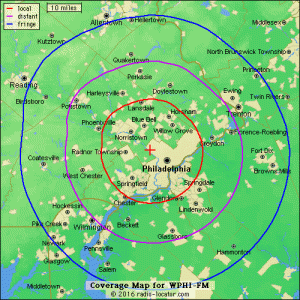
Just recently, Entercom bought a lower power FM in Philly to simulcast KYW Newsradio. I highly doubt they will "move" the station solely to FM since WPHI is only a class A station. Still, it will improve KYW's reach for sure.
 
Just recently, Entercom bought a lower power FM in Philly to simulcast KYW Newsradio. I highly doubt they will "move" the station solely to FM since WPHI is only a class A station. Still, it will improve KYW's reach for sure.
Big improvement. 1060 was iffy in Center City because of "wireless technology interference."

KYW.gif
 
Cox launched 95.5 WSBB in 2010.
The "pathfinder" for Cox was WHIO in Dayton. In 2006 they needed temporary programming for 95.7 WDPT, Piqua, OH waiting for a pending sale. So they simulcast News Talk WHIO on 95.7 and changed the call letters to WHIO-FM. The sale later fell through, but in the meantime the ratings for WHIO went up. Cox never changed the format on 95.7, and before long FM listenership eclipsed the AM. That worked out so well it led to WSBB.
 
WWL 870 is a two tower directional with a broad cardioid pattern, daytime and nighttime.
All in all, WSB and WWL are excellent AM signals.
 
Last edited:
WWL 870 is a two tower directional with a broad cardioid pattern, daytime and nighttime. It is a bit more than 50 KW ERP towards New Orleans.
There is seemingly the idea that stations would not want to be directional if it were not a condition of licensing. As you point out, WWL benefits by not "swimming with the fishes" in the Gulf, just as WBZ directionalizes to cover the populated areas around Boston better.

When in Ecuador, I got the opportunity to put on two stations, one each in the two largest cities. I decided to go for 10 kw on each, even though the two locations are only about 200 miles apart, edge of the metro to edge of the metro. I installed two directional systems. For Quito, located in the Andean highland zone that is almost pure north to south with little population to either side, I did a two-tower directional using equal length coax (measured electrically) from the final stage of the transmitter to each tower. The spacing did an elongate figure 8 without sharp center nulls. It had nice coverage for over 100 miles to the North and South.

In Guayaquil, on the Coast, we located in salt flats SE of the city and shot NNW by SSW over the coastal population areas.

Neither had phasers. Just electrically identical coax feeding each tower. The towers were spaced to achieve the desired pattern, which, since not imposed by regulation, was at our discretion. All done with a Cleveland Institute electronics slide rule and a Potomac OIB.

Buy directionalizing, we were able to use the frequency in the two biggest population centers without cannibalizing the coverage in between the two by interference of two 10 kw non-directionals right only a few hundred miles apart.

 
Markets expand. Directional AM patterns preserve 1930s realities. The protection of each other's skywave service areas has remained unchanged for decades. "Fair, efficient and equitable" distribution of radio could use a reboot. I have no idea how.
 
Another highly successful AM is KMOX (1120) St Louis. From what I can tell they "own" 1120. They are HD4 on sister station KECK. Not sure how much market penetration they have via the HD.
They have a live overnight show called Overnight America which appears to have a regional audience. They run lots of sports on weekends.
 
Status
This thread has been closed due to inactivity. You can create a new thread to discuss this topic.


Back
Top Bottom