• Get involved.
    We want your input!
    Apply for Membership and join the conversations about everything related to broadcasting.

    After we receive your registration, a moderator will review it. After your registration is approved, you will be permitted to post.
    If you use a disposable or false email address, your registration will be rejected.

    After your membership is approved, please take a minute to tell us a little bit about yourself.
    https://www.radiodiscussions.com/forums/introduce-yourself.1088/

    Thanks in advance and have fun!
    RadioDiscussions Administrators

Digital-Only Signals Could Help Bring AMs ‘Back From The Brink Of Extinction

There is another angle I'll reveal about running an AM station. I used to get people all the time trying to get us to do a format (oldies, local talk, etc.). When you are in the GM seat and start trying to figure the numbers out, the biggest challenge is building awareness. Nobody wants to trade advertising for a station station with no ratings, so you're buying those billboards and TV spots. Next, you need staff to run it and salespeople to sell it. Add in all those salaries. So, now you're leasing billboards, buying TV ads, hiring staff and paying them.

Whatever the format you choose, you can't look too successful. Why? You have lots of hungry competitors (and that includes the big boys). If you appear to be doing well, pull some reasonable ratings for an AM or are running more than a couple of spots an hour, you can bet somebody with a better signal or an FM has their eye on you and can and will steal your format after you easily invested about $1,000,000 or so to make the format go. The only thing to do is try another format at that point in hopes you can pay back that initial investment from the first format and the new format ramp up.

If you wonder why so many AM stations choose to lease to a client that provides their own programming, it's the best way to keep your budget bare bones and cover your expenses (and hopefully a tiny profit). You have less of a chance of losing your client to another station (although that happens about 50% of the time).

So, as you look at these 'investments' you have to gauge the income potential and hopefully have enough profit to pay down the investment as if it was a 10 year note.
 
Just checking the books from other markets, this doesn’t seem uncommon. KOA-AM from Denver appears in the Cheyenne book. Several Boston stations appear in the Hartford and Providence books. Several New Orleans stations appear in Biloxi and Baton Rogue books. If the station owner knows how to leverage the asset, it can be a significant revenue generator.

In most of these cases, the shares in the other markets are low. And they are adjacent markets with spillage of usable signals.

A radio market is determined by some economic factors (like commuting patterns) and mostly by listening. If a county that could be in two different markets shows more listening to one than the other, Nielsen puts the country into that metro survey area. Radio metros are radio based and are not the same in many cases as the OMB's definition of Metropolitan Statistical Areas.

But that is a minor point. The real issue is that radio advertising is bought market by market. Nobody buys an LA station to sell in Riverside/San Bernardino because they can buy local stations for one-tenth the rate... or less.

Nobody in Cheyenne will buy a Denver station for the same reasons. And so on.

So local accounts... the car dealer in San Berdoo or the A/C and Heating shop in Cheyenne won't buy an LA or a Denver station as 95% of the audience is not local.

And agencies by local stations by market. They do not buy one market's stations to cover another. Example: none of the LA stations buys the Riverside / San Bernardino books (one still gets them but is not renewing) because they can't make a dime off the coverage of an adjacent market. It's not how radio is bought.

There is no way to "leverage" tiny listening levels outside the home market. Retail accounts don't care about customers 60 miles away, and agencies have a different business model. Any extra coverage is a bonus, but not bought.

FMs can't increase coverage in 99.9% of cases as the band is "full".

In any case, the only AM stations with bigger signals now could not increase power as the US has a 50 kw limit and there are international agreements on the use of channels. Of course, even if they could increase power, they'd not want to spend the huge money needed. Example: a 50 kw Miami AM lowered its power when it sold the land for five times what the station is worth... there was no reason to invest in lots of new land and towers.
 
Geez, I don’t see how any station could stay afloat with such abysmal revenue. This seems to reinforce my theory that if the FCC allowed standalone translators, the marketplace would help eliminate these noise generators from the AM band.

Some will argue, me included, that adding FM translators for AM stations has done nothing more than add more congestion to the FM band. Same goes with LPFM's. More than 70% have failed, or had to be 'sold' to churches or organizations with NCE radio networks.

There is only so much space on the FM band. There's no way every AM station could get their own translator one to one.
 
There is only so much space on the FM band. There's no way every AM station could get their own translator one to one.

I agree, and I also don't believe it's fair to the FM owners who spent full price for a signal, and now have to compete against these translators from AM stations that bought their signals at fire sale prices. They're getting a place at the table without paying the price.
 
If the station owner knows how to leverage the asset, it can be a significant revenue generator.

Probably not. In addition to what David said, businesses tend to build themselves around media markets because it helps with marketing efficiency.

If you're based in Chicago, and advertise in Chicago mass media, and decide to expand, is it more effective to open the next branch in Des Moines, or in Kenosha, Wis.? The Kenosha branch would already benefit from the marketing you're doing, and probably have some degree of name recognition from day one.

For that reason, a business based in Denver probably has very few to no customers in Cheyenne, and a business based in Cheyenne has very few customers in Denver. There are exceptions, but I really doubt the exceptions would add up to "significant revenue" for a station like KOA, or KMOX, or WWL.

Another way to think about it: What is the revenue possibility for a radio station with a 1 share in Cheyenne, market #260? I'd guess it would cost iHeart more to have a Cheyenne-based salesperson for KOA, than that seller would bring back in revenue.
 
Probably not. In addition to what David said, businesses tend to build themselves around media markets because it helps with marketing efficiency.

If you're based in Chicago, and advertise in Chicago mass media, and decide to expand, is it more effective to open the next branch in Des Moines, or in Kenosha, Wis.? The Kenosha branch would already benefit from the marketing you're doing, and probably have some degree of name recognition from day one.

For that reason, a business based in Denver probably has very few to no customers in Cheyenne, and a business based in Cheyenne has very few customers in Denver. There are exceptions, but I really doubt the exceptions would add up to "significant revenue" for a station like KOA, or KMOX, or WWL.

Another way to think about it: What is the revenue possibility for a radio station with a 1 share in Cheyenne, market #260? I'd guess it would cost iHeart more to have a Cheyenne-based salesperson for KOA, than that seller would bring back in revenue.
In the 1970s, KGO had a 26 share at night in Portland OR, 650 miles away! I think it was Ira Blue. I wasn't a regular listener but I once heard a spot for a place a mile from my house! "...but(as the old song goes)that was once upon a time, many years ago."!
 
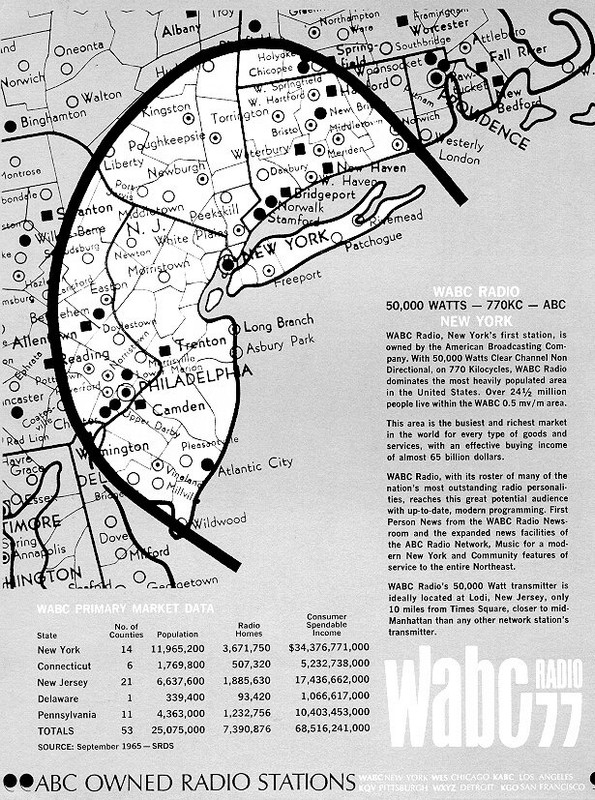
The sales material and advertising kits I’ve seen from radio stations include a summary of the of signal coverage area and reach of the station (population, demographics, etc.). I found this page for WABC indicating that their signal covers Hartford, Philadelphia, and all points in between.

06-E950-A1-ABBD-4108-80-CE-49704840-B6-EA.jpg


I can understand that this extensive reach wouldn’t appeal to a pawn shop or a convenience store owner on a street corner in Chinatown, but it would be a consideration for an agency, national advertiser, brokered time purchase, or national syndicator. Maybe the smaller and weaker stations don’t disclose this detail because it would be like pointing out a their own competitive weakness.
 
Maybe the smaller and weaker stations don’t disclose this detail because it would be like pointing out a their own competitive weakness.

Hmmm, not sure how correct the statement is Lodi is "closer to mid-town Manhattan than any other network station's transmitter."

As I recall both WCBS and WNBC towers are on City Island in the Bronx. If you look at a map, the two locations are approximately equa-distant from the GW Bridge.

My other quibble is calling it NYC's "first radio station." The fact is that when the station started, it was located in Newark NJ.

It moved to NYC in 1923, and WNBC (WEAF) had been in NYC since 1922.
 
The sales material and advertising kits I’ve seen from radio stations include a summary of the of signal coverage area and reach of the station (population, demographics, etc.). I found this page for WABC indicating that their signal covers Hartford, Philadelphia, and all points in between.

I can understand that this extensive reach wouldn’t appeal to a pawn shop or a convenience store owner on a street corner in Chinatown, but it would be a consideration for an agency, national advertiser, brokered time purchase, or national syndicator. Maybe the smaller and weaker stations don’t disclose this detail because it would be like pointing out a their own competitive weakness.

That map is the 0.5 millivolt per meter coverage; long long ago stations used to show those maps in a prime example of "puffery". No station has been able to count on even the 1 mV/m coverage since the 50's... and slowly as man made noise has reduced this in the last three or so daces to only a tiny part of past AM coverage.

And note that the map is 55 years old!

The ITU has said that in metro areas, we need a 10 mV/m signal. That does not even give WABC coverage of most of Suffolk County. Just to Rockland to the north, and only part of Monmouth to the South. To the East, parts of Somerset.

Again, ad agencies don't buy out of market stations for their local market campaigns. Radio is not important enough for most ad campaigns to start making exceptions of a handful of stations. Heck, even the software agencies buy to make buys is purely market-based. Yes, there are national buys, but they use different additive data from the individual markets and don't even contemplate the out of market stations.
 
Last edited:
Some will argue, me included, that adding FM translators for AM stations has done nothing more than add more congestion to the FM band. Same goes with LPFM's. More than 70% have failed, or had to be 'sold' to churches or organizations with NCE radio networks.

The LPFM is a terrific example of politically originated ideas that in practice just don't work. The LPFM looked good on paper, but what happened is that in a few cases they ended up with one person giving 100% of their time to a station few people listen to. Others have found that the only groups that tend to provide ongoing support are church groups who will help out with the neighborhood radio station.

I never looked, but I don't think that similar very low power stations have been tried successfully in any other country, either.

On the other hand, Mexico and Canada never over-populated the FM band, leaving the band with space for AMs to migrate. Mexico, in fact, changed the local market separation standards to match today's receivers (except near the US border where international agreements prohibit it). more than 75% of Mexican AMs have moved to FM. A few of the AMs have been given to things like serving the huge indigenous language communities in Mexico.
 
The sales material and advertising kits I’ve seen from radio stations include a summary of the of signal coverage area and reach of the station (population, demographics, etc.). I found this page for WABC indicating that their signal covers Hartford, Philadelphia, and all points in between.

That example is from 55 years ago, and the mapped contour is the 0.5mV/m daytime contour, below the level that modern listeners will accept. That contour may have been provided valuable listening back then, but not now.

Think about the radio environment in 1965. Most local markets didn't have very many AM stations. The market where I currently work had nine AM stations in 1965, of which four were daytimers. FM radio was still in its infancy as a mass-market medium, and FM receivers were far less common than AM receivers.
 
That map is the 0.5 millivolt per meter coverage; long long ago stations used to show those maps in a prime example of "puffery". No station has been able to count on even the 1 mV/m coverage since the 50's... and slowly as man made noise has reduced this in the last three or so daces to only a tiny part of past AM coverage.

And note that the map is 55 years old!

The ITU has said that in metro areas, we need a 10 mV/m signal. That does not even give WABC coverage of most of Suffolk County. Just to Rockland to the north, and only part of Monmouth to the South. To the East, parts of Somerset.

Again, ad agencies don't buy out of market stations for their local market campaigns. Radio is not important enough for most ad campaigns to start making exceptions of a handful of stations. Heck, even the software agencies buy to make buys is purely market-based. Yes, there are national buys, but they use different additive data from the individual markets and don't even contemplate the out of market stations.
I don't think you have to go back to the 50s for a usable 0.5mv/m contour. In the 70s, we had plenty of listeners in Salem OR and that's right at the end of the contour. Also, you could clearly hear the station on a car radio with a long whip antenna, all the way to but not including Eugene, more than twice the distance to Salem!
 
I don't think you have to go back to the 50s for a usable 0.5mv/m contour. In the 70s, we had plenty of listeners in Salem OR and that's right at the end of the contour. Also, you could clearly hear the station on a car radio with a long whip antenna, all the way to but not including Eugene, more than twice the distance to Salem!

I owned AM's in the 60's. Among the was 2 kw each on 570, 590 and 805 and 10 kw directional on 660 in one market, 2 kw on 1140 in another, 10 kw on 660 in yet another as well as some lesser 1 kw station on 1170, another on 840 and yet one last one on 1480. So I am familiar with the propagation of a lot of stations that I built myself.

While very rural areas could use low intensity signals back then ( I could hear almost all my own stations from 7 different markets during weekends at a hacienda of a friend we visited often) but in any urban area below at least 3 to 3 mV/m was just impossible unless you were willing to put up with some noise. Most listeners are not willing that way.

Skywave is different. But since there has been limited radio night listening for decades and decades, and advertisers ceased even including night in buys thirty to forty years ago, skywave is an exception and only applies to a couple of dozen station in the whole country.
 
I don't think you have to go back to the 50s for a usable 0.5mv/m contour. In the 70s, we had plenty of listeners in Salem OR and that's right at the end of the contour. Also, you could clearly hear the station on a car radio with a long whip antenna, all the way to but not including Eugene, more than twice the distance to Salem!

The BBG, now USAGM, still publish to this day coverage maps down to .5mVm. They used to get irritated at me when I would call them on the deceptive nature of using those contours with people who don't know better. Especially these days in a world of terrestrial noise, there is no way an average listener in a vehicle or especially a portable radio, could reliably receive that low of field strength.
 
The BBG, now USAGM, still publish to this day coverage maps down to .5mVm. They used to get irritated at me when I would call them on the deceptive nature of using those contours with people who don't know better. Especially these days in a world of terrestrial noise, there is no way an average listener in a vehicle or especially a portable radio, could reliably receive that low of field strength.

All that buzzing at intersections here even interferes with the once-impervious New York blowtorches. As for the Hartford stations, forget about anything but WTIC pushing through unaffected.
 
Status
This thread has been closed due to inactivity. You can create a new thread to discuss this topic.


Back
Top Bottom