
• Get involved.
    We want your input!
    Apply for Membership and join the conversations about everything related to broadcasting.

    After we receive your registration, a moderator will review it. After your registration is approved, you will be permitted to post.
    If you use a disposable or false email address, your registration will be rejected.

    After your membership is approved, please take a minute to tell us a little bit about yourself.
    https://www.radiodiscussions.com/forums/introduce-yourself.1088/

    Thanks in advance and have fun!
    RadioDiscussions Administrators

Do American Stations Need to Protect Other Stations Not in North America?

Three or less channels may be doable. 990 to 1240 really tuff. Most likely would be at the lowest power the transmitter would run. One would wonder in a nuclear fallout environment who is going to go to the dog house to retune the antenna? Did they ever have a test to see if changing frequency 20 or 30 channels up would really work?
There were either 5 or 6 tests of CONELRAD from the later 50’s and early 60’s. I heard several of them, and you could tell hear different stations were cycling on and then off.

The system worked as designed and was AM only. During the tests, all US stations went off the air while the designated ones were on 640 or 1240 alternating.

Stations did not retune the ATU as that can take many hours to many days. They just ran low power that allowed the system to work without overloading from SW and shutting down.

Go to worldradiohistory.com and look for the CONELRAD page.
 
Hawaiian stations are non-directional.
That may be true. But I remember something about 870 Honolulu moving to 880. That allowed the 870 in Los Angeles (now Salem talk station KRLA) to go 50,000 watts by day and add nighttime authorization at 3,000 watts. It had been a 5,000 watt daytimer.

It is interesting that several Honolulu stations run 10,000 watts (690, 760, 830 and 1040) but nobody goes over that. You'd think some Hawaiian stations would run higher power. Is it that a 25 or 50,000 watt signal would cover mostly water and not reach other islands? Or with non-directional signals, they might start interfering with stations on the mainland?
 
That may be true. But I remember something about 870 Honolulu moving to 880. That allowed the 870 in Los Angeles (now Salem talk station KRLA) to go 50,000 watts by day and add nighttime authorization at 3,000 watts. It had been a 5,000 watt daytimer.

It is interesting that several Honolulu stations run 10,000 watts (690, 760, 830 and 1040) but nobody goes over that. You'd think some Hawaiian stations would run higher power. Is it that a 25 or 50,000 watt signal would cover mostly water and not reach other islands? Or with non-directional signals, they might start interfering with stations on the mainland?
Honolulu has several impediments to higher power AM stations: first, the enormously high cost of electricity and second the huge cost of land for towers.

If you look at distances, higher power would not garner enough audience to warrant the costs.

870 tried 50 kw from across the straits to better cover Oahu, but the ceased that due to cost and minimal gains on Oahu.
 
Good question; I will look this up later. My collection does not include much on the history of the VOA / RFE / Radio Martí / et. al. but I believe that the original founding of the VOA specified that it could not direct programming at domestic audiences.

If anyone has links or sources for data on the early days of the VoA, please let me know and I will try to build a section of WorldRadioHistory about it!

Wasn't part of the Smith-Mindt act, The U.S. Information and Educational Exchange Act of 1948, was to prohibit broadcasting by the Voice of America to a domestic audience?
 
If you look at complete skywave studies on some applications, you will see that all the stations in the Region 2 Database are protected. Most stations in Central and South America don't present much of a problem, but some of them are still Class A, and have all the protected skywave points, even if they are now unused. Some of the Treaty Class As are on Regional Channels.

KFMB 760 was a thorn in the side of WJR, as 760 was not a channel that was supposed to be used as a Class II-A. The agreement with WJR supposedly limited it to 5000, and then 10000 watts Night as I recall. But we see how that ended up. There weren't supposed to be two high power stations on KDKA's 1020 frequency either, but KSWS and KTNQ ended up there.
 
Also, WCCO is the farthest North Class I-A, not WGY. Maybe the fact that WGY has a lot of its signal over the Ocean and Canada is what they meant as far as protected area covered, but Canadian area would also apply to WCCO. All the protected skywave stations in the North have substantially less distance covered under the newer skywave model. The near 750 mile coverage they used to talk about only really happens with stations further South.
 
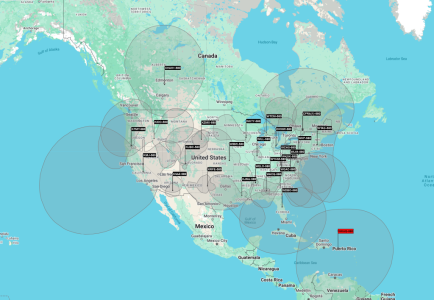
It would be good to see a map of Mexican stations, their daytime and nighttime (primarily) coverage areas, much like this site includes Canadian and Caribbean stations with U.S. stations (but not Mexican).

I include this map as the site, Night Patterns – Amateur Radio Station NF8M
is a suggestion of expected coverage areas.

This map is 580 AM:

1738562008866.png
 
Status
This thread has been closed due to inactivity. You can create a new thread to discuss this topic.


Back
Top Bottom