
• Get involved.
    We want your input!
    Apply for Membership and join the conversations about everything related to broadcasting.

    After we receive your registration, a moderator will review it. After your registration is approved, you will be permitted to post.
    If you use a disposable or false email address, your registration will be rejected.

    After your membership is approved, please take a minute to tell us a little bit about yourself.
    https://www.radiodiscussions.com/forums/introduce-yourself.1088/

    Thanks in advance and have fun!
    RadioDiscussions Administrators

Efforts to Ban Drug Commercials on Radio

Reviving this thread. Apparently, the law to ban DTC drug advertising is getting closer to reality:

This bill would ban advertising of prescription drugs. Given the advertising situation for radio, this could be catastrophic. My view is that mere advertising isn't a public safety issue. Point of purchase is where the actual safety and prevention takes place. It brought to mind that advertising for handguns isn't illegal in most states. There was an attempt to regulate handgun advertising, but it was overturned on first amendment grounds. Seems to me the same thing applies in this case.
 
This bill would ban advertising of prescription drugs. Given the advertising situation for radio, this could be catastrophic. My view is that mere advertising isn't a public safety issue. Point of purchase is where the actual safety and prevention takes place. It brought to mind that advertising for handguns isn't illegal in most states. There was an attempt to regulate handgun advertising, but it was overturned on first amendment grounds. Seems to me the same thing applies in this case.
Tobacco companies haven't been able to advertise on radio or TV since around 1970 or so.
 
Tobacco companies haven't been able to advertise on radio or TV since around 1970 or so.

The difference is that cigarette smoking was found to cause cancer. These prescription drugs don't cause disease. They just require a doctor's prescription in order to purchase. Advertising isn't harmful unless someone breaks the law. That's not the problem of broadcasters, but the sellers.

Here's some background on the cigarette ban:

 
This bill would ban advertising of prescription drugs. Given the advertising situation for radio, this could be catastrophic. My view is that mere advertising isn't a public safety issue. Point of purchase is where the actual safety and prevention takes place.
Admittedly, this policy would be bad for radio and most especially TV, but good for the rest of us.

Medicare spent almost $276 billion in 2023 on prescription drugs, and a huge percentage of them were the drugs you see advertised all the time. The top 5 were Eliquis, Ozempic, Jardiance, Trulicity, and Xarelto. Together, the government spent $50 billion on those drugs to treat only 9 million people. Private insurance and Medicaid surely spent even more.

The single most expensive drug for Medicare is Eliquis, a blood thinner. Medicare pays $600 a month per patient for Eliquis, compared to $10 per month for warfarin, which had been the standard treatment for decades. Today, 80% of Medicare recipients who take a blood thinner use Eliquis. Why? Pfizer spent hundreds of millions on ads to convince patients that Eliquis is safer than warfarin.

For scale, the government spends dramatically more on Eliquis than it does on the FBI. $18 billion for Eliquis, and $11 billion (in 2021) for the FBI.
 
Medicare spent almost $276 billion in 2023 on prescription drugs, and a huge percentage of them were the drugs you see advertised all the time.

So maybe the problem is the high cost of prescription drugs, not the advertising. I thought the president said he had a plan to bring down the cost of prescription drugs. Here's the reality: If the government bans advertising, the cost of drugs won't go down. The drug companies will just find other ways to get their message out. Drug prices are high in this country (compared to others) because we allow them to be.
 
So maybe the problem is the high cost of prescription drugs, not the advertising.
As with most things in politics, this isn't an either/or scenario.

There's only two scenarios that can be true:
1. Advertising doesn't work, so all those millions Pfizer, GSK and Bristol-Meyer-Squibb spend are wasted
2. Advertising does work, and so all those millions in ad dollars are at the root of the problem.

I know which one of those two the media industry wants to be true.
 
First you say:

As with most things in politics, this isn't an either/or scenario.

And then you give an either/or scenario
There's only two scenarios that can be true:

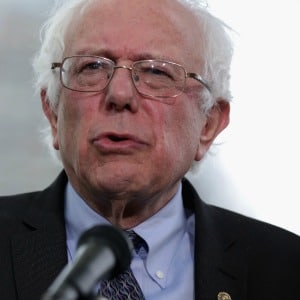
Sanders believes that by banning drug advertising, that will lower the cost of drugs. What he really should do is pass a law that caps the price of drugs. He's hurting broadcasters, when he really wants to hurt big pharma. He's aiming his law at the wrong place.
 
So maybe the problem is the high cost of prescription drugs, not the advertising. I thought the president said he had a plan to bring down the cost of prescription drugs. Here's the reality: If the government bans advertising, the cost of drugs won't go down. The drug companies will just find other ways to get their message out.
Absolutely. Businesses are in business to sell, and they will simply look to other methods for promotion. I dread that those millions in ad money end up filling my mailbox (real and virtual) with drug promotions.
Drug prices are high in this country (compared to others) because we allow them to be.
Pärt is the system of intermediaries. We have the most complex system in the world and each step adds a percentage to the cost. In my area, we are less than 2 hours from Mexicali, Mexico. Many people drive there regularly for all their prescriptions; the same drug companies operate in Mexico as here and the drugs are the same, but the cost is about 25% of U.S. retail prices.

Ooops. Non-broadcasting topic, but a good talk show subject.
 
What he really should do is pass a law that caps the price of drugs. He's hurtin
That sounds like a good idea, but (this is most likely off topic) I think that government price controls is a rather slippery slope...
 
That sounds like a good idea, but (this is most likely off topic) I think that government price controls is a rather slippery slope...
Instead encourage more compounding by Pharmacists for any drug over $100 a month.

The US customers literally have paid for most of the Pharmacical companies' R & D since WW2 when we had the only economy that was not severely screwed up from the war.

I am really disappointed that the old NAFTA treaty did allow easier access to Canadian Drug Prices. We should see Canadian or Mexican pharmacies advertising like Walgreens or CVS.
 
Instead encourage more compounding by Pharmacists for any drug over $100 a month.

The insurance providers get very nervous about that. You could find a lot less coverage if such compounding took place, since doing so would automatically be outside the formulary.

I am really disappointed that the old NAFTA treaty did allow easier access to Canadian Drug Prices. We should see Canadian or Mexican pharmacies advertising like Walgreens or CVS.

Again, that took those prescriptions outside of insurance coverage.

I don't know your age, but I am 69, and therefore my prescription drug coverage is governed by federal regulations. One of those says "no coupons or manufacturer discounts" and another says "no non-domestic filling of prescriptions". Effective this year, anyone who has drug coverage through Medicare cannot be charged more than a cumulative total of $2000 in co-pays per calendar year. (I am about to hit that limit with my next prescription refill.) But any prescription filled outside of insurance doesn't count. At all.

Sorry, but even with its flaws, the existing process works. I, for one, am not going to support your dismantling of it.
 
I am really disappointed that the old NAFTA treaty did allow easier access to Canadian Drug Prices. We should see Canadian or Mexican pharmacies advertising like Walgreens or CVS.
Walgreens now owns the largest pharmacy chain in Mexico. However, the trend is toward low-cost pharmacies, such as Dr. Simi, which is one of the main clients of national radio. Unlike Benavides (Walgreens), which is entirely focused on digital, neglecting traditional media.
 
The insurance providers get very nervous about that. You could find a lot less coverage if such compounding took place, since doing so would automatically be outside the formulary.


Again, that took those prescriptions outside of insurance coverage.

I don't know your age, but I am 69, and therefore my prescription drug coverage is governed by federal regulations. One of those says "no coupons or manufacturer discounts" and another says "no non-domestic filling of prescriptions". Effective this year, anyone who has drug coverage through Medicare cannot be charged more than a cumulative total of $2000 in co-pays per calendar year. (I am about to hit that limit with my next prescription refill.) But any prescription filled outside of insurance doesn't count. At all.

Sorry, but even with its flaws, the existing process works. I, for one, am not going to support your dismantling of it.

I have just crossed the $2k copay last month I get that. If I could pay what a person in the UK pays I would have spent around $850 total so far this year average retail without insurance. No I don't want to shovel snow so I will pay the extra

I believe sooner or later American healthcare will go broke paying multiple times for the same drugs as the rest of the world pays for the same drug.

According to healthline.com the average price of Ozempic in the USA is around $936 per month. In Japan the next highest average cost is $169, it's $93 in the UK. If the US Government and Trump have the guts to stand up to the Prescription Drug Cartel at least change the rules to allow local pharmacy made drugs to be used for Medicare part D it would save the taxpayers billions.

The "formulary" is just part of the insurance companies tatics of not paying. If a drug is approved by the FDA it should be covered period. That being said a retail price similar to what the rest of the world pays should be part of approval process.

Here is what someone working with AI should check:

Find prescription drugs in Canada that cost more than the same drug in the USA.
The insurance providers get very nervous about that. You could find a lot less coverage if such compounding took place, since doing so would automatically be outside the formulary.


Again, that took those prescriptions outside of insurance coverage.

I don't know your age, but I am 69, and therefore my prescription drug coverage is governed by federal regulations. One of those says "no coupons or manufacturer discounts" and another says "no non-domestic filling of prescriptions". Effective this year, anyone who has drug coverage through Medicare cannot be charged more than a cumulative total of $2000 in co-pays per calendar year. (I am about to hit that limit with my next prescription refill.) But any prescription filled outside of insurance doesn't count. At all.

Sorry, but even with its flaws, the existing process works. I, for one, am not going to support your dismantling of it.

I understand it's better now than 5 years ago.
I have already joined the $2k club, but I still am blessed enough to still have to pay quarterly tax estimates.

IMHO the current US healthcare system will go broke unless something happens to the Big Pharma Cartel. One example is Ozempic. According to healthline.com: Ozempic retails for around $936 a month in the USA. In Japan the next highest country it has a list price of $169 a month. The UK (which I believe still includes Canada) it is $93. The US is getting screwed.
 
Then why the disclaimers?

The lawyers and the government. If it was up to the drug companies, it would be all good news and happy music.

I was at an amusement park the other day, and there was a big list of disclaimers before I could ride the roller coaster.


Back
Top Bottom