• Get involved.
    We want your input!
    Apply for Membership and join the conversations about everything related to broadcasting.

    After we receive your registration, a moderator will review it. After your registration is approved, you will be permitted to post.
    If you use a disposable or false email address, your registration will be rejected.

    After your membership is approved, please take a minute to tell us a little bit about yourself.
    https://www.radiodiscussions.com/forums/introduce-yourself.1088/

    Thanks in advance and have fun!
    RadioDiscussions Administrators

FCC to consider ongoing operation of existing FM6/Franken FMs, Expanded FM Band and Elimination of Reserved Band Protection Requirements

Michi

Moderator
Staff member

At the June FCC Open Meeting, the Commission will consider a Notice of Proposed Rulemaking (NPRM) in MB Docket 03-185 in regards to Low Power TV (LPTV) stations operating on Channel 6 that provide an analog FM radio service on 87.75 MHz. REC and the FCC refer to these as "FM6" stations and they are commonly referred to as "Franken FM" stations. The FCC is also considering changes that would eliminate the reserved band FM Channel 6 protection requirements and to extend the FM broadcast band to 82.1 MHz in areas where no channel 6 operations are taking place.

It is important to remember, this is only a proposed rulemaking. The FCC has not yet approved ongoing FM6 operations, nor will the June decision approve such operations. The June decision is to re-open and expand the discussion of specific changes to the rules and like in all other NPRMs, may result in some, all or no rule changes.

Maintaining the status quo for 13 FM6 LPTV stations​

For many years, LPTV channel 6 stations have found some success with using the analog audio carrier frequency of Channel 6 (87.75 MHz) to reach FM radios and operating unrelated video on their analog video carrier as the audio carrier of TV Channel 6 can be received on many FM radio receivers. With the shutdown of analog LPTV on July 13, 2021, LPTV stations operating as FM6 stations were able to seek special temporary authority (STA) to continue the analog carrier operations. New technology that has been developed allows for the insertion of an analog audio carrier within the 6 MHz spectrum of a digital television signal. This is done by allocating the lower portion of the 6 MHz TV channel to operate as a narrower digital data stream while the upper portion is used for the analog FM carrier. This permits a functional digital television station with related audio and video to operate along side the analog service. This utilizes the new ATSC3 standard.

In the NPRM public draft document, the FCC will be accepting comments on various issues including whether continued FM6 operations are in the public interest. According to the draft, there are currently 13 LPTV stations engaged in FM6 operation on STAs. The question is also being raised as to whether FM6 operation should be considered as an ancillary or supplementary service, which would mean that such services would be required to make an additional fee payment that is equivalent to 5 percent of the FM6 operation's revenues.

The FCC is also asking whether they should codify the various conditions that FM6 has been authorized to operate with under the STAs. This includes that it must operate in conjunction with an ATSC3 low power digital television service, FM6 operations can only be conducted on 87.75 MHz, no interference to other services, the station's audio and video carriers must reach similar populations, periodic written reports detailing no interference and the service reaching similar aural and video populations, the station must operate at least one free-to-air video stream, the technical facilities cannot be modified and that the station cannot be transferred. The FCC is also asking whether FM6 operations should be subject to certain rules that apply to FM radio broadcast stations.

Under the FCC proposal, only those LPTV stations that are currently engaged in FM6 operations would be able to do so and no new FM6 operations would be authorized.

Extending the FM band down to 82 MHz​

In the past, both REC and NPR have advocated to extend the FM broadcast band to accommodate new noncommercial educational (NCE) FM broadcast stations. NPR endorses the use of Channel 6 spectrum, while REC had endorsed the use of Channels 5 and 6 in areas where spectrum is available. NPR states that the spectrum occupied by TV Channel 6 could accomodate up to 30 new FM stations (actually up to 30 channels within the 6 MHz TV channel). Both NPR and REC have stated in the past that the use of 82~88 MHz for FM sound broadcasting would be a far better use of a scarce resource and provide much more diversity than the use of the spectrum by an FM6 operation, or for that matter a single Chanel 6 TV station without FM6 operation. The FCC seeks comments on whether an expanded FM band should be limited to noncommercial operations or whether spectrum should also be available for commercial stations. The FCC is also inquiring about the availability of radio receivers to receive the 82-88 MHz "Wide FM" broadcast band, especially considering that most radio receivers marketed in the United States only receive about 2 or 3 channels within the proposed expanded FM band.

Eliminating the reserved band Channel 6 protection requirements​

Since 1985, broadcast stations operating on 88.1~91.9 MHz, also known as the "reserved band" had to provide a level of protection to Channel 6 TV operations. Full service FM stations only had to protect full service TV stations, while LPFM, FM translator and FM booster stations had to provide protection to both full service and LPTV Channel 6 stations. In 2018, REC proposed changes specific to protection of Channel 6 by LPFM stations requesting that the FCC revert from using a "simple" distance separation method to using a contour based separation model. This was because the maximum facility values that were attributed to TV Channel 6 stations far exceeded most existing Channel 6 operations at the time. This was most pronounced by Channel 6 LPTV stations where an REC study demonstrated that a very small number of Channel 6 LPTV stations were operating at or near the maximum facility that the distance separation rules were based on. In MB Docket 19-193, the FCC had originally proposed in a circulation draft, to eliminate all FM to Channel 6 protection requirements. This was a totally unexpected move that even surprised REC. Due to two weeks of back-and-forth ex parte communications, with the most vocal objections being made by ABC Disney, the licensee of full-service Channel 6 station WPVI, Philadelphia, the FCC turned back on the complete elimination, but instead gave LPFM what REC originally asked for on a waiver basis.

In 2009, NPR demonstrated that newer digital television receivers are substantially less vulnerable from FM interference than on older analog television sets. The FCC is seeking comments on this issue, especially in light of the recent repack of television channels with the loss of Channels 38 to 51.


REC's initial positions on these various issues​

While REC will completely reevaluate the issues, especially given the amount of time when these various items were last considered and with various events that have taken place including the recent repack as well as the recent rulemaking proceedings initiated by Gray Television and others to reallocate VHF TV stations to UHF, we will be prepared with a fresh set of comments and positions when the comment period is ripe on this proceeding.

In the past, REC has taken a positions that FM6 operations, if permitted, should be required to also follow various radio administrative and technical rules, including maximums on service contour sizes. In addition, commercial FM6 operations should be paying annual regulatory fees comparable to those of FM stations with similar facilities in the market, with the additional understanding that FM6 operations are secondary, but under the current rules, would only be able to be displaced by a full-service Channel 6 operation.

In the past, REC has supported an extended FM band that would repurpose TV Channels 5 and 6 (76~88 MHz) for FM sound broadcasting. In the past, REC has presented allocation plans that would protect existing Channel 5 and 6 primary full-service TV stations as well as plans that would call for the reallocation of TV stations out of this spectrum. With the latter, REC was cognizant that some stations, such as WPVI are in very spectrum crowded areas, where the opportunity to move to another channel, even within low VHF would not be possible. In the past, REC has advocated for a complete elimination of VHF low band television operations with reallocations to sound broadcasting, the Amateur Radio Service and other potential future narrow band operations where operation at these longer wavelengths would be practical. This last position is, of course, extremely forward thinking and does not reflect the reality of the current landscape in the low VHF TV broadcast band.

REC has advised the Commission on numerous occasions that the spectrum from 76~88 MHz is currently used in Japan as a part of their primary FM sound broadcast band (Japan's original FM band went from 76~90 MHz) and within the past decade, Japan has extended their FM broadcast band to 95 MHz to support their own form of "AM Revitalization". As a result, virtually all FM radios now marketed in Japan are called ワイドFM (Wide-FM) and cover the entire 76~108 MHz band. This includes radio models of all types from table models, portable radios and vehicle entertainment systems. The spectrum from 76~88 MHz is also used in Brazil and marketed as "eFM". It has been REC's position that radio receivers that are already being manufactured can be marketed in the United States (initially without any HD Radio capability) and can be of interest, especially to niche audiences such as expatriate communities.

While REC's position is that the FM to Channel 6 protection requirements should be limited, we agree that the discussion of the complete elimination of Channel 6 protections was not given a complete consideration in MB Docket 19-193 as only REC's petition to maintain, but liberalize the Channel 6 protection requirements by LPFM stations was under consideration. We agree that the discussion on total elimination of Channel 6 protections should be given a "full set of downs" with a comment and reply period. This new proceeding will be just that.

Again, these are initial positions based on historical positions taken by REC Networks in the past and are subject to change. REC will give each issue at hand in this proceeding a fresh look and consideration from an administrative, technical and common sense perspective.
 
The FCC is also considering changes that would eliminate the reserved band FM Channel 6 protection requirements and to extend the FM broadcast band to 82.1 MHz in areas where no channel 6 operations are taking place.

Extending the FM band down to 82 MHz​

In the past, both REC and NPR have advocated to extend the FM broadcast band to accommodate new noncommercial educational (NCE) FM broadcast stations. NPR endorses the use of Channel 6 spectrum, while REC had endorsed the use of Channels 5 and 6 in areas where spectrum is available. NPR states that the spectrum occupied by TV Channel 6 could accomodate up to 30 new FM stations (actually up to 30 channels within the 6 MHz TV channel). Both NPR and REC have stated in the past that the use of 82~88 MHz for FM sound broadcasting would be a far better use of a scarce resource and provide much more diversity than the use of the spectrum by an FM6 operation, or for that matter a single Chanel 6 TV station without FM6 operation. The FCC seeks comments on whether an expanded FM band should be limited to noncommercial operations or whether spectrum should also be available for commercial stations. The FCC is also inquiring about the availability of radio receivers to receive the 82-88 MHz "Wide FM" broadcast band, especially considering that most radio receivers marketed in the United States only receive about 2 or 3 channels within the proposed expanded FM band.
HOLY COW there's a chance! REJOICE!
 
In the past, both REC and NPR have advocated to extend the FM broadcast band to accommodate new noncommercial educational (NCE) FM broadcast stations.

I agree with that view, and would also suggest moving current non-commercial stations operating in the commercial part of the band to the new "extended band." That would open space in the commercial spectrum being used by non-commercial stations. It would also mean that any current franken FMs would have to operate non-commercially.
 
I agree with that view, and would also suggest moving current non-commercial stations operating in the commercial part of the band to the new "extended band." That would open space in the commercial spectrum being used by non-commercial stations. It would also mean that any current franken FMs would have to operate non-commercially.
I do not feel that it is necessary for stations on commercial allotments that choose to operate as NCE to be forced to change into the new band. With a very few small exceptions, most of the stations in the commercial part of the band that choose to operate noncommercially can, at any time, change back to commercial operations. There should, however, be an ownership cap on noncommercial stations (which would be totally out of scope for this NPRM).

In addition, there would need to be some serious protections given to existing full-service Channel 6 TV operations, albeit, there's only 8 full-service Channel 6 stations remaining, they would need protection. Just to protect WPVI in Philly, stations in NYC, Baltimore and Washington would have to operate at reduced powers or with directional antennas to protect the embedded TV stations. I am working on proposed protection methods for "co-channel" channel 6 stations and I will present that in the comment period.
 
I do not feel that it is necessary for stations on commercial allotments that choose to operate as NCE to be forced to change into the new band.

If the idea is to extend the band to accommodate 30 new non-coms, then why should non-coms also get space in the commercial band? Otherwise eliminate the "reserved band" aspect and open that portion of the band to any kind of operation.
 
Let's review this point-by-point, now that I've come off that "expanding the FM band" high.
It is important to remember, this is only a proposed rulemaking. The FCC has not yet approved ongoing FM6 operations, nor will the June decision approve such operations. The June decision is to re-open and expand the discussion of specific changes to the rules and like in all other NPRMs, may result in some, all or no rule changes.
I will keep that in mind. Since the FCC requests comment, how do I respectfully reach them?

Maintaining the status quo for 13 FM6 LPTV stations​

For many years, LPTV channel 6 stations have found some success with using the analog audio carrier frequency of Channel 6 (87.75 MHz) to reach FM radios and operating unrelated video on their analog video carrier as the audio carrier of TV Channel 6 can be received on many FM radio receivers. With the shutdown of analog LPTV on July 13, 2021, LPTV stations operating as FM6 stations were able to seek special temporary authority (STA) to continue the analog carrier operations. New technology that has been developed allows for the insertion of an analog audio carrier within the 6 MHz spectrum of a digital television signal. This is done by allocating the lower portion of the 6 MHz TV channel to operate as a narrower digital data stream while the upper portion is used for the analog FM carrier. This permits a functional digital television station with related audio and video to operate along side the analog service. This utilizes the new ATSC3 standard.
From what I have seen, the new tests have been highly successful. Several stations, including WTBS, KXDP, WRME, and KBKF (all LD) have noted that their NextGen signal does not interfere with the 87.7 frequency, and vice versa. In addition, the signals achieve the same distance (which is to be expected, because of the HEVC codec in ATSC3 that wasn't available in ATSC1.
In the NPRM public draft document, the FCC will be accepting comments on various issues including whether continued FM6 operations are in the public interest. According to the draft, there are currently 13 LPTV stations engaged in FM6 operation on STAs. The question is also being raised as to whether FM6 operation should be considered as an ancillary or supplementary service, which would mean that such services would be required to make an additional fee payment that is equivalent to 5 percent of the FM6 operation's revenues.
So, most of today's Franken FM's such as KXDP and WNYZ, serve a Spanish-speaking audience, so I think it is in the interest of minority groups to continue these operations to run. It is expensive to afford a radio-station, get the licensing out and everything, and these Channel 6 FM's have afforded these minorities an opportunity to broadcast their culture. This is what LPFM's were supposed to solve, but IMO the LPFM's have become a landing spot for churches, which half the time doesn't provide things a "community" would expect from a "community" station, such as a calendar, locally inspired music/talk, and lost/found support services. That is not to say that all religious LPFM's are bad, because some, like KWYG-LP in Wyoming, do a very good job of adding that local element while carrying what is truly a regional if not national format. It should be in the public interest to provide a small section of the band dedicated to helping local interests and Ethnicities get on radio, who might otherwise not have a voice, or resort to piracy. Not all pirates are jerks, they just can't afford to broadcast anywhere else. Hopefully, the FCC will consider small groups when deciding either to keep Franken FM's, or expand the FM band. Without such groups, actually, the Franken FM's are otherwise a repeat of what you can find elsewhere on the band. It might also be in the public interest to give LPFM's their own chunk of the band, in a similar fashion to Franken FM's, but without the hassle of being on Channel 6.

One thing in favor of Franken FM's is that you get a TV signal and an FM signal packed into one, which may serve doubly. When one tunes into WRME-LD (at least before they switched to Jewelry TV), there was a constantly updating weather map. Useful! On WDCN-LP, local ads ran on the screen. Useful! However, not all Franken-FM's do this. There was one in Florida that just put a blank screen on channel 6. Not useful! The one in Georgia, WTBS-LP, stopped broadcasting the audio-carrier altogether, I kid you not. However the advent of the ATSC 3.0 signal has uniquely given these stations to broadcast as many video streams as they wish, while having the 87.7 audio broadcasting something else. There is mixed implications here, and as I mentioned earlier, WRME-LD Chicago now runs Jewelry TV on virtual channel 33, while still having "Me-TV audio" on 87.7.
The FCC is also asking whether they should codify the various conditions that FM6 has been authorized to operate with under the STAs. This includes that it must operate in conjunction with an ATSC3 low power digital television service, FM6 operations can only be conducted on 87.75 MHz, no interference to other services, the station's audio and video carriers must reach similar populations, periodic written reports detailing no interference and the service reaching similar aural and video populations, the station must operate at least one free-to-air video stream, the technical facilities cannot be modified and that the station cannot be transferred. The FCC is also asking whether FM6 operations should be subject to certain rules that apply to FM radio broadcast stations.
As I have mentioned before, the current tests have ran very well. Because FM6's are practically FM from the perspective of a reugular listener, they should be held to similar standards regarding Legal ID's, advertisements, and what not, however we do need to give them financial leniency, otherwise it's just another part of the FM band, and these LP's probably will go away if that were to happen, with maybe one of them finding a forever home after going off channel 6.
Under the FCC proposal, only those LPTV stations that are currently engaged in FM6 operations would be able to do so and no new FM6 operations would be authorized.
Talk about maintaining the status quo here, are possibly putting those FM6's on life-support here.

Extending the FM band down to 82 MHz​

In the past, both REC and NPR have advocated to extend the FM broadcast band to accommodate new noncommercial educational (NCE) FM broadcast stations. NPR endorses the use of Channel 6 spectrum, while REC had endorsed the use of Channels 5 and 6 in areas where spectrum is available. NPR states that the spectrum occupied by TV Channel 6 could accomodate up to 30 new FM stations (actually up to 30 channels within the 6 MHz TV channel). Both NPR and REC have stated in the past that the use of 82~88 MHz for FM sound broadcasting would be a far better use of a scarce resource and provide much more diversity than the use of the spectrum by an FM6 operation, or for that matter a single Chanel 6 TV station without FM6 operation. The FCC seeks comments on whether an expanded FM band should be limited to noncommercial operations or whether spectrum should also be available for commercial stations. The FCC is also inquiring about the availability of radio receivers to receive the 82-88 MHz "Wide FM" broadcast band, especially considering that most radio receivers marketed in the United States only receive about 2 or 3 channels within the proposed expanded FM band.
This option excites me, because the FM band is getting overcrowded as it is, and we eventually need to welcome AM move in's. Being forced on to translators is rather unfair to AM's used to covering several markets at once, and if we are going to make the move to FM permanent, we have to do it right the first time. Also, I counted, and NPR's statement is correct. You will receive 30 new FM channels, assuming that they get rid of Channel 6. Of those 30, I would say the first 5 (82.1-82.9) goes to a new breed of LPFM's that are up to 150 watts, and they have reduced qualifications for application, which would help the FrankenFM's and other LPFM's find a permanent home. The next 23 channels (83.1-87.5) would be home to Non-Commercial applications, which would shift the current NCEFM band (88.1-91.9) over to, the aforementioned 83.1-87.5 area, and there would be three extra channels in this new bandplan. The Next 22 channels (87.7 through 91.9) would be home to AM move in's, prioritizing first-service, at perhaps a Class A or Class C2 level, as to help reduce interference on the new band, but allowing entire metros to be within the 50-60+ dbu coverage. This should mainly prioritize the large cities first. Rural AM's should be allowed to move onto the regular FM band at full power, if spacing allows for it. Stations like KOA, KLZ, KHOW, and KDFD should go to the designated 88 Mhz band, whilst stations like KFBC should be allowed to expand their power on their current frequency if they wish.

Continued in Part 2...
 

Eliminating the reserved band Channel 6 protection requirements​

Since 1985, broadcast stations operating on 88.1~91.9 MHz, also known as the "reserved band" had to provide a level of protection to Channel 6 TV operations. Full service FM stations only had to protect full service TV stations, while LPFM, FM translator and FM booster stations had to provide protection to both full service and LPTV Channel 6 stations. In 2018, REC proposed changes specific to protection of Channel 6 by LPFM stations requesting that the FCC revert from using a "simple" distance separation method to using a contour based separation model. This was because the maximum facility values that were attributed to TV Channel 6 stations far exceeded most existing Channel 6 operations at the time. This was most pronounced by Channel 6 LPTV stations where an REC study demonstrated that a very small number of Channel 6 LPTV stations were operating at or near the maximum facility that the distance separation rules were based on. In MB Docket 19-193, the FCC had originally proposed in a circulation draft, to eliminate all FM to Channel 6 protection requirements. This was a totally unexpected move that even surprised REC. Due to two weeks of back-and-forth ex parte communications, with the most vocal objections being made by ABC Disney, the licensee of full-service Channel 6 station WPVI, Philadelphia, the FCC turned back on the complete elimination, but instead gave LPFM what REC originally asked for on a waiver basis.

Everyone should have the right to protection on the FM/TV band, at least out to a certain point. However, stations that are in a packed market that were forced on to 88.1 kind of got a rotten deal. How in the world did KVOD get on air?
In 2009, NPR demonstrated that newer digital television receivers are substantially less vulnerable from FM interference than on older analog television sets. The FCC is seeking comments on this issue, especially in light of the recent repack of television channels with the loss of Channels 38 to 51.
This is a good sign, undoubetdly, and we should be able to take advantage of this to gain more space. However, it sucks that the FCC keeps auctioning off TV spectrum, because at one point, we had nearly 80 channels. Our hope at this point is that ATSC 3.0 will allow us to pack in more TV stations into one signal. Some tests suggested that 10 channels good be of at least 720p on the Next-Gen signal, whilst others showed you could squeeze in up to 40 channels. More tests will need to be ran, but most of our future legislation will fall on the outcome of ATSC 3.0. It would be nice if the FCC could dig up some space to add a few TV channels, however that would be a complicated process, and cause people to go out and buy new TVs again (although, with ATSC 3.0, people are already doing this anyways, so this might be the time to re-arrange the TV bands).

Also, most vehicular radios only goes down to 87.7, so there would have to be a big upgrade or force of change. People have already tried to tell me that this will take too long, however I maintain that once we start mandating new vehicles to have a wide-FM band, the transition will go smoother than most of us realize. It's just taking that first step. Overall, this process should take about 10-15 years as people slowly go out and buy newer cars. We could also consider a form of adapter for older cars. I have several radios at home. 1 will go all the way down to 64.0 Mhz, another only goes down to 76.0 Mhz (but it's still quite eligible for this new bandplan), and the others only go down to 87.5 Mhz. People won't really buy portables anymore, but we can slowly roll out these changes on vehicles anyways, and then heavily advertise these changes.

REC's initial positions on these various issues​

These are all good points.
 
Also, most vehicular radios only goes down to 87.7, so there would have to be a big upgrade or force of change.
I bet most car radios manufactured in the last 20-25 years are the same physical unit when sold in cars in Japan, Europe, or North America. Meaning there is probably a way for a dealership or mechanic to update the software in your 2009 Jeep Wrangler so it might tune to 87.1.

Whether the other automakers would bother to make such an update available is a different question.
 
I bet most car radios manufactured in the last 20-25 years are the same physical unit when sold in cars in Japan, Europe, or North America. Meaning there is probably a way for a dealership or mechanic to update the software in your 2009 Jeep Wrangler so it might tune to 87.1.
I forgot that was an option. Thanks!
Whether the other automakers would bother to make such an update available is a different question.
True. But if such an update was federally mandated, they would do one of three things: Implement the software, fight it in court, or move their business out of the US, which is kind of extreme when you could just install or update the software to begin with.
 
2009 Jeep Wrangler
You were only four years off, LOL. Mine is a 2005 Jeep Liberty, but I might have to give it up anyways if I can't get the battery to function properly.
 
. People have already tried to tell me that this will take too long, however I maintain that once we start mandating new vehicles to have a wide-FM band, the transition will go smoother than most of us realize. It's just taking that first step. Overall, this process should take about 10-15 years as people slowly go out and buy newer cars. We could also consider a form of adapter for older cars. I have several radios at home. 1 will go all the way down to 64.0 Mhz, another only goes down to 76.0 Mhz (but it's still quite eligible for this new bandplan), and the others only go down to 87.5 Mhz. People won't really buy portables anymore, but we can slowly roll out these changes on vehicles anyways, and then heavily advertise these changes.
The average car today is 12 years old. That means it will take a decade to get even half of all cars able to hear the new band extension. It will take a quarter century to replace all vehicles.

While some radios may be re-programmable via software, I suspect that is not a major percentage of cars and trucks.

The movement to streaming and on-demand services is moving much faster. By the time there is sufficient in-car reach of a band extension, nobody will be using terrestrial radio FM services any longer.
 
There should be a complete reorganization of non-comm allocations. Non-comms (NPR stations in particular) that operate on 92–108 with rimshot class As should be given priority on a class C1 in 82–88 with maximum power and optimal city-grade coverage.

Even if a transitional move as FM usage declines, it’s still a move you make.
 
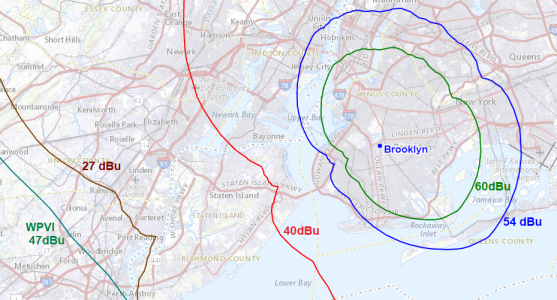
The 8 TV stations would need to have some serious protections. This will severely limit the ability to put stations in some major cities. In NYC, WTC and ESB would be totally out. A station in the middle of Brooklyn could probably be done with 65w at 100m HAAT into a directional antenna. I feel that there would be a market for expat communities to set up smaller stations to serve their local communities. Not everyone has a wireless phone and those that do, they do not always have unlimited data. "Wide FM" radios can be sold in local shops.

There are some things here that can be or need to be considered:
  • The 8 TV stations need a substantial protection, perhaps out to the 27 dBu interfering contour. The current "Channel 200" rule has a 15 dBu interfering contour requirement. I think that is overkill, but I think 27 dBu (-20 U/D, same as co-channel FM to FM) may be a reasonable consideration. IIRC, the old U/D requirement for analog TV into digital TV was only a -2 U/D ratio. The current Channel 201 (88.1) U/D for translators is +7 dBu (and this was based on analog into analog).
  • This may be a good ground to test certain technical rule changes that some of us want to see, such as the elimination of third and possibly second adjacent (with full protections continuing to 88.1~107.9 stations).
  • Stations on the low end of the dial (82.1) may have to afford some kind of protection to Channel 5, but it does not need to span 20 channels like the current rules. If the FCC agrees that all FM->Ch 6 protections can go away, it would be likewise for WideFM->Ch 5.
  • I think the band should be limited to local applicants with restrictions slightly more forgiving than LPFM's (10/20 mile rule) and/or there should be national ownership caps.
  • The most popular channels (87.5, 87.7 and 87.9) should be reserved for LPFM stations with no more than a 7.1 km service contour (250w @ 30m). This will also provide a guard band between the Wide-FM band and the legacy FM band.
  • The band should remain noncommercial with no table of allotments or rulemaking proceedings.
  • Like with X-band AM, it will take a very long time for radios to penetrate... but in all fairness, the penetration rate of new radio receivers is far far less than it was back in the X-band era.
A 65 watt @ 100m HAAT (9.3 km) community station in Brooklyn with a compliant DA could look something like:
1653005206997.png

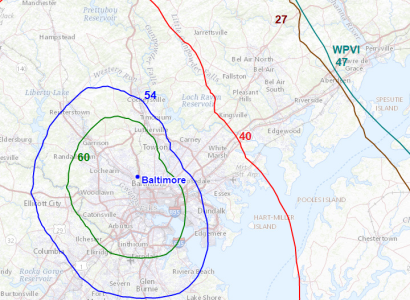
In Baltimore, a 55w @ 309m (15.9km contour, class A) and a compliant DA (+/- 2dB, 15 dB F/B) on the WBAL candelabra.
1653006245172.png

In many parts of the country, this spectrum could be very wide open space, but there is definitely some urban potential.
 
Whether the other automakers would bother to make such an update available is a different question.
That's easy, they won't. The car buying public wants vehicle access and interaction with the owner's phone, not adding to the available broadcast band. Unless a simulcast of an existing NCE, any station assigned to any 'expansion' will be on an island by themselves. Hard to survive if you're the only one on the island.
 
Long ago, people in my state fought hard for the canals that provided the transportation here. We tried to stop the railroads from coming to town. But, the train was faster and better. Those who bought stock in canals went broke.

Today, those of us still in broadcasting are like the canal boat captains in days of old. Even if we think we are the best canal boat captain, we now live in the day of the train. The internet is the train.

Anyone interested in starting a new broadcast station today or in the future should use caution. Forty years ago I could put a new signal on the air and people found it quickly. People tuned the dial back then. And, a front page news story informed the whole city.

Today listeners who would love what you're doing might not find your station for a decade or more. That's even in the middle of the FM dial.

82.1 MHz even in a major city would fare even worse than all digital AM.

Maybe I wish this wasn't so because I always loved radio.
 
From a business/profit only POV - if the Franken FM has a viable format and gets fairly good ratings, then the format can be moved to a low rated existing FM station in the same radio market, no need for AM+FM translator, using analog FM radios only (to tune 87.75) etc.


Kirk Bayne
 
<...>
It has been REC's position that radio receivers that are already being manufactured can be marketed in the United States (initially without any HD Radio capability) and can be of interest, especially to niche audiences such as expatriate communities.
The existing FM band has been with us here in North America since January of 1949 - over 73 years so far.

I can certainly see this being a positive in the long run, but as mentioned earlier in the thread, many would seem to desire Android Auto/Apple Car Play capability.

...or, what future technology will supersede these capabilities.
 
Even if you can solve the hardware and listener behavior issues, what about the economics? There are serious revenue issues (advertising, underwriting, listener support, etc.) for radio as it is. How does adding a bunch of new signals to compete for the already shrinking revenue pie help radio as a whole? I just don't see it.
 
What's interesting to me is we have the FCC talking about expanding the FM band, making Franken FMs legal, and other ways of growing FM radio. Meanwhile at RadioInk, their big story is Fred Jacobs' survey about declining radio listenership. All the comments there are about how no one listen to FM because of the music and commercials.


If this is true, and listenership is declining, why in the world are we talking about expanding the FM band? Adding more stations isn't going to solve the problems of boring playlists and too many commercials. In fact, it's likely to make the situation worse.
 
Status
This thread has been closed due to inactivity. You can create a new thread to discuss this topic.


Back
Top Bottom