• Get involved.
    We want your input!
    Apply for Membership and join the conversations about everything related to broadcasting.

    After we receive your registration, a moderator will review it. After your registration is approved, you will be permitted to post.
    If you use a disposable or false email address, your registration will be rejected.

    After your membership is approved, please take a minute to tell us a little bit about yourself.
    https://www.radiodiscussions.com/forums/introduce-yourself.1088/

    Thanks in advance and have fun!
    RadioDiscussions Administrators

FM Translator Frequencies reused in a given Radio Market

Having looked at some of the radiation patterns of FM translators on radio-locator.com and since the requirement is to fit the FM translator radiation patterns into existing full or near full power FM stations, I'm wondering if a single FM translator frequency could be reused in a given radio market (translating the same AM station)?

Perhaps FM translator towers could be located near the edges of a radio market, with their radiation patterns more toward the edge than the interior of a radio market and 1 tower near the center of a radio market, all using the same FM frequency (with a figure 8 and/or an oval and/or offset circle pattern etc.).


Kirk Bayne
 
Possible especially if sync for freq offset and audio is delayed to each xmtr...paging and full power stations have done that for decades using simulcast techniques. Only issue is contour overlap but directional antennas can fix that
 
It's not quite the same situation, but San Antonio has two LPFM's on the same frequency on opposite sides of town. Kansas City has a translator and an LPFM on the same frequency as well with the translator highly directional to the west from Johnson County.

I'd think you could do the same thing with two translators.
 
unlike AM, FM detects the strongest of multiple signals and rejects the rest.

AM will grab it all and send it to the detector.

There are many cases of "on channel" boosters in the FM world, WXRV out of Andover MA (COL) has several dotted in and around Boston.

I can't think of an AM with one than more "translator", they may feed more than one HD-2 but I can't recall ever seeing a AM with more than one translator.

I'm sure @SomeRadioGuy will be along to correct me in a minute if I am wrong... I bow to his superior knowledge
 
@Kent A LPFM is a different story as they have a limited area they can cover by design

Between wattage, ERP and HAAT they can only cover a 3.5 mile maximum radius.
In a large metro area you could have several stations on the same frequency

But the LPFM can not interfere with the translator, and the Translator can get the LPFM shut down or moved by a claim of interference in their licensed coverage area
 
unlike AM, FM detects the strongest of multiple signals and rejects the rest.

AM will grab it all and send it to the detector.

There are many cases of "on channel" boosters in the FM world, WXRV out of Andover MA (COL) has several dotted in and around Boston.

I can't think of an AM with one than more "translator", they may feed more than one HD-2 but I can't recall ever seeing a AM with more than one translator.

I'm sure @SomeRadioGuy will be along to correct me in a minute if I am wrong... I bow to his superior knowledge
WKGX and WJRI in Lenoir, NC both have two translators each. It‘s not something you see often though.
 
But the LPFM can not interfere with the translator, and the Translator can get the LPFM shut down or moved by a claim of interference in their licensed coverage area
That is not correct. Since LPFM uses distance separation instead of contours, the FCC considers an LPFM that meets distance separation at the time of application as not interfering. There is no rule that allows a translator to make an interference claim against an LPFM.

The opposite is true though. An LPFM can make a complaint against a subsequently applied for translator pursuant to §74.1204(f) and §74.1203(a).
 
In the Los Angeles area, there are several LPFMs on 99.1
  • Hollywood Hills (3 commonly located LPFMs that share time with Venice).
  • Venice (shares time with the 3 LPFMs in the Hollywood Hills).
  • Malibu
  • Long Beach
  • Simi Valley (which also has a booster to cover the San Fernando Valley)
 
100 watts at 100' should cover about 5 miles.
On flat terrain, a 60 dBu contour for an LPFM is 3.5 miles (5.6 kilometers). Actual coverage can vary based on terrain.
 
Having looked at some of the radiation patterns of FM translators on [an inferior lookup site that will not be named] and since the requirement is to fit the FM translator radiation patterns into existing full or near full power FM stations, I'm wondering if a single FM translator frequency could be reused in a given radio market (translating the same AM station)?

Perhaps FM translator towers could be located near the edges of a radio market, with their radiation patterns more toward the edge than the interior of a radio market and 1 tower near the center of a radio market, all using the same FM frequency (with a figure 8 and/or an oval and/or offset circle pattern etc.).
I am currently working with someone who may do this in a major market. Obviously, I can't give details.

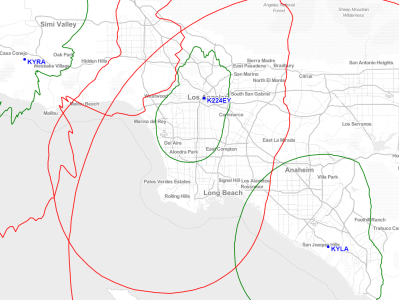
In Los Angeles, EMF has an SFN-like operation that involves two full-service FMs and a translator on the same channel (92.7).
1650378047682.png
 
unlike AM, FM detects the strongest of multiple signals and rejects the rest.

AM will grab it all and send it to the detector.

There are many cases of "on channel" boosters in the FM world, WXRV out of Andover MA (COL) has several dotted in and around Boston.

I can't think of an AM with one than more "translator", they may feed more than one HD-2 but I can't recall ever seeing a AM with more than one translator.

I'm sure @SomeRadioGuy will be along to correct me in a minute if I am wrong... I bow to his superior knowledge

stop it... lol you make me look bag

WGNS 1450 Murfreesboro, TN has two translators
 
100 watts at 100' should cover about 5 miles.
But by law, they are limited to 3.5 miles/5.5KM coverage radius

They can play with wattage (up to 100) and HAAT to get to that point, but not exceed it.

If you were say at 1000' HAAT, you would not be able to use anything near 100 watts or you would blow thru that radius limitation by miles
 
100 watts at 100' should cover about 5 miles.
In the old days, I could hear 10 Watt stations about 8 miles away on potable FM radios. With a good receiver and directional antenna, I heard many 10 Watt stations 120 miles away. That was with a little tropo and the FM band was much cleaner then.

LPFM range is also limited today because the FM band is clogged in many areas. The frequencies that are available for LPFM are right on top of another station in their secondary coverage.
 
But by law, they are limited to 3.5 miles/5.5KM coverage radius
By rule, they are limited to a 5.6 km service contour. There is no "law" (i.e. Local Community Radio Act) that limits LPFM stations to 100 watts (see Creation of a Low Power Radio Service, Sixth Report and Order, 27 FCC Rcd. 15402, 15479 at para. 206 (pg. 77), "We note, however, that the LCRA does not contain any language limiting the power levels at which LPFM stations may be licensed. We also fund unpersuasive NAB's and NPR's reliance on certain statements in the legislative history.")
If you were say at 1000' HAAT, you would not be able to use anything near 100 watts or you would blow thru that radius limitation by miles
At 1000 feet (305 meters) HAAT, an LPFM station is limited to 1 watt ERP.
 
In the old days, I could hear 10 Watt stations about 8 miles away on potable FM radios. With a good receiver and directional antenna, I heard many 10 Watt stations 120 miles away. That was with a little tropo and the FM band was much cleaner then.
Pre-1978 10 watt Class D FM stations were 10 watts transmitter power output, not effective radiated power. Many Class D stations did use high gain antennas to bring up the ERP. But yes, at the time, the dial was a lot less crowded and some of those Ds can pack a punch.
 
In 1978, Class B FM's had listeners 50 miles out. Now, those stations don't come in. The white noise level is way up because of the Wi-Fi routers in our homes and businesses. Only strong signals can be heard.
 
By rule, they are limited to a 5.6 km service contour. There is no "law" (i.e. Local Community Radio Act) that limits LPFM stations to 100 watts (see Creation of a Low Power Radio Service, Sixth Report and Order, 27 FCC Rcd. 15402, 15479 at para. 206 (pg. 77), "We note, however, that the LCRA does not contain any language limiting the power levels at which LPFM stations may be licensed. We also fund unpersuasive NAB's and NPR's reliance on certain statements in the legislative history.")

At 1000 feet (305 meters) HAAT, an LPFM station is limited to 1 watt ERP.
I bow to your superior knowledge, your reputation precedes you... btw congrats on the promotion to Grand Poobah/Moderator!

Since I am very rusty in my radio stuff these days, can you think of any LPFM that is running at or over 100 watts to get the 5.6KM coverage in their primary area?

Also are there any known cases where that magic circle has been punched thru and the FCC has told the operator to decrease the power or alter the antenna in some way to reel them in?
 
100 watts is the maximum for an LPFM regardless of height above average terrain. The center of radiation though could be 200 feet above average terrain in one direction and a minus number in other directions. The 100 foot HAAT rule is an average of several directions. So, yes you would do better than 3.5 miles in the direction that's 200 feet HAAT. Here's an example WYRZ . See it's not a circle. But it's real handy that their best direction is towards Indianapolis.
 
Last edited by a moderator:
100 watts is the maximum for an LPFM regardless of height above average terrain. The center of radiation though could be 200 feet above average terrain in one direction and a minus number in other directions. The 100 foot HAAT rule is an average of several directions. So, yes you would do better than 3.5 miles in the direction that's 200 feet HAAT. Here's an example WYRZ . See it's not a circle. But it's real handy that their best direction is towards Indianapolis.

HEre's another good lpfm: WXZY LP 101.7 Kane, PA 10 watts at 295 feet

Thanks to my high up locaiton in Ridgway south of town, and yagi antenna.. i could hear WXZY with RDS just about every day 18 miles away
 
Status
This thread has been closed due to inactivity. You can create a new thread to discuss this topic.


Back
Top Bottom