• Get involved.
    We want your input!
    Apply for Membership and join the conversations about everything related to broadcasting.

    After we receive your registration, a moderator will review it. After your registration is approved, you will be permitted to post.
    If you use a disposable or false email address, your registration will be rejected.

    After your membership is approved, please take a minute to tell us a little bit about yourself.
    https://www.radiodiscussions.com/forums/introduce-yourself.1088/

    Thanks in advance and have fun!
    RadioDiscussions Administrators

Future of AM transmitter sites in the Boston area

The 2 that come to mind are WEEI-AM in Needham and WRKO in Burlington. Audacy has the 850 AM site in Needham with 3 towers and iHeart has 3 towers with 680 AM.

Audacy has to be close to killing WEEI-AM

iHeart has to be considering moving WRKO to the WBZ-AM site in Hull or moving WBZ-AM to Burlington.

That is the reality as transmitter sites are worth more than the stations.
 
There is a
That is the reality as transmitter sites are worth more than the stations.
There is a lot more to this than just property values.

First to consider is the ability of a site to accommodate a specific directional pattern without losing either power levels or coverage of critical areas.

Second, in the case of a shared site requiring one or more additional towers, whether the site is large enough and whether there might be significant zoning and NIMBY considerations.

Third is whether the existing site is worth significantly more than the cost of moving.

Fourth is whether the towers at the move-to site are tall enough for the station's minimum wavelength for its class.

Finally, if the two frequencies are too close together, the bandwidth of each will suffer as the tuning & rejection networks will have to have a very narrow bandwidth. In other words, don't try to put 680 and 740 on the same towers. And you may not even want to try to put 590 and 680 on the same sticks... even if the directional patterns can be achieved by one set of towers.
 
There is a

There is a lot more to this than just property values.

First to consider is the ability of a site to accommodate a specific directional pattern without losing either power levels or coverage of critical areas.

Second, in the case of a shared site requiring one or more additional towers, whether the site is large enough and whether there might be significant zoning and NIMBY considerations.

Third is whether the existing site is worth significantly more than the cost of moving.

Fourth is whether the towers at the move-to site are tall enough for the station's minimum wavelength for its class.

Finally, if the two frequencies are too close together, the bandwidth of each will suffer as the tuning & rejection networks will have to have a very narrow bandwidth. In other words, don't try to put 680 and 740 on the same towers. And you may not even want to try to put 590 and 680 on the same sticks... even if the directional patterns can be achieved by one set of towers.
At one time, I thought that diplexed AM stations had to be at least 150KHz apart. Was that ever true?
 
At one time, I thought that diplexed AM stations had to be at least 150KHz apart. Was that ever true?
In theory, they can be perhaps 80 to 90 kHz apart. But the shape of the tuning and rejection networks bandwidth is going to be less than flat out 10 kHz or more and that will cause the same quality issues as restricting frequency response to run the near-dead AM HD.

It is pretty hard to create a nearly square bandwidth shape with a very flat and broad top and almost immediate deep fall-offs to the side. By hard, I mean $$$$. With computers, we can calculate it, but building one that sounds at least "okay" is harder.
 
WEEI's site is unlikely to be worth much for future development, abutted against a wetland conservation area. WRKO is also in a wetland and adjacent to park ground.

The AM sites that get developed tend to become industrial or large housing developments. I just can't see either of those two sites becoming one of those uses.
 
At one time, I thought that diplexed AM stations had to be at least 150KHz apart. Was that ever true?
Think of it more as a percentage of wavelength - the very rough rule of thumb I have always heard is that it's very difficult to diplex stations that are less than 10% apart in wavelength.
 
Think of it more as a percentage of wavelength - the very rough rule of thumb I have always heard is that it's very difficult to diplex stations that are less than 10% apart in wavelength.
That is an interesting and reasonable perspective. As wavelength affect the effectiveness of rejection / tuning components in the ATU, it makes sense and is easy to remember.

A world expert in those was Alan Roycroft, the Kiwi who established himself in Hawai'i putting two and three and even four stations on a single tower. He passed away a while back, and a number of the stations there have had problems with their tuning units due to a lack of experienced AM engineers.
 
Last edited:
A world expert in those was Alan Roycroft, the Kiwi who established himself in Hawai'i puttint two and three and even four stations on a single tower.
KRZY's tower in Albuquerque hosts four stations:

KSVA - 920 (the former KQEO of Top-40 fame)
KNMM - 1150
KKNS - 1310
KRZY - 1450

Last year, when I was most recently in Albuquerque, three of the four stations sounded normal. But KRZY sounded like it was undermodulating considerably.
 
KRZY's tower in Albuquerque hosts four stations:

KSVA - 920 (the former KQEO of Top-40 fame)
KNMM - 1150
KKNS - 1310
KRZY - 1450

Last year, when I was most recently in Albuquerque, three of the four stations sounded normal. But KRZY sounded like it was undermodulating considerably.
I wonder who designed the system, who built it (Kintronics, I assume) and who did the install. All deserve at least the first round of beer!

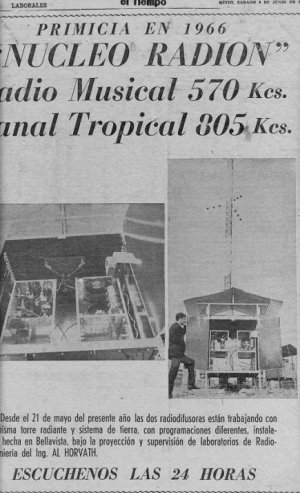
Here is my first diplexer (570 and 805 AM) with a very young (age 20) MiniMe next to it. Design: Ing. Al Horvath, Installation: yours truly. I was nowhere good enough to design it, but learned a lot watching it be built.

1723431044456.jpeg
 
Given its currently silent state… and the post below… what about the old WKOX facilities? Next to the dump is generally not prime real estate, but the immediate area to the east has seen a complete transformation in the past few years.
 
Given its currently silent state… and the post below… what about the old WKOX facilities? Next to the dump is generally not prime real estate, but the immediate area to the east has seen a complete transformation in the past few years.
Am I missing something? WKOX is a non-directional facility with one self supporting tower in a river estuary.
 
Am I missing something? WKOX is a non-directional facility with one self supporting tower in a river estuary.
Yes, but the former WKOX facility is close to 9 acres, the primary radio tenant is off the air and probably pretty unlikely to come back on the air, and the estate of the deceased owner is presumably looking to cash out.

While it’s not enough land to become a subdivision or office park, I’d have to put Mount Wayte pretty high on the towards sites at risk watchlist.
 
When it was WKOX 1190 and later 1200, along with sister station WVBF (etc) 105.7
the studios were on 100 Mt Wayte Ave in Framingham and AM stick nearby. I
remember stopping in to pick up a prize
I'd won on Morgan White's Talking Trivia.
Later iHeart swapped calls of 1200 with
1430; 1200 is currently WXKS with conservative talk--low ratings but they get
to clear ads on shows like Beck and Hannity.

Their AM stick is in Newton now.
1430 later got donated...I thought what is
now WKOX 1430 had a stick nr the Meadow Glen Mall in Medford. Looking it up on a couple sites it shows what looks like the WROL tower in the marshes of Saugus on the way to Lynn. The river estuary...
The "deceased tenant" referred to above would be Alex Langer and the station is/was WZBR
1410, I'd think. Was it the former 590 tower, also in Medford?
 
Oops, the “one self supporting tower” should have been my giveaway. Was not referring to re-use of the WKOX 1430 tower site. Instead, was referring to the historical WKOX 1190/1200 site along the pond in Framingham, most recently home to WSRO 650 and its translator.
 
When it was WKOX 1190 and later 1200, along with sister station WVBF (etc) 105.7
the studios were on 100 Mt Wayte Ave in Framingham and AM stick nearby. I
remember stopping in to pick up a prize
I'd won on Morgan White's Talking Trivia.
Later iHeart swapped calls of 1200 with
1430; 1200 is currently WXKS with conservative talk--low ratings but they get
to clear ads on shows like Beck and Hannity.

Their AM stick is in Newton now.
1430 later got donated...I thought what is
now WKOX 1430 had a stick nr the Meadow Glen Mall in Medford. Looking it up on a couple sites it shows what looks like the WROL tower in the marshes of Saugus on the way to Lynn. The river estuary...
The "deceased tenant" referred to above would be Alex Langer and the station is/was WZBR
1410, I'd think. Was it the former 590 tower, also in Medford?
I think the former owner of 1190 WKOX and 105.7 WVBF was named Fairbanks. The call letters WVBF were the initials of the owner's Wife, Virginia B Fairbanks.
 
iHeart has to be considering moving WRKO to the WBZ-AM site in Hull or moving WBZ-AM to Burlington.
Moving WRKO (class B and comparable to former II-A) to Hull would be very disadvantageous. WRKO nulls the west at night to protect KNBR in San Francisco and from Hull much more of the Boston area would be nulled. The ideal location for WRKO would be a few miles west of where is; the WEEI site would be an example of a good location.

WBZ is class A (formerly I-A and not protecting anyone) and could adjust its pattern to make up any deficiencies resulting from moving to WRKO's site in Burlington, and with negligible loss of coverage elsewhere.
 
Last edited:
I am confused. Why would a station bother with the expense of a directional pattern? The market is not area wise big compared to New York or Chicago where they need to "strengthen" a 50kw signal for one part of town.
 
I am confused. Why would a station bother with the expense of a directional pattern? The market is not area wise big compared to New York or Chicago where they need to "strengthen" a 50kw signal for one part of town.
WBZ directionalized to avoid wasting power over the ocean.

Years ago, with synchronous WBZA in Springfield, they wanted to cover as much of Massachusetts as they could.

Perhaps Fybush can expand on this.
 
It just seems if they would have put the tower halfway to Worcester 50 KW would cover most of Massachusetts. Could WBZ just go Omni directional since they are the dominant station on the channel?

Trying to get this thread back on track (sorry)

Any change of a directional pattern is expensive. Unless there is a land sale to make it worthwhile I doubt anybody is spending money to improve an AM signal unless there is a translator that has to go farther than the 25 mile rule involved.
 
It just seems if they would have put the tower halfway to Worcester 50 KW would cover most of Massachusetts.
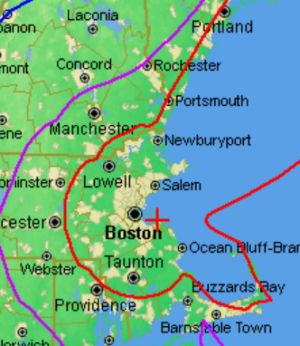
The usable 10 mV/m signal or greater just barely covers the metro as it is now.

Take the red contour and reduce it by about a third and that is the approximate good coverage area of WBZ today.

1723833275726.png
Could WBZ just go Omni directional since they are the dominant station on the channel?
They could, but that would decrease central city building penetration,.
Any change of a directional pattern is expensive. Unless there is a land sale to make it worthwhile I doubt anybody is spending money to improve an AM signal unless there is a translator that has to go farther than the 25 mile rule involved.
In the case of WBZ, the current signal works well. Moving has no advantage unless the land is worth, let's say, $30 to $40 million and new land and the tech work can be done for less than a quarter of that.
 
Status
This thread has been closed due to inactivity. You can create a new thread to discuss this topic.


Back
Top Bottom