• Get involved.
    We want your input!
    Apply for Membership and join the conversations about everything related to broadcasting.

    After we receive your registration, a moderator will review it. After your registration is approved, you will be permitted to post.
    If you use a disposable or false email address, your registration will be rejected.

    After your membership is approved, please take a minute to tell us a little bit about yourself.
    https://www.radiodiscussions.com/forums/introduce-yourself.1088/

    Thanks in advance and have fun!
    RadioDiscussions Administrators

History of Top of The Hour News.

Greetings,
With the pending closing of CBS News Radio (Formerly known as CBS/CBS Radio Network) on Friday May 22nd. It got me thinking; when did top of the hour newscasts first became a regular thing? Not 24/7 permanent as it was the case for CBS in 1973. But I'm talking top of the hour 5 minute newscasts. I know some were around as early as 1955 with Robert Trout for CBS. But when did the practice became common? I imagine it had to be after World War II and around the time that Television replaced Radio as the top entertainment attraction in the early 1950's for sure.
 
I imagine it had to be after World War II and around the time that

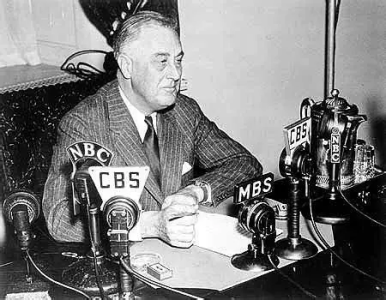
Before WW2. CBS News dates its own start to 1931. News was an integral part of the network concept. The difference was the network owned the news programming, while the sponsors owned the entertainment programming. Edward R Murrow made his reputation reporting from London during World War 2. But by the war, all of the radio networks: CBS, NBC, and Mutual, had network news departments and regular programs. There is a famous picture of President Roosevelt at his desk in the oval office in front of microphones from the big three networks. The start of the war was announced on network radio. CBS was broadcasting a Giants football game on Sunday, broke into the game with a bulletin that the Japanese had attacked Pearl Harbor.


1779286767327.png
 
Last edited:
Before WW2. CBS News dates its own start to 1931. News was an integral part of the network concept. The difference was the network owned the news programming, while the sponsors owned the entertainment programming. Edward R Murrow made his reputation reporting from London during World War 2. But by the war, all of the radio networks: CBS, NBC, and Mutual, had network news departments and regular programs. There is a famous picture of President Roosevelt at his desk in the oval office in front of microphones from the big three networks. The start of the war was announced on network radio. CBS was broadcasting a Giants football game on Sunday, broke into the game with a bulletin that the Japanese had attacked Pearl Harbor.
What you wrote is accurate, but it doesn't answer the OP's question, which is when the CBS Radio Network began regular top-of-hour-every-hour 5 minute newscasts.

Somebody authored an overview of CBS's history on Wikipedia, but it doesn't mention a specific date, or even a year, when the hourly newscasts began. (But like the tribute that CBS Sunday Morning produced, it pinpoints the birth of the CBS World News Roundup to 1938 and Hitler's invasion of Austria.)
 
You might be able to answer the five minute newscast with when (minutes after top of the hour) did the "entertainment" shows started. Go to one of Dave's history sites and check out the soap operas times. If they were and even 15 or 30 minutes then there was no time for a 5 minute newscast. I don't know if any 1920's or 30's program logs have survived but that would give you a good indication of what a station was doing. Also you might be able to access old newspapers from that time. Some of them might have radio listings like TV listings today.
 
That makes sense. NBC seems to always be first, if not close to being first. That along with the decline of radio networks as general entertainment hubs makes total sense for news. At least news that is done without as Wayne Cabot said nearly two years ago, without the needles brainwashing.
 
The purpose of the short form radio newscasts was to find new relevance on a platform that had completely abandoned the network system. It wasn't that radio didn't do news in the 30s and 40s. They did. But it was long-form news, similar to what they do now on TV with the half hour evening news. The networks were desperate to find ways to get stations to air their commercials. They didn't want to shut down. So by offering hourly short news casts, they found a way to get some stations to carry their content, but more importantly, carry their commercials.

That was the first reinvention of radio networks in the 50s. The second reinvention came about in the 70s and 80s. Radio audiences had moved from AM to FM, so the networks sought to appeal to those FM stations. But the traditional newscast wasn't going to work on a rock radio station. So ABC came up with networks aimed at those stations. First was the ABC FM network. Later came the ABC Rock radio network in 1982. Around that same time, NBC came up with The Source. They provided short form news, written in ways that might be more colloquial for the rock music audience. Kind of what you ended up seeing on MTV in the 80s with Kurt Loder. CBS was the last to enter the "young network" business with "Radio Radio." The next generation of network radio also created concerts and other syndicated programming. The line was blurring between traditional networks and program syndicators. Both had existed side by side, but by the 80s, there wasn't much difference.
 
Last edited:
That was the first reinvention of radio networks in the 50s. The second reinvention came about in the 70s and 80s. Radio audiences had moved from AM to FM, so the networks sought to appeal to those FM stations. But the traditional newscast wasn't going to work on a rock radio station. So ABC came up with networks aimed at those stations. First was the ABC FM network. Later came the ABC Rock radio network in 1982. Around that same time, NBC came up with The Source. They provided short form news, written in ways that might be more colloquial for the rock music audience. Kind of what you ended up seeing on MTV in the 80s with Kurt Loder. CBS was the last to enter the "young network" business with "Radio Radio." The next generation of network radio also created concerts and other syndicated programming. The line was blurring between traditional networks and program syndicators. Both had existed side by side, but by the 80s, there wasn't much difference.
The FCC rules did not allow one network to have simultaneous broadcasts. So ABC developed a system whereby each hour carried newscasts for multiple networks at different times during the hour.
 
The FCC rules did not allow one network to have simultaneous broadcasts. So ABC developed a system whereby each hour carried newscasts for multiple networks at different times during the hour.

They were all on a single 5khz AT&T phone line. Thus one network, meeting the FCC rules. Irony being that ABC was the beneficiary of this rule, since it forced NBC to divest the blue network, which became ABC. Then ABC is the first to "multicast" its news services. Mutual followed with it's Mutual Black Network on the same line. The thing that threw the whole system out the window was the entry of satellite, replacing phone lines.

By the 80s, that one ABC network was busy almost every minute, with six newscasts, news audio feeds, commercial feeds, and other content. I have a clock somewhere here. From my memory: The ABC-I network was TOH. FM was at :15. Entertainment was :30. Direction was :45. Contemporary was :55. Then Rock was in there too.

1779315613330.png

Here's another thread on this subject:

 
They were all on a single 5khz AT&T phone line. Thus one network, meeting the FCC rules. Irony being that ABC was the beneficiary of this rule, since it forced NBC to divest the blue network, which became ABC. Then ABC is the first to "multicast" its news services.
But the point is that ABC was never offering any simultaneous services, Each "network" was on at separate times, thus complying with the FCC prohibition for simultaneous service which was what forced the Blue Network to be spun off in the 1940's.
 
But the point is that ABC was never offering any simultaneous services, Each "network" was on at separate times, thus complying with the FCC prohibition for simultaneous service which was what forced the Blue Network to be spun off in the 1940's.

This was before ABC added the music channels in the 80s. By then, everything was simultaneous.
 
This was before ABC added the music channels in the 80s. By then, everything was simultaneous.
And that was due to a rules change. There were many duopolies of two AMs in a market prior to the rule change at the FCC that required Red and Blue to become plain NBC and the new ABC. At the same time, owners of two AMs in a market had to sell one... Earle C. Anthony had to get rid of his smaller LA signal, for example.
 
They were all on a single 5khz AT&T phone line. Thus one network, meeting the FCC rules. Irony being that ABC was the beneficiary of this rule, since it forced NBC to divest the blue network, which became ABC. Then ABC is the first to "multicast" its news services. Mutual followed with it's Mutual Black Network on the same line. The thing that threw the whole system out the window was the entry of satellite, replacing phone lines.

By the 80s, that one ABC network was busy almost every minute, with six newscasts, news audio feeds, commercial feeds, and other content. I have a clock somewhere here. From my memory: The ABC-I network was TOH. FM was at :15. Entertainment was :30. Direction was :45. Contemporary was :55. Then Rock was in there too.

View attachment 12003

Here's another thread on this subject:

All correct: The Entertainment and Contemporary networks had a 1 minute headline versions at :27 and :50


Back
Top Bottom