• Get involved.
    We want your input!
    Apply for Membership and join the conversations about everything related to broadcasting.

    After we receive your registration, a moderator will review it. After your registration is approved, you will be permitted to post.
    If you use a disposable or false email address, your registration will be rejected.

    After your membership is approved, please take a minute to tell us a little bit about yourself.
    https://www.radiodiscussions.com/forums/introduce-yourself.1088/

    Thanks in advance and have fun!
    RadioDiscussions Administrators

In a future filled with electric cars, AM radio may be left behind (off-topic)

What you're overlooking is how the industry is responding to the mandate, which is positively. One in eight vehicles sold in the United States is sold in California. It's why California emissions standards (after a period of building "49-state" cars and "California emissions" cars) became what manufacturers built to.
Of course manufacturers support the EV mandate. Building one version of a vehicle is much less complicated than building ICE, EV and EV-H forms.
Also, on October 28, the European Union announced it's going forward with a mandate that mirrors California. Same basic parameters---no new internal combustion passenger vehicles sold after 2035, with a carve-out for plug-in hybrids with 50 miles or more of pure electric range.
EV-H pro's are the best of both world's for range.
EV-H con's are the worst in terms of complexity, initial and repair costs.
Last year, with sales constrained by supply-chain issues, 10-million new passenger cars were sold in the EU.

With those numbers, it's unlikely that manufacturers would continue production of very many ICE vehicles even if California were the lone state with a 2035 cutoff, and it's unlikely that will be the case. In fact, 17 other states are weighing adopting the California standard at this moment, with only two of those (Pennsylvania and Colorado) considered probable "no" votes.
Wait until EV "mandaters" try dealing with the lack of battery performance in the northern half of the country.
17 states weigh adopting California's electric car mandate

There really is no manufacturer resistance to speak of. Many, in fact, will beat the deadline and won't have gasoline or diesel-powered passenger vehicles in production well before 2035:
The customer decides what will be manufactured, not the manufacturer.
Every Automaker’s EV Plans Through 2035 And Beyond

As for the power grid, it's worth noting that 80 percent of all EV charging happens at home, 30 to 40% of those home charging units are powered by solar, and publicly-owned utilities are not part of the grid that's in trouble (which is largely PG&E's). That includes the Los Angeles Department of Water & Power and the Sacramento Metropolitan Utilities District (SMUD):
You cannot charge an EV at night when the charging depends upon the sun. You could depend if the source is from the electric utility but then you've just changed one polluting source to the other. Mox nix.
MAP: California Communities That Supply Their Own Power | KQED

And, the thing everyone forgets---they don't all charge at once. Most EVs now provide upwards of 250 miles on a charge, matching or exceeding the range available on a full tank of gas. Most people don't go to the gas station and fill their tank every day.
No, they don't all charge at once but just wait until most do. Not enough electrons to fill everyone's battery unless significant improvements are made to the grid.....and then just wait until the overnight electric usage rates go through the roof.
But---with an EV, you can plug in and keep your vehicle continually topped off every night. It's a small amount of electricity if you've just driven 40 miles, but IF there's a massive blackout, you've got the electric equivalent of a full tank. And, in a blackout, gas pumps don't work, so you're actually a bit ahead of your neighbor.
Really? Just how often does a major part of the US experience a long lasting blackout other than the idiot energy managers in TX?
Having now driven two dozen different EVs for a week each as part of my work as an automotive journalist, and not having charging beyond a 110V extension cable in my garage, I can tell you the weak link at the moment is public charging, which is essential not only for road trips but for people living in multi-unit dwellings.
Or for non-Tesla owners.
And finally, we're talking about 12 years, not a week from Thursday. It's worth remembering that 12 years ago there were exactly ZERO electric vehicles on the market, and ZERO public charging stations (unless they were leftovers from the GM EV-1 experiement in the 1990s). Today, there are 34 EVs for sale in the US:
There are no EV-1's in existence unless GM has some hidden away. They were all returned to GM and crushed.

Today there are 34 EV's available. Except for pickup trucks (which can't carry or tow like an ICE truck can) and heavy duty semi's, and about 90% are too expensive for the average buyer, not enough EV repair facilities and knowledgeable repair techs. And, like Tesla, if it breaks down in Jasper Junction it has to be towed a significant distance to a Tesla repair shop.

And did I mention the trouble EV manufacturers are going to have obtaining raw materials for batteries and the problems related to disposition and/or reuse (not to mention cost and the fact that a lot of these raw materials are mined in countries not friendly with the USA?
EV charging stations compared to ICE fueling stations: ICE - how many minutes do you spend waiting at a gas station because all pumps are busy? Note: # of pumps at an average gas station is 8 vs 4/5 at an EV charger. Got a good book to read while waiting?
All of that has happened since the Tesla Model S went on sale 10 and a half years ago. We have that much time, plus a year and a half, to build out the infrastructure.
Not enough time. You have to have an electric source nearby to support high charging volumes such as along freeways. Think construction of gas stations is time-consuming and costly? Try running new high voltage lines, probably underground, all over towns.

Have kids? That'll make stopping for a quick charge every couple of hours even more pleasant.

Towing? In a freezing winter day? Cut your battery capacity in half.
In the meantime, you can buy whatever you want, and after 2035, if you still don't like it, you can buy used (three times as many used cars are sold every year as new).
Yup. The next go-to business will be the skyrocketing cost of used cars. Wait.....that's already here.
 
I absolutely agree -- leasing an EV is definitely the way to go.

There's no need to worry about how the electricity is generated, or consider the impact of mining the lithium, manganese, cobalt, graphite, steel, and nickel that goes into the batteries. By leasing, you'll never get a $25,000 bill if the battery dies, and the ultimate responsibility of discarding the EV along with its half-ton+ toxic battery into the landfill falls solely on the lessor.
I don't think you understand how business works. EV lessors are not going to take it where the sun don't shine. They will find a way to extract every last cent out of your lease rate and some blood to boot.
 
In my personal case; the majority of the EV charging will be via 22 solar panels mounted to the South-facing roof of my garage. An investment that is estimated to pay for itself in a little less than ten years.
That's great, but only if you can convert your existing garage, build a new one or buy another house already appropriate for solar panels. I leased my system, nothing down, no maintenance costs. I am into the 7th year and am just now breaking even. But I can't use mine to charge an EV because the sun is sleeping overnight just like I am. Once the electric utilities find out they cannot afford to have reduced overnight rates they'll bump them up and there go your advantages.
 
That's great, but only if you can convert your existing garage, build a new one or buy another house already appropriate for solar panels. I leased my system, nothing down, no maintenance costs. I am into the 7th year and am just now breaking even. But I can't use mine to charge an EV because the sun is sleeping overnight just like I am. Once the electric utilities find out they cannot afford to have reduced overnight rates they'll bump them up and there go your advantages.
Answer: batteries store daytime energy accumulation and use it at night to charge.
 
That's great, but only if you can convert your existing garage, build a new one or buy another house already appropriate for solar panels. I leased my system, nothing down, no maintenance costs. I am into the 7th year and am just now breaking even. But I can't use mine to charge an EV because the sun is sleeping overnight just like I am. Once the electric utilities find out they cannot afford to have reduced overnight rates they'll bump them up and there go your advantages.
Seven year payback/breakeven is actually a little better than the typical average estimated length. If the breakeven point is estimated to be over ten years, then waiting for solar panel efficiency to improve further might be warranted. There are other variables too; like how much South-facing roof or open space to face additional panels.
Leasing a solar system with the intent solely of selling power back to the grid is definitely a lower cost solar option, but as you already know, typically doesn't allow for power storage for when the sun goes down, or a cloud blocks the sun. That's where a battery bank comes in. The older solar leasing companies weren't interested in absorbing the cost of batteries, because their business model is solely to sell power back to the utility during the day using many neighborhood roofs.

There isn't just one use for solar energy anymore. There are literally dozens of options/variables, depending on the location and application. Before I went EV, I wanted a plan to charge it cheaper than utility, power my garage independent of my house, and all with a payback of ten years or less. That means with a four to five year lease on my wife's EV, without an AM radio included ;) , I'll be charging two different vehicles over time before any upgrades or solar panel replacement-investment will be required.

 
....Yikes. My previous post had a couple glaring typos.... "subscription" (not subsiption), Windows (not Window 15). I suppose I need a new subscription to a dictionary.
 
Of course manufacturers support the EV mandate. Building one version of a vehicle is much less complicated than building ICE, EV and EV-H forms.
Toyota's CEO sees it differently.

"Toyota chief executive Akio Toyoda claims that he is among the “silent majority” of those in the automotive industry questioning whether electric vehicles are the only way forward.

While recently speaking with reporters in Thailand, Toyoda once again reiterated his belief that the best way forward is to develop a host of different powertrain technologies, including hybrids, plug-in hybrids, hydrogen-powered, and battery-electric vehicles. This comes despite the fact that many of the world’s largest car manufacturers have already committed to all-electric futures.

“People involved in the auto industry are largely a silent majority,” Toyoda told reporters. “That silent majority is wondering whether EVs are really OK to have as a single option. But they think it’s the trend so they can’t speak out loudly…The right answer is still unclear, we shouldn’t limit ourselves to just one option.”

 
“People involved in the auto industry are largely a silent majority,” Toyoda told reporters. “That silent majority is wondering whether EVs are really OK to have as a single option. But they think it’s the trend so they can’t speak out loudly…The right answer is still unclear, we shouldn’t limit ourselves to just one option.”
And surprisingly I agree with that sentiment. The automotive industry has a lot more viable propulsion options than they did even ten years ago. Opinions that automakers are going to somehow force you to purchase an EV is misguided, intentional hyperbole.

Electric/battery is one option, hydrogen fuel cells in some areas another, and I believe even methane likely will become one in a few years. Long haul trucks will likely still be burning diesel, or some form of biodiesel well into the future. Where EV's fit into the puzzle, is for consumers who use a vehicle for commuting or strictly transportation. Except for not being equipped with AM radio tuners, which who really cares anyway, ;) I don't think anyone in the industry, other than maybe Elon Musk, is recommending that all dino-fueled vehicles need to be off the road by 2035.
 
The customer decides what will be manufactured, not the manufacturer.

If that were true, nobody would be bitching about mandates or about stuff they can't get anymore.

A more accurate way to phrase that is "sufficient customer demand to meet manufacturer profit margin targets decides what will be manufactured unless it's no longer legal for sale."

I mean, you yourself actually said it in the same argument:

Of course manufacturers support the EV mandate. Building one version of a vehicle is much less complicated than building ICE, EV and EV-H forms.

A declining number of people who want that choice (and with every EV convert, every young first new car buyer who wants one, and the death or retirement from driving of every die-hard EV opponent, that number of people declines) is ultimately seen as a complication to a more simplified (and profitable) business model.

You cannot charge an EV at night when the charging depends upon the sun.

Which is why most EV owners who go solar (and an increasing number of solar purchasers who don't have an EV) also include battery storage in their systems. They capture the energy they don't use during the day for use as needed after the sun goes down. This is becoming very common.

No, they don't all charge at once but just wait until most do. Not enough electrons to fill everyone's battery unless significant improvements are made to the grid.....and then just wait until the overnight electric usage rates go through the roof.

Most won't, Tuna. Time zones and individual vehicles perpetually being at greater or lesser states of charge depending on their use alone insures that won't happen.

Grid and infrastructure improvements are a given. As to rates, I've been an Arizona Public Service customer, so I get where you're coming from. And I'm glad I'm a SMUD (Sacramento Metropolitan Utility District) rather than a PG&E customer now for the same reason.

Really? Just how often does a major part of the US experience a long lasting blackout other than the idiot energy managers in TX?

Well, you're answering my answer to an EV skeptic who wanted to know what you do in a blackout, so I answered. You're right. It's rare, but not unheard of: https://www.electricchoice.com/blog/worst-power-outages-in-united-states-history/

Beyond that, people near but not in fire zones in the increasingly-populated Sierra foothills have been without power for days if a major transmission line is destroyed. And protective blackouts (usually in high winds to prevent lines from coming down in trees and brush) have recently lasted three days or longer.

I'm gonna leave my quote in here:
And finally, we're talking about 12 years, not a week from Thursday. It's worth remembering that 12 years ago there were exactly ZERO electric vehicles on the market, and ZERO public charging stations (unless they were leftovers from the GM EV-1 experiement in the 1990s). Today, there are 34 EVs for sale in the US:

There are no EV-1's in existence unless GM has some hidden away. They were all returned to GM and crushed.

I know, Tuna. The EV-1 reference was saying that, unless there were leftover chargers from that experiment, there were ZERO public charging stations in the U.S. 12 years ago.

As a side note, of the 1,117 EV-1s produced, 37 still exist, most of them disabled and donated by GM to museums and universities, but one operational EV-1 is owned by Francis Ford Coppola and another was discovered, caked in dust in an Atlanta parking garage just three years ago: https://www.hemmings.com/stories/how-many-gm-ev1s-remain/


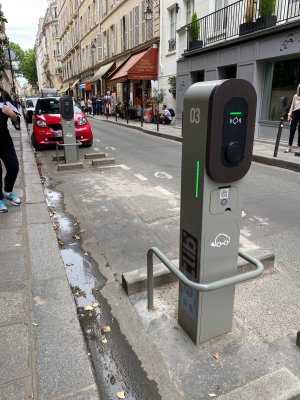
And we agree on existing infrastructure. EV charging stations need to look more like truck stops than gas stations---64 individual chargers, minimum for big ones by the interstate. And we need to be looking hard at everyplace someone's car sits for any length of time.

When I was in France this summer, I saw an elegant solution in several cities---chargers in street parking spaces:

IMG_1195.jpeg


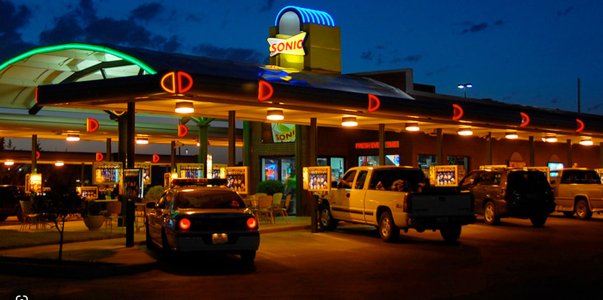
My much more American twist (and you live in an area that has these, Tuna, so you'll know what I'm talking about):


Screenshot 2022-12-23 at 7.02.09 AM.jpg

Seriously. Some EV charging company needs to partner with Sonic to put chargers in every one of those posts holding a menu board. The board could even be configured to display charge and accept payment as well as show you the food. Those cars are sitting there for 20-40 minutes a pop as part of Sonic's day-to-day business already.

Have kids? That'll make stopping for a quick charge every couple of hours even more pleasant.

The bare minimum range apart from a couple of outliers (Mini EV, Nissan Leaf) is 250 miles of range now. A lot of EVs deliver more and the number of EVs that do and the range are both increasing. But let's just take 250. At an average of 65 mph, that's 3.84 hours of travel. That time lengthens with range.

Having raised kids, I'm not sure which is the bigger challenge---stopping every three and a half hours or straight-through seven hours at a shot with no break in the car.

Towing? In a freezing winter day? Cut your battery capacity in half.

I expect we're learning a lot about this in most of the U.S. this week.
 
Last edited:
Toyota's CEO sees it differently.

"Toyota chief executive Akio Toyoda claims that he is among the “silent majority” of those in the automotive industry questioning whether electric vehicles are the only way forward.

While recently speaking with reporters in Thailand, Toyoda once again reiterated his belief that the best way forward is to develop a host of different powertrain technologies, including hybrids, plug-in hybrids, hydrogen-powered, and battery-electric vehicles. This comes despite the fact that many of the world’s largest car manufacturers have already committed to all-electric futures.

“People involved in the auto industry are largely a silent majority,” Toyoda told reporters. “That silent majority is wondering whether EVs are really OK to have as a single option. But they think it’s the trend so they can’t speak out loudly…The right answer is still unclear, we shouldn’t limit ourselves to just one option.”

Toyota (the company) and Toyoda (the man) went all-in on conventional hybrids (the Prius) and hydrogen (the Mirai). They are SO late to the pure EV party that they had to partner with Subaru to get one done (the Toyota bz4X and Subaru Solterra) for the 2023 model year and it's only barely competitive.

He may like plug-in hybrids, but he hasn't really put his money where his mouth is there--offering only two, the Prius Prime for the past ten years and the RAV4 Prime for the last two.
 
I don't think anyone in the industry, other than maybe Elon Musk, is recommending that all dino-fueled vehicles need to be off the road by 2035.

No one in government, either. The mandate is to stop selling new dino-fueled (I like that) vehicles by 2035---except for plug-in hybrids with electric range of 50 miles or more. As I've said in this thread, a realistic estimate beyond that is that maybe you can retire 95% of the ICE fleet in 25-40 years. Maybe.
 
I don't think you understand how business works. EV lessors are not going to take it where the sun don't shine. They will find a way to extract every last cent out of your lease rate and some blood to boot.
Sure, but you know all that upfront. If you're willing to pay the price, along with the high insurance premiums for EVs, just sit back and enjoy the ride!
 
One reason the article doesn't mention for the increased cost is the risk of a serious fire in a crash. I'm not sure if that's true but it's something I've heard.
 
One reason the article doesn't mention for the increased cost is the risk of a serious fire in a crash. I'm not sure if that's true but it's something I've heard.
This is probably the most thorough thing I've read about that. The summary: EVs are less likely than gasoline or hybrid vehicles to catch fire overall, but there are unique risks in crash situations. Manufacturers continue to increase reinforcement around battery cells to reduce those risks:

https://www.theregreview.org/2022/0...icle-fires-spark-firefighter-safety-concerns/
 
One reason the article doesn't mention for the increased cost is the risk of a serious fire in a crash. I'm not sure if that's true but it's something I've heard.
Not true. I checked both Progressive and Liberty Mutual, and neither have any sort of extra charges for EV's. Any additional is due to insuring a more expensive vehicle, depending on what model the EV is.
 
Not true. I checked both Progressive and Liberty Mutual, and neither have any sort of extra charges for EV's. Any additional is due to insuring a more expensive vehicle, depending on what model the EV is.
And replacement cost is always a consideration, as any of us who've upgraded as our circumstances allowed know. If you total a Nissan Versa, that's $16,000. If you total a Porsche 911 Carrera GTS Cabriolet, that's $160,000.
 
Status
This thread has been closed due to inactivity. You can create a new thread to discuss this topic.


Back
Top Bottom