• Get involved.
    We want your input!
    Apply for Membership and join the conversations about everything related to broadcasting.

    After we receive your registration, a moderator will review it. After your registration is approved, you will be permitted to post.
    If you use a disposable or false email address, your registration will be rejected.

    After your membership is approved, please take a minute to tell us a little bit about yourself.
    https://www.radiodiscussions.com/forums/introduce-yourself.1088/

    Thanks in advance and have fun!
    RadioDiscussions Administrators

Is CBK 540 The Best Coverage AM Station in North America in The Daytime?

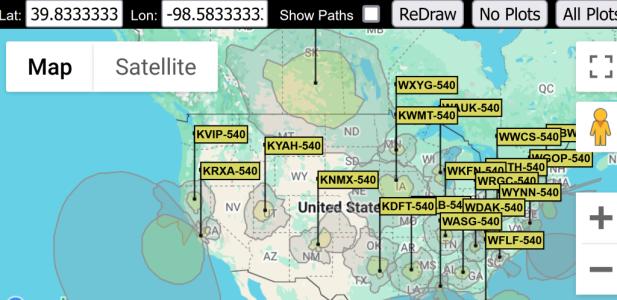
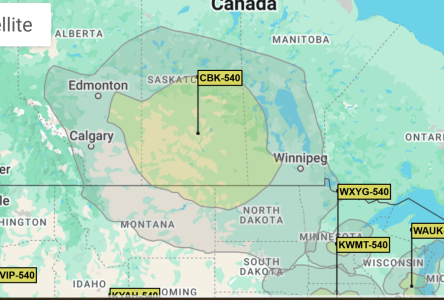
In the daytime, the lower on the AM dial you go, the better the propagation via groundwave. People say CBK 540 Watrous-Regina, at 50,000 watts non-directional, may have the best signal of any AM station in North America.

Folks report hearing it in the daytime across Saskatchewan, Alberta, Manitoba, and down into Montana, The Dakotas, Wyoming, Idaho and Minnesota with little problem, especially in the winter. That's thanks to its lowest spot on the AM dial coupled with good ground conductivity in the Prairie States and Provinces.
 
That and WNAX seem to have been the consensus in my years on this board. I have never heard either signal with my own ears.
KLIF, WBAP and WSCR are the best groundwave signals I've personally heard. WLW is not far behind, but their reach to the east and south of Cincinnati is less than other directions because of poorer ground conductivity.
 
It does have a monster daytime pattern.
1731037623424.png


1731037691460.png
 
I’m glad that the CBC has decided to stick with some of their powerhouse AM stations. Their migration to FM is well noted on this board, but there’s no way FM could cover as much ground as a 50kw AM. If you’re in a remote area, you’re not listening to CBC on FM. There is a network of repeaters on FM, but it’s far from perfect. Maybe you can stream it, but it’s far easier to just get in the car and punch in 540.

In Vancouver, the CBU 690 site is really looking worse for wear. I’m not sure how much longer it will stay on the air, but I know it reaches a lot more listeners than their metropolitan FM does (even in the market). The CBC has committed to exploring digital only options in the future. Who knows what that will look like.
 
The CBK night signal does quite well; I recall in the mid 1980s they regularly had nice reception into the Texas panhandle, and I also heard them a few times in Houston. This was at a time when XEWA was on low power (or off the air) and prior to the sign-on of KDFT.
 
That and WNAX seem to have been the consensus in my years on this board. I have never heard either signal with my own ears.
KLIF, WBAP and WSCR are the best groundwave signals I've personally heard. WLW is not far behind, but their reach to the east and south of Cincinnati is less than other directions because of poorer ground conductivity.
I remember hearing WNAX very well during a couple of trips to Des Moines in the '90s. That's 212 miles as the crow flies. It sounded just as good as the New York AMs sounded in my former Connecticut location, which was less than 100 miles from metropolitan New York City.
 
Looks like CBK covers the populated areas of three provinces.... Looks like the CBC is getting their money's worth. They are my longest daytime DX, as I heard them around 1-2 in the afternoon some time between 2011-2014. About 800+/900 miles away.
 
This question is from the opposite end of the Canadian AM dial reception topic to be sure, but I'm curious.
I bring up those 40 and 25-watt CBC relays that sprouted like TIS or HAS stations in the early 1970's, and on the standard AM dial.
Just a glance and a casual flip now through an old NRC logbook shows 22 such wee relays on 1450 alone, and lots more of them on the other graveyard/local frequencies.
690, 710, 740 and other frequencies had a few, too.
The Queens (NYC) clique heard several of these things; these unknowing forerunners to
our US daytimers getting their 27 nighttime watts and our FM translator craze.
Do they still exist, and if not, when were they scrubbed?
 
Keremeos BC is still around on 1350 CBKY. 40 watts. But I've never heard them. Keremeos is SW of Penticton. Also a 40w on 740 in Salmo BC, CBUN. A few on 860 in rural parts of the Kamloops market, and another on 900 in Kimberley, which is northwest of Cranbrook.
 
I remember hearing WNAX very well during a couple of trips to Des Moines in the '90s. That's 212 miles as the crow flies. It sounded just as good as the New York AMs sounded in my former Connecticut location, which was less than 100 miles from metropolitan New York City.
That conductive Midwestern soil works wonders. I know what you mean: I worked in the Hudson Valley for a short time in 1984 and was appalled at how poor the AM propagation was.

During the winter months in the 1980s, I could get a faint signal from WNAX in Columbia, Missouri pretty consistently. I suspect ambient noise levels now would make that more difficult.
 
Circling back to the topic of CBC’s network of repeaters: I’m still not sure that I understand what they’re trying to achieve in some cases. It seems like they tend to stick a lot of repeater stations that are well within the contour for major stations like CBW, CBU, etc. It seems like it would be a lot easier for a listener to find the programming on AM than move between multiple other frequencies every time they drive out of one community and move into another. It seems like this kind of setup would be pretty expensive to operate, as someone has to keep all of this on the air.

In the Lower Mainland of BC, there’s at least five repeater stations that are well within the listening contour for Radio One on 690. It may be AM, but it seems a lot easier to find and listen to if you’re casually driving around and don’t know where else to find CBC on the FM dial. The only case I could see for the repeater is if there were a diehard CBC fan who knew what frequency to find it on in their smaller community, and wanted to listen at their house in crystal clear FM.
 
. It may be AM, but it seems a lot easier to find and listen to if you’re casually driving around and don’t know where else to find CBC on the FM dial. The only case I could see for the repeater is if there were a diehard CBC fan who knew what frequency to find it on in their smaller community, and wanted to listen at their house in crystal clear FM.
I think it's the same for commercial AM talkers on multiple FM translators.
 
KFYR Bismarck, ND, has the largest daytime *land* coverage in North America, followed rather closely by WNAX.

CBK's coverage includes plenty of water, though is quite impressive.
 
CBK 540 is NOT the radio station with the largest coverage area in North America....

That distinction goes to 540 XEWA in Monterrey, Mexico (Mexico is in North America). With a monster signal of 150,000 watts at the lowest end of the AM dial.. ..well, you do the math.
 
CBK 540 is NOT the radio station with the largest coverage area in North America....

That distinction goes to 540 XEWA in Monterrey, Mexico (Mexico is in North America). With a monster signal of 150,000 watts at the lowest end of the AM dial.. ..well, you do the math.
Picky point, but XEWA is in San Luis Potosí. They do have a 1.5kw day/1kw night synchro in Monterrey, however.

You would need to compare ground conductivity to judge groundwave coverage for CBK and XEWA.

The XEWA night signal into Texas is not as good as it once was, so they may be running much less than 150kw.
 
Status
This thread has been closed due to inactivity. You can create a new thread to discuss this topic.


Back
Top Bottom