
So only an hour and 45 minutes of the Nielsen window for afternoon drive (3:00-7:00) is on daytime power.In LA the FCC specified radio sunset time for both Nov and Dec is 4:45 PST.

-
Get involved.
We want your input!
Apply for Membership and join the conversations about everything related to broadcasting.
After we receive your registration, a moderator will review it. After your registration is approved, you will be permitted to post.
If you use a disposable or false email address, your registration will be rejected.
After your membership is approved, please take a minute to tell us a little bit about yourself.
https://www.radiodiscussions.com/forums/introduce-yourself.1088/
Thanks in advance and have fun!
RadioDiscussions Administrators
You are using an out of date browser. It may not display this or other websites correctly.
You should upgrade or use an alternative browser.
You should upgrade or use an alternative browser.
Is KRDC 1110 am los angeles shutting down on the 22nd?
- Thread starter Syfy
- Start date
Jackie was 40 and Autry 74 when they got married.And with his young(er) wife!
By the middle 80s, when Autry was entering his 80s, the business had morphed into planning Gene's estate. Jackie, whose background was in finance, was running the show...cheaply.
There's an aircheck of Robert W. Morgan on KMPC around 1991 wondering when they're going to get around to replacing the light bulb in the men's room.
I grew up in the R&R era, so my stations were primarily KFWB and KRLA(1110) and of course later KPPC, KMET, KLOS etc. I understood what Drake/Chenault was doing with KHJ, but I didn't listen very much because I though the playlist was too "bubble gum" for me. Interestingly, I thought what I heard on 1360 KGB when I was in San Diego was much better!KSFO had a remarkable run and was in fact #1 for a long time.
KMPC---well, I grew up thinking it had to be number one, but looking at the ratings, it rarely was after '65. I show it tied for number one in the November/December 1966 Pulse (with KHJ and KLAC), and in third place in '67 and '68. In '69, '70 and '71, it was seventh and in 1972, it fell out of the top ten to #11.
It managed to crawl back into the top ten, but not the top five, from '73 through '78, and then dropped back to a tie for 11th in the Fall '79 Arbitron. That no doubt prompted the big changes that happened in 1980---and which drove the station to 15th and 16th in '81 and '82. Going Standards got them back in the top ten for about seven years.
What I was getting to, even though KMPC played "my parents type of music" I much appreciated what a marvelous radio station it was. My folks switched back and forth between KMPC and KGIL 1260. KGIL was another great station which for a time dominated the SF Valley. Its signal of course was too weak outside of the Valley to actually compete with full market LA stations.
KGIL, especially in the days before electrical interference began eating the AM band, didn't have too bad a signal. The Valley, downtown and the Westside---all the way down to Long Beach. East L.A. and the Inland Empire were pretty much all KGIL missed at that time.What I was getting to, even though KMPC played "my parents type of music" I much appreciated what a marvelous radio station it was. My folks switched back and forth between KMPC and KGIL 1260. KGIL was another great station which for a time dominated the SF Valley. Its signal of course was too weak outside of the Valley to actually compete with full market LA stations.
As a result, KGIL, while never a threat to KMPC, did okay in the ratings for a while (no doubt aided by all the ink L.A. Times radio critic Don Page gave KGIL in general and Sweet Dick Whittington in particular).
It tied KNX, KGBS and KFAC in the fall of '67 and was only a point behind KFI in the fall of '68. From '69 on, though, it was pretty much one shares.
But even though the Valley was not its own separate ratings market, there were more than a million people living there---which allowed KGIL to do very well in Valley-targeted agency sales and local direct. Well into the 70s, it billed a lot better than its ratings suggested.
But even though the Valley was not its own separate ratings market, there were more than a million people living there---which allowed KGIL to do very well in Valley-targeted agency sales and local direct. Well into the 70s, it billed a lot better than its ratings suggested.
Of course these days KGIL is known as KMZT. Saul Levine bought the station in 1993 and it's been through a series of format changes since then. Here's an article about the sale to Levine and an interview with Saul:
KGIL | Los Angeles Business Journal
Happy days are here again, or so it seems on KGIL-AM 1260, which last month switched its format from all Beatles music to show tunes.
KSPN 710 will be dropping its day power to 34kw and its night power to 2.5kw, along with less favorable directional patterns.If they are both 50000 watt stations what is the difference if it’s on 710 or 1110 I’d think 710 is actually a better frequency to have being the station right after 640 kfi.
KGIL and Whittington's antics even got a writeup in Newsweek magazine in the late 1960s.As a result, KGIL, while never a threat to KMPC, did okay in the ratings for a while (no doubt aided by all the ink L.A. Times radio critic Don Page gave KGIL in general and Sweet Dick Whittington in particular).

He could be a real horse's rear end - a trait no doubt learned from his collection of Arabian horses. His Scottsdale horse ranch was sold after Chauncey's death, and the land now houses high end auto dealerships and upscale condos and apartments. FOX 10 still operates out of the KOOL-TV studios in downtown Phoenix.There was also a glaring difference in management. Tom Chauncey was one mean SOB, given to verbally abusing and humiliating his employees in front of each other.
Autry believed in personality and doing everything first class. Just think about what it must have cost to make the Wilshire studios look like the White House in the front and be state of the art inside. In the '60's and '70's, KMPC, KSFO, KEX and KVI were the stations that personality MOR's around the country tried to emulate.Yeah, but really, the end was 30-plus years ago. Numbers fell dramatically from '90 until they dumped the music in '92. And nothing worked after that, until ESPN (to the extent that it does).
The signal has been slowly losing its effectiveness as the noise floor rises. But man, for most of those 40 years that Gene Autry owned it, it was something.
I always got confused about which station had Dick Whittington which had Dick Whittinghill.KGIL and Whittington's antics even got a writeup in Newsweek magazine in the late 1960s.

And for some years, the metal relief letters at the front of the building included K-LIT. A staff meeting was once called to tell everyone that anyone caught removing the hyphen, again, would be fired.Autry believed in personality and doing everything first class. Just think about what it must have cost to make the Wilshire studios look like the White House in the front and be state of the art inside. In the '60's and '70's, KMPC, KSFO, KEX and KVI were the stations that personality MOR's around the country tried to emulate.
One thing I never see analyzed is... is KMZT (formerly KGIL and KSUR, maybe others?) actually a money maker for Saul? He has run it as lean as can be all these years. What did he pay for it? How much annual cash flow has it thrown off? What could he sell the signal for today?Of course these days KGIL is known as KMZT. Saul Levine bought the station in 1993 and it's been through a series of format changes since then. Here's an article about the sale to Levine and an interview with Saul:
KGIL | Los Angeles Business Journal
Happy days are here again, or so it seems on KGIL-AM 1260, which last month switched its format from all Beatles music to show tunes.labusinessjournal.com
I don't know any of these answers, but I bet when all is said and done, owning the signal will have turned out to have been a profitable endeavor for him.
One thing I never see analyzed is... is KMZT (formerly KGIL and KSUR, maybe others?) actually a money maker for Saul? He has run it as lean as can be all these years. What did he pay for it?
If you had clicked on the link, you would have seen:
In 1993, Los Angeles-based Mt. Wilson Broadcasters, which also owns classical music station KKGO-FM 105.1, purchased KGIL for $2.5 million.
Mt. Wilson is privately owned, and Levine has no obligation to share his profit information.
Roddy:Autry believed in personality and doing everything first class. Just think about what it must have cost to make the Wilshire studios look like the White House in the front and be state of the art inside. In the '60's and '70's, KMPC, KSFO, KEX and KVI were the stations that personality MOR's around the country tried to emulate.
The studios were on Sunset (5858) and the exterior design was the same from 1919 on. It was Warner Bros. before they moved to Burbank. Gene’s office used to be Jack Warner’s.
In the 1940s and 50s it was the Sunset Bowling Center, then an annex of Paramount Pictures, which bore the cost of converting it back to office space. Autry got it in ‘64 when he bought KTLA, Channel 5 from Paramount. He moved KMPC in in June of 1968.
Not saying Gene didn’t spend money on state of the art studios, but the White House replica had been there for 49 years when KMPC moved in.
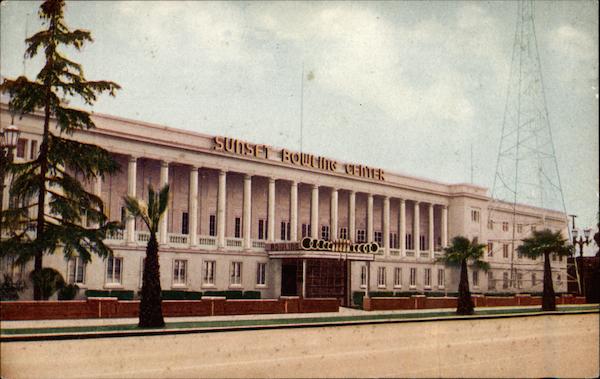
Sunset Bowling Center
A statuesque exterior, flanked by tall towers on each side, has gained for Sunset Bowling Center recognition as Hollywood's newest and brightest landmark. Ve...
Looks the Sunset Bowling Center had a directional antennaRoddy:
The studios were on Sunset (5858) and the exterior design was the same from 1919 on. It was Warner Bros. before they moved to Burbank. Gene’s office used to be Jack Warner’s.
In the 1940s and 50s it was the Sunset Bowling Center, then an annex of Paramount Pictures, which bore the cost of converting it back to office space. Autry got it in ‘64 when he bought KTLA, Channel 5 from Paramount. He moved KMPC in in June of 1968.
Not saying Gene didn’t spend money on state of the art studios, but the White House replica had been there for 49 years when KMPC moved in.
Sunset Bowling Center
A statuesque exterior, flanked by tall towers on each side, has gained for Sunset Bowling Center recognition as Hollywood's newest and brightest landmark. Ve...www.cardcow.com
 .
.Looks the Sunset Bowling Center had a directional antenna
I think that was for KFWB. There were two antennas. One was removed a long time ago. The second was demolished about 3 years ago.
Warner Bros. Pictures was the original owner of KFWB, which broadcast from that building in the 1920s.Looks the Sunset Bowling Center had a directional antenna
Hollywood Historic Photos - KFWB Radio Mobile Unit 1926
Warner Bros. Hollywood Studio Hollywood Historic Photos .com is a subsidiary of Decor Art Galleries, Inc. established in Studio City, CA in 1994. We are the representatives for Bison Archives, an historic photograph collection founded in 1971 by the Los Angeles motion picture historian and...
hollywoodhistoricphotos.com
I think the second was relocated during the construction of the Netflix building and is now closer to the gate on Bronson.I think that was for KFWB. There were two antennas. One was removed a long time ago. The second was demolished about 3 years ago.
The lone tower in the KTLA parking lot that says "KTLA" on it was one of the KFWB towers. "WB was not directional, the two free standing towers were used to support a wire antenna.I think the second was relocated during the construction of the Netflix building and is now closer to the gate on Bronson.
KMPC's original transmitter used a wire antenna located in the Beverly Hills area.
- Status
- This thread has been closed due to inactivity. You can create a new thread to discuss this topic.