• Get involved.
    We want your input!
    Apply for Membership and join the conversations about everything related to broadcasting.

    After we receive your registration, a moderator will review it. After your registration is approved, you will be permitted to post.
    If you use a disposable or false email address, your registration will be rejected.

    After your membership is approved, please take a minute to tell us a little bit about yourself.
    https://www.radiodiscussions.com/forums/introduce-yourself.1088/

    Thanks in advance and have fun!
    RadioDiscussions Administrators

Is there really an “optimal” location in the Bay Area for FM/TV to broadcast from?

I’ve been thinking about this quite a bit, as I’ve been spending more and more time in the Bay Area in 2025 (so far). As most people who’ve listened to radio in the Bay Area know, FM is challenging. The hilly terrain causes shadowing for many parts of the region.

As far as I can tell, just about every transmission site has some major advantages (and major drawbacks). But with that being said, I really can’t identify any site as being “better” than another. Even the Sutro Tower has issues in certain areas (after looking at a Longely-Rice coverage map). No matter where your equipment is located, there’s going to be shadowing for various parts of the market.

I wanted to throw this question out and see if anyone has any insight on this topic. Is there truly a site that’s “optimal”?
 
This is an excellent question, and something I was pondering when I was in the Bay Area last month.

You're correct that there's no one perfect spot to blanket the whole area. San Jose is just a little too far south to get quite enough signal from any of the San Francisco sites, though San Bruno does best down there since it's significantly closer than Sutro or Beacon.

Another factor is that you're dealing with a fairly wide range of power levels because of the stations that are grandfathered in at higher than standard class B. Are KIOI and KQED good because they're on San Bruno, or because they're superpower? A little of each, probably.

The potential game changer now is the improvement in on-channel booster technology. It matters less where your primary signal is, when you can fill in your bad spots with multiple boosters in places like Contra Costa.

Interesting, too, that more FMs didn't look at the East Bay hills as a possible location. Look at how well KPFA covers from its Berkeley site!
 
I’ve been thinking about this quite a bit, as I’ve been spending more and more time in the Bay Area in 2025 (so far). As most people who’ve listened to radio in the Bay Area know, FM is challenging. The hilly terrain causes shadowing for many parts of the region.

As far as I can tell, just about every transmission site has some major advantages (and major drawbacks). But with that being said, I really can’t identify any site as being “better” than another. Even the Sutro Tower has issues in certain areas (after looking at a Longely-Rice coverage map). No matter where your equipment is located, there’s going to be shadowing for various parts of the market.

I wanted to throw this question out and see if anyone has any insight on this topic. Is there truly a site that’s “optimal”?
The short answer is "no". As you no doubt have surmised by now, terrain is a significant issue. @fybush correctly points out some other issues, including variation in power levels.
The potential game changer now is the improvement in on-channel booster technology. It matters less where your primary signal is, when you can fill in your bad spots with multiple boosters in places like Contra Costa.
This will be significant particularly for the Diablo Valley.

Interesting, too, that more FMs didn't look at the East Bay hills as a possible location. Look at how well KPFA covers from its Berkeley site!
Five words: East Bay Regional Park District. Most of the land on the bay side of the hills is privately owned, much of which is residential. I lived in one of those neighborhoods. The big exception is Oakland's Joaquin Miller Park, which is adjacent to the EBRPD lands. On the inland side, it's almost all forest until you get to Canyon, Orinda, and Moraga. EBRPD has a few small tower sites, one of which is near the Pacifica-owned KPFA site, mostly used for its own purposes, with little broadcast activity. If I recall correctly some of the new boosters will go on a tower near Grizzly Peak. And KALX's site is on University of California-owned land near the Lawrence Hall of Science near the top of the hills.

But you might think that, say, Redwood Peak in Oakland would make a good site. It's 493m, in the same range as the peaks in the Grizzly Peak area. It was about a 20 minute walk from my house, and I can tell you that it's entirely forested, mostly redwoods. There is no road to Round Top, not even a fire trail, just hiking trails. There is no way EBRPD is going to allow any kind of development there. The only way you can really tell that you're on Round Top is the survey marker that indicates the height at that location. Interestingly, there is three-phase power nearby but that's for the Chabot Space & Science Center, which is also adjacent to park lands.

This leaves aside other considerations, such as fire danger in the dry season, which is significant (and which is why we moved away). By comparison, Sutro is unlikely to have that problem; not sure about San Bruno or Beacon.

Also keep in mind that for all of KPFA's greater-than-B power and height combination, it still needs KPFB to cover the Berkeley lowlands.

Edit: I guess after two years away, one starts forgetting things. I was referring to Redwood Peak, so I made the correction above. Round Top is near an environmentally sensitive preserve within the EBRPD parklands (and actually not far from where Jerry Brown used to live!). It indeed is 531m in height and even less likely to have any kind of development.
 
This is an excellent question, and something I was pondering when I was in the Bay Area last month.

You're correct that there's no one perfect spot to blanket the whole area. San Jose is just a little too far south to get quite enough signal from any of the San Francisco sites, though San Bruno does best down there since it's significantly closer than Sutro or Beacon.

Another factor is that you're dealing with a fairly wide range of power levels because of the stations that are grandfathered in at higher than standard class B. Are KIOI and KQED good because they're on San Bruno, or because they're superpower? A little of each, probably.

The potential game changer now is the improvement in on-channel booster technology. It matters less where your primary signal is, when you can fill in your bad spots with multiple boosters in places like Contra Costa.

Interesting, too, that more FMs didn't look at the East Bay hills as a possible location. Look at how well KPFA covers from its Berkeley site!
Thank you for summing up many of my thoughts! I totally agree, KQED and KIOI are probably the Bay Area’s best bets. And it does seem like San Bruno Mountain provides a little bit of help too, since it’s located in a decent spot to hit the most important areas.

Mount Sutro surprises me a bit, because I noticed that KOIT sounds pretty good throughout the market (though 104.5 doesn’t sound as strong). I’m sure having more ERP makes a big difference. I thought there’d be more issues with shadowing, but this wasn’t really the case.

When I’m in the area I normally listen to 103.7. They seem to do pretty well, despite being a bit limited on power. However, they sound pretty rough in parts of the South Bay (near Silicon Valley and Los Gatos). Still plenty listenable though.

I also listen to KCBS for news and traffic. I know Audacy really likes to plug 106.9, but I’ve found 740 to be much more pleasant to listen to if you’re in the South Bay. The transmitter location for 106.9 in the Marin Highlands just doesn’t hit many of the key areas it would need to hit to be effective. So I (personally) find 740 to be far more effective.
 
The short answer is "no". As you no doubt have surmised by now, terrain is a significant issue. @fybush correctly points out some other issues, including variation in power levels.

This will be significant particularly for the Diablo Valley.


Five words: East Bay Regional Park District. Most of the land on the bay side of the hills is privately owned, much of which is residential. I lived in one of those neighborhoods. The big exception is Oakland's Joaquin Miller Park, which is adjacent to the EBRPD lands. On the inland side, it's almost all forest until you get to Canyon, Orinda, and Moraga. EBRPD has a few small tower sites, one of which is near the Pacifica-owned KPFA site, mostly used for its own purposes, with little broadcast activity. If I recall correctly some of the new boosters will go on a tower near Grizzly Peak. And KALX's site is on University of California-owned land near the Lawrence Hall of Science near the top of the hills.

But you might think that, say, Redwood Peak in Oakland would make a good site. It's 493m, in the same range as the peaks in the Grizzly Peak area. It was about a 20 minute walk from my house, and I can tell you that it's entirely forested, mostly redwoods. There is no road to Round Top, not even a fire trail, just hiking trails. There is no way EBRPD is going to allow any kind of development there. The only way you can really tell that you're on Round Top is the survey marker that indicates the height at that location. Interestingly, there is three-phase power nearby but that's for the Chabot Space & Science Center, which is also adjacent to park lands.

This leaves aside other considerations, such as fire danger in the dry season, which is significant (and which is why we moved away). By comparison, Sutro is unlikely to have that problem; not sure about San Bruno or Beacon.

Also keep in mind that for all of KPFA's greater-than-B power and height combination, it still needs KPFB to cover the Berkeley lowlands.

Edit: I guess after two years away, one starts forgetting things. I was referring to Redwood Peak, so I made the correction above. Round Top is near an environmentally sensitive preserve within the EBRPD parklands (and actually not far from where Jerry Brown used to live!). It indeed is 531m in height and even less likely to have any kind of development.
Thanks for sharing your local perspective. That’s really interesting information, as I was also curious about if there would be an advantage to having a site located on the east side of the bay. It sounds like it just wouldn’t be a good idea for a myriad of logistical factors. I was always curious if Mount Diablo would work (but looking at the map, it’s too far away from the population centers to make much sense).
 
Depends on what you mean by optimum location. As mentioned here we think of Marin Highlands, Twin Peaks, San Bruno Mountains and Mount Sutro as the three places to transmit signals from. That's if you intend to get the signal cover for San Francisco and Oakland. However if the intent is to aim for San Jose and the South Bay there's a Mount Allison in Fremont, California. The stations that have their transmitters there are KDTV, KTSF, KSTS, KTLN transmit their TV signals there.


KICU-TV has their transmitter at Monument Peak in the San Jose area.


The geographic center of the SF radio market is around Richmond or Berkeley. But that's likely not the ideal place to broadcast from because the population center is quite a bit south of there, since much of Marin, Napa, and Sonoma counties are rural.

If you assumed flat terrain throughout the market, a tower near Oakland International Airport might be ideal to reach the most people. However, I would guess San Bruno Mountain would make a site that far south undesirable for reception in SF itself.

So to answer the titular question: No, there probably isn't one ideal location to serve the SF-Oakland market.
 
There is no single ideal location in the Bay Area. That's why we're seeing all those FM booster applications now appearing along commuter routes - although some geo-specific advertising may be at the root of this effort.
 
If only Alcatraz wasn’t going to be reopened…
I could see Alcatraz from my driveway in Oakland as long as there wasn't any fog.

Also, in 2017, I was on the island one morning as part of a charitable project with my employer, basically helping tidy up the island. It was a clear day, no fog at all, and the views were spectacular.
 
Thanks for sharing your local perspective. That’s really interesting information, as I was also curious about if there would be an advantage to having a site located on the east side of the bay. It sounds like it just wouldn’t be a good idea for a myriad of logistical factors. I was always curious if Mount Diablo would work (but looking at the map, it’s too far away from the population centers to make much sense).
The original KOVR-TV (analog channel 13, licensed to Stockton) tried Diablo, to cover both San Francisco and Sacramento. That failed for economic reasons, and KOVR moved into the Sacramento market exclusively, where it is today. And the original site for KTNC-TV, analog channel 42, was on Diablo. The station, licensed to Concord, is now on Sutro. Much of Berkeley and Oakland is shadowed from Mt. Diablo, but parts of San Francisco with a clear shot to the east could get a decent signal from there.

I spent more than a quarter-century in the Bay Area, so I hope I remember a few things from those years!
 
If you assumed flat terrain throughout the market, a tower near Oakland International Airport might be ideal to reach the most people.
One problem with that: the airport. While service has declined there in recent years, Southwest is still using it heavily, as do charter services.
 
The original KOVR-TV (analog channel 13, licensed to Stockton) tried Diablo, to cover both San Francisco and Sacramento. That failed for economic reasons, and KOVR moved into the Sacramento market exclusively, where it is today. And the original site for KTNC-TV, analog channel 42, was on Diablo. The station, licensed to Concord, is now on Sutro. Much of Berkeley and Oakland is shadowed from Mt. Diablo, but parts of San Francisco with a clear shot to the east could get a decent signal from there.

I spent more than a quarter-century in the Bay Area, so I hope I remember a few things from those years!

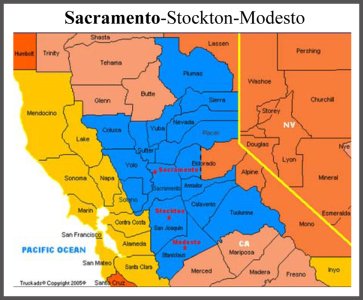
Yes and the history over KOVR's affiliation deal can explain why they had to move their transmitter off Mt Diablo and a factor why Solano County is split in two different TV Markets like Vallejo and Benicia are in the San Francisco TV Market while Vacaville, Dixon and Rio Vista is in the Sacramento TV Market. .

region_new_800_sac.jpg

In 1955, the FCC had begun questioning why KOVR's transmitter was so far (35 miles) from its city of license -- it was actually closer by five miles to San Francisco -- and since they were never going to get an ABC affiliation sitting atop Mt. Diablo anyway they filed in August 1956 to move to Butte Mountain, just east of their actual city of license, and announced that they intended to secure the ABC affiliation for the Sacramento market after the move. The ink was barely dry on channel 13's application when KCCC-TV filed an application of its own for that channel, using the existing facilities on Diablo, saying they would be happy to operate as an independent serving both markets "if KOVR can't make a go of it themselves." When that tactic failed, they filed a protest against the move, charging that KOVR was "attempting to move in on Sacramento and secure the ABC affiliation," which was difficult to dispute given its owners' public statements.

The FCC stayed the KOVR move in January 1957 and agreed to hold hearings on misrepresentation or concealing of facts in its application such as areas and population which would lose service, whether service to Stockton increased or decreased and whether the move might injure authorized (channel 40) or proposed (channel 46) UHFs in the area. Meanwhile, as if to prove the argument against itself, channel 13 announced their affiliation with ABC, effective February 17; but, seeing that he wasn't going to be able to curb the momentum of a UHF-to-VHF affiliation swap, Lincoln Dellar purchased an 18% interest in KOVR, sold it KCCC-TV's assets, withdrew his objection to the transmitter site move, and took channel 40 dark on May 31, 1957.
 
The original KOVR-TV (analog channel 13, licensed to Stockton) tried Diablo, to cover both San Francisco and Sacramento. That failed for economic reasons, and KOVR moved into the Sacramento market exclusively, where it is today. And the original site for KTNC-TV, analog channel 42, was on Diablo. The station, licensed to Concord, is now on Sutro. Much of Berkeley and Oakland is shadowed from Mt. Diablo, but parts of San Francisco with a clear shot to the east could get a decent signal from there.

I spent more than a quarter-century in the Bay Area, so I hope I remember a few things from those years!
I'm glad that you're here to share your insights (especially for those of us like myself, who are newer to the Bay Area). As I recall, KOFY might have been on Mount Diablo at one time as well. I recall seeing a YouTube clip of their first sign-on from Sutro, which included a message about moving off of Mount Diablo. That was probably a wise decision if Mount Diablo is so inconsistent across the market.
 
I'm glad that you're here to share your insights (especially for those of us like myself, who are newer to the Bay Area). As I recall, KOFY might have been on Mount Diablo at one time as well. I recall seeing a YouTube clip of their first sign-on from Sutro, which included a message about moving off of Mount Diablo. That was probably a wise decision if Mount Diablo is so inconsistent across the market.
It was on San Bruno Mtn.
 
I had been thinking about this problem recently, before @FordRanger opened this thread. And I've come to the same conclusion as everyone else: There's no place in or over the SFBA that would transmit a signal that wouldn't be shadowed somewhere. If you were able to create a Sutro Tower in the sky, high over the San Mateo Bridge, or the East Bay Hills, or Treasure Island, or basically anywhere, there would still be sections that would be in the shadow of some geological structure, or too far away. Some spots might be better than others, affect the fewest people, but I think it's impossible to find a location that would be good for everyone. And even there, it would have to be so high up in the sky that there would be no way to keep it suspended, power it or maintain it, or not interfere with aviation.
 
Status
This thread has been closed due to inactivity. You can create a new thread to discuss this topic.


Back
Top Bottom