• Get involved.
    We want your input!
    Apply for Membership and join the conversations about everything related to broadcasting.

    After we receive your registration, a moderator will review it. After your registration is approved, you will be permitted to post.
    If you use a disposable or false email address, your registration will be rejected.

    After your membership is approved, please take a minute to tell us a little bit about yourself.
    https://www.radiodiscussions.com/forums/introduce-yourself.1088/

    Thanks in advance and have fun!
    RadioDiscussions Administrators

"K-I-X-I Mercer Island, Seattle and Cosmopolis on 880"?

I didn't know if I should post this here or in the general Washington forum, but since it's a Seattle-area station I'll post it here. DavidEduardo or frankberry can move it if it doesn't belong here.

Here's an oddity I heard in my KIXI 1987 aircheck (https://archive.org/details/KIXI1987August07). The station's transmitter site was (still is) in a forested plain near Bellevue. [1] The top-of-hour idents mention Cosmopolis, a little town next to Aberdeen; a good 100 miles or so west of Seattle and with a mountain range in between, yet. [2]

Did they really put out enough signal that the central coast was considered part of their service area, or is there a suburb of Seattle with that same name that I'm just unaware of? If the former, shouldn't it have been receivable enough in the Portland area that flea-powered KWIP wouldn't have ended up on 880? I live/d near/in Vancouver and certainly don't remember ever hearing it here except weakly via nighttime skywave DX. Their transmitter array looks like it was constructed for a SW/NE directional pattern so maybe they do hit the coast reliably.

----------------------------
[1] http://mapper.acme.com/?ll=47.58264,-122.18215&z=17&t=SLB
[2] http://mapper.acme.com/?ll=46.95498,-123.77309&z=14&t=SLB
 
Great aircheck! KIXI is licensed to Mercer Island, they were likely doing what many stations do... Legal ID, followed by assorted other towns and cities within their listening area. No doubt you could hear it in Cosmopolis, which by the way does these days have a licensed FM station... KANY 107.3.

Stardust was SMN, then to ABC. We carried Stardust in Aberdeen on KBKW maybe close to 20 years ago, until one day I noticed that the really "mature" announcers were all gone and the music no longer ended properly at the end of the song on the top of the hour. Sure enough, ABC had made one of the early moves to the modern miracle of "voice-tracking". I cancelled and moved to AP All News Radio, which only lasted a few years.
 
KIXI has a colorful history in Seattle. I won't go into all the details but Wiki has some interesting history.

I had the opportunity to work for Wally Nelskog on their FM in the early 80's. I may have shared this story on another thread, but what the heck I will share it again. KIXI-FM was then located on the top floor of Tower 801, that 60's-built circular tower near the Paramount Theater. Our studio looked directly out at I-5 below. The FM format at 95.7 was more contemporary than the AM (then at 910 AM), still playing standards. Today it would be called "Soft AC". Rent became too high at Tower 801, so the operation moved to Dexter Avenue, just south of the old KING broadcasting studios in 1982. I did the evening show in the early 80's. On September 1st, 1983, Wally Nelskog phoned me on the hotline and told me to announce U.S. Senator Henry Jackson had died. (He knew him personally, so he was one of the first to get the news). So KIXI-FM was the first to announce the news of the Senator's death that evening. I didn't realize how important this news was at the time (I was 24), so I put it on the air and played another Stephen Bishop tune, thinking nothing of it. The next day I realized what a big story this was. A memory I will never forget. KIXI-FM went on to become KJR-FM, today known as "The Jet". Sorry for this nostalgia break. Carry on...
 
Last edited:
I didn't know if I should post this here or in the general Washington forum, but since it's a Seattle-area station I'll post it here. DavidEduardo or frankberry can move it if it doesn't belong here.

Here's an oddity I heard in my KIXI 1987 aircheck (https://archive.org/details/KIXI1987August07). The station's transmitter site was (still is) in a forested plain near Bellevue. [1] The top-of-hour idents mention Cosmopolis, a little town next to Aberdeen; a good 100 miles or so west of Seattle and with a mountain range in between, yet. [2]

Did they really put out enough signal that the central coast was considered part of their service area, or is there a suburb of Seattle with that same name that I'm just unaware of? If the former, shouldn't it have been receivable enough in the Portland area that flea-powered KWIP wouldn't have ended up on 880? I live/d near/in Vancouver and certainly don't remember ever hearing it here except weakly via nighttime skywave DX. Their transmitter array looks like it was constructed for a SW/NE directional pattern so maybe they do hit the coast reliably.

----------------------------
[1] http://mapper.acme.com/?ll=47.58264,-122.18215&z=17&t=SLB
[2] http://mapper.acme.com/?ll=46.95498,-123.77309&z=14&t=SLB
KIXI 910 and KWIP 1460 arrived on 880 at about the same time, both as part of a second breaking down of the clears. By the way, I don't think that 5KW non-directional on 880AM is "flea-powered"!
 
Here's an oddity I heard in my KIXI 1987 aircheck (https://archive.org/details/KIXI1987August07). The station's transmitter site was (still is) in a forested plain near Bellevue. [1] The top-of-hour idents mention Cosmopolis, a little town next to Aberdeen; a good 100 miles or so west of Seattle and with a mountain range in between, yet. [2]

Did they really put out enough signal that the central coast was considered part of their service area, or is there a suburb of Seattle with that same name that I'm just unaware of? If the former, shouldn't it have been receivable enough in the Portland area that flea-powered KWIP wouldn't have ended up on 880? I live/d near/in Vancouver and certainly don't remember ever hearing it here except weakly via nighttime skywave DX. Their transmitter array looks like it was constructed for a SW/NE directional pattern so maybe they do hit the coast reliably.

In that era, quite a few stations that had suburban licenses would do IDs that had "suburban city, big city, other city" in which the final city or cities would rotate.

So, it is quite possible that KIXI rotated towns, cities and villages in the area as the third of three. The idea was to mask the suburban city of license by always having another even more distant town mentioned along with Seattle in the second place after the COL.
 
In that era, quite a few stations that had suburban licenses would do IDs that had "suburban city, big city, other city" in which the final city or cities would rotate.

So, it is quite possible that KIXI rotated towns, cities and villages in the area as the third of three. The idea was to mask the suburban city of license by always having another even more distant town mentioned along with Seattle in the second place after the COL.
I always thought that the idea was to make smaller communities feel like they were part of the listening audience.
 
Well, of course most know this, but the only FCC requirement at the time (and I think still) is to spell the call letters, followed by the city of license. What you put before or after did not matter. For example, you could say "KJR, Seattle Washington's highest rated radio station serving Seattle, Tacoma, Everett, and vicinity". Which actually was one of their lines back in the day.
 
Well, of course most know this, but the only FCC requirement at the time (and I think still) is to spell the call letters, followed by the city of license. What you put before or after did not matter. For example, you could say "KJR, Seattle Washington's highest rated radio station serving Seattle, Tacoma, Everett, and vicinity". Which actually was one of their lines back in the day.

You are correct. Call letters followed by city of license makes a legal ID. One could announce the station as: 'KIXI, Mercer Island', then follow it with Sequim, or even Pocatello if they wanted.

Now here's an interesting twist that some of you probably don't know: For stations that have the same call letters for AM and FM, the proper ID while simulcasting would be: 'KJR and KJR-FM, Seattle' If not simulcasting, then the AM would identify itself as: KJR, Seattle (not KJR-AM). The FM would identify itself as: KJR-FM, Seattle.

Honestly though; I doubt if the Commission is getting it's panties in a wad if stations fool around with the order of verbiage. I guess if an in-person inspection was taking place and the Inspector heard the incorrect station ID, they would potentially send the station an NAL. Most Inspector's I've dealt with, assuming there aren't several flagrant violations found, would just verbally bring it to the station's attention that they might want to change their station ID.
 
There's not too many folks that know what a legal ID actually is...it's exactly what KellyA describes. I agree that if the FCC visited your station and your station didn't have a bunch of issues and you were being cooperative with the agent, you'd likely only be told versus getting a NAL. On one visit from the FCC, everything was fine except I forgot to put a letter in the EAS file about when we took the EAS out of service to be repaired at the manufacturer. I was told versus getting a NAL. I have always felt that with the FCC, the more diligent you are at being legal to the letter of the rules, the easier the FCC is on you if they find a problem. It likely helped we made a desk available to him and brewed a fresh pot of coffee for him.
 
While it is perfectly legal to add in other cities, why would a station add a city so far away? Bellevue, Everett, Tacoma, North Bend, or Edmonds would all make much more sense than Cosmopolis. A few stations still rotate that third city, the best example I know of is KMNT Chehalis, Centralia, rotating third city always in Lewis County. The ones I've heard are Toledo, Winlock, and Napavine. KXL down here is usually KXL Portland, Vancouver, Salem.
 
You are correct. Call letters followed by city of license makes a legal ID. One could announce the station as: 'KIXI, Mercer Island', then follow it with Sequim, or even Pocatello if they wanted.

Now here's an interesting twist that some of you probably don't know: For stations that have the same call letters for AM and FM, the proper ID while simulcasting would be: 'KJR and KJR-FM, Seattle' If not simulcasting, then the AM would identify itself as: KJR, Seattle (not KJR-AM). The FM would identify itself as: KJR-FM, Seattle.

Honestly though; I doubt if the Commission is getting it's panties in a wad if stations fool around with the order of verbiage. I guess if an in-person inspection was taking place and the Inspector heard the incorrect station ID, they would potentially send the station an NAL. Most Inspector's I've dealt with, assuming there aren't several flagrant violations found, would just verbally bring it to the station's attention that they might want to change their station ID.
I'm having an issue with inserting the word, "and" between "KJR" and "KJR-FM": Wouldn't that be in the same ballpark as placing "in" between "KJR" and "Seattle"? Shouldn't it be, "KJR/KJR-FM Seattle? By the way, that would make a trimulcast, "KJR/KJR-FM/KJR-FM-HD1"!
 
While it is perfectly legal to add in other cities, why would a station add a city so far away? Bellevue, Everett, Tacoma, North Bend, or Edmonds would all make much more sense than Cosmopolis. A few stations still rotate that third city, the best example I know of is KMNT Chehalis, Centralia, rotating third city always in Lewis County. The ones I've heard are Toledo, Winlock, and Napavine. KXL down here is usually KXL Portland, Vancouver, Salem.

In the case of KIXI, it's probably intended to catch the attention of the listener. (that's right, I said listener) 'Wait, did they just say Cosmopolis??'
 
I'm having an issue with inserting the word, "and" between "KJR" and "KJR-FM": Wouldn't that be in the same ballpark as placing "in" between "KJR" and "Seattle"? Shouldn't it be, "KJR/KJR-FM Seattle? By the way, that would make a trimulcast, "KJR/KJR-FM/KJR-FM-HD1"!

Why do some people get stuck on TOH ID semantics? It's like red meat to radio nerds.

For a simulcast including the HD channel, the proper ID would be: KJR and KJR-FM HD1, Seattle. There would be no need to treat the HD-1 as a separate set of call letters or city. All you are identifying is that KJR-FM is also running an HD channel.
 
KIXI has used a number of weird liners, such as the Bob Liddle-voiced "You're in KIXIland if you can hear the best music of the last 40 years throughout Western Washington on 8-80". Even "KIXI Light, K-I-X-I", also voiced by Bob Liddle - years after KIXI-FM became KJR-FM.

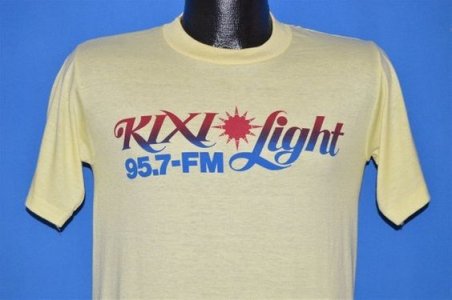
(Speaking of KIXI Light, here's a vintage KIXI Light t-shirt, circa 1982 below.)

KEZX-FM often read local weather reports that finished with "and in (some locale on the very outskirts of the signal) it's X degrees"

As for Cosmopolis, I guess if you got 50,000 watts, use them.

As for call letters, it wouldn't surprise me at all if those became voluntary instead of mandatory in the near future. Trouble is, that's also taking away a major American radio tradition. While average listeners couldn't care less about the call letters than the stations themselves, it's one of the few things separating terrestrial and internet radio. And sometimes, the call letters themselves are the brand (KZOK, KISW.)
 

Attachments

  • 83b486cdad21ccbd2b0a9cf0faaa19cb.jpg
    83b486cdad21ccbd2b0a9cf0faaa19cb.jpg
    26.7 KB · Views: 9
As for call letters, it wouldn't surprise me at all if those became voluntary instead of mandatory in the near future. Trouble is, that's also taking away a major American radio tradition. While average listeners couldn't care less about the call letters than the stations themselves, it's one of the few things separating terrestrial and internet radio. And sometimes, the call letters themselves are the brand (KZOK, KISW.)

Calls can be embedded in content in a variety of way. The purpose of calls was to identify interference; there are better ways now.

When radio was new and experimental, the USA got into the habit of using calls as the station identity. In most other nations, stations got names. They used them alone or in addition to the calls.

"LR3 Radio Belgrano" or "WKAQ Radio Reloj". But in much of the world, just the name was... and is used. In at least one, a local station was not allowed to use calls on the air... the calls were for legal identity, not on the air one.

Does anyone know the call letters of any BBC stations?
 
In the case of KIXI, it's probably intended to catch the attention of the listener. (that's right, I said listener) 'Wait, did they just say Cosmopolis??'

In Miami in 1982 when the Ft. Lauderdale and Miami markets were combined by Arbitron, one station did IDs that were...

WZZZ Miami, Ft Lauderdale and Davie
WZZZ Miami, Ft Lauderdale and Kendall
WZZZ Miami, Ft Lauderdale and Hollywood
WZZZ Miami, Ft Lauderdale and Hialeah

... and so on. The idea was to create an "all of us" atmosphere and each station wanted to seem accepting to listeners of both former markets.
 
In Miami in 1982 when the Ft. Lauderdale and Miami markets were combined by Arbitron, one station did IDs that were...

WZZZ Miami, Ft Lauderdale and Davie
WZZZ Miami, Ft Lauderdale and Kendall
WZZZ Miami, Ft Lauderdale and Hollywood
WZZZ Miami, Ft Lauderdale and Hialeah

... and so on. The idea was to create an "all of us" atmosphere and each station wanted to seem accepting to listeners of both former markets.

Absolutely this was a common ID strategy. By mentioning outer suburbs or even neighborhoods you could potentially get some diary entries. I don’t know of any studies that prove the theory but it certainly was worth a try.
 
Absolutely this was a common ID strategy. By mentioning outer suburbs or even neighborhoods you could potentially get some diary entries. I don’t know of any studies that prove the theory but it certainly was worth a try.

This was the same sort of thing the Drake stations did by inserting rotating metro area locations for temperature checks.

"It's 87 in Los Angeles, In Burbank it is 92 and it's 76 in Santa Monica... I'm Bill Bullet, KHJ 20-20 News." Or something like that.
 
Why do some people get stuck on TOH ID semantics? It's like red meat to radio nerds.

For a simulcast including the HD channel, the proper ID would be: KJR and KJR-FM HD1, Seattle. There would be no need to treat the HD-1 as a separate set of call letters or city. All you are identifying is that KJR-FM is also running an HD channel.
In a situation where KJR-FM exists as separate calls from KJR, if there is an HD channel, you would have to ID as KJR-FM-HD1 but if you don't say anything else, you haven't identified the main channel, KJR-FM.
 
Status
This thread has been closed due to inactivity. You can create a new thread to discuss this topic.


Back
Top Bottom