• Get involved.
    We want your input!
    Apply for Membership and join the conversations about everything related to broadcasting.

    After we receive your registration, a moderator will review it. After your registration is approved, you will be permitted to post.
    If you use a disposable or false email address, your registration will be rejected.

    After your membership is approved, please take a minute to tell us a little bit about yourself.
    https://www.radiodiscussions.com/forums/introduce-yourself.1088/

    Thanks in advance and have fun!
    RadioDiscussions Administrators

Rest of Arizona KBLU AM 560 Silenced: Yuma’s 80+ Year Radio Legacy Ends

And the city is "San Luis Río Colorado". That means "The town of San Luis on the Colorado River". Without the "Colorado" it could be "San Luis Río Mississippi" for all I know!

For the record, there are no towns named San Luis Rio located in the U.S. However, I did find three San Luis's: San Luis, CO; San Luis, NM; and San Luis, AZ. That last one is located directly across the Mexico-Arizona border from San Luis Rio (I'm not going to try to guess which of the accent marks to use here though I humbly thank @K.M. Richards for supplying them) Colorado, Sonora, Mexico and has the largest population of the three. While I haven't been to the Arizona San Luis (it's the southern endpoint for U.S. Route 95), I'm quite sure that the Mexican AM and FM outlets are received much better there than in Yuma.
 
For the record, there are no towns named San Luis Rio located in the U.S
"San Luis Río" is (despite being grammatically incorrect) "The Saint Louis River". The Mexican border town near Yuma is the city of San Luis on the Colorado River. Or "San Luis Río Colorado".
 
Prior to this season, there were also a pretty significant influx of foreign "snowbirds" from many regions of Canada. Reasons why are well-known by anyone who pays attention to what happens in DC.

Likely still more Canadian snowbirds than 2020-21, where it was illegal for Canadians to travel
 
While I haven't been to the Arizona San Luis (it's the southern endpoint for U.S. Route 95), I'm quite sure that the Mexican AM and FM outlets are received much better there than in Yuma.
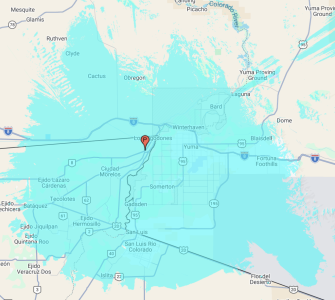
With the very likely exception of XHLPS-FM, the northernmost broadcast facility in Mexico, whose transmitter site is in Col. Ladrillera, Baja California, about even with Yuma's 24th St. (County 10th St.) It's 3 kW @ 48m HAAT, which is quite underclass for a Class B station. If it had a coverage area that filled its 65 km statutory coverage area*, it'd serve the eastern half of Mexicali. Map from CPCREL:

Screenshot 2026-03-06 at 01.00.37.png

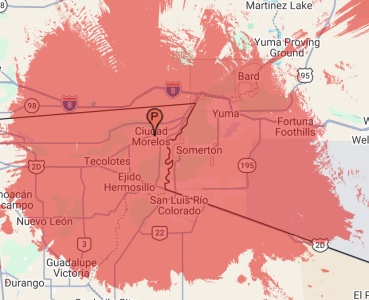
XHDY-FM Ciudad Morelos BC (run as part of the OIR SLRC cluster) is a slightly overclass B1 (CPCREL lists its ERP as 25.903 kW) and equidistant from Yuma and SLRC. It reaches about 71,000 more listeners within Mexico per CRT figures. Its US-site coverage is about the same.

Screenshot 2026-03-06 at 01.01.58.png

* In Mexico, FM stations are given a statutory coverage area by class, defined typically as a radius from reference coordinates for the locality. Class A (3 kW): 24 km. Class AA (6 kW): 28 km. Class B1: 45 km. Class B: 65 km. Class C1: 72 km. Class C: 92 km. Class D (50 watts): 5 km. Some stations, particularly new-insert noncoms, are restricted-A stations with statutory radii of less than 24 km.
 
With the very likely exception of XHLPS-FM, the northernmost broadcast facility in Mexico, whose transmitter site is in Col. Ladrillera, Baja California, about even with Yuma's 24th St. (County 10th St.) It's 3 kW @ 48m HAAT, which is quite underclass for a Class B station. If it had a coverage area that filled its 65 km statutory coverage area*, it'd serve the eastern half of Mexicali. Map from CPCREL:

View attachment 11566

XHDY-FM Ciudad Morelos BC (run as part of the OIR SLRC cluster) is a slightly overclass B1 (CPCREL lists its ERP as 25.903 kW) and equidistant from Yuma and SLRC. It reaches about 71,000 more listeners within Mexico per CRT figures. Its US-site coverage is about the same.

View attachment 11567

* In Mexico, FM stations are given a statutory coverage area by class, defined typically as a radius from reference coordinates for the locality. Class A (3 kW): 24 km. Class AA (6 kW): 28 km. Class B1: 45 km. Class B: 65 km. Class C1: 72 km. Class C: 92 km. Class D (50 watts): 5 km. Some stations, particularly new-insert noncoms, are restricted-A stations with statutory radii of less than 24 km.

What I was thinking of when I wrote that was San Luis Rio Colorado's AM outlets: the now discontinued 1080 (which was daytime only then), the 1260/1270 outlet (I heard that one on both frequencies on my trips through Yuma), 1350, 1450 (now 1460), and 1520 (which may have been a daytimer as well) stations. But you're right. With the possible exceptions of the stations at 89.5, 102.5 and 107.9, the San Luis Rio Colorado FM stations did not have good signals in Yuma.
 
With the very likely exception of XHLPS-FM, the northernmost broadcast facility in Mexico, whose transmitter site is in Col. Ladrillera, Baja California, about even with Yuma's 24th St. (County 10th St.) It's 3 kW @ 48m HAAT, which is quite underclass for a Class B station. If it had a coverage area that filled its 65 km statutory coverage area*, it'd serve the eastern half of Mexicali. Map from CPCREL:

View attachment 11566

XHDY-FM Ciudad Morelos BC (run as part of the OIR SLRC cluster) is a slightly overclass B1 (CPCREL lists its ERP as 25.903 kW) and equidistant from Yuma and SLRC. It reaches about 71,000 more listeners within Mexico per CRT figures. Its US-site coverage is about the same.

View attachment 11567

* In Mexico, FM stations are given a statutory coverage area by class, defined typically as a radius from reference coordinates for the locality. Class A (3 kW): 24 km. Class AA (6 kW): 28 km. Class B1: 45 km. Class B: 65 km. Class C1: 72 km. Class C: 92 km. Class D (50 watts): 5 km. Some stations, particularly new-insert noncoms, are restricted-A stations with statutory radii of less than 24 km.

The tower for XHLPS looks empty as of August 2025
 
From the Radioland mobile app...

Using the coordinates for downtown central Yuma, these are the receivable FM signals with a dBuV/m reading of 60 or higher. The last number is the exact dBuV/m reading.

88.1 KCFY - 78
88.9 KAWC - 62
89.5 XHRCL - 61
90.1 K211DD - 62
91.9 KVRM - 76
92.5 KYVD-LP - 68
93.1 KLJZ - 94
93.9 XHLBL - 74
94.7 K244CZ - 70
95.1 KTTI - 92
95.9 KUKY - 65
98.3 XHMIX - 78
99.9 KYMZ - 86
100.9 KYLK (KQSR) - 80
101.5 KRJY-LP - 76
102.5 XHLPS - 79
103.1 K276F6 - 67
104.5 KCEC - 70
105.5 XHCMS - 59 (just below)
107.1 XHDY - 75
107.9 XHSLR - 89
 
KLJZ is one of the smallest 100kw signals i know of.., 82 feet height above average terrain, 135 feet off the ground.. but the News Director tells me 93.1 out performs what the maps say by quite a bit when shes been driving


Back
Top Bottom