• Get involved.
    We want your input!
    Apply for Membership and join the conversations about everything related to broadcasting.

    After we receive your registration, a moderator will review it. After your registration is approved, you will be permitted to post.
    If you use a disposable or false email address, your registration will be rejected.

    After your membership is approved, please take a minute to tell us a little bit about yourself.
    https://www.radiodiscussions.com/forums/introduce-yourself.1088/

    Thanks in advance and have fun!
    RadioDiscussions Administrators

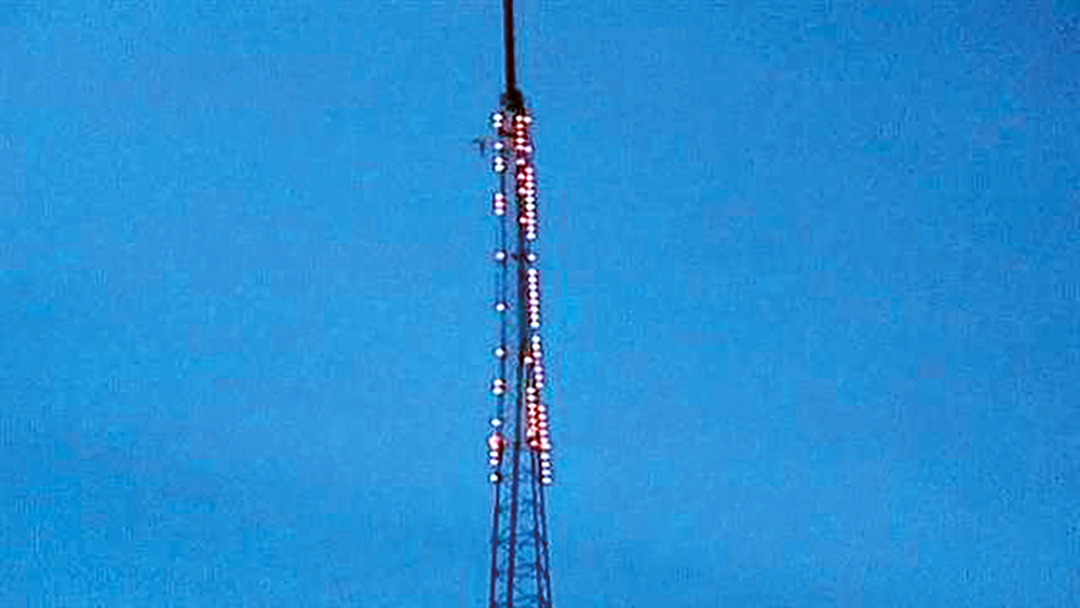
KCTV5 broadcast tower to shine once again with relighting ahead of 2026 World Cup

From the article:

“Extinguished in 2004 due to aging infrastructure and maintenance challenges, the tower has stood dark for over 20 years—until now.”

Aren’t they required to light the tower?
 
They're referring to the solid string of lights that covered the outline of the tower, basically making it look like a giant, lit pyramid.

Back in the '90s they would change the color scheme based on the weather forecast.
What colors did they use? I’m guessing blue for rain or clear skies, etc.?
 
What colors did they use? I’m guessing blue for rain or clear skies, etc.?

Rob has it correct. If the KCTV 5 tower was flashing, it meant precipitation was predicted in the next 24 hours.

I left KC in the summer of 2001, and I believe it was still doing that at the time. My last address in KC was Parkville, and you could see the KCTV tower from English Landing Park. It was quite a landmark!
 
They started around 1990, ending in the early 2000s.
November 29, 1989. The late Barry Garron, who wrote about everything in Kansas City broadcasting, had a column on it in that afternoon's Star, noting that the lights would go into operation that evening. The story contained a paragraph that I think only Barry could have written:

In the past, the tower occasionally reflected weather conditions. In winter months, chunks of ice falling from the upper reaches of the tower indicated a warming trend. They also indicated the start of the busy season for nearby automobile body repair shops.

Rob has it correct. If the KCTV 5 tower was flashing, it meant precipitation was predicted in the next 24 hours.
There was also an indication of whether the temperature would increase or decrease the next day, with the white lights flashing either up the tower or down the tower in sequence. The precipitation lights were alternating red and white on the top third of the tower.
 
November 29, 1989. The late Barry Garron, who wrote about everything in Kansas City broadcasting, had a column on it in that afternoon's Star, noting that the lights would go into operation that evening. The story contained a paragraph that I think only Barry could have written:

Barry's observation hasn't changed in the least. KC has had to close the area around 31st and Grand for a long time when ice starts falling off that tower. I always thought working for KCTV and, during my time in KC, KCMO-FM would be a bit of a pain in the winter. With how much ice would start falling from that tower, I can't imagine either of those antennas had deicers. The constant checking the transmitters for ice and lowering the power when the plate current got too high would've had to have been a huge pain.

There was also an indication of whether the temperature would increase or decrease the next day, with the white lights flashing either up the tower or down the tower in sequence. The precipitation lights were alternating red and white on the top third of the tower.

I vaguely remember the lights flashing upward or downward, but I mostly remember the flashing off and on for precipitation. Katie Horner mentioned it frequently, and KCTV changed its logo to reflect the iconic tower around the same time. I don't remember the precipitation lights flashing red and white or being just the top third of the tower, though that's possible. My usual view of the tower was from English Landing Park, where I might not have actually been seeing the entire tower, or driving 65-70 mph up 635 while crossing the railyard.
 
The temperature lights were first used by WBKB (WLS) in Chicago around 1964, when it went to its new tower atop Marina City. Different colors meant different conditions, lights going up ment rising temps, etc. Thought it really cool as a kid.
 
The city still closes 31st St. when the carpet bombing of tower ice is in progress. Working at Tower Tavern is probably a lot of fun on those days.

WDAF-TV has the same problem, though the southerly wind typically blows the ice onto the roofs rather than the street. I know several people who have had car damage from falling ice.
 
KCCI did the same thing in Des Moines, starting in 1960:

KCCI weather tower beacon.jpg
 
KCCI did the same thing in Des Moines, starting in 1960:

Interesting that one of the reasons to shut down the beacon was that the tower had to shed some weight. Early in the digital transition, there was talk of putting KCTV's digital signal on one of the candelabras near the Sports Complex where many of the radio and TV stations are now. The reason was because supporting two full-power TV signals (one digital, one analog) plus a Class C FM radio signal was believed to be a likely problem for that tower. Ultimately, Susquehanna relocated what was then known as Oldies 95 to a tower off of Blue Ridge and Truman, which solved that problem.
 
Ice falling off towers can happen in "the sunny south" too. IIRC the old analog Channel 2 tower in Atlanta had a street running between the tower base and the guy wires. We don't get snow offen but ice falling off the tower used to happen a least once every other year forcing a road closure.
 
Barry's observation hasn't changed in the least. KC has had to close the area around 31st and Grand for a long time when ice starts falling off that tower. I always thought working for KCTV and, during my time in KC, KCMO-FM would be a bit of a pain in the winter. With how much ice would start falling from that tower, I can't imagine either of those antennas had deicers. The constant checking the transmitters for ice and lowering the power when the plate current got too high would've had to have been a huge pain.
There were apartments and individual houses near the tower in the Union Hill neighborhood. Meredith, which owned KCMO radio and TV for decades, bought out some of those properties in 1984 and may have bought out more in later years. The ice falling from the tower did a number on those buildings.

{regarding KCCI in Des Moines:
}

Interesting that one of the reasons to shut down the beacon was that the tower had to shed some weight.
The tower that you see today northwest of downtown Des Moines off Keo Way on 9th Street isn't the original channel 8 tower. That tower was at 9th & Pleasant, where the headquarters of the Principal Financial Group are today. I don't know when the Principal complex was built. The construction of that complex forced KCCI to relocate its studios. The actual transmitting site for channel 8 moved to Alleman decades ago. KCCI (it may have still been KRNT then) was the last of the four legacy TV stations (the others: WOI, KDIN, WHO) to move to Alleman. The story I've heard is that KRNT was originally going to join the other three stations of the time at the first Alleman tower. But the stations drew straws for tower position and KRNT got the lowest position. Instead, they decided to build their own tower nearby. The tower you see in Des Moines proper today is mostly to support an STL. KFMG-LP is on that tower as well.

Assuming that the KDPS-FM tower is going away soon (I'll be in Des Moines in early October so I can see for myself at that time), the KCCI tower may be the last one standing in that part of the city.


Early in the digital transition, there was talk of putting KCTV's digital signal on one of the candelabras near the Sports Complex where many of the radio and TV stations are now. The reason was because supporting two full-power TV signals (one digital, one analog) plus a Class C FM radio signal was believed to be a likely problem for that tower. Ultimately, Susquehanna relocated what was then known as Oldies 95 to a tower off of Blue Ridge and Truman, which solved that problem.
KQRC would've had to relocate, too. It was on the KCTV tower throughout the 1990s.
 
KQRC would've had to relocate, too. It was on the KCTV tower throughout the 1990s.

I didn't remember KQRC being on the KCTV tower, but, looking at the FCC filings, you would be correct. Looks like it moved off of that tower around the same time KCMO-FM did.

I don't remember the engineer I spoke with mentioning two FM's on that tower at the time, but it's entirely possible he did mention it, and I just don't remember it. That was half, or more, of my life ago, and I have enough trouble remembering what I ate for breakfast this morning, let alone a discussion I had a quarter century ago!
 
I didn't remember KQRC being on the KCTV tower, but, looking at the FCC filings, you would be correct. Looks like it moved off of that tower around the same time KCMO-FM did.
What was then KCWV moved onto the KCTV tower September 11, 1987, coinciding with its format change from satellite-delivered oldies as KZZC to satellite-delivered music similar to Los Angeles' KTWV. WV stood for "The Wave". The KCTV tower replaced a 900-foot tower that KZZC built at Basehor, Kansas, in the far western reaches of the Kansas City metropolitan area, in 1983. Before 1983, the transmitter site was just south of Leavenworth. At one time, the station had a "beautiful country" format.

Mark Wodlinger bought the station in 1982, hoping that he would repeat the success he had with KBEQ in the 1970s. He went head-on after KBEQ. It didn't work. So he went to oldies and started shopping the station. Proposed sales to Beasley and to Ragan Henry fell through until Journal bought it toward the end of October 1989. The Wodlingers may also have been distracted by winning an LPTV license for Houston, putting K05HU on the air in 1985 as an all-music-video station.
 
The tower that you see today northwest of downtown Des Moines off Keo Way on 9th Street isn't the original channel 8 tower. That tower was at 9th & Pleasant, where the headquarters of the Principal Financial Group are today. I don't know when the Principal complex was built. The construction of that complex forced KCCI to relocate its studios. The actual transmitting site for channel 8 moved to Alleman decades ago. KCCI (it may have still been KRNT then) was the last of the four legacy TV stations (the others: WOI, KDIN, WHO) to move to Alleman. The story I've heard is that KRNT was originally going to join the other three stations of the time at the first Alleman tower. But the stations drew straws for tower position and KRNT got the lowest position. Instead, they decided to build their own tower nearby. The tower you see in Des Moines proper today is mostly to support an STL. KFMG-LP is on that tower as well.

Assuming that the KDPS-FM tower is going away soon (I'll be in Des Moines in early October so I can see for myself at that time), the KCCI tower may be the last one standing in that part of the city.
The original KCCI Alleman tower collapsed (1973 or early 1974?) in an ice storm that almost took the WHO/KDIN/WOI tower with it.

When the KCCI Weather Beacon hardware was removed from the downtown STL tower, it shed enough weight to allow not only KFMG-LP to move there, but four FM translators on 3 different antennas (two from Des Moines Radio Group combined on one, Northwestern-St.Paul, on another, and the translator Iowa Catholic Radio is selling to Latin World along with the former KWKY, now KDLX 1150.


Back
Top Bottom