• Get involved.
    We want your input!
    Apply for Membership and join the conversations about everything related to broadcasting.

    After we receive your registration, a moderator will review it. After your registration is approved, you will be permitted to post.
    If you use a disposable or false email address, your registration will be rejected.

    After your membership is approved, please take a minute to tell us a little bit about yourself.
    https://www.radiodiscussions.com/forums/introduce-yourself.1088/

    Thanks in advance and have fun!
    RadioDiscussions Administrators

Looking for information on a local radio station that was in Kissimmee Florida

Hi,

Not sure I have this in the right category, let me know if I should move it. Anyway I'm looking for any information on a radio station that was in Kissimmee Florida WFIV 1080 AM. This was an "easy listening" station and I would like to find out who the owner's were to see if it's possible to get some old "playlists". I know this is a longshot! I collect easy listening music, lounge music, exotica records. It went country eventually but I"m intersted in finding the "easy listening" history if possible. Any leads much appreciated. Uploading ad I found in a 1980 Kissimmee yearbook. Thanks.
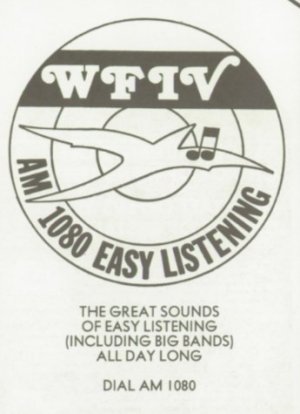
 

Attachments

  • chrome_f3Q9aJI4JB.jpg
    chrome_f3Q9aJI4JB.jpg
    30.8 KB · Views: 3
The owner of the station in that era was Edward Allmon. He died in 2002. I believe he owned the station from its sign on in the mid 1960s until his retirement in 2000.

Interestingly, I can't find any evidence other than your advertisement that the station aired an easy listening format in 1980. The Broadcasting Yearbook reports the format as "Farm/C&W", and the same in '79, '81 and '82.

Even this newspaper story from 1985 suggests WFIV was country continuously from its sign-on, although it uses a bit of flowery wording that isn't totally black and white.

 
Thanks for that. Maybe I can find some playlists if I talk to some of the former dj's. we will see. I want the playlists from when the station was playing "easy listening" but I don't think they had that format for long.

Thanks again and have a good weekend.
 
The owner of the station in that era was Edward Allmon. He died in 2002. I believe he owned the station from its sign on in the mid 1960s until his retirement in 2000.

Interestingly, I can't find any evidence other than your advertisement that the station aired an easy listening format in 1980. The Broadcasting Yearbook reports the format as "Farm/C&W", and the same in '79, '81 and '82.

Even this newspaper story from 1985 suggests WFIV was country continuously from its sign-on, although it uses a bit of flowery wording that isn't totally black and white.

Just saw this thanks, yeah I guess the "easy listening" format was only a "blip", must not have worked out?
 
I know a guy who used to work there. I'll send him a message and direct him to this thread. It will take a few days, so stay tuned! I remember them as C/W.
 
That's really unlikely. You're talking about a format that existed 46 years ago. Even if you assume there are living employees, what are the chances that they kept a piece of paper from a job they had 46 years ago?
The only chance of getting playlists and the like is with former employees. Most stations clear out their files regularly.... I even heard of as station that was inspected by its insurance company as part of a request to increase coverage and they were told to reduce the "old paperwork" that was way past legal requirements as it was a fire hazard.

As has been published here before: we run businesses, not museums.
 
The only chance of getting playlists and the like is with former employees. Most stations clear out their files regularly.... I even heard of as station that was inspected by its insurance company as part of a request to increase coverage and they were told to reduce the "old paperwork" that was way past legal requirements as it was a fire hazard.

As has been published here before: we run businesses, not museums.

Typical shortsighted, "what's-in-it-for-me-this-quarter" attitude of radio executives.

If you treat your valuable history with care, you can use it to your advantage in your business. For instance, a milestone anniversary broadcast special that attracts attention and goodwill in the community along with quality advertisers to sponsor it.
 
Typical shortsighted, "what's-in-it-for-me-this-quarter" attitude of radio executives.
Why in the world would we want to keep paperwork and artifacts from more than the legal requirements? We keep business data to have financial information in the event of a tax audit. We keep program data long enough to support us in the event of a legal claim, and not a moment more.

We might keep music logs on a hard drive for as long as streaming requirements obligate us or as long as as our maximum song rotations cover. Keep contracts with staff, office rental, leased vehicles and the like for, perhaps the current and prior versions. We might keep the last two or three license renewal applications.

FCC paperwork would be kept for as long as it applies to current operations.

The few things "keepable" might be awards framed and hung in the lobby if we have awards and a lobby. If in the hands of the original owner, maybe some other things are kept for sentimental reasons. But no listener cares at all.
If you treat your valuable history with care, you can use it to your advantage in your business. For instance, a milestone anniversary broadcast special that attracts attention and goodwill in the community along with quality advertisers to sponsor it.
To me, the only anniversaries that are significant are the most recent ones... such as "ten years bringing country hits to Anyville".

Anything else makes the station appear to not be fresh and not "new". It makes you look old. I recall quashing the 40th anniversary of KLVE in Los Angeles as 40 years was, then, older than 75% of our listeners. Old, old, old. Oh, and at the time the station was #1 or #2 in the market so we had the "right" philosophy.

With very few exceptions, there is no such thing about "valuable history" at a radio station that is of any interest to the average listener.
 
Typical shortsighted, "what's-in-it-for-me-this-quarter" attitude of radio executives.

If you treat your valuable history with care, you can use it to your advantage in your business. For instance, a milestone anniversary broadcast special that attracts attention and goodwill in the community along with quality advertisers to sponsor it.
I mean... I'd be amazed if anybody outside of this forum cares much at all about a station's history. Especially in today's industry.
 
I mean... I'd be amazed if anybody outside of this forum cares much at all about a station's history. Especially in today's industry.

Several notable stations have had very public celebrations of their 100th anniversaries lately that generated plenty of attention, not only in the broadcast industry and on this site, but also more broadly among the public in their own markets.

KMOX keeps an amazing archive of its historical recordings and other materials that supported its very well-produced anniversary broadcast.

WOR was the opposite. It DID have well-kept archives, but iHeart dumped everything Eduardo-style when it acquired the station and then they had to scrounge up whatever they could find for their anniversary. Fortunately for them, there was material to be found because it's NYC and private collectors happen to keep stuff like that.

WLS also celebrated it's 100th in similar fashion, and I'm sure there have been others. There are people who are interested in this kind of stuff. People love nostalgia. Just look at the music radio plays, most of it is old and people love it.
 
Why in the world would we want to keep paperwork and artifacts from more than the legal requirements? We keep business data to have financial information in the event of a tax audit. We keep program data long enough to support us in the event of a legal claim, and not a moment more.

We might keep music logs on a hard drive for as long as streaming requirements obligate us or as long as as our maximum song rotations cover. Keep contracts with staff, office rental, leased vehicles and the like for, perhaps the current and prior versions. We might keep the last two or three license renewal applications.

FCC paperwork would be kept for as long as it applies to current operations.

The few things "keepable" might be awards framed and hung in the lobby if we have awards and a lobby. If in the hands of the original owner, maybe some other things are kept for sentimental reasons. But no listener cares at all.

To me, the only anniversaries that are significant are the most recent ones... such as "ten years bringing country hits to Anyville".

Anything else makes the station appear to not be fresh and not "new". It makes you look old. I recall quashing the 40th anniversary of KLVE in Los Angeles as 40 years was, then, older than 75% of our listeners. Old, old, old. Oh, and at the time the station was #1 or #2 in the market so we had the "right" philosophy.

With very few exceptions, there is no such thing about "valuable history" at a radio station that is of any interest to the average listener.
Capital in the UK turned 50 a couple of years ago. It's a full-on CHR, targeting a 15-34 audience. It wasn't even on the air outside of London when it launched in 1973, it didn't start expanding until 2011, so the anniversary is of zero relevance to its current listeners on a number of levels. It's owned by Global, not known for being anything other than a hard-nosed commercial radio company.

They still found the time and resources to put together a couple of podcasts on the station's history:

 
Several notable stations have had very public celebrations of their 100th anniversaries lately that generated plenty of attention, not only in the broadcast industry and on this site, but also more broadly among the public in their own markets.

KMOX keeps an amazing archive of its historical recordings and other materials that supported its very well-produced anniversary broadcast.
And how did the station benefit from celebrating programming and content that has no relevance to what they do today?
WOR was the opposite. It DID have well-kept archives, but iHeart dumped everything Eduardo-style when it acquired the station and then they had to scrounge up whatever they could find for their anniversary.
Much of the WOR archival material was lost in the multiple moves of the transmitter site. Again, the cost, fire hazard and needed space does not warrant a concerted preservation effort.

In a related field, the only 100% complete collection of on of the best modern era broadcast engineering magazines, "Broadcast Engineering" from 1959 until 2013 was close 13 years ago. I wrote to the publisher to get their archive for WorldRadioHistory; I was told that the staff wanted to give me everything but the publisher said it would cost too much to pack and ship and to"not waste time and just put it in the dumpster. A contractor had been hired to empty the office.
Fortunately for them, there was material to be found because it's NYC and private collectors happen to keep stuff like that.
Very little of it. I have gotten a big collection of NAB publications on eBay from sellers who swooped up their old files which were not considered relevant.
WLS also celebrated it's 100th in similar fashion, and I'm sure there have been others. There are people who are interested in this kind of stuff. People love nostalgia. Just look at the music radio plays, most of it is old and people love it.
There are not many people who "love it" in regards to old radio stations, particularly since nearly none are doing the same format as they did decades ago. I'll bet that less than a generous handful of stations have a really interesting history that was of interest to either local listeners or anyone else.
 
I mean... I'd be amazed if anybody outside of this forum cares much at all about a station's history. Especially in today's industry.
There are enough folks interested in radio and related music and tech fields to generate over 1,000,000 monthly page views for WorldRadioHistory.

About 2/3 of all views are related to music (Billboard, fanzines) and tech journals (Microwave, Electronics, Pöpular Electronics) and not strictly radio.


Back
Top Bottom