• Get involved.
    We want your input!
    Apply for Membership and join the conversations about everything related to broadcasting.

    After we receive your registration, a moderator will review it. After your registration is approved, you will be permitted to post.
    If you use a disposable or false email address, your registration will be rejected.

    After your membership is approved, please take a minute to tell us a little bit about yourself.
    https://www.radiodiscussions.com/forums/introduce-yourself.1088/

    Thanks in advance and have fun!
    RadioDiscussions Administrators

Media Companies Are Ready to Sell. Does Anyone Want to Buy?

Status
Not open for further replies.
Fox (the company not the news network) did the right thing at the right time. They have their piece of the pie with Hulu. The Murdochs should be lighting their cigars constantly over the smart moves they made. I’m surprised people keep thinking Netflix, Amazon, Apple will be major tv players. Why would they make the same mistakes tv companies have made? Buying tv networks does nothing for them except add eventual unnecessary debt. No one else thinks the streaming bubble will burst?
There will be no streaming bubble. That said, once all video content goes online, the revenues for each content provider will drop some. Bigger pie, smaller slices. There will still be key players, like Google (YT), Netflix, and Amazon. Those three are already key TV players, because -- increasingly -- "TV" is now online.

But streaming isn't really a bubble that will burst. It's rapidly become the defacto way of consuming content, be it music, games, or video.

If you mean that the government should guarantee such service to everyone, thing about this: telephones were never a "basic service" nor was cable. Nor radio, or TV.

Yes, there should be a basic service at a reasonable price, maybe even with a low-income subsidy. But there are many areas, particularly rural ones, where the cost of installation is so high at this time that free enterprise can not provide such service.

But nobody provided cable for free. Why should broadband be given away?
I'm not sure broadband should be 'given away', but internet access is a requirement anymore for a lot of things, even things relating to government or government services.

Banking is going online with the increased reduction in branches, branch hours, and ATMs disappearing due to their becoming liabilities (maintenance costs, theft, break-ins, etc.). The government now expects you to log in to services like the IRS, SocSec, and many states (like mine) expect you to create an account if you get state funded services.

Need to deal with a local utility? They expect you to "Go Online".

Need a job? Potential employers tell you to "Go Online".

It's not 1991 anymore. The internet is not a playtoy or luxury like it was back then. It's become a necessity.
 
It's called the Rural Electrification Administration.
A tremendous success. My Great-grandfather was the first treasurer of his local REMC. They put a lot of sweat equity in to building those first lines in the winter of 1935-36. The first 60 miles of rural lines in his county were powered up in May, 1936. Supposedly among the first in the nation.

60 miles of line means thousands of poles, transformers, meters, and weather heads had to be set dug, hung and strung. The government provided the money for the equipment, but the labor had to be funded locally.
 
There had been attempts by some local governments to provide free wifi. I know that I utilize free wifi in certain airports. (although not all of them). It is typically a sponsored service provided by the airport authority.
Several of the lower-income cities in the Palm Springs metro have subsidized, through the school system, iPads for every student whose family can not afford them. I currently buy two iPads for students via my annual property tax bill, too.
 
I'm not sure broadband should be 'given away', but internet access is a requirement anymore for a lot of things, even things relating to government or government services.

Banking is going online with the increased reduction in branches, branch hours, and ATMs disappearing due to their becoming liabilities (maintenance costs, theft, break-ins, etc.). The government now expects you to log in to services like the IRS, SocSec, and many states (like mine) expect you to create an account if you get state funded services.

Need to deal with a local utility? They expect you to "Go Online".

Need a job? Potential employers tell you to "Go Online".

It's not 1991 anymore. The internet is not a playtoy or luxury like it was back then. It's become a necessity.
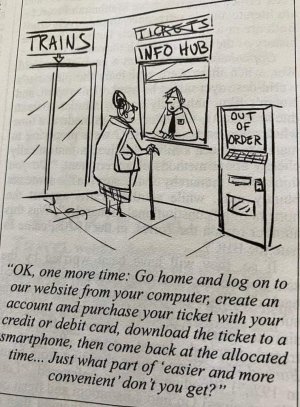
Unfortunately, there are many people who are not connected or who are not Internet capable. Those can be seniors, persons with disabilities and persons with mental issues.

Many entities have decided to force their users or customers to use the Internet. They don't consider those who just can't or wont.

I have a relative who is a "senior" who has tried, over the years, to use laptops and smartphones. No matter whic of the more computer literate family members tries to "train" her, it does not work. We end up having a family member on her accounts and she tells us what she wants and we log in and do the work for her.

Stores and offices used not to have handicapped ramps. Now they do. People who are not tech savvy need equal protection.
 
Meantime, word that Apple's not the only streamer Disney's discussing the future of ESPN with:

 
Apple is the bigger company, valued at almost $3 trillion, vs. Amazon at $2 trillion. Each would love to access the staffing and resources of ESPN and put it behind their paywalls. They're already doing it to a limited extent with baseball.
Generally, market cap is more significant in a buy-out. In a merger, there can be more important issues such as growth potential, operating margins and actual bottom line performance.

Under those criteria, it is very possible that Amazon is a more valuable company.
 
Apple is the bigger company, valued at almost $3 trillion, vs. Amazon at $2 trillion. Each would love to access the staffing and resources of ESPN and put it behind their paywalls. They're already doing it to a limited extent with baseball.

Ugh, Amazon already massively hiked up the annual price of a Prime membership to subsidize its NFL football rights on the backs of subscribers who don't watch sports. Can't wait to see how much it goes up again if they get ESPN.

Everyone cut the cord to get away from this kind of constant price gouging from cable but now the streamers are behaving the same way.
 
Everyone cut the cord to get away from this kind of constant price gouging from cable but now the streamers are behaving the same way.

Keep in mind that cable and streaming services are merely the middle men. The price gouging begins with the content itself. Outrageous player salaries that are passed on with outrageous rights fees. Regardless of the medium, the cost will continue to rise because the cost keeps going up at the source.
 
Ugh, Amazon already massively hiked up the annual price of a Prime membership to subsidize its NFL football rights on the backs of subscribers who don't watch sports. Can't wait to see how much it goes up again if they get ESPN.
Most of the increase in Prime is due to the higher costs of shipping coupled with much higher return rates during the pandemic . The stream is used as a tangible advantage of Prime. Delivery is a harder sell as there is nothing sexy about a big truck at your front door. But lots of "free" movies and video stuff sells the brand better.
 
It's not just shipping costs. The point is cable was notorious for bundling channels not everyone wanted to watch into high priced packages with sports being the most expensive part of them.

It really sucked for someone who doesn't care about sports to have to pay for ESPN (and regional sports fees) in their cable subscription, and Amazon is already headed down the same road. Maybe Apple too. Probably all of them.

There is no way to opt out of Amazon's Thursday Night Football. I wouldn't doubt that it instantly became the most expensive thing for Amazon to put on Prime Video and they are charging all Prime subscribers for it whether they want sports or not.
 
It's not just shipping costs. The point is cable was notorious for bundling channels not everyone wanted to watch into high priced packages with sports being the most expensive part of them.
It is indeed mostly the shipping and cost of returns as well as organized crime stealing from trains and trailers.

I watch no American sports at all, ever. Not even the SuperBowl and the like. No matter how hard I try, I can't get cable or streams that have otherwise content I like that don't charge a huge amount for sports.
It really sucked for someone who doesn't care about sports to have to pay for ESPN (and regional sports fees) in their cable subscription, and Amazon is already headed down the same road. Maybe Apple too. Probably all of them.
But, again, the Amazon fees are mostly for free delivery.
There is no way to opt out of Amazon's Thursday Night Football. I wouldn't doubt that it instantly became the most expensive thing for Amazon to put on Prime Video and they are charging all Prime subscribers for it whether they want sports or not.
Again, on a per-person basis, nowhere near what we are paying for ESPN on cable or the Disney bundle.
 
Just got a notification from Amazon Prime that since Showtime (long offered as a separate channel on Prime) became part of Paramount+ in June, the offering on Amazon Prime will expand at the end of this month to become:

Paramount+ with SHOWTIME

In other words, everything that's on Paramount+. Glad I dumped that subscription when we finished whatever it was we were watching over there. Now I'll have it for the revival of FRASIER when we get back from our vacation, and I won't have to reactivate Paramount+.

Frankly, if Shari Redstone doesn't offload the whole enterprise (Paramount/CBS), it wouldn't surprise me to see them eventually just offer Paramount+ on the Amazon Prime platform and dump their proprietary app.
 
Last edited:
As someone who paid and got great value with Amazon Prime for years, that value has steadily eroded. I got it for the free shipping. Also the fast shipping which was a rarity at the time. I wouldn’t mind price increases if they were just for shipping costs. Things go up which I understand. But I didn’t sign up for music, audiobooks, podcasts, streaming video, whatever the heck else they’re trying to “include” now. Now Prime Video has ads which it originally didn’t. If they’re going to keep “enhancing” the offerings, they need to offer different tiers or they’re going to start losing subscribers. I can get next day shipping from Walmart if I spend over $35 and similar with Target. Home Depot offers 2 day shipping for free. I believe Amazon offers standard shipping at $35 or so.

Perhaps Amazon’s goal for Prime is to eventually focus it on a streaming service. I’m a huge Netflix, Max, Roku, and Pluto watcher but I don’t really care for Prime TV’s offerings, same for Hulu and paramount. Probably going to let my Prime subscription lapse next year. At this point I’m paying for more of what I don’t use than I do use.
 
As someone who paid and got great value with Amazon Prime for years, that value has steadily eroded. I got it for the free shipping. Also the fast shipping which was a rarity at the time. I wouldn’t mind price increases if they were just for shipping costs. Things go up which I understand. But I didn’t sign up for music, audiobooks, podcasts, streaming video, whatever the heck else they’re trying to “include” now.

See, I did it exactly backwards from you. I subscribed to it for the streaming video and now I get stuff I buy from them shipped for free.

Now Prime Video has ads which it originally didn’t.

That's only on freevee (the Amazon Prime channel that is specifically ad-supported) and other third-party channels.

If they’re going to keep “enhancing” the offerings, they need to offer different tiers or they’re going to start losing subscribers. I can get next day shipping from Walmart if I spend over $35 and similar with Target. Home Depot offers 2 day shipping for free. I believe Amazon offers standard shipping at $35 or so.

And here, I'd agree with you. There should be a pure shopping tier at a lower price for people who don't want Amazon's streaming offerings.

Perhaps Amazon’s goal for Prime is to eventually focus it on a streaming service. I’m a huge Netflix, Max, Roku, and Pluto watcher but I don’t really care for Prime TV’s offerings, same for Hulu and paramount. Probably going to let my Prime subscription lapse next year. At this point I’m paying for more of what I don’t use than I do use.

I think Amazon will keep Prime Video bundled with Prime shopping just because of the crossover. I buy more from Amazon now that I have free shipping from subscribing to streaming.
 
For what it's worth, Amazon also offers discounts and sales at Whole Foods to Prime members.

As we move to cord-cutting, we may pick up Prime as a video source. This is something I will sort out after we get our move completed. (Fiber-optic Internet is already up and running in the new house; I made sure of that.)
 
Again, on a per-person basis, nowhere near what we are paying for ESPN on cable or the Disney bundle.
Not to mention "regional sports fees" on cable. I wonder if ours ($17.25/month) are jacked up because of the number of major-league sports teams here and whether they would be less in a place like Albuquerque that has no major-league sports teams. I suspect not.

Xfinity/Comcast pretty much admits that it's overhead:

The Regional Sports Network Fee is an itemized charge that you'll see on your bill. This charge is not a government-mandated fee and will increase from time to time. It's based on our costs of providing the regional sports networks that we carry on our cable systems in each area. These costs include the fees that regional sports networks charge us to carry them on our cable systems, which are among the fastest growing components of our programming costs. [...]

From: https://forums.xfinity.com/conversa...ntly-asked-questions/602da77bc5375f08cdead190

Oh, and there's a lawsuit about it: https://inklaws.com/comcast-regional-sports-fee-lawsuit/
 
Unfortunately, there are many people who are not connected or who are not Internet capable. Those can be seniors, persons with disabilities and persons with mental issues.

Many entities have decided to force their users or customers to use the Internet. They don't consider those who just can't or wont.

I have a relative who is a "senior" who has tried, over the years, to use laptops and smartphones. No matter whic of the more computer literate family members tries to "train" her, it does not work. We end up having a family member on her accounts and she tells us what she wants and we log in and do the work for her.

Stores and offices used not to have handicapped ramps. Now they do. People who are not tech savvy need equal protection.
In my active adult community, the ages of residents range from 55-103. When surveyed last year, about 30% of this population do not own computers, tablets, or smart phones. Even though the Computer Club here started an "each one teach one" volunteer program where residents give in-home computer instruction to other residents, there are many ( including a lot of my neighbors) who really struggle with technology.

This community has its own weekly newspaper, which is very popular, because it lists all the upcoming special events, like concerts, travel tours around the world, bus trips to local shows and museums, art classes, and cultural lectures. The Board of Directors wanted to cancel the print version of the newspaper in order to save time, paper, and delivery costs. They wanted to publish an online version only, which required a user name and password to access. That discussion led to a huge push-back by residents who were worried that they did not have the tech skills, nor the computers to access the newspaper online.

When I was a young schoolteacher, the earliest microcomputers I remember receiving for my classroom were Apple in approximately the years 1982-1984. I was on a grant-writing team which had to apply for funds not only for the computer, but also for staff development funding to train the faculty. The graduating class of seniors was born in about 1964-66. That is the first of Generation X and the last of the boomers -- approximately. ( although there were some home computers available for retail sale in the 70's)
In general, for most baby boomers (defined as being born between 1946 and 1964), there was very little high school training available in micro computer technology in my area of southern California. The last of that generation, who graduated in the early 80's, had some rudimentary high school training. ( I'm speaking of training at the average public high school in southern California). This is my experience only. Disclaimer: YMMV. JMO.
 

Attachments

  • Technology.jpg
    Technology.jpg
    278.6 KB · Views: 11
Last edited:
In my active adult community, the ages of residents range from 55-103. When surveyed last year, about 30% of this population do not own computers, tablets, or smart phones. Even though the Computer Club here started an "each one teach one" volunteer program where residents give in-home computer instruction to other residents, there are many ( including a lot of my neighbors) who really struggle with technology.
My father always wanted the latest and greatest workstation, tablet, laptop, and version of Windows. Problem was; he'd be poking around online all day, eventually clicking on the wrong link, or opening an E-mail attachment that he didn't recognize. It got to the point where I installed all sorts of net nannies, anti-you-name-it-ware, and RDP so I could remote in and un-do whatever he had done earlier that day. Before I did all that, I could count on the phone call from Mom every evening after work that my father was upset because 'his computer was broken again', and whether I could stop by and have a look. Being able to remote-in saved my sanity.
 
Status
Not open for further replies.


Back
Top Bottom