• Get involved.
    We want your input!
    Apply for Membership and join the conversations about everything related to broadcasting.

    After we receive your registration, a moderator will review it. After your registration is approved, you will be permitted to post.
    If you use a disposable or false email address, your registration will be rejected.

    After your membership is approved, please take a minute to tell us a little bit about yourself.
    https://www.radiodiscussions.com/forums/introduce-yourself.1088/

    Thanks in advance and have fun!
    RadioDiscussions Administrators

News/talk ratings skyrocketing due to high gas prices

It's a function of what's important. If you really want to save on gas, buy an electric or hybrid car.

We've created this myth of cheap gas, but they're not killing any more dinosaurs, so the supply isn't limitless.

Gas prices in England are $7.99 a gallon when converted from litre/pound.
Fair enough, but EVs cost money. Not everyone has $70K in their back pocket, or money trees growing in their back yard. Just sayin'.

Gas may not be limitless, but neither is electricity apparently, when the news media are warning of rolling blackouts in parts of the country this summer due to electricity shortages, especially if there are heat waves. Of course, that possibility remains to be seen.

England itself is smaller than Oregon, and has 55 million people. More train transport. Higher gas cost hits them a bit less than it does in most of the US.
 
The inconvenient truth here is that while some costs are going up, one of the reasons is that wages are also going up:


If you're an employee caught in a squeeze, it's a good time to shop for a new job.
The top ten growth career fields, according to the BLS, pay $15 / hr or less, and are unskilled labor.

It's also doubtful that increases in wages are in the 10%+ range, which is where inflation is right now for many necessities.

You're right about it being a worker's labor market, although companies are also automating a lot of jobs out of existence.

So it's a matter of the glass either being half full or half empty. But perception in this case doesn't change the reality that inflation is a problem.
 
So it's a matter of the glass either being half full or half empty. But perception in this case doesn't change the reality that inflation is a problem.

It's a problem because some people want to make it a problem. But none of those people have a solution either.
 
Well aware of all that. People spent two years driving less, causing gas prices to drop. Now the opposite is happening. In my view, the oil companies are making up for lost profits.
The same issue is ocurring even in nations where the government controls gasoline production, such as Mexico to name one near us. My daughter has told me of how gas has nearly doubled in price in Ecuador, which is hardly a nation that likes to mirror US policy.

The crude oil prices evolve around the OPEC nation government consensus prices, not the free market. The free market generally follows OPEC.
But that's just me. Rich people binge traveling are also making it worse. At the same time, there are lots of jobs out there, so there are opportunities for some who need more money to find a second job. At one time I worked four jobs, so it's possible.
As a nation that has considerable issues with parents who don't spend enough time with children, having two or three jobs is not a desirable social goal.
 
True. If your 401(k) and/or IRA is loaded with petroleum-related stocks and you're approaching or beginning retirement, the last thing you want is an oil glut and tanking stock prices. You may gripe to friends about $5-7 gas, but secretly, you're probably loving this.
Nearly all 402(k) and IRA accounts are invested in mutual funds and administered by a fund management company. Generally, all the options are balanced accounts spread across nearly all sectors of the economy.
 
It's a problem because some people want to make it a problem. But none of those people have a solution either.
There is no immediate solution for global warming, either. That does not mean it is an invented or constructed issue.
 
It's a problem because some people want to make it a problem. But none of those people have a solution either.
True, but it's definitely a problem if you can't afford your rent because your food and fuel costs skyrocketed.

And a lot of the people at the bottom of the economic pyramid, who are the biggest victims of inflation, aren't supposed to be the ones with the solutions. That's ostensibly why Congresspeople and Presidents are elected.
 
True, but it's definitely a problem if you can't afford your rent because your food and fuel costs skyrocketed.

And a lot of the people at the bottom of the economic pyramid, who are the biggest victims of inflation, aren't supposed to be the ones with the solutions. That's ostensibly why Congresspeople and Presidents are elected.
It's all the fault of poor people for being poor. Not only are they morally deficient because they had a kid, or need a place to live, or want to wear clothes, or they buy too much avocado toast, too many coffees, Netflix subscriptions, cell phones or whatever, they're also the ones who have the responsibility to find the solutions to fix the national and world economy (while wearing sack cloth and sipping their gruel, the only approved food for poor people). Heaven forbid the people with the money and the power use those resources to do anything.
 
The same issue is ocurring even in nations where the government controls gasoline production, such as Mexico to name one near us. My daughter has told me of how gas has nearly doubled in price in Ecuador, which is hardly a nation that likes to mirror US policy.

I lived in a Middle East country for about 7 years and the pump price for the lowest grade gasoline, 91 octane, never changed during the time I lived and bought fuel there. The price of gasoline per gallon was between 80 and 82 US cents per gallon, the difference being the minor shifts in exchange rates.

I figured the selling price has zero relationship to the price of crude oil, but was more a factor in the costs of refining the crude into the three grades of gasoline available in the market and paying for the staffing at the stations. Profit did not appear to be the main motive driving the retail prices of gasoline.

The crude oil prices evolve around the OPEC nation government consensus prices, not the free market. The free market generally follows OPEC.

Very true. As long as crude oil selling prices somewhat track OPEC pricing and none or very few crude oil products buck OPEC pricing very much, the pump price for gasoline and other fuel products will have a rough relationship with the OPEC pricing.

Bottom line, I think we could have $1.50 per gallon pricing of fuels in the United States provided the domestic crude oil producers sold their product at low enough pricing for those pump prices.

The situation isn't free market but capitalism, since no US domestic crude oil producer is going to sell crude at that low a price when they can get world market prices. Well, not voluntarily.
 
The situation isn't free market but capitalism, since no US domestic crude oil producer is going to sell crude at that low a price when they can get world market prices. Well, not voluntarily.
And today a significant portion of North American production comes from more expensive production sources: fracking, oil sands, offshore. Another factor today for world pricing is transportation, which has increased pricing significantly. Even in the US, getting those barrels from northern Alaska to the lower 48 is more costly than transporting from the Permian Basin or the Gulf offshore wells.

I listened to an annual shareholder meeting for one gasoline retailer several years ago and a simple answer to a question about price is that "the gallon of gas is priced to make a profit even from our most expensive sources. If the world price goes up, we can develop even more costly sources and put them into the pricing formula."

Where did you live in the Middle East? That sounds like a "fascinating" experience!
 
If you really want to save on gas, buy an electric or hybrid car.

Gas prices in England are $7.99 a gallon when converted from litre/pound.
You will save money on fuel if you use an electric/hybrid but cost over time is almost immeasurable. When a hybrid breaks it will cost you a fortune to fix and the knowledge base with competent repair facilities aren't there yet. An electric costs much more than a comparable petro vehicle initially and when that battery needs replacement it is a very major expense.....and that is only if you don't die in a vehicle fire before that. And while you have it you suffer from lack of charging stations, longer trip times due to charge times and increased buying costs due to higher price and longer loan time.

The only current logical reason to use a full electric is to commute to work and back and charge overnight. That assumes you are not too far from work and your electric costs are reasonable. If you want a 'fast' charging station in your home get ready to pay another few grand. Most people would need a petro vehicle for long trips so overall you would not come out ahead financially.

Another huge reason not to buy an electric is climate. Cold weather saps battery charge which greatly reduces distance. This makes electrics problematic in the Rust Belt, mountainous regions, Alaska and New England. And forget towing/carrying anything over 1,000 lbs.

Major differences between the USA and the UK: Their cars tend to be much smaller with dinky little engines (no emissions equipment or AC) and much shorter distances to drive. You will not see virtually any pickup trucks or SUV's in the UK.
 
Another huge reason not to buy an electric is climate. Cold weather saps battery charge which greatly reduces distance. This makes electrics problematic in the Rust Belt, mountainous regions, Alaska and New England. And forget towing/carrying anything over 1,000 lbs.
Where I am it will hit 118° later this week. That means running the A/C full blast even at 9 at night, and that reduces the range of electric vehicles enormously.

And the trips we take are into the LA area. Combine the need for intensive A/C and 240 to 280 mile round trips to places without chargers and we are just not ready until there is a major upgrade in range, charging locations and charging speed.
 
You will save money on fuel if you use an electric/hybrid but cost over time is almost immeasurable. When a hybrid breaks it will cost you a fortune to fix and the knowledge base with competent repair facilities aren't there yet. An electric costs much more than a comparable petro vehicle initially and when that battery needs replacement it is a very major expense.....and that is only if you don't die in a vehicle fire before that. And while you have it you suffer from lack of charging stations, longer trip times due to charge times and increased buying costs due to higher price and longer loan time.
I watched a show a few weeks ago where they restored a classic sports car that was headed for the scrap heap and, at the same time, converted it to electric. The amount of stuff that was removed and junked was incredible - engine, transmission, muffler, you name it, it was gone. All those pipes that spring a leak and metal bits that rust and corrode and moving parts that wear over time - gone.

In its place was a large bank of batteries that filled the space where the engine used to be, a control computer (taken from a Tesla, according to the show) and a motor roughly the size of a large Thermos. It feels like with electric, there's a lot less to go wrong, a lot less chance that any given week will require an expensive trip to the mechanic.

There's a really interesting recent piece in the Financial Times talking about how the mechanical simplicity of EVs compared to conventional vehicles means China is in a position to ramp up its own production and export. European, Japanese and US expertise in ICEs is losing relevance:

For Japanese and European carmakers, the challenge is that while electric vehicles may be high-tech, they are not complex. Internal combustion engines were at the heart of 20th-century industrial prowess. A vehicle built around one is a complex assembly of crankshaft, pistons, fuel pumps, turbochargers and myriad other components, each of which must be mastered and integrated. Even after 150 years of development it is still a difficult task, calling for deep technical expertise and a vast network of suppliers, rather than access to the lowest possible labour costs.

The drive train of an electric vehicle, by comparison, is extraordinarily simple: a battery, a motor and not much else. Production of the crucial component, the battery, is a business of huge scale and thin margins; the economics are similar to another green technology, the solar panel. Assembly of electric vehicles needs some of the skills of traditional carmaking, but bears comparison as well to other electrical goods. Solar panels and consumer electronics are industries where Chinese manufacturing dominates on cost.

 
You will save money on fuel if you use an electric/hybrid but cost over time is almost immeasurable. When a hybrid breaks it will cost you a fortune to fix and the knowledge base with competent repair facilities aren't there yet. An electric costs much more than a comparable petro vehicle initially and when that battery needs replacement it is a very major expense.....and that is only if you don't die in a vehicle fire before that. And while you have it you suffer from lack of charging stations, longer trip times due to charge times and increased buying costs due to higher price and longer loan time.
1. The Toyota Prius has proven to be a very reliable car. It has been on the market for around 20 years. Toyota has a generous battery pack warranty on the Prius (10 yr/ 150,000 mi), but I don't personally know any owners who have needed to take advantage of it. It is probably too soon to make an evaluation on battery longevity for pure EVs.

2. Not all EVs are Teslas, which exclusively targets upscale consumers. The Nissan Leaf is a perfectly reasonable car that can be had for under $20,000 after government incentives or about $26,500 without.

The only current logical reason to use a full electric is to commute to work and back and charge overnight. That assumes you are not too far from work and your electric costs are reasonable.
Which, of course, is a very common use case. The average car is driven 37 miles a day, so even a 100 mile vehicle range like the first generation Nissan Leaf would satisfy well over half of people.
Residential electricity rates in the US average about 12 cents per kWh, so recharging an EV with a fairly typical 75kWh battery at home will run you $9. It isn't the case in my state, but I understand some states (Illinois, Georgia) have a lower cost electricity late at night, which would tip the economics further.

If you want a 'fast' charging station in your home get ready to pay another few grand. Most people would need a petro vehicle for long trips so overall you would not come out ahead financially.
A "fast" charging station in the home, known as a level 2 charger, is just a 240V dryer outlet. I can't imagine running one to the garage would cost "a few grand". Level 3 chargers are not practical for the home because the electric grid to homes is not sufficient.

Another huge reason not to buy an electric is climate. Cold weather saps battery charge which greatly reduces distance. This makes electrics problematic in the Rust Belt, mountainous regions, Alaska and New England. And forget towing/carrying anything over 1,000 lbs.
This is definitely a real effect. But not especially relevant for the daily commuter who needs to go 20 miles in their 250 mile rated EV.

Major differences between the USA and the UK: Their cars tend to be much smaller with dinky little engines (no emissions equipment or AC) and much shorter distances to drive. You will not see virtually any pickup trucks or SUV's in the UK.
Yes, and these are all good things. Although I do think British cars do come equipped with A/C and emissions equipment in 2022.
 
And the trips we take are into the LA area. Combine the need for intensive A/C and 240 to 280 mile round trips to places without chargers and we are just not ready until there is a major upgrade in range, charging locations and charging speed.
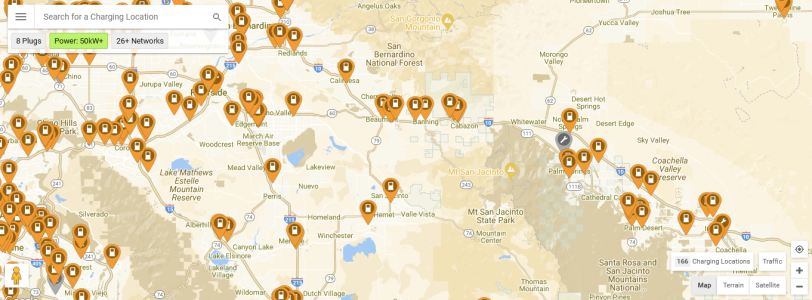
There are hundreds of EV charging stations in the LA metro, San Bernardino and the Coachella valley. The chances of you becoming stranded for lack of fuel are quite low. I've attached a map of EV charging facilities in the area east of LA. Any of these stations would charge an EV while you have dinner (1 to 1.5 hrs), some would charge much faster.

Is it as convenient as gas? No, it isn't. But I think the charging network is more mature than some people realize, especially in major cities like LA.

1654777081490.png
 
Google is your friend. Use it to find postings by hundreds of EV people who have tried to take trips over 200 miles and spent considerable time waiting to recharge - or get to a recharge station and find their equipment does not work with your EV. BTW, just saw an article this morning that President Biden is pushing standardization of charging equipment to address this problem.

In addition, I would refer you to any one of a dozen or so articles on Youtube by Scotty Kilmer on EV's. He is a lifetime auto mechanic who is not fond of EV's for a variety of important reasons. Whether you agree with him or not you will learn a lot about this immature technology.
 
1. The Toyota Prius has proven to be a very reliable car. It has been on the market for around 20 years. Toyota has a generous battery pack warranty on the Prius (10 yr/ 150,000 mi), but I don't personally know any owners who have needed to take advantage of it. It is probably too soon to make an evaluation on battery longevity for pure EVs. [\quote]

Yes, the Prius and the Leaf are reliable....also very small. GM's Volt was also cramped for space although it was a gas to drive. But how many petro cars do you know what would need the equivalent of a complete engine overhaul/replacement at 150,000 miles?
2. Not all EVs are Teslas, which exclusively targets upscale consumers. The Nissan Leaf is a perfectly reasonable car that can be had for under $20,000 after government incentives or about $26,500 without. [\quote]
I believe that incentive is actually a tax credit. Useful for those who pay higher taxes but not the rest of us.

Which, of course, is a very common use case. The average car is driven 37 miles a day, so even a 100 mile vehicle range like the first generation Nissan Leaf would satisfy well over half of people.
Residential electricity rates in the US average about 12 cents per kWh, so recharging an EV with a fairly typical 75kWh battery at home will run you $9. It isn't the case in my state, but I understand some states (Illinois, Georgia) have a lower cost electricity late at night, which would tip the economics further. [\quote]
Recharging overnight (off-peak) is exactly what the utilities need you to do. Grid capacity during on-peak hours is already at virtual capacity in many areas of the country. And with normal charging time you could not use your EV during these hours.
A "fast" charging station in the home, known as a level 2 charger, is just a 240V dryer outlet. I can't imagine running one to the garage would cost "a few grand". Level 3 chargers are not practical for the home because the electric grid to homes is not sufficient. [\quote]
My Volt owning neighbor paid around $2,500 for his upgraded home charging station.

This is definitely a real effect. But not especially relevant for the daily commuter who needs to go 20 miles in their 250 mile rated EV.
[\quote]
Owning one car used entirely for commuting and short runs to the super market is expensive no matter how you look at it. Not sure where you got your commute mile number but it is actually 40-41 miles per day on average in the USA. Other disadvantages:

Forget about towing your travel trailer or boat.
Forget about larger families or taking your soccer team to the game.
Forget about making the rated battery miles in very cold or very warm climates.
Forget about parking your new EV fire hazard in your garage.
And imagine the smile on everyone's face when you pull into a charging station and it's full. You wait for them then wait for you.
 
Google is your friend. Use it to find postings by hundreds of EV people who have tried to take trips over 200 miles and spent considerable time waiting to recharge - or get to a recharge station and find their equipment does not work with your EV.
Aside from the fact I don't like new cars and that's just how they look (never mind complicated features) I will be going on one of those trips next week. I filled up with gas and may have enough gas not to need more. I have no interest in delays caused by charging.

I hope to have details of my trip to report here.
 
Status
This thread has been closed due to inactivity. You can create a new thread to discuss this topic.


Back
Top Bottom