@DavidEduardo - I was looking at the DC monthlies and saw WWUZ from the Fredericksburg metro and WWEG from the Hagerstown metro both get a 0.1 in the DC book. Since it's the lowest possible share would those diary market stations 1) be subscribing to the DC metro and 2) be encoding for PPM? It hardly seems worth it for a 0.1 showing in the monthlies in some books.

-
Get involved.
We want your input!
Apply for Membership and join the conversations about everything related to broadcasting.
After we receive your registration, a moderator will review it. After your registration is approved, you will be permitted to post.
If you use a disposable or false email address, your registration will be rejected.
After your membership is approved, please take a minute to tell us a little bit about yourself.
https://www.radiodiscussions.com/forums/introduce-yourself.1088/
Thanks in advance and have fun!
RadioDiscussions Administrators
You are using an out of date browser. It may not display this or other websites correctly.
You should upgrade or use an alternative browser.
You should upgrade or use an alternative browser.
Out of market streaming impact on the ratings
- Thread starter vw86
- Start date

Excellent question. The first is "if not in the metro, why would they encode?". Frederick Country is in the metro, so it may be that.@DavidEduardo - I was looking at the DC monthlies and saw WWUZ from the Fredericksburg metro and WWEG from the Hagerstown metro both get a 0.1 in the DC book. Since it's the lowest possible share would those diary market stations 1) be subscribing to the DC metro and 2) be encoding for PPM? It hardly seems worth it for a 0.1 showing in the monthlies in some books.
And, second, why would they be listed.
One possibility you can look up (I don't have access right now) is whether the owner of each is group-subscribed. That would explain part of it, but the encoding question is another.
Here is the metro map in red:
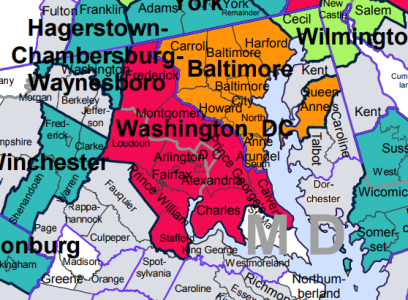
Looking at the DC monthlies for the following month and WWUZ doesn't even get a 0.1, but they do have a Cume of 16,000. Seeing how many other stations that did show a share of 0.1-0.2 don't even have a five digit cume, would this mean the 0.1 from the previous month was a rare showing because they did actually have enough listening despite not being subscribed?
How were ratings measured for out-of-market listeners in the decades prior to internet streaming when distant distribution of various radio stations was done via satellite and microwave?
The most common examples of this were rural cable systems bringing in far-flung major market stations. But there were also cases where cable systems in major cities imported stations from other major cities. KMET used to get ratings in Phoenix, for example, because it was used as the audio for one of the channels on the cable system in that town (probably one of the character generator type channels showing channel listings all day).
Terrestrial AM and FM stations were also once not uncommon on C-band and Ku-band, where they uplinked themselves during the days when millions still had large backyard dishes. I specifically remember KLON 88.1 FM Long Beach as an example of a station in my market (Los Angeles) that was up there for decades. Today, the only terrestrial stations I still see listed at Lyngsat are WCPE and several Alaskan stations in the Alaska mux.
The most common examples of this were rural cable systems bringing in far-flung major market stations. But there were also cases where cable systems in major cities imported stations from other major cities. KMET used to get ratings in Phoenix, for example, because it was used as the audio for one of the channels on the cable system in that town (probably one of the character generator type channels showing channel listings all day).
Terrestrial AM and FM stations were also once not uncommon on C-band and Ku-band, where they uplinked themselves during the days when millions still had large backyard dishes. I specifically remember KLON 88.1 FM Long Beach as an example of a station in my market (Los Angeles) that was up there for decades. Today, the only terrestrial stations I still see listed at Lyngsat are WCPE and several Alaskan stations in the Alaska mux.
The ratings company (Arbitron) had no idea how the listeners achieved their listening.How were ratings measured for out-of-market listeners in the decades prior to internet streaming when distant distribution of various radio stations was done via satellite and microwave?
It would have been handled the same as any other out-of-market listening, whether that was listening to the Chicago stations in Milwaukee, or a family who lived in Charlotte but traveled to Jacksonville with their ratings diary. If it was enough listening during the ratings period, it got published.
BTW, the story about KMET getting ratings in Phoenix appears to be apocryphal. I went through the 1981, 82 and 83 ratings publications from R&R, as found in David's archive, and could not find KMET listed except in the LA, Anaheim/Orange County and San Diego markets.
Wikipedia strikes again!The ratings company (Arbitron) had no idea how the listeners achieved their listening.
It would have been handled the same as any other out-of-market listening, whether that was listening to the Chicago stations in Milwaukee, or a family who lived in Charlotte but traveled to Jacksonville with their ratings diary. If it was enough listening during the ratings period, it got published.
BTW, the story about KMET getting ratings in Phoenix appears to be apocryphal. I went through the 1981, 82 and 83 ratings publications from R&R, as found in David's archive, and could not find KMET listed except in the LA, Anaheim/Orange County and San Diego markets.

KMET never showed in the Phoenix ratings - though it did show up with as much as a 3.3 in Palm Springs.The ratings company (Arbitron) had no idea how the listeners achieved their listening.
It would have been handled the same as any other out-of-market listening, whether that was listening to the Chicago stations in Milwaukee, or a family who lived in Charlotte but traveled to Jacksonville with their ratings diary. If it was enough listening during the ratings period, it got published.
BTW, the story about KMET getting ratings in Phoenix appears to be apocryphal. I went through the 1981, 82 and 83 ratings publications from R&R, as found in David's archive, and could not find KMET listed except in the LA, Anaheim/Orange County and San Diego markets.
There are examples of stations that were carried on cable that did show in out-of-market ratings in the early 80s (WVEE/Atlanta showed up a couple of times in the Tallahassee, FL book; KZEW/Dallas showed up in San Angelo, TX). If enough people wrote down a station, it would show up, but as the preponderance of evidence shows, it is/was extremely rare for any out-of-market station to accrue enough listening to register.
Probably worth mentioning again that listening by the resident of one market to stations from another is tabulated in the market of residence.
In other words, if a resident of Pensacola listens to a station from Tallahassee (whether on a trip or with a good antenna) the listening to the Tallahassee station is registered in the Pensacola book.
The main reason for this practice is that advertisers want to know what listeners in each market listen to. They buy advertising on a Pensacola stations to sell stuff in the Pensacola metro area. And, like most of the ratings practices, they are focused on providing needed services to advertisers; that is the reason stations buy ratings services.
In other words, if a resident of Pensacola listens to a station from Tallahassee (whether on a trip or with a good antenna) the listening to the Tallahassee station is registered in the Pensacola book.
The main reason for this practice is that advertisers want to know what listeners in each market listen to. They buy advertising on a Pensacola stations to sell stuff in the Pensacola metro area. And, like most of the ratings practices, they are focused on providing needed services to advertisers; that is the reason stations buy ratings services.
Although the Pensacola resident may very well patronize Tallahassee businesses while there, making him valuable to the Tallahassee advertisers as well. But I suppose Nielsen can't be bothered with outliers like that.Probably worth mentioning again that listening by the resident of one market to stations from another is tabulated in the market of residence.
In other words, if a resident of Pensacola listens to a station from Tallahassee (whether on a trip or with a good antenna) the listening to the Tallahassee station is registered in the Pensacola book.
The main reason for this practice is that advertisers want to know what listeners in each market listen to. They buy advertising on a Pensacola stations to sell stuff in the Pensacola metro area. And, like most of the ratings practices, they are focused on providing needed services to advertisers; that is the reason stations buy ratings services.
It's not the "bother". It is the policy that residents of each metro are counted in their home metro. They do not suddenly become residents of a different one while on vacation or traveling.Although the Pensacola resident may very well patronize Tallahassee businesses while there, making him valuable to the Tallahassee advertisers as well. But I suppose Nielsen can't be bothered with outliers like that.
Local businesses that advertise as well as national and regional accounts that buy time want to know about each market's residents and what they listen or watch. If a significant amount of listening goes to out-of-market stations, they see that in the local report and decide on how to approach such a market.
For example, about half of the Riverside-San Bernardino listening goes to LA MSA stations. However, there is so little interest by advertisers in that seeming "bonus" listening that only one radio group in the LA market buys the separate Inland Empire book because there is "no money there". And stations that do very well "out there" can't get a dime higher rates due to that added listening; agencies think of it as a bonus.
- Status
- This thread has been closed due to inactivity. You can create a new thread to discuss this topic.