• Get involved.
    We want your input!
    Apply for Membership and join the conversations about everything related to broadcasting.

    After we receive your registration, a moderator will review it. After your registration is approved, you will be permitted to post.
    If you use a disposable or false email address, your registration will be rejected.

    After your membership is approved, please take a minute to tell us a little bit about yourself.
    https://www.radiodiscussions.com/forums/introduce-yourself.1088/

    Thanks in advance and have fun!
    RadioDiscussions Administrators

President Trump has destroyed the norms of White House reporting: NPR

I am suggesting that the intent is to have a better balance of perspectives by the reporters covering an event or press conference. Not a control on what is reported.

No, I want to have a better balance of media and reporters.

I've lived and worked in oppressive situations. Until you've had armed soldiers with rifles in your studios and newsroom, you can only speak theoretically. Every day, with every story, one has to evaluate what can be said without risking being jailed or "disappeared". We have nothing remotely like that here in the U.S.A.
All of what you are saying is to control the media. What does a better balance even mean?

Trump would love to have goons at newsrooms controlling the narrative.
 
Without getting into politics or examples of "news items" that were widely reported despite not being accurate, I will mention that every reporter gives a bit of "flavor" to every story they write or deliver. I've seen major news events where different media has a totally different focus on the same event... so different that sometimes the story does not seem to be about the same events.

I've described in depth before how I saw an internationally significant event reported by different agencies, ranging from AP, UPI and Reuters to Prensa Latina and TASS and others like Time, Der Spiegel that demonstrated what I have said above: totally different perspectives, motives and aspects.
Absolutely. I use a news app (Ground News) that provides multiple (sometimes hundreds) of articles on the same subject from media sources around the world. You don't have to read too many articles on any one subject to illustrate your point. Differing agendas become readily apparent.

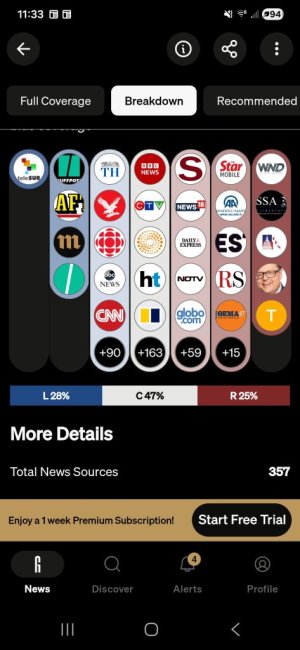
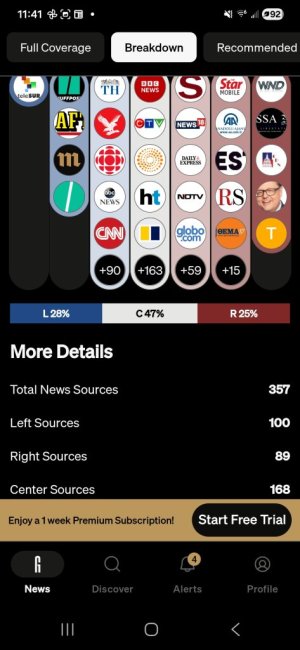
As an example, here's how the site presented Iran's seizure of two ships in the Straits of Hormuz a couple days ago. In this case, there are three hundred fifty seven news sources to choose from across the spectrum from far left to far right as shown below.

Screenshot_20260423_114103_Ground News.jpg
Here's the link to the topic:


Attachments

  • Screenshot_20260423_113326_Ground News.jpg
    Screenshot_20260423_113326_Ground News.jpg
    84.5 KB · Views: 1
  • Screenshot_20260423_114103_Ground News.jpg
    Screenshot_20260423_114103_Ground News.jpg
    87 KB · Views: 1
I am suggesting that the intent is to have a better balance of perspectives by the reporters covering an event or press conference. Not a control on what is reported.

No, I want to have a better balance of media and reporters.

I've lived and worked in oppressive situations. Until you've had armed soldiers with rifles in your studios and newsroom, you can only speak theoretically. Every day, with every story, one has to evaluate what can be said without risking being jailed or "disappeared". We have nothing remotely like that here in the U.S.A.
Do you consider letting trump clean out the press corps of anyone critical of his administration to be a better balance?

When he complains do you think he wants more accurate journalism? No. He doesn't
 
Absolutely. I use a news app (Ground News) that provides multiple (sometimes hundreds) of articles on the same subject from media sources around the world. You don't have to read too many articles on any one subject to illustrate your point. Differing agendas become readily apparent.

As an example, here's how the site presented Iran's seizure of two ships in the Straits of Hormuz a couple days ago. In this case, there are three hundred fifty seven news sources to choose from across the spectrum from far left to far right as shown below.

View attachment 11850
Here's the link to the topic:

News is news it doesn’t have a slant. It either happened or it didn’t.
 
News is news it doesn’t have a slant. It either happened or it didn’t.
Facts are non negotiable, the agenda with which facts are presented in a news story is written/reported creates bias. That's perfectly fine as long as it's understood there is a clear distinction between facts/data and opinions/commentary.
 
trump has been suing journalists to try to cobtrol them for decades. In perhaps the most egregious example, he sued the New York Time because one of their reporters said he's "only" worth $250 million!!! Idk if hes ever won any of these suits, intimidation is the point, definitely an enemy of free press

 
Facts are non negotiable, the agenda with which facts are presented in a news story is written/reported creates bias. That's perfectly fine as long as it's understood there is a clear distinction between facts/data and opinions/commentary.
And Fox News blurs that line to a point where there is no line.

Then you get the White House hiding the truth anyway they can.
 
Who’s saying sources are not verified. When the media outlets all report the same thing they all have the same reporting. When Fox News reports something different guess what one the outlier is.
While I agree with your perspective, it should be noted that what you are describing is called pack journalism. I had to read a book about the subject for one of my Communication Arts classes back in 1982. Basically, the author, a critic of pack journalism, argued that the White House press who traveled in packs and followed the President wherever he went usually never got the most immediate and most important news first, mainly because they were relying on the answers given by the President and his publicists and not doing any of their own researching on various subjects. Of course, it was a *lot* more difficult to do primary research back then: the Internet was in its infancy and was only available in the Department of Defense; and computers were these *huge* things that took up almost entire rooms and made my current desktop look portable by comparison. For primary research, reporters had to go to libraries and actually seek printed copies of old magazines and newspapers to see what was happening that the President and his staff wern''t telling them. And *that* took time away from traveling with the pack!
 
Facts are non negotiable, the agenda with which facts are presented in a news story is written/reported creates bias. That's perfectly fine as long as it's understood there is a clear distinction between facts/data and opinions/commentary.

While both you and @davideduardo are correct as far as perspectives go, the situation is a little more complicated than that. The perspectives in question may not be those of the reporter but of the publication or radio station/network he/she works for. NPR is viewed by the right as a liberal news source. And while I do *not* necessarily share this perspective (it's much more towards the center than most people on the far right recognize), I would say that its listener base which is mainly college professors and people trained in the professions, wish to hear a more humanistic version of the news than the right and far right is willing to offer.
 
While I agree with your perspective, it should be noted that what you are describing is called pack journalism. I had to read a book about the subject for one of my Communication Arts classes back in 1982.

The Boys On The Bus by Timothy Crouse. That same experience was chronicled by Hunter Thompson in Fear & Loathing on the Campaign Trail.

There's a similar thing that happens to sports reporters who follow specific teams. In fact it also happens to music journalists who cover specific genres.

Those who do it have to work to maintain their originality. There are lots of ways to do it. But yes, it can happen. I notice it's happened to this president who only travels with certain people, and he lives in that echo chamber where he's always right and no one challenges him.
 
While I agree with your perspective, it should be noted that what you are describing is called pack journalism. I had to read a book about the subject for one of my Communication Arts classes back in 1982. Basically, the author, a critic of pack journalism, argued that the White House press who traveled in packs and followed the President wherever he went usually never got the most immediate and most important news first, mainly because they were relying on the answers given by the President and his publicists and not doing any of their own researching on various subjects. Of course, it was a *lot* more difficult to do primary research back then: the Internet was in its infancy and was only available in the Department of Defense; and computers were these *huge* things that took up almost entire rooms and made my current desktop look portable by comparison. For primary research, reporters had to go to libraries and actually seek printed copies of old magazines and newspapers to see what was happening that the President and his staff wern''t telling them. And *that* took time away from traveling with the pack!
And when the DOD throws all of the reporters out of the Pentagon they need to find those sources elsewhere.
 
The Boys On The Bus by Timothy Crouse. That same experience was chronicled by Hunter Thompson in Fear & Loathing on the Campaign Trail.

There's a similar thing that happens to sports reporters who follow specific teams. In fact it also happens to music journalists who cover specific genres.

Those who do it have to work to maintain their originality. There are lots of ways to do it. But yes, it can happen. I notice it's happened to this president who only travels with certain people, and he lives in that echo chamber where he's always right and no one challenges him.

Thank you. It was the Krouse book I had to read, though I couldn't remember the title or author when I wrote my response.
 
While both you and @davideduardo are correct as far as perspectives go, the situation is a little more complicated than that. The perspectives in question may not be those of the reporter but of the publication or radio station/network he/she works for. NPR is viewed by the right as a liberal news source. And while I do *not* necessarily share this perspective (it's much more towards the center than most people on the far right recognize), I would say that its listener base which is mainly college professors and people trained in the professions, wish to hear a more humanistic version of the news than the right and far right is willing to offer.
Of course, which was my point and why I used "Ground News" to illustrate it. Each article is identified by both source and political bias. Media sources are less likely to hire writers/reporters whose personal opinions/viewpoints are counter to the sources' established editoral positions. In the US, going against the "company line" will get you fired, in other places it will get you killed.

And yes, some news organizations do, or at least did, hire "token" opposing counterpoint commentators to at least give the impression of being fair. But they were hired specifically to present the opposite position, not change the media source's editoral stances.
 
Of course, which was my point and why I used "Ground News" to illustrate it. Each article is identified by both source and political bias. Media sources are less likely to hire writers/reporters whose personal opinions/viewpoints are counter to the sources' established editoral positions.

I'm not sure I agree with that. Not everything the media covers is political. That's the mistake the government made about public broadcasting. A lot of public broadcasters don't carry NPR News. They cover the arts and other things besides politics. Forcing people to view everything through the political lens is dividing this country, and that's not healthy.
 
I'm not sure I agree with that. Not everything the media covers is political. That's the mistake the government made about public broadcasting. A lot of public broadcasters don't carry NPR News. They cover the arts and other things besides politics. Forcing people to view everything through the political lens is dividing this country, and that's not healthy.
I never mentioned politics.
 
I never mentioned politics.

You said "political bias." There is no political bias in Mozart.
Each article is identified by both source and political bias.

I've said before that when I was a credentialed reporter covering the white house and capitol, no one ever asked me about my politics. It wasn't a factor in how I was hired. I worked along side some former politicians whose bias was well known. But I didn't share their views, nor was I asked about my views. That wasn't my job. There were commentators and opinion people who handled that. Not me.
 
You said "political bias." There is no political bias in Mozart.
I was pointing out the political bias rating of sources given by "Ground News" as I explained their site. And I purposely chose a "Ground News" example that dealt primarily with geographical/military issues, not domestic partisan politics, for my post. Pretty safe bet you'll have a tough time finding a pro-Isreali piece in any of the Muslim sources cited on the what's happening in the Gulf. And if you do, it's an even safer bet that piece was directed/approved by their government before it was written/published.
I've said before that when I was a credentialed reporter covering the white house and capitol, no one ever asked me about my politics. It wasn't a factor in how I was hired. I worked along side some former politicians whose bias was well known. But I didn't share their views, nor was I asked about my views. That wasn't my job. There were commentators and opinion people who handled that. Not me.
Exactly. And that's who @davideduardo and I were talking about, reporters, not commentators/columnists. Reporters should stick to the foundational 5Ws/H, give facts and supporting data, not opinion/commentary.
 
I was pointing out the political bias rating of sources given by "Ground News" as I explained their site.

My point is their rating is subjective, and therefore is in itself biased. If anyone categorized what I did in that way, I would sue them.

Reporters should stick to the foundational 5Ws/H, give facts and supporting data, not opinion/commentary.

I agree. Which is why I believe placing an entire company's work under one ideological category is wrong.


Back
Top Bottom